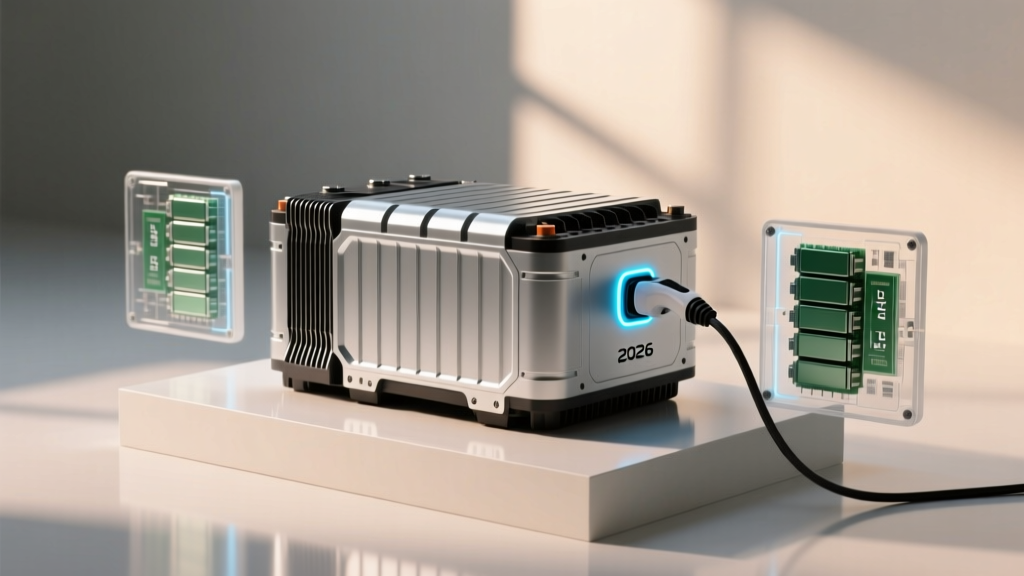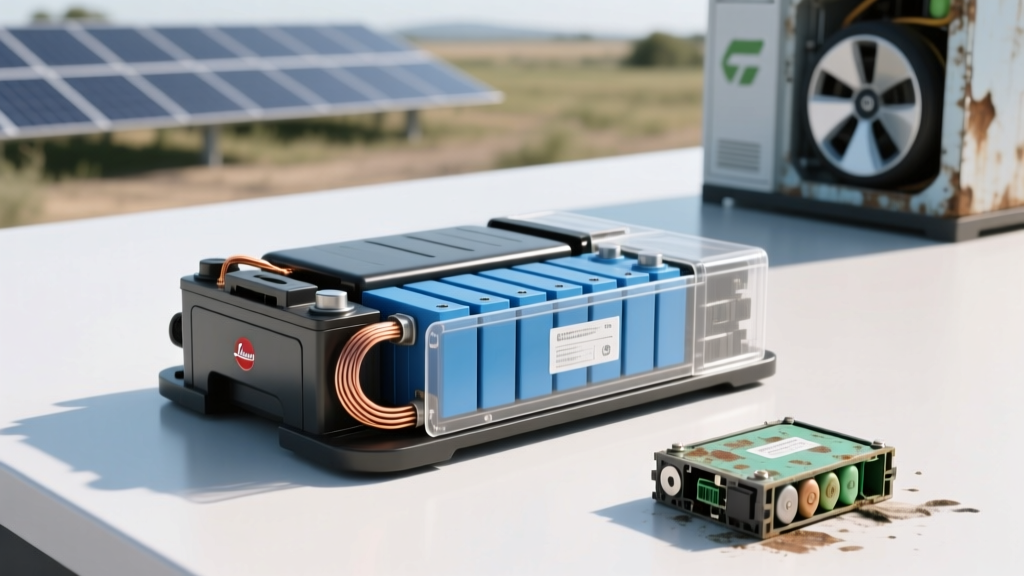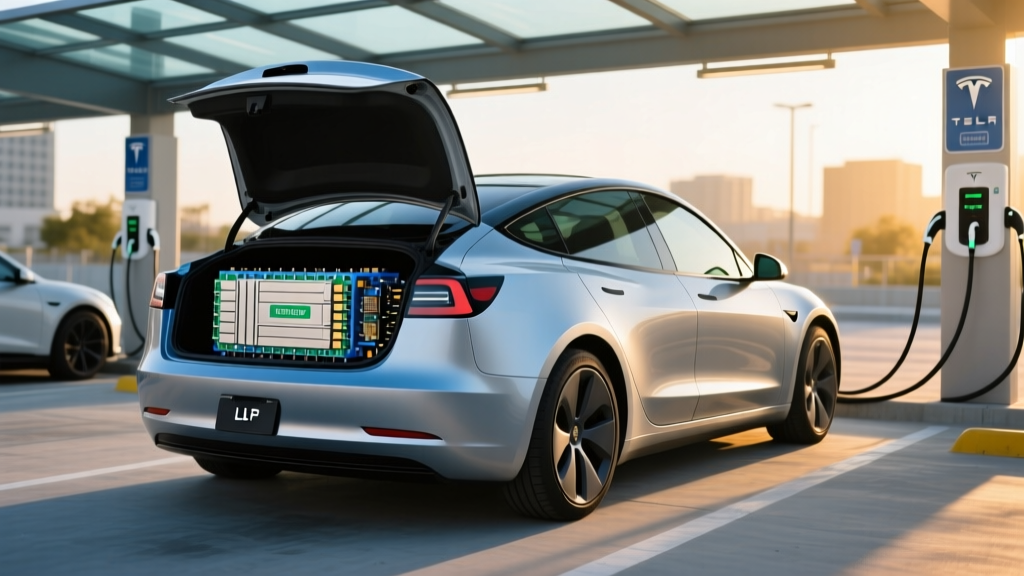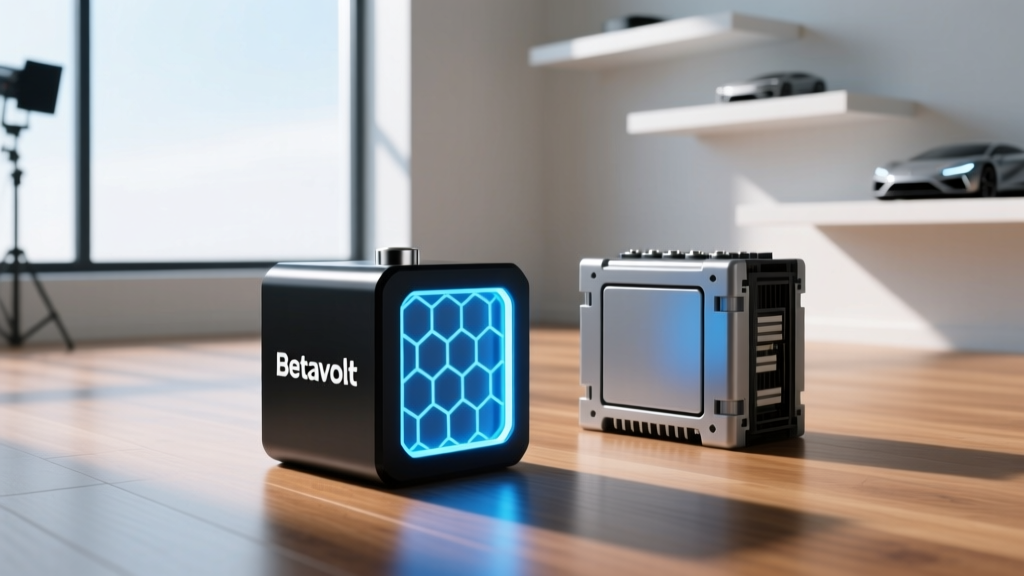
When Chinese startup Betavolt Technology announced a nuclear-powered battery that could run for 50 years without charging, EV forums lit up with a predictable question: "When can I put one in my car?" The short answer is not in your lifetime, and certainly not in any 2026 model-year vehicle. But the longer answer reveals exactly why today's lithium-ion traction batteries remain the only game in town for electric vehicles — and what you actually need to know about the pack powering your EV right now.
This guide breaks down what Betavolt's BV100 nuclear diamond cell actually delivers, why it cannot replace a lithium-ion traction battery, and — more usefully — everything you need to know about the real battery chemistry, degradation, warranty, and replacement economics of the EV you drive or plan to buy.
What Is a Betavolt Battery, Exactly?
Betavolt's BV100 is a betavoltaic cell — not a rechargeable battery in the conventional sense. It uses a thin film of nickel-63 (a beta-emitting radioactive isotope) layered against a diamond semiconductor. As the isotope decays, it emits beta particles (electrons) that the diamond converts into a tiny electrical current. The company claims a 50-year operational life with no maintenance and no thermal runaway risk.
The critical number most headlines omit: the BV100 produces 100 microwatts of power at 3 volts. That is 0.0001 watts. For context, a single USB-C phone charger delivers 20 to 100 watts — roughly 200,000 to 1,000,000 times more power. A Tesla Model Y Long Range battery pack holds about 75 kWh of energy and can discharge at over 350 kW during acceleration. Betavolt's entire cell stores no meaningful energy capacity; it is a continuous micro-power source, not an energy reservoir.
Betavolt has positioned the technology for aerospace sensors, medical implants (pacemakers, cochlear implants), and remote IoT devices where replacing a battery is physically impossible. The company has announced plans to scale up power output through stacking and future isotopes like promethium-147, but no production EV application has been proposed, prototyped, or even theorized at a drivetrain scale. The physics of energy density simply do not translate: you would need tens of millions of BV100 cells to match the energy and power demands of a single highway merge.
Today's Real EV Battery Chemistries: LFP vs NMC vs NCA
Every EV sold in the US in 2026 uses one of three lithium-ion cathode chemistries in its high-voltage traction battery: Lithium Iron Phosphate (LFP), Nickel Manganese Cobalt (NMC), or Nickel Cobalt Aluminum (NCA). These chemistries define the pack's energy density, cycle life, cold-weather behavior, cost, and degradation profile. Choosing the right one matters far more to your ownership experience than any speculative future technology.
| Attribute | LFP (LiFePO₄) | NMC / NCA |
|---|---|---|
| Energy density (cell-level) | 160–180 Wh/kg | 250–300 Wh/kg |
| Typical pack size (2026 EVs) | 60–82 kWh usable | 75–100+ kWh usable |
| Cycle life (to 80% SoH) | 3,000–5,000+ cycles | 1,000–2,500 cycles |
| Cold-weather range loss (-10°C / 14°F) | ~30–40% loss | ~20–30% loss |
| Recommended daily SoC | 100% OK (periodic full charges help calibration) | 80–90% daily; 100% only before trips |
| Cell cost (2026 estimates) | ~$70–85/kWh | ~$95–120/kWh |
| Thermal runaway risk | Very low | Low (requires active BMS & cooling) |
| Example 2026 models | Tesla Model 3 RWD, Model Y Std Range, Ford Mustang Mach-E Select (LFP option), BYD Seal | Tesla Model Y LR/Perf, Hyundai Ioniq 5/6 LR, BMW i4/iX, Rivian R1T/R1S, Lucid Air |
Which is better? It depends on your use case. LFP wins on longevity, cost, and safety — ideal if you charge daily at home, keep cars 8+ years, and live in a mild climate. NMC/NCA wins on range-per-kilogram and cold-weather efficiency — the right pick if you need 320+ miles of EPA range, tow, or regularly drive in sub-freezing weather. Neither chemistry is universally superior; both are mature, warrantied, and proven across millions of vehicles.
How Long Do EV Batteries Actually Last?
The fear that EV batteries need replacing every few years is not supported by fleet data. A 2024 analysis by Recurrent Auto, tracking over 15,000 EVs in real-world use, found median degradation of roughly 5–8% after five years and 60,000–80,000 miles across popular models. Most packs retain 85–92% of original capacity at the 100,000-mile mark.
Typical capacity retention by age (fleet averages, mixed chemistries):
- Year 1 / 15k miles: ~96–98% SoH (initial formation loss)
- Year 3 / 45k miles: ~91–94% SoH
- Year 5 / 75k miles: ~88–92% SoH
- Year 8 / 120k miles: ~82–88% SoH
- Year 10 / 150k miles: ~78–85% SoH (varies widely by climate and charging habits)
Note: Degradation is non-linear — the steepest loss occurs in the first year, then the curve flattens. A pack at 88% SoH at year five is very likely to still be above 80% at year ten.
Outliers exist. Early-generation Nissan Leaf packs (passive air cooling, NMC) in hot climates saw 20–30% loss within five years. But modern liquid-cooled packs with sophisticated Battery Management Systems (BMS) from Tesla, Hyundai/Kia, BMW, and GM have largely solved the thermal management problem. The vehicles most likely to outlive their original battery are early-2010s models with passive cooling — not anything sold in 2024 or later.
Battery Warranty Terms: What's Actually Covered
Federal law (EPA emissions warranty provisions and CARB rules adopted by multiple states) effectively mandates a minimum 8-year/100,000-mile warranty on EV battery packs. Most manufacturers exceed this baseline. Here is how the major warranties stack up for 2026 model-year vehicles:
| Manufacturer | Warranty Term | Capacity Retention Threshold | Notes |
|---|---|---|---|
| Tesla (Model 3/Y LFP) | 8 yr / 120,000 mi | 70% minimum | Long Range/Perf NMC: 8 yr / 120k mi at 70% |
| Hyundai / Kia (E-GMP) | 10 yr / 100,000 mi | 70% minimum | Among the longest terms in the industry |
| Ford (Mach-E, F-150 Lightning) | 8 yr / 100,000 mi | 70% minimum | LFP packs on Select trim share same terms |
| GM (Ultium platform) | 8 yr / 100,000 mi | 70% minimum (some trims 60%) | Varies by Blazer EV, Equinox EV, Silverado EV trim |
| BMW / VW Group | 8 yr / 100,000 mi | 70% minimum | Includes module-level replacement where possible |
| Rivian | 8 yr / 175,000 mi | 70% minimum | Best-in-class mileage cap for R1T/R1S |
What triggers a warranty claim: The warranty covers defects and abnormal capacity loss — specifically when the pack falls below the stated retention threshold (typically 70% of original kWh capacity) within the term. It does not cover damage from collisions, flooding, improper charging equipment, or unauthorized modifications. A gradual decline from 100% to 85% over six years is considered normal and is not warrantable.
What actually happens during a claim: Most manufacturers do not replace the entire pack. Module-level repair — swapping one or two degraded modules within the pack — is now standard practice at Hyundai, BMW, VW, and increasingly Tesla. This keeps costs manageable and turnaround times under a week.
EV Battery Replacement Cost: The Real Numbers
Out-of-warranty battery replacement remains the single largest potential ownership cost of an EV, and it is the metric most frequently exaggerated in anti-EV commentary. Here are current 2026 replacement figures based on manufacturer service bulletins and independent shop data:
| Vehicle / Pack Size | Full Pack Replacement (Parts + Labor) | Module Repair (typical) | When Is It Needed? |
|---|---|---|---|
| Tesla Model 3 RWD (60 kWh LFP) | $12,000–$16,000 | $2,500–$4,500 per module | Rare before 200k+ mi; most packs outlive chassis |
| Hyundai Ioniq 5 (77.4 kWh NMC) | $14,000–$20,000 | $2,000–$3,800 per module | Very rare under 150k mi; 10-yr warranty covers most |
| Ford F-150 Lightning Ext Range (131 kWh) | $22,000–$32,000 | $3,500–$6,000 per module | Larger pack = higher cost; mostly commercial fleet concern |
| Chevy Bolt EV/EUV (65 kWh NMC) | $9,500–$14,000 | N/A (pack-level replacement typical) | Post-recall packs show minimal degradation; rarely needed |
| BMW i4 eDrive40 (83.9 kWh NMC) | $18,000–$26,000 | $3,000–$5,500 per module | Module-repair strategy keeps most claims under $6k |
The honest context: According to data aggregated by fueleconomy.gov, the average age of a scrapped passenger vehicle in the US is roughly 15 years. The vast majority of EVs sold since 2020 with liquid-cooled packs will reach end-of-vehicle life with 75–85% battery capacity remaining. Full pack replacement is statistically uncommon — it is a tail-risk event, not an expected ownership cost. For comparison, a gas vehicle's transmission replacement runs $4,000–$8,000 and is far more likely within the first 150,000 miles.
Factors That Actually Affect Battery Life
Battery degradation is driven by a handful of well-understood stressors. Managing them is straightforward and does not require obsessive behavior — just a few informed habits.
- State of Charge (SoC) habits: For NMC/NCA packs, keep daily SoC between 20% and 80–90%. Reserve 100% charges for road-trip departures. LFP packs tolerate (and benefit from) periodic 100% charges for BMS cell-balancing calibration.
- DC fast-charging frequency: Occasional 150–350 kW DCFC sessions are fine. But daily DC fast charging, especially without battery preconditioning, accelerates degradation by ~1–3% over five years compared to Level 2 home charging. The heat generated at high C-rates is the stressor, not the electrons themselves.
- Extreme heat exposure: Sustained ambient temperatures above 95°F (35°C) — especially combined with high SoC parking — cause more degradation than any other factor. Park in shade or a garage when possible. Liquid-cooled packs mitigate this significantly but are not immune.
- Extreme cold: Cold does not permanently damage batteries, but charging a frozen pack without preconditioning can cause lithium plating on the anode — a real degradation mechanism. Always use preconditioning (most EVs do this automatically when you navigate to a charger).
- Deep discharge storage: Never leave an EV sitting at 0–5% SoC for weeks. If storing for a month or more, leave the pack at ~50% SoC and plugged into Level 1 or Level 2 to maintain.
- Mileage matters less than you think: A pack cycled from 80% to 30% daily (shallow cycles) ages more slowly than one cycled from 100% to 10% (deep cycles), even at the same total mileage.
How to Check and Monitor Battery Health (SoH)
State of Health (SoH) is the percentage of original usable capacity the pack currently holds. A new pack is 100% SoH; a pack that originally held 75 kWh and now holds 67.5 kWh is at 90% SoH.
In-vehicle tools: Tesla provides a battery health estimate in the Service menu (introduced in 2023 software updates). Hyundai/Kia's Bluelink app shows estimated SoH. Most other OEMs do not expose a direct SoH number in-vehicle, relying instead on the range estimate as a proxy.
Third-party OBD-II diagnostics: Apps like Leaf Spy (Nissan), Scan My Tesla, and Car Scanner ELM OBD2 read the BMS-reported SoH directly via the OBD-II port. These readings are typically accurate within ±2% and are the gold standard for used-EV buyers evaluating a pre-purchase inspection.
Dealer-level diagnostics: Any authorized service center can pull a full battery health report showing per-module voltage deviation, internal resistance, and calculated SoH. Request this during any warranty-period service visit — it is your right as the owner, and the data can preemptively flag a module imbalance before it triggers a warranty threshold.
DIY range test: Charge to 100%, reset the trip meter, drive to ~10% SoC under mixed conditions, and compare miles driven to the original EPA rating adjusted for your typical efficiency. This is crude (±5%) but free and requires no tools.
Beyond Lithium-Ion: Solid-State and Silicon Anode Timelines
While Betavolt's nuclear diamond cell is a micro-power curiosity, two genuine next-generation EV battery technologies are in active development with credible production timelines:
Solid-state batteries replace the liquid electrolyte with a solid ceramic, polymer, or sulfide conductor. The promise: higher energy density (potentially 400–500 Wh/kg at cell level, roughly 50–80% more than today's NMC), faster charging (10–80% in under 10 minutes), and near-zero fire risk. Toyota has announced limited solid-state production for 2027–2028, initially in low-volume luxury models. Samsung SDI and QuantumScape are targeting similar timelines. Realistically, broad solid-state availability in mainstream EVs (under $50,000 MSRP) is a 2030+ proposition due to manufacturing scale-up challenges and cost.
Silicon-dominant anodes are closer to market. Companies like Sila Nanotechnologies and Group14 are replacing graphite anodes with silicon composites, boosting energy density 20–40% without changing the cathode chemistry. These are already appearing in limited applications (Mercedes G-Class electric prototype, select consumer electronics) and should reach volume EV production by 2027–2028. The benefit is incremental but real: a 320-mile NMC pack becomes a 380-mile pack at the same weight.
Neither technology will appear in a 2026 model-year vehicle available at a US dealership. Both are forward-looking, and both will debut at premium price points before reaching mainstream affordability. For anyone buying an EV in 2026, today's LFP and NMC packs — with their proven degradation curves, 8–10 year warranties, and declining costs — are the rational choice.
Frequently Asked Questions
Could a Betavolt nuclear battery ever power an electric car?
Not with current or foreseeable physics. The BV100 produces 100 microwatts — you would need roughly 3.5 million of them to match the sustained power output of a Tesla Model 3 motor (350 kW). The cost, weight, volume, and regulatory burden of that many radioactive cells make it physically and economically impossible. Betavolt's technology is real but belongs in pacemakers and space probes, not drivetrains.
How long do EV batteries last in years and miles?
Modern liquid-cooled lithium-ion packs (2020 and later) typically retain 82–90% of original capacity at 100,000 miles and 78–85% at 150,000 miles. In years, expect 12–20 years of usable service before capacity falls to a level (below ~70%) that noticeably impacts daily range. Most packs will outlast the vehicle's body, suspension, and interior.
How much does it cost to replace an EV battery?
Full pack replacement ranges from ~$9,500 (Chevy Bolt) to ~$32,000 (F-150 Lightning Extended Range), parts and labor included. However, module-level repairs — which address most real-world failures — typically cost $2,000–$6,000. Full replacement is rare; the vast majority of EVs are scrapped for unrelated reasons (collision, corrosion) while the battery still holds 75%+ capacity.
What does the EV battery warranty actually cover?
By federal and CARB-state mandate, at minimum 8 years/100,000 miles against defects and capacity loss below ~70% of original. Hyundai/Kia and Rivian extend to 10 years or up to 175,000 miles. The warranty does not cover accident damage, flood damage, or degradation within the normal range (e.g., dropping from 100% to 88% over five years is expected, not warrantable).
LFP or NMC — which battery should I choose?
Choose LFP if you prioritize longest lifespan, lowest cost, and plan to keep the car 10+ years with daily home charging. Choose NMC/NCA if you need maximum range (320+ EPA miles), tow regularly, or live in a cold climate where LFP's ~35% winter range loss is a meaningful hit. Both chemistries are reliable, warrantied, and well-supported in 2026.
Does DC fast charging damage my battery?
Occasional DCFC use (road trips, 1–2 times per week) has a negligible effect on long-term health. Daily DCFC use, especially at 250–350 kW without preconditioning, can accelerate degradation by an additional 1–3% over five years versus exclusive Level 2 home charging. The mechanism is heat and lithium plating at high charge rates, not the DC current itself. If you must rely on DCFC daily, precondition the battery (navigate to the charger) and limit sessions to 80% SoC.