Search forums long enough and you'll eventually encounter the term battery trickler — a concept borrowed from the 12-volt world of lead-acid maintainers and applied (sometimes incorrectly) to high-voltage EV traction batteries. The idea is appealing: plug in a low-power device that "trickles" energy into your battery pack, keeping it topped off without the stress of fast charging. But does trickle charging actually help a lithium-ion EV battery, or is it a misunderstanding of how modern battery management systems (BMS) already operate?
This guide cuts through the noise with hard data on EV battery chemistry, degradation curves, warranty coverage, and the habits that genuinely extend pack life — whether you're driving a Tesla Model 3 with an LFP pack or a Ford F-150 Lightning with NMC cells.
What "Battery Trickler" Means in an EV Context
In the conventional automotive world, a battery trickler (or trickle charger/maintainer) is a low-amperage device — typically 1–2 amps — that slowly replenishes a 12V lead-acid battery to prevent sulfation during long storage periods. Brands like Battery Tender and NOCO make popular units for garage-kept sports cars and motorcycles.
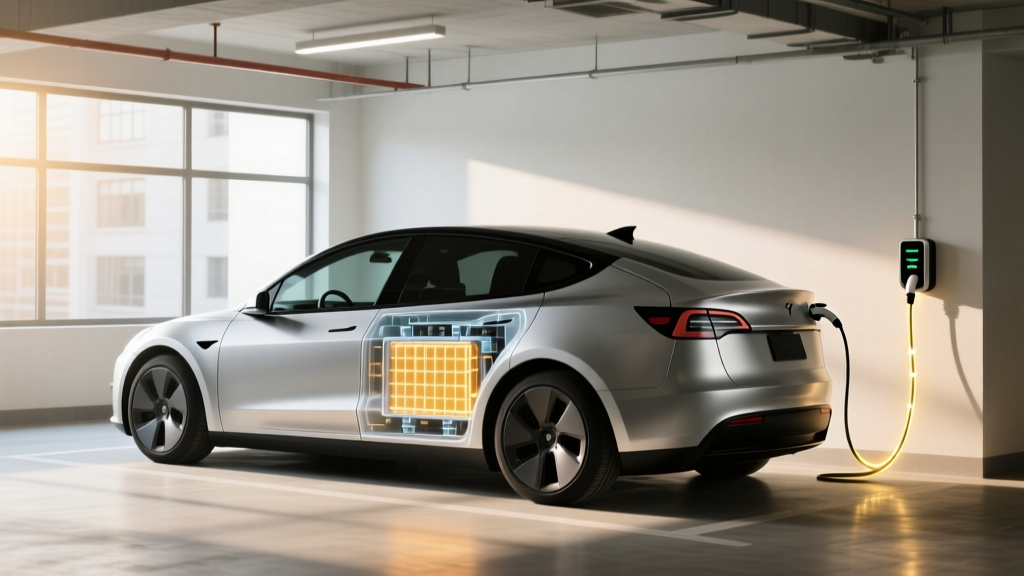
Applied to an EV's high-voltage traction battery (400V or 800V, 50–130+ kWh), the concept translates to very slow AC charging at Level 1 speeds (1.0–1.9 kW), which adds roughly 3–5 miles of range per hour. Some EV owners deliberately use Level 1 charging as a "trickle" strategy, reasoning that slower charge rates generate less heat and therefore less degradation.
Here's the nuance: modern EV battery management systems already regulate charge rates, cell balancing, and thermal conditions. When you plug into a Level 2 charger (7–19 kW AC), the car's onboard charger and BMS manage current flow to each cell group. The "trickle" benefit is real in one specific sense — lower charge rates produce less resistive heating — but the magnitude of the benefit is smaller than most enthusiasts assume.
LFP vs NMC: The Chemistry That Determines Your Care Strategy
Whether a slow-trickle charging approach benefits your EV depends heavily on your battery chemistry. The two dominant chemistries in 2026 model-year EVs are LFP (lithium iron phosphate) and NMC (nickel manganese cobalt), with NCA (nickel cobalt aluminum) used primarily by Tesla in Long Range and Performance models.
| Attribute | LFP (LiFePO₄) | NMC / NCA |
|---|---|---|
| Energy density | ~160–180 Wh/kg (lower) | ~220–260 Wh/kg (higher) |
| Cycle life | 3,000–5,000+ cycles | 1,000–2,000 cycles |
| Cold-weather performance | Weaker — more range loss below 32°F | Better low-temp discharge capability |
| Optimal daily SoC | Can charge to 100% daily (recommended by Tesla, BYD) | 80% daily; 100% only for trips |
| Cost per kWh | Lower — no cobalt or nickel | Higher — commodity-sensitive |
| Thermal stability | Excellent — less prone to thermal runaway | Good — requires more active cooling |
| Common 2026 vehicles | Tesla Model 3/Y RWD, Ford Mustang Mach-E Select (base), BYD models, Rivian Standard | Tesla LR/Performance, Hyundai Ioniq 5/6, Kia EV6/EV9, Ford Lightning Extended, Chevrolet Equinox EV |
Which is better? There is no universal winner. NMC delivers more range in a smaller, lighter pack — critical for long-range sedans and large SUVs. LFP offers dramatically longer cycle life, lower cost, and the simplicity of daily 100% charging, making it ideal for standard-range commuters. If you're evaluating a "battery trickler" approach, LFP chemistry is already so robust that slow-charging benefits are marginal; NMC packs benefit slightly more from reduced charge rates and lower SoC ceilings.
How Long Do EV Batteries Actually Last?
The short answer: most EV traction batteries will outlast the vehicle they're installed in. The long answer requires data.
According to analysis by Recurrent Auto, which tracks over 15,000 EVs in real-world conditions, the average EV battery retains approximately 90–95% of its original capacity after 5 years and 85–90% after 8 years / 100,000 miles. Degradation is not linear — it follows a curve with steeper loss in the first 1–2 years (roughly 2–5%), then a long, slow plateau.
- Tesla Model 3/Y (NMC, 2019–2022): ~5% loss at 50,000 miles, ~8% at 100,000 miles (fleet data)
- Tesla Model 3 RWD (LFP, 2022+): ~3% loss at 50,000 miles — slower degradation due to LFP chemistry
- Chevrolet Bolt EV/EUV (NMC, 2017–2023): ~6–8% loss at 80,000 miles; some early packs replaced under warranty due to manufacturing defects (not normal degradation)
- Nissan LEAF (passive cooling, older generations): 15–25% loss at 80,000 miles — a cautionary example of inadequate thermal management
- Hyundai Ioniq 5 (NMC, 2022+): Early data shows ~4% loss at 40,000 miles; active liquid cooling performing well
The Nissan LEAF is the outlier that proves the rule: thermal management matters more than charging speed. The LEAF's passive air-cooling design allowed heat to accumulate during fast charging and hot-weather driving, accelerating degradation. Every major EV sold in 2026 uses active liquid cooling, which is why modern degradation rates cluster in the 1–2% per year range under normal use.
What Does the EV Battery Warranty Cover?
Federal law mandates a minimum battery warranty of 8 years / 100,000 miles for EVs sold in the United States (California and states adopting CARB standards require 10 years / 150,000 miles). Here's how major manufacturers structure coverage in the 2026 model year:
| Manufacturer | Duration | Capacity Threshold | Notes |
|---|---|---|---|
| Tesla | 8 yr / 100,000–120,000 mi (varies by model) | 70% retention | Model 3/Y: 100k mi; Model S/X: 150k mi |
| Hyundai / Kia | 10 yr / 100,000 mi | 70% retention | Among the longest coverage in the segment |
| Ford | 8 yr / 100,000 mi | 70% retention | Covers battery and hybrid/electric components |
| General Motors (Chevy, Cadillac) | 8 yr / 100,000 mi | 60–70% retention (varies by model) | Ultium platform; check specific model terms |
| Rivian | 8 yr / 120,000 mi | 70% retention | Higher mileage cap reflects adventure-use positioning |
| BMW | 8 yr / 100,000 mi | 70% retention | Covers high-voltage battery only |
The critical number is the capacity retention threshold, typically 70%. If your battery's State of Health (SoH) drops below that threshold within the warranty period, the manufacturer must repair or replace it at no cost. In practice, very few modern liquid-cooled packs breach this threshold under normal use — it would require roughly 30% degradation, which current data suggests takes 15+ years for most chemistries.
How Much Does an EV Battery Replacement Cost?
This is the question that generates the most anxiety — and the most misinformation. Let's ground it in actual numbers.
| Vehicle | Battery Size | Estimated Replacement Cost | Context |
|---|---|---|---|
| Tesla Model 3 RWD (LFP) | ~60 kWh | $10,000–$13,000 | LFP packs are cheaper; module-level repair often possible |
| Tesla Model Y Long Range | ~75 kWh | $12,000–$16,000 | 4680 structural pack; full replacement more likely |
| Hyundai Ioniq 5 | 77.4 kWh | $14,000–$18,000 | E-GMP platform; module replacement may reduce cost |
| Ford F-150 Lightning Extended | ~131 kWh | $20,000–$28,000 | Largest consumer pack; labor-intensive removal |
| Chevrolet Equinox EV | ~85 kWh | $13,000–$17,000 | Ultium modular design allows partial replacement |
Important context: full battery replacement is rare. Most degradation-related issues involve individual modules or cell groups. Many manufacturers can replace a single faulty module for $2,000–$5,000 rather than the entire pack. And as noted above, the vast majority of packs never reach the 70% threshold within the warranty period.
For perspective, a $15,000 battery replacement at year 15 of ownership works out to roughly $1,000 per year — comparable to what many gas-car owners spend on transmission repairs, timing chains, or engine work over the same period. According to fueleconomy.gov, the fuel savings of an EV over a comparable gas vehicle typically offset this cost within 5–7 years of average driving.
Factors That Actually Affect Battery Life
Research from the National Renewable Energy Laboratory (NREL) and real-world fleet data identify these factors in approximate order of impact:
- Extreme temperatures without preconditioning: Charging a cold battery (below 32°F / 0°C) without preconditioning causes lithium plating on the anode — a permanent, irreversible form of degradation. This is the single most damaging habit. Always use your EV's preconditioning feature before charging in cold weather.
- Sustained high State of Charge (NMC only): Storing an NMC battery at 100% SoC for days or weeks accelerates calendar degradation. LFP batteries are far less sensitive to this — Tesla explicitly recommends periodic 100% charges for LFP packs to maintain BMS calibration.
- Frequent DC fast charging at peak rates: Exclusively using 150–350 kW DC fast chargers generates significant heat. Fleet data from Tesla shows that vehicles that DC fast charge more than 90% of the time experience roughly 1–2% additional degradation over 100,000 miles compared to predominantly Level 2 charging. The effect is real but modest — not catastrophic.
- Deep discharge cycles: Regularly driving below 10% SoC stresses the battery. The buffer zone (the unusable capacity below 0% displayed) protects against true deep discharge, but habitually arriving at 0% still accelerates wear.
- High ambient heat without garage parking: Batteries parked for weeks in 100°F+ environments without thermal management active will degrade faster. If you live in Phoenix or Las Vegas, a garage is the single best battery investment.
How to Check and Maximize Battery Health (SoH)
State of Health (SoH) is the percentage of original capacity your battery can still hold. A brand-new pack is 100% SoH; a pack that held 75 kWh when new and now holds 69 kWh is at 92% SoH.
How to check SoH:
- Tesla: The mobile app displays estimated range at 100% charge. Compare this to the original EPA range — a Model 3 LR originally rated at 358 miles that now shows 330 miles at 100% has roughly 92% SoH. Third-party apps like Tessie and Stats provide more granular SoH estimates using OBD-II data.
- Hyundai/Kia: The EV dashboard in the infotainment system shows battery health percentage directly on newer models (2024+).
- OBD-II diagnostic tools: Devices like the OBDLink MX+ paired with apps such as EV Bat Mon or Car Scanner can read BMS-reported SoH data on most EVs. This is the most accurate method outside a dealer diagnostic.
- Dealer service check: Any authorized service center can run a full battery health report. Request this during routine service visits — it's typically free.
Practical battery care checklist:
- Set daily charge limit to 80% for NMC; 100% is fine for LFP
- Enable preconditioning before DC fast charging and in cold weather
- Avoid letting SoC sit below 10% for extended periods
- Use scheduled departure/charging features to minimize time at high SoC
- Garage park when possible, especially in extreme heat
- Don't obsess over fast charging — use it when convenient, rely on Level 2 for daily needs
- For long storage (2+ weeks): leave NMC at ~50% SoC; LFP at 50–70%
- Keep the 12V auxiliary battery maintained — a dead 12V can strand you even with a full traction battery
Emerging Battery Technology: What's Next
The battery landscape is evolving, but it's critical to separate announced research from production-ready technology:
Solid-state batteries: Toyota, Samsung SDI, and QuantumScape have all announced solid-state prototypes promising 500+ mile range, 10-minute charging, and improved safety. Toyota has stated a target of limited production by 2027–2028. However, manufacturing scale-up and cost remain unsolved challenges. Expect solid-state to appear first in premium, low-volume vehicles — not mainstream models — and not before 2028 at the earliest.
Silicon-dominant anodes: Companies like Sila Nanotechnologies and Group14 are replacing graphite anodes with silicon-based materials to boost energy density by 20–40%. These are already appearing in limited applications (the Mercedes G-Class 580e uses a Sila anode) and will become more common through the late 2020s. This is the most likely near-term improvement.
Sodium-ion batteries: CATL and BYD have begun producing sodium-ion packs for low-cost, short-range EVs in China. Sodium-ion offers lower energy density but dramatically lower material costs and better cold performance. US-market availability is not expected before 2028 and will likely be limited to budget city cars and commercial fleets.
Frequently Asked Questions
Is a battery trickler or trickle charger good for my EV?
A traditional trickle charger is designed for 12V lead-acid batteries and cannot be connected to your EV's high-voltage traction battery. However, using Level 1 AC charging (1.0–1.9 kW from a standard 120V outlet) as a slow "trickle" charge is safe and produces minimal heat. The long-term degradation benefit over Level 2 charging is marginal — modern thermal management systems handle Level 2 heat effectively. Level 1 is fine as your primary charge method if it meets your daily mileage needs, but don't expect it to meaningfully extend battery life beyond what Level 2 provides.
How long do EV batteries last in years and miles?
Current data indicates most liquid-cooled EV batteries retain 85–90% capacity after 8 years and 100,000 miles. At that rate, reaching the 70% warranty threshold would take approximately 15–20 years under normal use. Many EV batteries will remain functional (albeit with reduced range) for 200,000+ miles.
How much does it cost to replace an EV battery?
Full pack replacement ranges from approximately $10,000 for a 60 kWh LFP pack to $28,000 for a 131 kWh NMC pack (like the F-150 Lightning Extended Range). However, full replacements are rare — most issues are resolved with module-level repairs costing $2,000–$5,000. Battery costs have declined roughly 80% since 2013 and continue to trend downward.
Does fast charging damage my EV battery?
Exclusively DC fast charging adds roughly 1–2% additional degradation over 100,000 miles compared to Level 2 charging, based on fleet data. This is a modest effect, not a crisis. Modern BMS and liquid cooling manage fast-charge heat effectively. Use DC fast charging for road trips and when convenient; rely on Level 2 for daily charging. The bigger risk is fast charging a cold battery without preconditioning — always precondition in freezing weather.
LFP or NMC — which battery should I choose?
Choose LFP if you want lower cost, longer cycle life (3,000–5,000 cycles), the convenience of daily 100% charging, and don't need maximum range. Choose NMC if you need the longest possible range per charge, better cold-weather performance, or are buying a larger vehicle where energy density matters. Both chemistries are well-warrantied and will outlast most ownership periods.
How do I check my EV's battery health?
Compare your 100% charge range display to the original EPA rating — the ratio approximates your State of Health. For more precision, use an OBD-II adapter with an EV-specific app (EV Bat Mon, Tessie, Car Scanner) or request a battery health report from your dealer during service. Most EVs also display battery health metrics in their mobile app or infotainment system.