What the Battery Symbol on Your EV Dashboard Actually Means
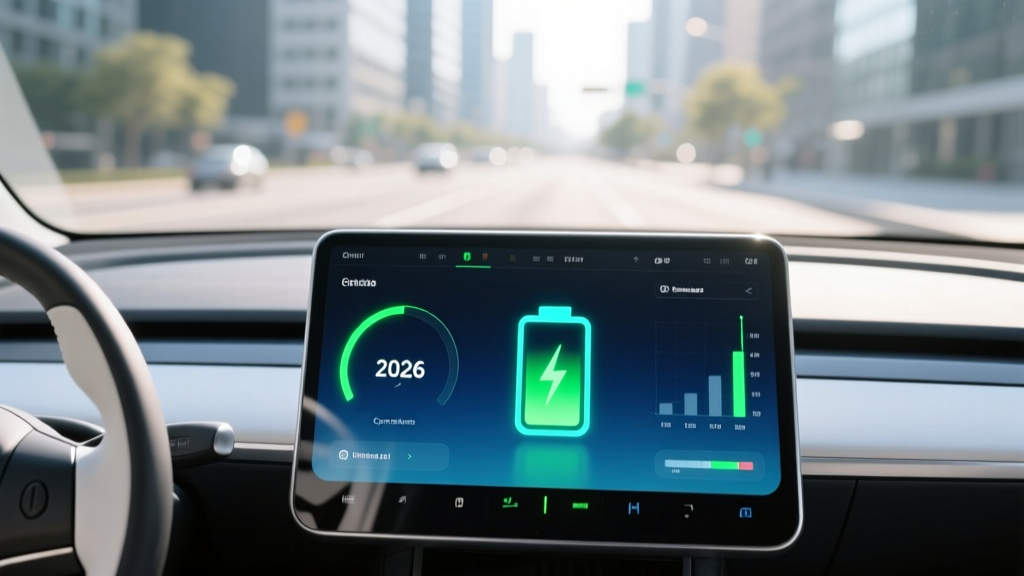
When a battery symbol illuminates on your EV's instrument cluster, it is almost always referencing the high-voltage traction battery — the large lithium-ion pack that powers the electric motor — not the small 12V auxiliary battery that runs the infotainment and lights. In most 2026 models from Tesla, Hyundai, Ford, and BMW, a yellow battery icon signals a battery management system (BMS) warning: reduced capacity, a cell-imbalance fault, or a thermal-management alert. A red battery icon typically means an immediate fault requiring you to pull over and contact service.
Before we get to what triggers that light, it helps to understand the chemistry inside the pack, how it degrades over time, what the warranty actually covers, and what you would pay if a replacement were ever needed. This guide covers all of that with real numbers — not marketing claims.
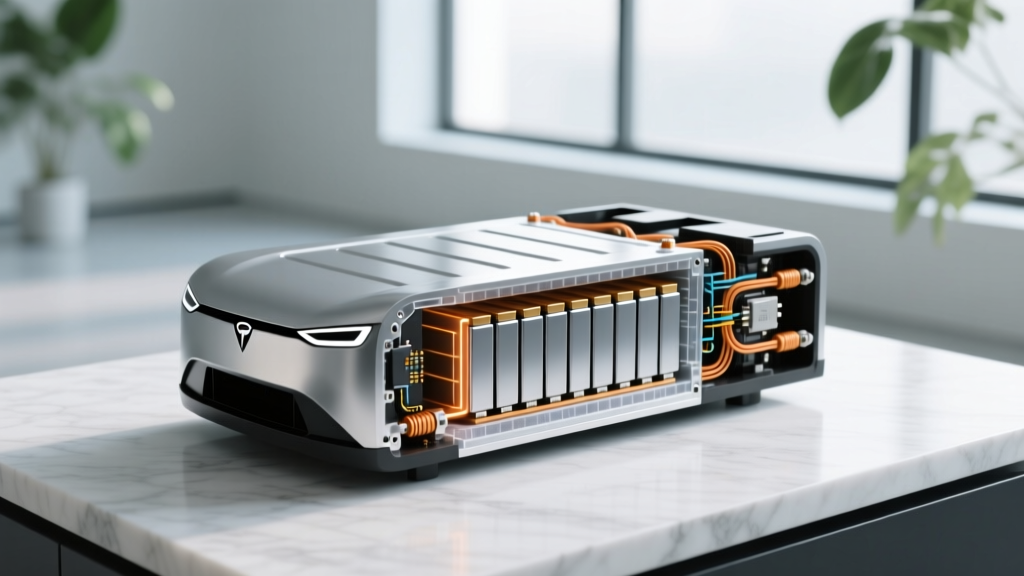
Every EV still carries a conventional 12V battery (often lead-acid or small lithium) to power electronics, door locks, and safety systems. If your car won't "start" or the screens stay dark, that's usually the 12V. The dashboard battery symbol we're discussing here refers to the main traction pack — the 50–120 kWh unit under the floor that determines your range and costs thousands to replace.
LFP vs NMC vs NCA: Which Chemistry Is in Your Pack?
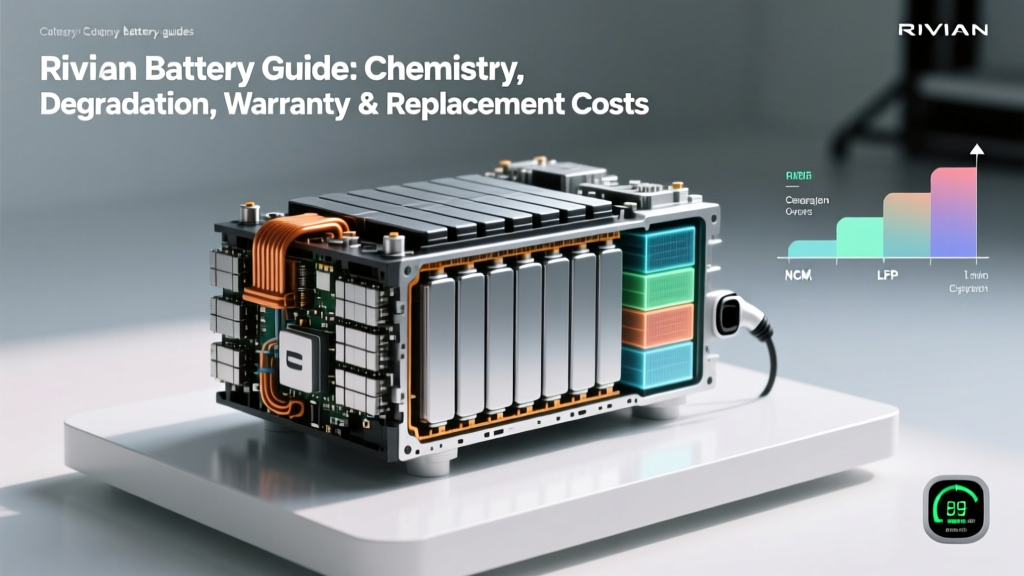
Not all EV batteries are the same. The two dominant chemistries in 2026 are lithium iron phosphate (LFP) and nickel manganese cobalt / nickel cobalt aluminum (NMC/NCA). The chemistry your car uses affects range, longevity, cold-weather behavior, and price. Here's how they compare:
| Attribute | LFP (Lithium Iron Phosphate) | NMC / NCA (Nickel-Based) |
|---|---|---|
| Energy Density | ~160–180 Wh/kg (lower) | ~230–300 Wh/kg (higher) |
| Typical Cycle Life | 3,000–5,000+ cycles | 1,000–2,000 cycles |
| Cold-Weather Performance | More range loss below 32°F (~20–30%) | Better cold retention (~10–20% loss) |
| Charging to 100% Daily | Recommended by most OEMs | Not recommended; 80% daily preferred |
| Cost per kWh (pack level) | ~$90–$110 | ~$120–$150 |
| Common In 2026 Models | Tesla Model 3/Y RWD, Ford Mustang Mach-E Select, BYD, base Chevy Equinox EV | Tesla Long Range, Hyundai Ioniq 5/6, BMW iX, Rivian, Porsche Taycan |
| Key Trade-Off | Longer life, lower cost; less range per kg, worse in cold | More range, better cold performance; shorter cycle life, higher cost |
Which is better? There's no universal winner. If you live in a mild climate, charge mostly at home, and plan to keep the car 8–10+ years, LFP's superior cycle life and tolerance for 100% daily charges make it the pragmatic choice. If you need maximum range for road trips, live in a cold-weather state, or tow frequently, NMC/NCA packs deliver more energy density and better winter performance. Most buyers won't choose wrong — OEMs match chemistry to the vehicle's intended use case.
How Long Do EV Batteries Actually Last?
The short answer: far longer than most buyers expect. Real-world fleet data from sources including fueleconomy.gov and long-term studies by Recurrent Auto show that the average EV battery in 2026 retains approximately 90–95% of its original capacity after 5 years / 75,000 miles, and roughly 83–90% after 8 years / 100,000 miles. Catastrophic failure requiring full replacement before 150,000 miles is rare — well under 2% of packs in major fleets.
- Tesla Model 3/Y (NMC, 2019–2022 fleets): ~92% capacity at 60,000 mi; ~87% at 100,000 mi (Recurrent Auto 2025 report)
- Chevrolet Bolt EV/EUV (NMC, 2017–2023): ~90% at 80,000 mi; some early 2017 units recalled for fire risk, not degradation
- Hyundai Ioniq 5 (NMC, 2022–2025): ~94% at 40,000 mi based on owner-reported SoH data
- Tesla Model 3 RWD (LFP, 2021–2024): ~96% at 50,000 mi; LFP packs show minimal early degradation
- Nissan Leaf (passive air cooling, 2011–2017): Notable outlier — some packs degraded to 70–75% by 80,000 mi due to lack of liquid thermal management
Most modern EVs use liquid-cooled battery packs with sophisticated BMS software that buffers the top and bottom of the state of charge, meaning the usable window is narrower than the total cell capacity. This buffer — often 5–10% at the top and bottom — is a major reason degradation curves have flattened compared to early EVs like the original Leaf.
What Does the EV Battery Warranty Cover?
Federal law (enforced by the EPA and referenced in IRS §30D credit documentation) mandates that EV batteries carry a minimum warranty of 8 years or 100,000 miles (whichever comes first). In California and states that follow CARB standards (currently 17 states plus D.C.), that extends to 10 years or 150,000 miles. Here's what the major OEMs offer in 2026:
| Manufacturer | Warranty Period | Mileage Limit | Capacity Retention Threshold |
|---|---|---|---|
| Tesla (Model 3/Y RWD – LFP) | 8 years | 100,000 mi | 70% |
| Tesla (Model 3/Y LR, Model S/X) | 8 years | 120,000 mi | 70% |
| Hyundai / Kia / Genesis | 10 years | 100,000 mi | 70% |
| Ford (Mustang Mach-E, F-150 Lightning) | 8 years | 100,000 mi | 70% |
| General Motors (Chevy, Cadillac, GMC) | 8 years | 100,000 mi | 70% (60% on some commercial) |
| BMW | 8 years | 100,000 mi | 70% |
| Volkswagen / Audi | 8 years | 100,000 mi | 70% |
| Rivian | 8 years | 120,000 mi (175k commercial) | 70% |
What triggers a warranty claim? If your battery's State of Health (SoH) drops below the threshold — typically 70% of original capacity — within the warranty period, the manufacturer must repair or replace the pack at no cost. Note: this covers degradation, not just catastrophic failure. If your EPA-rated 320-mile EV is only delivering 224 miles at full charge (70%) within the warranty window, you're covered. Damage from accidents, flooding, or unauthorized modifications is excluded.
How Much Does an EV Battery Replacement Cost?
This is the question that generates the most anxiety — and the most misinformation. Yes, out-of-warranty battery replacement is expensive. But context matters: most EV batteries outlast the vehicle's economic life, and prices per kWh have dropped roughly 90% since 2010. Here are current replacement cost ranges for popular 2026 models:
| Vehicle | Battery Size (kWh) | Chemistry | Estimated Replacement Cost |
|---|---|---|---|
| Tesla Model 3 RWD | ~60 kWh | LFP | $7,000–$10,000 |
| Tesla Model Y Long Range | ~82 kWh | NMC | $12,000–$16,000 |
| Hyundai Ioniq 5 | 77.4 kWh | NMC | $11,000–$15,000 |
| Ford Mustang Mach-E Extended Range | 91 kWh | NMC | $14,000–$18,000 |
| Ford F-150 Lightning Extended Range | 131 kWh | NMC | $18,000–$25,000 |
| Chevrolet Equinox EV | ~85 kWh | NMC | $12,000–$16,000 |
| BMW iX xDrive50 | 111.5 kWh | NMC | $18,000–$24,000 |
| Porsche Taycan (Performance Battery Plus) | 93.4 kWh | NMC | $20,000–$28,000 |
When is replacement actually needed? Almost never during normal ownership. Data from NHTSA service bulletins and OEM warranty reports indicate that fewer than 1.5% of EV batteries require full replacement within the first 10 years. Most degradation is gradual — you might lose 1–2% of range per year, not hit a cliff. The vehicles most likely to need out-of-warranty replacement are high-mileage fleet vehicles (taxis, rideshare) exceeding 200,000+ miles, or cars with packs damaged by collisions or flooding.
Also worth noting: many service centers now replace individual battery modules rather than the entire pack. A single failed module in a 12-module pack might cost $1,500–$3,000 to swap rather than $15,000+ for the full assembly.
What Triggers the Battery Warning Light — and What to Do
If the battery symbol on your car illuminates while driving, here's what it typically means and how to respond:
- Yellow/amber battery icon: The BMS has detected a non-critical issue — cell imbalance, reduced cooling efficiency, or a sensor fault. You can usually continue driving, but range may be temporarily limited. Schedule a service appointment within a week.
- Red battery icon or "Stop Safely" message: A critical fault — possible coolant leak into the pack, severe cell imbalance, or thermal runaway risk. Pull over safely, power off the vehicle, and call roadside assistance. Do not attempt to drive further.
- Battery icon with a thermometer symbol: The pack is outside its optimal temperature range. This is common during extreme cold or after repeated DC fast charging in hot weather. The BMS may limit charge rate or power output until temperatures normalize.
- Battery icon during charging: Often indicates a charging fault — incompatible connector, ground-fault detection, or a communication error between the charger and the car's BMS. Try a different charger or cable.
In most cases, a diagnostic scan at the dealer or an EV-specialist shop will pinpoint the exact fault code. Many warnings resolve with a software update rather than hardware replacement.
How to Check and Maximize Your Battery's State of Health
Monitoring your battery's State of Health (SoH) is easier than ever in 2026. Here's how to stay ahead of degradation:
- Check SoH in-app: Tesla, Hyundai, Ford, BMW, and Rivian all display estimated SoH or range-vs-original metrics in their companion apps or service menus.
- Use an OBD-II EV scanner: Devices like the OBDLink SX + apps such as EVNotify or LeafSpy (for Nissan) read real cell-level voltage data and calculate SoH independently.
- Track range over time: Note your full-charge estimated range monthly under similar conditions. A steady decline of more than 2–3% per year warrants a dealer check.
- Limit DC fast charging to road trips: Frequent 150+ kW DC sessions accelerate degradation. For daily use, Level 2 home charging at 7–11 kW is gentler on cells.
- Avoid sitting at 100% or below 10%: For NMC/NCA packs, a daily charge limit of 80% and a floor of ~15% reduces stress. LFP packs are fine at 100% daily — OEMs recommend it for accurate BMS calibration.
- Precondition in extreme temps: Use your car's scheduled departure or preconditioning feature to warm or cool the battery while plugged in. This reduces the energy the pack spends on its own thermal management.
- Don't leave the car at low SoC in extreme heat: A pack sitting at 10% SoC in 100°F+ ambient heat for days is under maximum chemical stress. If storing, aim for ~50% SoC.
What's Next: Solid-State, Silicon Anodes, and Realistic Timelines
The next generation of battery technology is real — but not yet on dealer lots. Here's where things stand as of 2026:
- Solid-state batteries: Toyota, Samsung SDI, and QuantumScape have demonstrated prototype cells with 40–80% higher energy density and faster charging. Toyota has announced a limited production run for a 2027–2028 model, but mass-market availability at scale is realistically 2029–2032. Expect initial deployment in premium/low-volume models first.
- Silicon-dominant anodes: Companies like Sila Nanotechnologies and Group14 are supplying silicon-carbon anode materials to Panasonic and Mercedes-Benz/AMG. The 2026 Mercedes-AMG GT XX prototype uses a silicon-anode pack. Broader adoption is expected by 2027–2028, offering ~10–20% energy density gains over current graphite anodes.
- Sodium-ion batteries: CATL and BYD have begun deploying sodium-ion packs in Chinese-market budget EVs. Lower energy density but no lithium or cobalt dependency. US-market availability is 2027+, likely in entry-level models or stationary storage first.
- LFP improvements: CATL's "Shenxing" LFP variant achieves 400+ km (250+ mi) with 10-minute 10–80% DC fast charging — a significant leap for the chemistry already reaching Chinese and European markets in 2025–2026.
None of these technologies change the buy-now calculus. Current LFP and NMC packs already deliver 200,000+ mile lifespans with gradual, manageable degradation. If you're shopping today, the battery in the car you buy will very likely outlast your ownership.
Frequently Asked Questions
How long do EV batteries last in years and miles?
Most modern liquid-cooled EV batteries (2020 and newer) retain 83–90% of original capacity at 8 years / 100,000 miles. Based on current degradation curves, a typical pack should deliver usable range for 200,000–300,000+ miles before dropping below 70% capacity. Many will outlast the vehicle itself.
How much does it cost to replace an EV battery?
Out-of-warranty replacement costs range from roughly $7,000 for a smaller LFP pack (Tesla Model 3 RWD) to $25,000+ for a large NMC pack (F-150 Lightning Extended Range, Porsche Taycan). However, fewer than 1.5% of packs require full replacement within the first decade. Most are covered by the 8-year/100,000-mile federal warranty.
What does the battery warranty actually cover?
EV battery warranties cover both catastrophic failure and gradual degradation below a set threshold — typically 70% of original capacity — within 8 years/100,000 miles (10 years/150,000 miles in CARB states). If your range drops below the threshold, the OEM must repair or replace the pack at no cost. Accident damage and unauthorized modifications are excluded.
How do I check my EV battery's health?
Most OEM apps display SoH or current max range vs. original. You can also use an OBD-II EV scanner with apps like EVNotify or LeafSpy for cell-level data. Track your full-charge range monthly under consistent conditions — a decline exceeding 2–3% per year is worth a dealer diagnostic.
LFP vs NMC — which battery chemistry should I choose?
Choose LFP if you want maximum cycle life, lower cost, and plan to charge to 100% daily (common for commuters with home charging). Choose NMC/NCA if you need maximum range, tow frequently, or live in a cold climate where LFP's winter range loss is more pronounced. Neither is wrong — OEMs match chemistry to the vehicle's purpose.
Does fast charging damage my EV battery?
Occasional DC fast charging (road trips, a few times per month) has minimal impact. However, daily use of 150+ kW DC chargers does accelerate degradation compared to Level 2 home charging. The heat generated at high charge rates stresses cells over time. For daily charging, a home Level 2 setup at 7–11 kW is the best practice for long-term pack health.