The Companies Powering Your EV: Why Battery Suppliers Matter
When you buy an electric vehicle, you're not just buying a car — you're buying the battery inside it. The high-voltage traction battery is the single most expensive component in any EV, often representing 30–40% of the vehicle's total manufacturing cost. Yet most buyers focus on horsepower and 0–60 times while barely glancing at who actually built the cells powering their commute.
Understanding the major battery suppliers for electric cars — CATL, LG Energy Solution, Panasonic, SK On, Samsung SDI, BYD, and others — gives you real insight into what's under your floorpan: the cell chemistry, the likely degradation curve, the warranty you'll rely on, and the replacement cost if something goes wrong a decade from now. This guide breaks down the supplier landscape alongside the technical details every EV owner or buyer needs to know.
The Major Battery Suppliers for Electric Cars in 2026
Global EV battery production is dominated by a handful of mega-manufacturers, most headquartered in Asia, though North American and European capacity is expanding rapidly under IRA-driven onshoring incentives. Here's a snapshot of the key players and the automakers they supply:
| Supplier | HQ | Key Chemistries | Major Automaker Partners |
|---|---|---|---|
| CATL | China | LFP, NMC, Sodium-ion | Tesla, BMW, Mercedes-Benz, Ford, Volvo |
| BYD (FinDreams) | China | LFP (Blade Battery) | BYD, Tesla, Toyota (selected models) |
| LG Energy Solution | South Korea | NMC, NCMA | GM, Hyundai, Ford, Stellantis, Honda |
| Panasonic | Japan | NCA, NMC (2170/4680 cells) | Tesla (primary), Toyota |
| SK On | South Korea | NMC, NCM | Ford, Hyundai, Kia |
| Samsung SDI | South Korea | NMC, NCA | BMW, Stellantis, Volvo, Hyundai |
| Northvolt | Sweden | NMC | BMW, Volvo, Scania, VW |
This matters because the same vehicle model may use cells from different suppliers depending on model year, trim, and manufacturing plant. For example, the Tesla Model Y has used CATL LFP cells in Standard Range variants and Panasonic NCA cells in Long Range variants — yielding measurably different range, charging behavior, and long-term degradation profiles.
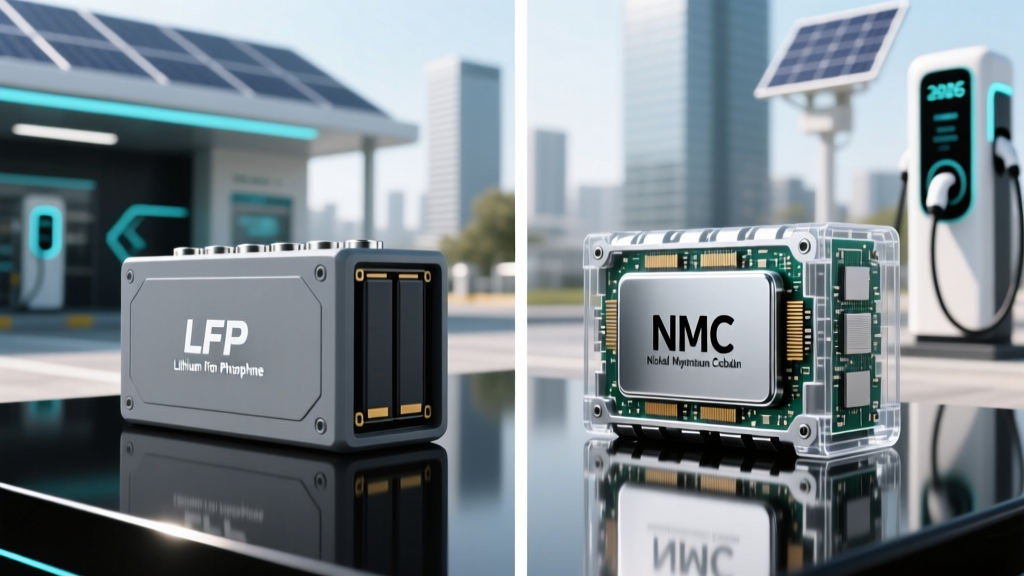
Battery Chemistry Decoded: LFP vs NMC vs NCA
The supplier often determines the chemistry. The three dominant lithium-ion chemistries in passenger EVs each carry distinct trade-offs that affect your daily ownership experience.
| Attribute | LFP (Lithium Iron Phosphate) | NMC (Nickel Manganese Cobalt) | NCA (Nickel Cobalt Aluminum) |
|---|---|---|---|
| Energy Density | Lower (~160–180 Wh/kg cell-level) | Higher (~220–260 Wh/kg) | Highest (~260–300 Wh/kg) |
| Cycle Life | Excellent (3,000–5,000+ cycles to 80% SoH) | Good (1,000–2,000 cycles to 80% SoH) | Good (1,000–1,500 cycles) |
| Cold-Weather Performance | Weaker — greater range loss below 32°F | Better low-temp discharge capability | Good low-temp performance |
| Cost per kWh | Lowest (~$90–110/kWh pack-level in 2026) | Higher (~$120–150/kWh) | Similar to NMC |
| Thermal Stability / Safety | Superior — highly resistant to thermal runaway | Good with proper BMS management | Good with proper BMS management |
| Charging to 100% | Recommended periodically for SoC calibration | Better kept at 80–90% daily | Better kept at 80–90% daily |
| Key Suppliers | CATL, BYD | LG, SK On, Samsung SDI, Northvolt, CATL | Panasonic, Samsung SDI |
| Example Vehicles (2026) | Tesla Model 3 RWD, Ford Mustang Mach-E SR, Rivian R1S Standard | Hyundai Ioniq 5, GM Ultium vehicles, BMW iX | Tesla Model S/X, Model Y LR |
Which is better? Neither is universally superior. If you prioritize maximum range and can charge at home daily, NMC/NCA delivers more miles per kWh of battery weight. If you plan to keep the car 10+ years, charge to 100% frequently, or want the lowest replacement cost, LFP's cycle-life advantage is substantial. Many 2026 Standard Range models from Tesla, Ford, and Rivian now use LFP specifically because the chemistry's longevity reduces warranty liability for the automaker.
How Long Do EV Batteries Last? Real Degradation Data
The most persistent fear among EV shoppers is that the battery will die prematurely, leaving them with a $15,000+ repair bill. The data tells a more reassuring story — but with important nuance.
Typical degradation trajectory (fleet-averaged data):
- Year 1 / 15,000 miles: ~2–5% capacity loss (initial formation loss)
- Year 3 / 45,000 miles: ~5–8% total loss
- Year 5 / 75,000 miles: ~7–12% total loss
- Year 8 / 120,000 miles: ~10–17% total loss (chemistry-dependent)
- Year 10+ / 150,000+ miles: ~12–22% total loss for well-maintained packs
According to data compiled from fueleconomy.gov and fleet studies by Recurrent Auto and Geotab, most modern liquid-cooled EV batteries retain 85–90% of their original capacity after 100,000 miles. LFP packs tend to cluster at the higher end of that range; early-generation NMC packs (2018–2020) at the lower end.
A 2025 Geotab study of over 10,000 EVs found an average annual degradation rate of approximately 1.8% per year across all chemistries, meaning a 300-mile EPA-rated vehicle would still offer roughly 255–270 miles of range after a decade. That's noticeable but not catastrophic — and it's well within warranty coverage thresholds for most manufacturers.
Real-world caveat: Degradation isn't linear. You'll see a steeper drop in year one (the "formation" period as cells stabilize), then a long, slow plateau. Vehicles subjected to frequent DC fast charging, extreme heat (Arizona, Texas summers), or habitual 100% SoC storage will trend toward the higher-loss end of these ranges.
What Does the Battery Warranty Actually Cover?
Federal law mandates that EV batteries carry a minimum warranty of 8 years / 100,000 miles (10 years / 150,000 miles in California and states adopting CARB standards). Most automakers meet or exceed this baseline. Here's how major warranties compare:
| Automaker | Warranty Period | Capacity Retention Threshold | Notes |
|---|---|---|---|
| Tesla | 8 yr / 100,000–120,000 mi (varies by model) | 70% minimum | Model S/X: 150k mi; Model 3/Y: 100k–120k mi |
| Hyundai / Kia | 10 yr / 100,000 mi | 70% minimum | Among the longest coverage periods |
| GM (Chevrolet, Cadillac) | 8 yr / 100,000 mi | 70% minimum (Ultium) | Module-level replacement where possible |
| Ford | 8 yr / 100,000 mi | 70% minimum | Covers battery and hybrid components |
| BMW | 8 yr / 100,000 mi | 70% minimum | Offers module-level repair |
| Rivian | 8 yr / 175,000 mi | 70% minimum | Highest mileage threshold in the market |
What triggers a warranty claim? The battery must fall below the stated capacity threshold (typically 70% of original usable kWh) as measured by the vehicle's onboard Battery Management System (BMS) or a dealer diagnostic tool. Normal gradual degradation above that threshold is considered expected wear and is not covered. Physical damage, flood damage, and unauthorized modifications are excluded.
Module-level vs. full-pack replacement: Some manufacturers (GM, BMW) design packs with individually replaceable modules, meaning a single degraded or defective module can be swapped for a fraction of a full-pack cost. Others (Tesla, many early EVs) require full-pack replacement, which is more expensive out of warranty.
EV Battery Replacement Cost: What to Budget For
If your battery degrades below the warranty threshold outside of warranty coverage — or if it suffers physical damage — replacement is a major expense. However, context matters: the vast majority of EV batteries outlast their vehicles' useful economic life without needing replacement.
| Vehicle / Battery Size | Battery Capacity | Estimated Replacement Cost (2026) | Typical Replacement Timeline |
|---|---|---|---|
| Tesla Model 3 RWD (LFP) | ~60 kWh | $10,000–$14,000 | Rarely needed before 200,000+ mi |
| Tesla Model Y Long Range (NCA) | ~82 kWh | $14,000–$18,000 | Rarely needed before 180,000+ mi |
| Hyundai Ioniq 5 (NMC) | 77.4 kWh | $12,000–$16,000 | Rarely needed before 180,000+ mi |
| Ford F-150 Lightning Extended | ~131 kWh | $22,000–$32,000 | Rarely needed; largest packs carry highest cost |
| Chevrolet Bolt EV/EUV | 65 kWh | $9,000–$14,000 | Recall-replaced packs show strong longevity |
| Rivian R1T / R1S Large Pack | ~135 kWh | $20,000–$28,000 | Rarely needed; covered to 175,000 mi |
Key context: Battery pack prices have fallen from over $1,000/kWh in 2010 to roughly $110–140/kWh at the pack level in 2026, according to BloombergNEF. The third-party replacement market is also growing — companies like NHTSA-registered repair facilities now offer refurbished pack swaps at 40–60% of OEM pricing. For most owners, the battery will never need replacement during their ownership period. Data from Geotab and Recurrent shows that fewer than 2% of EVs require out-of-warranty battery replacements due to degradation alone.
Factors That Accelerate (or Preserve) Battery Life
Battery degradation is driven by chemistry, temperature, and usage patterns. While you can't control the chemistry your supplier chose, you can meaningfully influence how quickly your pack ages.
Habits That Preserve Battery Health
- Keep daily SoC between 20–80% for NMC/NCA packs. LFP packs benefit from periodic 100% charges for BMS calibration.
- Use Level 2 home charging as your primary method. Slow, steady charging generates less heat stress than repeated DC fast charging.
- Precondition the battery before DC fast charging in cold weather. Most EVs do this automatically when you navigate to a charger; it warms the cells to the optimal ~95°F charging temperature.
- Avoid prolonged storage at extreme SoC. If leaving the car for weeks, set charge limit to ~50%.
- Park in shade or a garage during hot summers. Sustained battery temperatures above 104°F accelerate calendar degradation.
- Use scheduled charging so the car finishes charging right before you leave, minimizing time spent at high SoC.
Habits That Accelerate Degradation
- Frequent DC fast charging — especially at 150+ kW without preconditioning. Studies show vehicles that DC fast charge more than 3x per week degrade ~1–2% faster over 5 years.
- Habitual 100% charges on NMC/NCA packs held for extended periods (overnight or multi-day).
- Deep discharges to 0% and leaving the car at very low SoC for days.
- Extreme ambient heat without thermal management — a concern mostly for older, passively-cooled EVs (early Nissan Leaf, Fiat 500e).
- Towing or heavy track use generating sustained high C-rates and thermal load.
How to Check Your Battery's State of Health (SoH)
State of Health (SoH) is a percentage representing your battery's current maximum capacity relative to its original capacity. A new battery is 100% SoH; one that can hold only 80% of its original kWh is at 80% SoH.
Methods to check SoH:
- In-vehicle display: Some EVs (Tesla via service mode, Hyundai/Kia via the infotainment engineering menu, Rivian in the settings) display a SoH percentage or estimated current capacity.
- Dealership diagnostic: Any authorized dealer can run a full battery health report, measuring actual kWh capacity versus original. This is the most reliable method and is free during routine service visits.
- Third-party apps and OBD-II tools: Apps like Leaf Spy (Nissan), Scan My Tesla, and ABRP (A Better Routeplanner) with OBD-II dongles can read real-time battery telemetry including SoH, cell voltage variance, and internal resistance.
- Charge-log analysis: By tracking how many kWh you put into the battery from a known low SoC to a known high SoC, you can estimate current usable capacity. If your 77.4 kWh pack only accepts 65 kWh from 10% to 90%, your SoH is approximately 94% (65 ÷ (77.4 × 0.80)).
When to worry: If your SoH drops below 80% within the warranty period, you likely qualify for a warranty repair. If it drops unevenly (one module significantly weaker than others), that can indicate a cell imbalance issue that may be repairable without a full pack swap.
Emerging Battery Technologies: What's Next from Suppliers
The battery supplier landscape is evolving rapidly. Several next-generation technologies are in various stages of development, though none have reached mass production for consumer vehicles as of 2026.
Solid-state batteries replace the liquid electrolyte with a solid material (ceramic, polymer, or sulfide-based), promising higher energy density (potentially 400+ Wh/kg cell-level), faster charging, and improved safety. Toyota has announced a solid-state EV for 2027–2028 with a claimed 450+ mile range and 10-minute fast charging, though production volumes and pricing remain unconfirmed. Samsung SDI is targeting 2027 for initial production. These timelines have slipped multiple times; treat all solid-state announcements as preliminary until vehicles are shipping to customers.
Silicon-dominant anodes replace graphite anodes with silicon, which can store roughly 10x more lithium ions per gram. Companies like Sila Nanotechnologies and Group14 are supplying silicon anode materials to Panasonic and others, with early production applications appearing in the Mercedes G-Class electric SUV. Expect 10–20% energy density gains in near-term applications, with broader adoption through 2028–2030.
Sodium-ion batteries use abundant sodium instead of lithium, offering lower cost (~$50–70/kWh projected) at the expense of energy density. CATL has begun production for use in lower-range Chinese-market EVs and energy storage. U.S. passenger vehicle adoption is unlikely before 2028–2029 and would be limited to budget-oriented, shorter-range models.
LMFP (Lithium Manganese Iron Phosphate) adds manganese to LFP chemistry, boosting energy density by ~15–20% while retaining LFP's cost and safety advantages. CATL and other suppliers are ramping LMFP production, and it's expected to appear in 2027–2028 model-year vehicles targeting the mid-range segment.
For today's buyer, these technologies are forward-looking context, not purchase drivers. Current LFP and NMC/NMC packs from established suppliers are mature, well-understood, and backed by extensive warranty coverage.
Frequently Asked Questions
How long do EV batteries last in years and miles?
Most modern liquid-cooled EV batteries are designed to last 15–20 years or 150,000–200,000+ miles before degrading to 70–80% of original capacity. Fleet data from Geotab and Recurrent shows average degradation of approximately 1.8% per year across all chemistries. LFP packs from suppliers like CATL and BYD tend to outlast NMC packs in cycle-life terms, often exceeding 3,000 full charge cycles before hitting 80% SoH.
How much does an EV battery cost to replace in 2026?
Replacement costs range from roughly $9,000 for a 60–65 kWh pack (Chevrolet Bolt, Tesla Model 3 RWD) to $22,000–$32,000 for a 130+ kWh pack (Ford F-150 Lightning Extended, Rivian R1T). The cost per kWh at the pack level is approximately $110–140 in 2026, down from $200+ just a few years ago. Most owners will never need a replacement — fewer than 2% of EVs require out-of-warranty battery swaps due to degradation.
What does the EV battery warranty cover?
Federal law requires a minimum 8-year / 100,000-mile battery warranty (10 years / 150,000 miles in CARB states). The warranty covers capacity loss below a stated threshold — typically 70% of original usable capacity. It does not cover normal gradual degradation above that threshold, physical damage, flood damage, or unauthorized modifications. Some manufacturers (GM, BMW) offer module-level repairs rather than full-pack replacement, reducing cost and waste.
How do I check and maximize my EV battery health?
Check SoH through your vehicle's built-in diagnostics, a dealer service visit, or third-party OBD-II apps like Leaf Spy or Scan My Tesla. To maximize longevity: keep NMC/NCA packs between 20–80% SoC for daily use, minimize DC fast charging frequency, precondition before fast charging, avoid prolonged high-temperature exposure, and use scheduled charging to minimize time at high SoC. LFP owners should periodically charge to 100% for BMS calibration.
LFP vs NMC — which battery chemistry is better for me?
Choose LFP (from CATL, BYD) if you prioritize long-term cycle life, lower replacement cost, superior thermal safety, and don't mind slightly lower range per kWh of battery weight. LFP is ideal for daily commuters who charge at home and plan to keep their EV 8+ years. Choose NMC/NCA (from LG, Panasonic, SK On, Samsung SDI) if you need maximum range from a lighter pack, regularly take long road trips, or live in a cold climate where NMC's better low-temperature performance matters. Neither chemistry is universally "better" — the right choice depends on your driving patterns and ownership timeline.
Does the battery supplier affect my §30D tax credit eligibility?
Yes. Under current IRS §30D rules, the $7,500 federal tax credit requires that a percentage of battery components be manufactured or assembled in North America, and that critical minerals be sourced from the U.S. or free-trade-agreement partners. Vehicles using battery cells from CATL or BYD (Chinese suppliers) may fail the battery-component requirement and lose credit eligibility, even if the vehicle is assembled in the U.S. Always verify current-year eligibility on the IRS website before purchasing, as these rules tighten annually. Income caps ($150K single / $300K joint) and MSRP caps ($55K sedans / $80K SUVs and trucks) also apply. Consult a tax professional for your specific situation.