What the Battery Light on Your Car Actually Means in an EV
If you've seen a battery warning light illuminate on your EV's dashboard, your first instinct might be panic about a $20,000 traction battery replacement. In most cases, that fear is misplaced. The battery light on car meaning depends entirely on which battery the warning references — and every modern electric vehicle carries two fundamentally different battery systems.
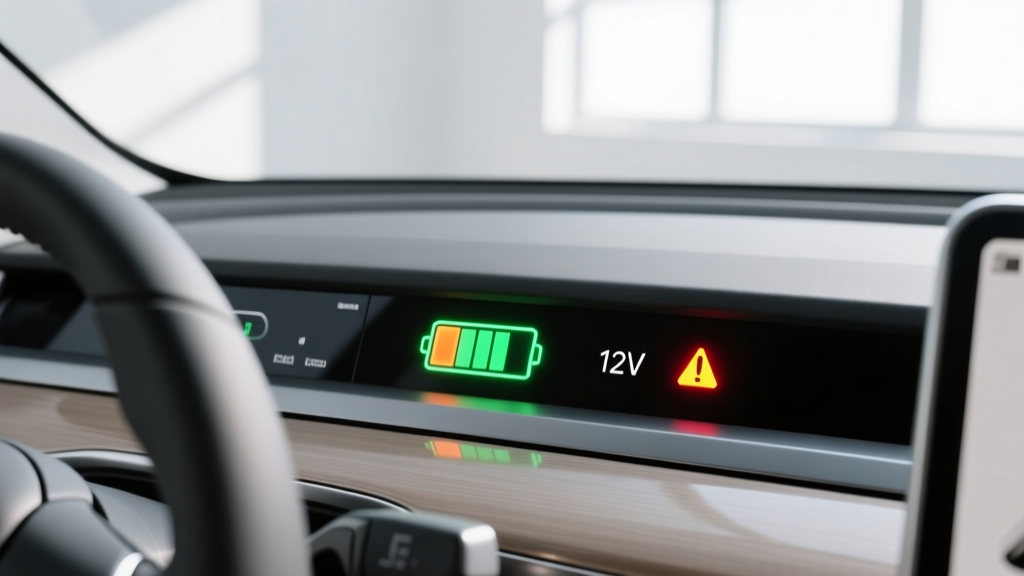
The small red battery icon that appears on most instrument clusters almost always refers to the 12-volt auxiliary battery, not the large high-voltage traction pack that propels the vehicle. This 12V battery powers the vehicle's computers, lights, infotainment, door locks, and safety systems. When it fails or its charging circuit malfunctions, the car may not start — even though the main traction battery is fully charged.
EV-specific traction battery warnings look different. They typically appear as text alerts ("High Voltage Battery Fault," "Battery System Malfunction"), a yellow or red car-with-exclamation icon, or a turtle-mode indicator signaling reduced power output. These warnings point to the high-voltage pack — the 60 to 100+ kWh lithium-ion system that actually drives the wheels.
Understanding this distinction is critical because the stakes, costs, and responses are entirely different. Below, we break down both systems, then focus on the traction battery — its chemistry, degradation behavior, warranty coverage, and the emerging technology reshaping what EV ownership looks like in 2026.
12V Auxiliary Battery vs High-Voltage Traction Battery
Every EV sold in the US has a dual-battery architecture:
| System | Voltage | Capacity | Chemistry | Function | Typical Replacement Cost |
|---|---|---|---|---|---|
| 12V Auxiliary | 12V | 40–70 Ah | Lead-acid or Li-ion (12V) | Computers, lights, locks, safety systems, DC-DC converter buffer | $150–$400 |
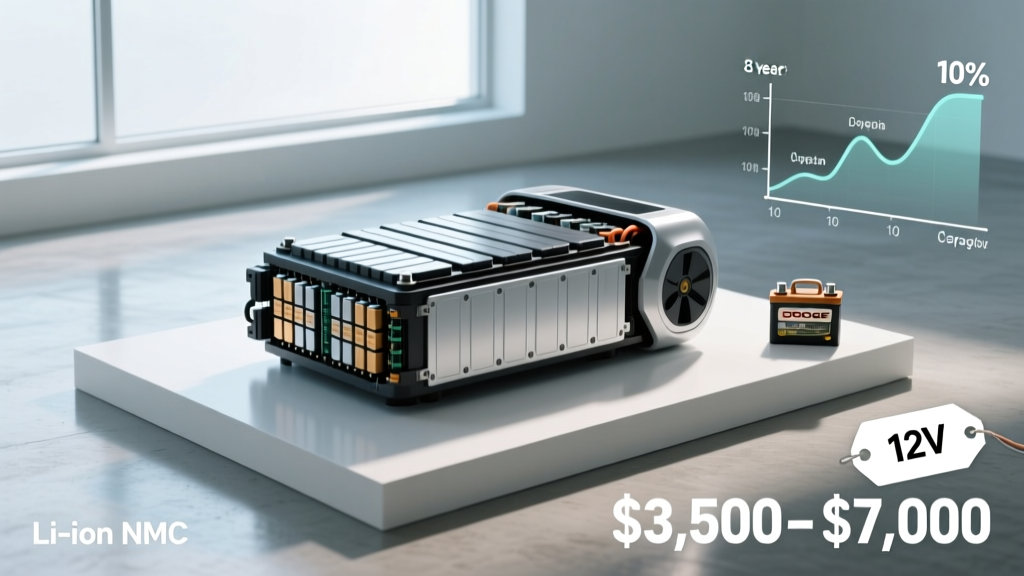
| Traction Battery | 350–800V | 60–115 kWh | LFP or NMC/NCA | Propulsion, regenerative braking storage, cabin heating/cooling | $5,000–$22,000+ |
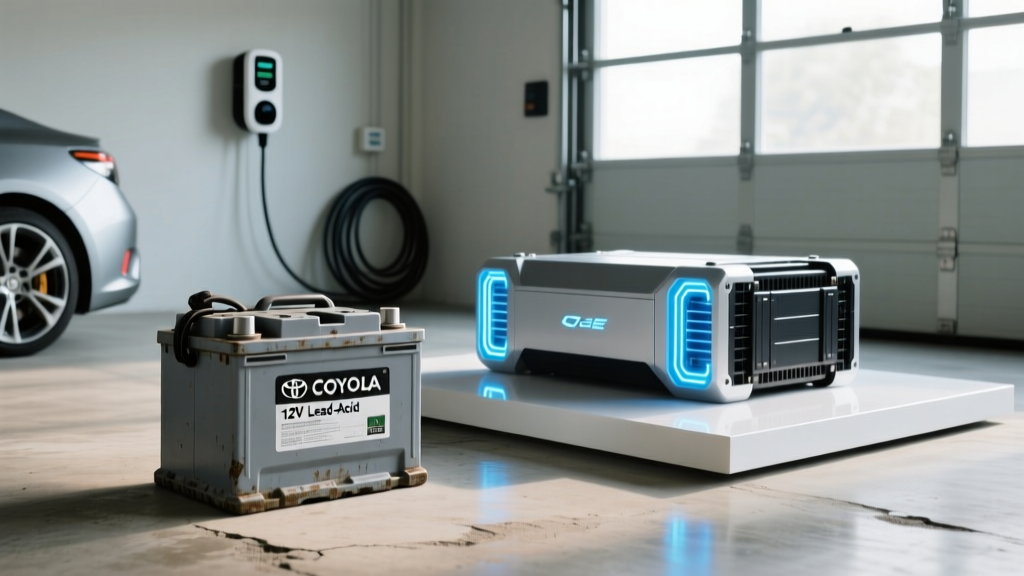
The 12V battery is the one behind the classic red battery warning light. In EVs like the Tesla Model 3/Y, the 12V system has moved to a lithium-iron-phosphate 12V unit that lasts longer than traditional lead-acid, but failures still occur. Hyundai, Kia, Ford, and GM still use AGM lead-acid 12V batteries in most models, which typically last 3–5 years.
If the red battery light appears while driving an EV, it means the DC-DC converter (which replaces the alternator) is not properly charging the 12V system, or the 12V battery itself is failing. Pull over safely and have the vehicle towed if the light stays solid — a dead 12V battery will brick the car even with a full traction pack.
EV Battery Chemistry: LFP vs NMC/NCA Trade-Offs
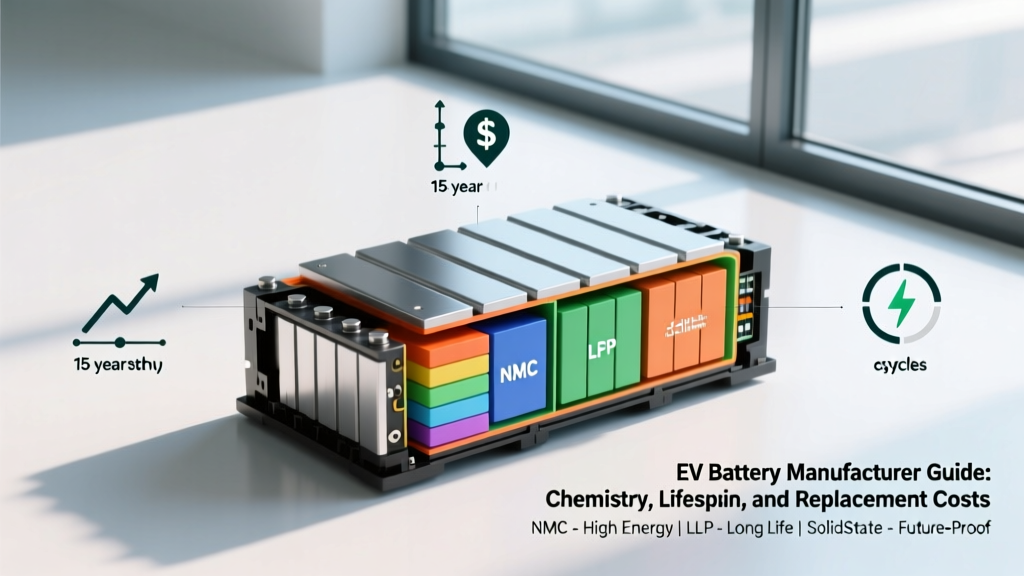
The high-voltage traction battery in your EV uses one of two dominant lithium-ion chemistries: LFP (lithium iron phosphate) or NMC/NCA (nickel manganese cobalt / nickel cobalt aluminum). The chemistry determines range, longevity, cold-weather behavior, and cost.
| Attribute | LFP (LiFePO4) | NMC / NCA |
|---|---|---|
| Energy Density | Lower (~160 Wh/kg cell-level) | Higher (~250–300 Wh/kg cell-level) |
| Cycle Life | 3,000–5,000+ cycles | 1,000–2,000 cycles |
| Cold Performance | Weaker below 32°F; slower charging | Better low-temp conductivity |
| State of Charge Tolerance | Can charge to 100% daily safely | Best kept 20–80% for longevity |
| Cost per kWh | Lower (~$80–100/kWh at cell level in 2026) | Higher (~$110–140/kWh) |
| Thermal Stability | Excellent; very low thermal runaway risk | Good with active management |
| Common in 2026 | Tesla Model 3 RWD, Model Y RWD, Ford Mustang Mach-E Select, Rivian Standard | Hyundai Ioniq 5/6, Chevy Equinox EV, BMW iX, Lucid Air, most long-range trims |
Which is better? It depends on your use case. If you charge at home nightly and want maximum battery lifespan with minimal management, LFP is the pragmatic choice — Tesla recommends charging LFP vehicles to 100% at least once weekly for accurate state-of-charge calibration. If you need maximum range per charge (road trips, towing, cold climates), NMC's higher energy density delivers more miles in the same physical pack size. Neither chemistry is universally superior; the right choice matches your driving pattern.
How Long Do EV Batteries Last? Degradation Data
The question "how long do EV batteries last" has a data-backed answer that surprises most shoppers: the vast majority of EV traction batteries outlast the vehicles they're installed in. Catastrophic failure is rare; gradual capacity loss is the norm.
Real-world degradation data points (sourced from fleet studies and manufacturer reports):
- Tesla 2025 Impact Report: Model 3/Y batteries retain approximately 85% of original capacity at 200,000 miles — roughly 15% degradation over the vehicle's typical first-owner lifespan.
- Geotab fleet study (6,300+ EVs): Average annual degradation of 1.8% across all chemistries, meaning ~14% loss over 8 years under normal use.
- LFP advantage: Fleet data shows LFP packs averaging 1.0–1.3% annual degradation vs 1.8–2.3% for NMC, particularly when NMC packs are routinely charged above 90%.
- Early Nissan Leaf (2011–2015, passive air cooling): Showed 20–30% degradation by year 8 in hot climates — a cautionary case that drove the industry toward active liquid thermal management in all current models.
At 1.8% average annual loss, a 300-mile EPA-rated EV would still deliver roughly 258 miles of range after 8 years — a noticeable but entirely livable reduction. Most owners sell or trade the vehicle before degradation becomes a daily inconvenience.
Battery Warranty Coverage: What's Protected and for How Long
Federal law mandates that EV batteries carry a minimum warranty of 8 years / 100,000 miles (10 years / 150,000 miles in California and states adopting CARB standards). Most manufacturers exceed this floor. Here's how major 2026 warranties compare:
| Manufacturer | Warranty Period | Capacity Retention Threshold | What Triggers a Claim |
|---|---|---|---|
| Tesla (Model 3/Y) | 8 yr / 120,000 mi (Long Range) 8 yr / 100,000 mi (RWD) | 70% | SoH drops below 70% or defect |
| Hyundai / Kia | 10 yr / 100,000 mi | 70% | Measured capacity below 70% of new |
| GM (Ultium-based) | 8 yr / 100,000 mi | 70% (some trims 60%) | Capacity or defect-based |
| Ford | 8 yr / 100,000 mi | 70% | Below 70% capacity retention |
| Rivian | 8 yr / 175,000 mi (Max Pack) | 70% | Capacity or manufacturing defect |
| BMW | 8 yr / 100,000 mi | 70% | Capacity below threshold |
The critical detail is the capacity retention threshold. If your 82 kWh (usable) NMC pack degrades to 57.4 kWh (70%), you have a valid warranty claim. In practice, very few packs reach this threshold within the warranty window — the data above shows most retaining 82–88% at the 8-year mark under normal conditions. Source: fueleconomy.gov EV technology overview.
EV Battery Replacement Cost: When and How Much
Out-of-warranty traction battery replacement is the cost scenario EV shoppers worry about most. The honest picture: it's expensive, but rarely needed within a vehicle's practical lifespan.
| Vehicle / Pack Size | Battery Capacity | Estimated Replacement Cost (2026) | Typical Replacement Trigger |
|---|---|---|---|
| Tesla Model 3 RWD (LFP) | ~60 kWh | $8,000–$12,000 | Physical damage, rare defect post-warranty |
| Hyundai Ioniq 5 (NMC) | 77.4 kWh | $12,000–$16,000 | Collision damage or extreme degradation |
| Ford F-150 Lightning Extended | 131 kWh | $18,000–$25,000 | Physical damage; degradation claims rare |
| Chevy Equinox EV | ~85 kWh | $11,000–$15,000 | Post-warranty defect or damage |
| Lucid Air Grand Touring | 112 kWh | $20,000–$28,000 | High-end pack; specialized service |
These figures include the battery module assembly and labor but exclude potential ancillary work (coolant flush, BMS recalibration). Independent EV repair shops are increasingly offering module-level repair — replacing individual degraded modules rather than the entire pack — for $3,000–$7,000 on common platforms. This option is growing in availability as the first-generation EV fleet ages.
When is replacement typically needed? Almost never for degradation alone within 15 years / 200,000 miles on liquid-cooled packs. The most common real-world replacement triggers are collision damage (not covered under battery warranty — that's insurance), manufacturing defects caught early (covered under warranty), and water intrusion in flood-damaged vehicles.
Factors That Accelerate (or Preserve) Battery Health
Battery degradation isn't random — it follows predictable electrochemical patterns driven by temperature, charge habits, and charging speed. Here's what the data says actually matters:
Habits That Preserve Battery Life
- Keep NMC packs between 20–80% SoC for daily use. Set your charge limit to 80% and only charge to 100% before long trips. LFP owners can ignore this — charge to 100% freely.
- Precondition the battery before DC fast charging. Most EVs do this automatically when you navigate to a charger. A cold battery charged at high power suffers accelerated lithium plating.
- Park in shade or a garage during extreme heat. Sustained battery temperatures above 95°F (35°C) accelerate electrolyte decomposition. Liquid cooling mitigates this, but doesn't eliminate it.
- Use Level 2 home charging as your primary method. At 7–11 kW, Level 2 charging generates minimal heat compared to 150–350 kW DC fast charging.
- Drive the car regularly. Lithium-ion cells prefer moderate cycling to prolonged sitting at high or low SoC. A car driven 30 miles daily degrades slower than one parked at 90% for weeks.
Habits That Accelerate Degradation
- Exclusive DC fast charging. Fleet data shows vehicles that fast-charge more than 3x per week show ~0.5–1.0% additional annual degradation vs Level 2-only charging.
- Routinely storing NMC at 100% SoC. High voltage stresses the cathode. This is the single worst daily habit for NMC longevity.
- Deep discharges to 0%. Dropping below 5% regularly stresses the anode. The buffer protects you from true 0%, but habitual low-SoC operation still accelerates wear.
- Ignoring extreme cold charging limits. Charging an NMC pack at full power below 25°F without preconditioning can cause permanent lithium plating on the anode.
How to Check and Monitor Battery State of Health (SoH)
State of Health (SoH) is the percentage of original capacity your battery can still hold. A new EV has 100% SoH; a pack holding 85% of its original kWh has 85% SoH. Monitoring this metric is essential for warranty claims, resale value, and peace of mind.
Built-in vehicle tools: Tesla provides a battery health estimate in the service menu (Settings → Service → Battery Health Test, introduced in 2024 software updates). Hyundai/Kia's Bluelink and FordPass apps show estimated range trends that correlate with SoH. Rivian displays a battery health metric in the vehicle settings menu.
OBD-II diagnostic tools: Third-party apps like OBDeleven, Car Scanner ELM OBD2, and Leaf Spy (for Nissan) read the Battery Management System (BMS) directly via the OBD-II port. These tools report actual measured capacity in kWh vs original, giving a precise SoH percentage. An OBD-II adapter costs $25–$60 and takes 5 minutes to run a test.
Charging-based estimation: If your EV's displayed range at 100% SoC has dropped from 310 miles (new) to 275 miles after 3 years, your approximate SoH is 275/310 = ~89%. This method is imprecise (temperature and driving style affect the estimate) but directionally accurate for trend monitoring.
When to check: Run a formal SoH check every 6 months or before a major trip, sale, or warranty claim. Document the readings — they're your evidence if you need to file a warranty claim for capacity loss below the 70% threshold. More details on EV battery testing are available from NHTSA's vehicle battery safety resources.
Emerging Battery Technology: Solid-State and Silicon Anodes
The battery landscape is shifting, but it's essential to separate laboratory milestones from production reality.
Solid-state batteries replace the liquid electrolyte with a solid ceramic, sulfide, or polymer layer. The theoretical benefits are significant: 2–3x energy density, faster charging (potentially 10–80% in under 10 minutes), and near-zero thermal runaway risk. Toyota has announced a solid-state battery targeting 750 km (~466 miles) of range for a 2027–2028 production vehicle. Samsung SDI and QuantumScape have demonstrated prototype cells to select OEM partners. However, manufacturing yield, cost (currently 3–5x NMC per kWh), and cycle-life validation remain unsolved at scale. Solid-state batteries are not available in any production vehicle as of 2026.
Silicon-dominant anodes are closer to market. Companies like Sila Nanotechnologies and Group14 Technologies are supplying silicon-carbon composite anode materials to manufacturers including Mercedes-Benz (for the upcoming G-Class EV) and Panasonic. Silicon anodes offer 20–40% higher energy density than graphite anodes. Expect limited production vehicles featuring this technology in 2027–2028, with broader adoption by 2030.
Sodium-ion batteries are entering the budget EV segment, primarily from Chinese manufacturers (CATL, BYD). They offer lower energy density than LFP but cost 30–40% less and perform better in extreme cold. US-market availability remains limited, but watch for sodium-ion in entry-level models by 2028.
For current buyers, these technologies are forward-looking context — not purchase factors. Today's LFP and NMC packs, properly cared for, will serve reliably for 15+ years.
Frequently Asked Questions
What does a red battery light mean on an electric car?
In nearly all EVs, the red battery warning light refers to the 12V auxiliary battery or the DC-DC converter that charges it — not the main high-voltage traction battery. If this light appears, the vehicle's low-voltage systems are not receiving adequate power. Pull over safely, as a dead 12V battery will prevent the car from starting or operating safety systems, even with a fully charged traction pack.
How long do EV batteries last in years and miles?
Based on fleet data, most liquid-cooled EV traction batteries retain 82–88% of original capacity after 8 years and 85%+ after 200,000 miles. At an average degradation rate of 1.8% per year, a battery should remain functional and useful for 15–20 years before capacity loss becomes a significant inconvenience. LFP chemistry typically degrades slower than NMC.
How much does it cost to replace an EV battery?
Full traction battery replacement costs range from $8,000 for a smaller LFP pack (e.g., Tesla Model 3 RWD ~60 kWh) to $25,000+ for large packs (e.g., Ford F-150 Lightning Extended Range 131 kWh). Module-level repair at independent shops can reduce this to $3,000–$7,000. In practice, most EV batteries never need replacement within the vehicle's lifespan — degradation alone rarely triggers a full swap.
What does the EV battery warranty cover?
Federal law requires a minimum 8-year/100,000-mile warranty on EV batteries (10 years/150,000 miles in CARB states). Most manufacturers guarantee the battery will retain at least 70% of its original capacity during this period. The warranty covers capacity loss below the threshold and manufacturing defects. It does not cover collision damage, flood damage, or modifications.
Is LFP or NMC better for battery longevity?
LFP (lithium iron phosphate) has a clear longevity advantage: 3,000–5,000+ charge cycles vs 1,000–2,000 for NMC, and it tolerates daily 100% charging without accelerated degradation. The trade-off is lower energy density (less range per kWh of pack weight) and weaker cold-weather charging performance. If longevity and low maintenance are your priorities, LFP is the stronger choice. If maximum range and cold-climate performance matter more, NMC is preferable.
Can I check my EV battery health myself?
Yes. Many EVs include built-in battery health tests (Tesla's Service menu, for example). You can also use an OBD-II adapter ($25–$60) with apps like Car Scanner or OBDeleven to read the Battery Management System's reported capacity vs original. Compare your 100% SoC displayed range to the original EPA rating for a rough estimate. Document readings every 6 months for warranty claim evidence.
Does frequent DC fast charging damage my EV battery?
Exclusive reliance on DC fast charging adds approximately 0.5–1.0% additional annual degradation compared to Level 2 home charging, according to fleet studies. It's not catastrophic, but it compounds over years. The best practice is to use Level 2 (7–11 kW) for daily charging and reserve DC fast charging (150–350 kW) for road trips. Always let the vehicle precondition the battery before a fast-charge session.
For current federal EV tax credit rules that may apply to your next EV purchase, consult the IRS Clean Vehicle Credit page — eligibility depends on MSRP caps, buyer income, and battery component sourcing requirements that change annually.