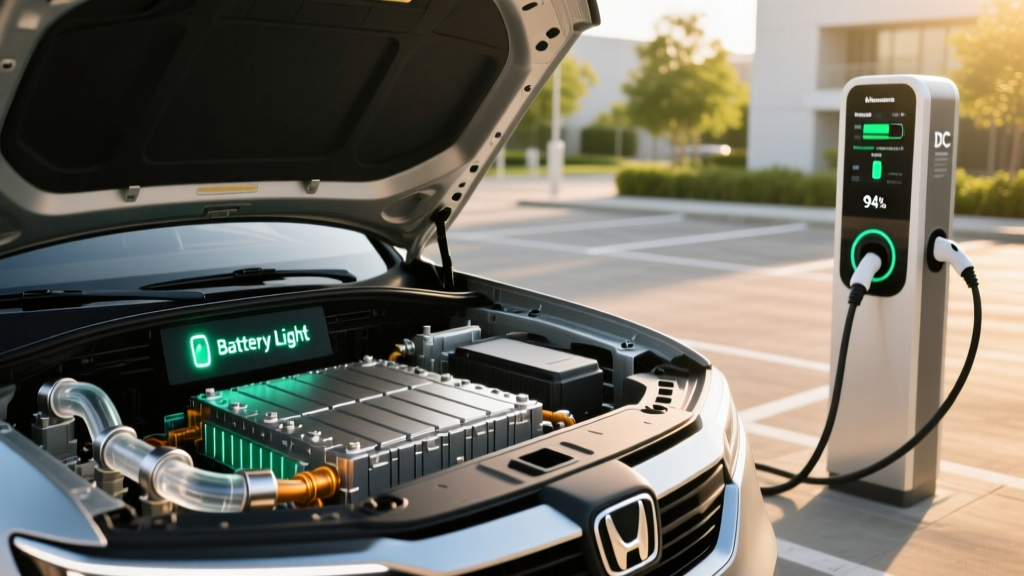
If you've seen a battery light on in Honda Pilot dashboards, you're likely dealing with a 12-volt auxiliary battery issue — not the high-voltage traction battery that powers an electric vehicle. But that warning light opens a larger question for drivers considering the shift to electrification: how long do EV batteries actually last, what happens when they degrade, and how much does replacement really cost?
This guide breaks down EV battery chemistry, real-world degradation data, warranty coverage, and care practices — the exact information you need whether you're troubleshooting a warning light or evaluating your first battery-electric purchase.
Why a Battery Light on in Honda Pilot Isn't an EV Traction Battery Warning
The Honda Pilot is a conventional internal-combustion SUV. When its battery warning lamp illuminates, the culprit is almost always the 12V lead-acid auxiliary battery or the alternator that charges it. This is a fundamentally different system from the high-voltage traction battery (typically 60–100+ kWh) that propels a battery-electric vehicle (BEV).
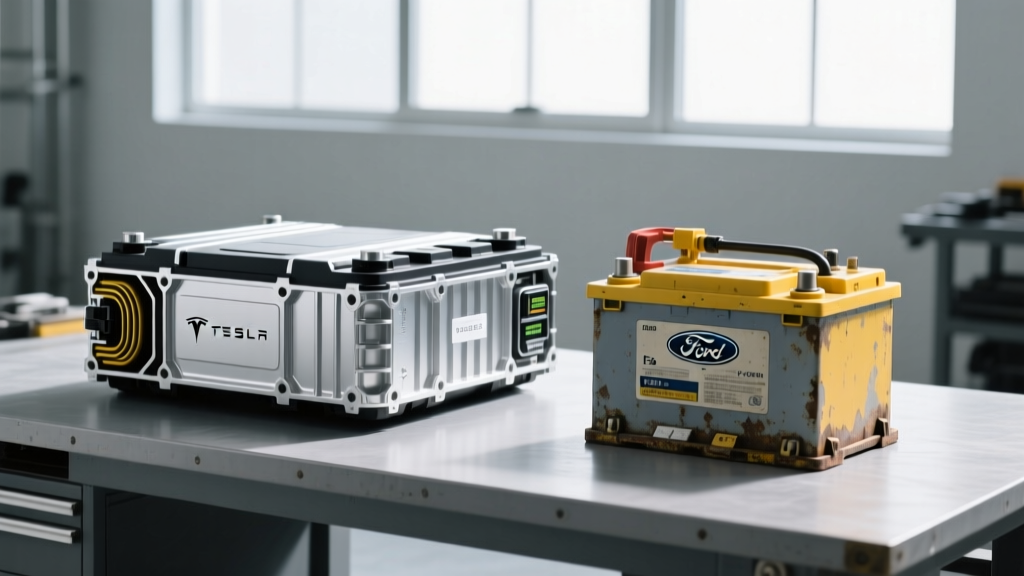
In an EV, the 12V battery still exists — it powers lights, infotainment, door locks, and control modules — but it's charged by a DC-DC converter drawing from the main traction pack, not by an alternator. A 12V failure in an EV can still strand you (the car won't "boot up" without it), but it's a $150–$300 fix, not the five-figure traction-battery replacement many drivers fear.
EV Battery Chemistry: LFP vs NMC vs NCA
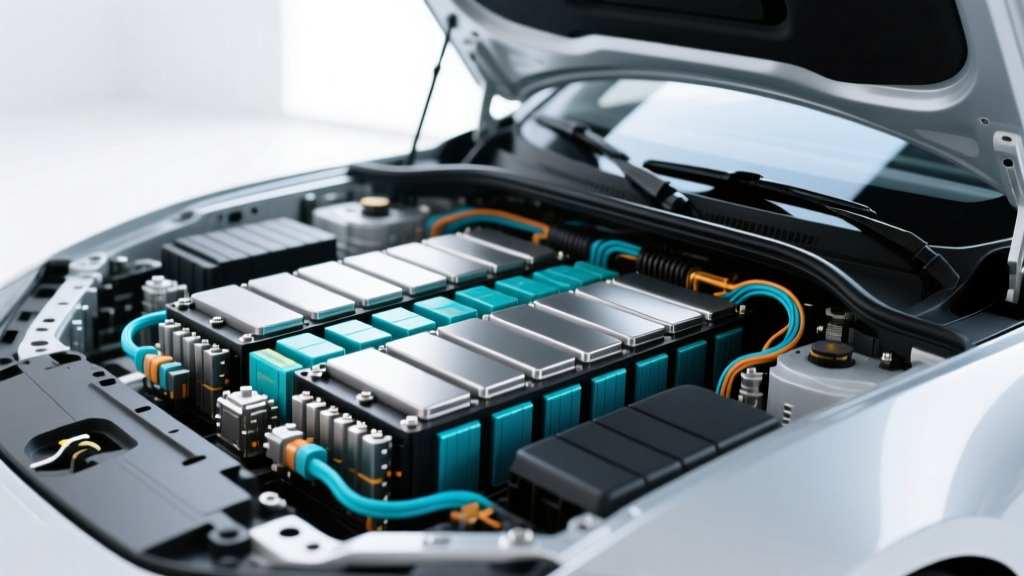
Not all EV batteries are the same. The two dominant lithium-ion chemistries in 2026 passenger EVs are LFP (lithium iron phosphate) and NMC/NCA (nickel manganese cobalt / nickel cobalt aluminum). Your choice of chemistry affects range, longevity, cold-weather performance, and price.
| Attribute | LFP (Lithium Iron Phosphate) | NMC / NCA (Nickel-based) |
|---|---|---|
| Energy density | Lower (~160–180 Wh/kg cell-level) | Higher (~220–300 Wh/kg cell-level) |
| Typical cycle life | 3,000–5,000+ cycles to 80% SoH | 1,000–2,000 cycles to 80% SoH |
| Cold-weather performance | Weaker; greater range loss below 32°F | Better low-temp discharge capability |
| Cost per kWh | Lower ($100–$130/kWh pack-level in 2026) | Higher ($130–$160/kWh pack-level) |
| Thermal stability | Excellent; less prone to thermal runaway | Good; requires robust BMS and cooling |
| Recommended daily SoC | Can charge to 100% regularly | Best kept at 80–90% daily; 100% for trips |
| Examples (2026 models) | Tesla Model 3 RWD, Ford Mustang Mach-E Select (LFP option), BYD models | Hyundai Ioniq 5, BMW iX, Rivian R1T, most long-range trims |
Which is better? If your priority is maximum range in a single charge and strong cold-weather driving, NMC/NCA remains the default. If you plan to own the vehicle for 10+ years, charge at home nightly, and want minimal degradation anxiety, LFP's superior cycle life and 100% daily charging tolerance make it the pragmatic pick — provided you can accept a slightly heavier pack or marginally lower EPA range.
How Long Do EV Batteries Actually Last?
The short answer: most EV traction batteries outlast the vehicles they're installed in. Current data from high-mileage fleets and owner-reported studies show typical capacity retention of 85–92% after 100,000 miles for liquid-cooled packs.
Here's what the degradation curve looks like in practice, drawn from aggregated fleet data and fueleconomy.gov lifecycle analyses:
| Age / Mileage | Typical Capacity Retained (NMC) | Typical Capacity Retained (LFP) |
|---|---|---|
| 1 year / 15,000 mi | 95–97% | 97–99% |
| 3 years / 45,000 mi | 91–94% | 95–97% |
| 5 years / 75,000 mi | 87–92% | 92–96% |
| 8 years / 120,000 mi | 82–88% | 89–94% |
| 10 years / 150,000 mi | 78–85% | 86–92% |
Two critical notes on this data:
- Early drop then plateau. Most lithium-ion packs lose 2–5% capacity in the first year, then degradation slows significantly. A 10% loss at 100,000 miles does not mean 20% at 200,000.
- Liquid cooling matters. Vehicles with active liquid thermal management (nearly all 2026 BEVs from major OEMs) degrade far more slowly than older air-cooled designs like the early Nissan Leaf.
What the EV Battery Warranty Actually Covers
Federal law mandates a minimum 8-year / 100,000-mile warranty on EV traction batteries for emissions-related compliance, and nearly every major automaker matches or exceeds this baseline. California Air Resources Board (CARB) states extend that to 10 years / 150,000 miles.
| Automaker | Warranty Period | Capacity Threshold |
|---|---|---|
| Tesla (Model 3/Y LFP) | 8 yr / 100,000 mi | 70% retention |
| Tesla (Model 3/Y LR, Model S/X) | 8 yr / 120,000 mi | 70% retention |
| Hyundai / Kia | 10 yr / 100,000 mi | 70% retention |
| Ford (Mustang Mach-E, F-150 Lightning) | 8 yr / 100,000 mi | 70% retention |
| GM (Ultium-based: Equinox EV, Blazer EV, Silverado EV) | 8 yr / 100,000 mi | 70% retention (some trims 60%+) |
| Rivian | 8 yr / 120,000 mi | 70% retention |
| BMW | 8 yr / 100,000 mi | 70% retention |
What triggers a warranty claim? If your pack's State of Health (SoH) drops below the stated threshold within the warranty window, the manufacturer must repair or replace it at no cost. In practice, very few packs fall below 70% within 100,000 miles — warranty claims remain rare for liquid-cooled systems. The warranty covers defects and abnormal degradation; it does not cover damage from collisions, flooding, or unauthorized modifications.
EV Battery Replacement Cost: What to Expect
Out-of-warranty traction battery replacement is the number one fear among EV shoppers. Here's what it actually costs in 2026, based on OEM parts pricing and independent shop data:
| Vehicle / Pack Size | Battery Capacity | Estimated Replacement Cost (Parts + Labor) |
|---|---|---|
| Tesla Model 3 RWD (LFP) | ~60 kWh | $12,000 – $16,000 |
| Hyundai Ioniq 5 | 77.4 kWh | $15,000 – $20,000 |
| Ford F-150 Lightning Extended Range | 131 kWh | $22,000 – $30,000 |
| Chevrolet Equinox EV | ~85 kWh | $14,000 – $18,000 |
| Rivian R1T (Large Pack) | 135 kWh | $25,000 – $32,000 |
Context matters here. Pack-level battery prices have fallen from over $1,000/kWh in 2010 to roughly $120–$150/kWh in 2026, according to BloombergNEF tracking. Module-level repairs are increasingly common: many shops can replace individual degraded modules rather than the entire pack, cutting costs by 50–70%. And because most packs retain 80%+ capacity at 150,000 miles, the vast majority of EVs are scrapped or retired for unrelated reasons (collision, body rust, electronics failure) long before the traction battery needs full replacement.
Factors That Accelerate (or Preserve) Battery Life
Battery degradation is not purely a function of time. Your charging habits and environment play a measurable role.
Practices That Preserve Battery Health
- Daily charging to 80% (NMC/NCA) or 100% (LFP). Storing an NMC pack at 100% SoC for extended periods accelerates calendar aging.
- Use Level 2 (AC) charging for daily needs. Overnight home charging at 7–11 kW generates far less heat than DC fast charging.
- Precondition the battery before fast charging. Most 2026 EVs do this automatically when a DCFC station is navigated to, warming the pack to ~95°F for optimal charge acceptance and reduced stress.
- Park in shade or a garage during extreme heat. Sustained pack temperatures above 104°F (40°C) accelerate electrolyte decomposition.
Practices That Increase Degradation
- Frequent DC fast charging (150+ kW) without preconditioning. High C-rates generate heat; doing this daily rather than on road trips measurably increases wear.
- Regularly draining below 10% SoC. Deep discharge stresses the anode; most BMS systems include a buffer, but habitual near-zero operation is unnecessary.
- Leaving the vehicle at 100% SoC in hot weather for days. High SoC + high temperature is the worst combination for calendar aging.
- Ignoring thermal management system maintenance. Coolant flushes (typically every 5 years or 75,000 miles) keep the liquid cooling loop functioning.
How to Check Your EV Battery's State of Health
State of Health (SoH) is the percentage of original capacity your pack currently holds. A new EV has 100% SoH; at 90% SoH, a 75 kWh usable pack delivers roughly 67.5 kWh.
In-vehicle methods:
- Tesla: The mobile app displays battery health under "Service" > "Battery Health" — a percentage estimate based on charge/discharge telemetry.
- Hyundai / Kia: The infotainment "EV" menu shows battery conditioning status; dealer diagnostic tools provide a precise SoH reading.
- GM (Ultium): The myChevrolet/myCadillac app includes a battery health indicator tied to OnStar diagnostics.
- Ford: FordPass provides battery state of charge; SoH requires a dealer scan tool or OBD-II reader with EV-capable software.
Third-party tools: OBD-II dongles paired with apps like Leaf Spy (Nissan), Teslalogger, or ABRP (A Better Routeplanner) telemetry can estimate SoH by comparing actual energy drawn during a full charge cycle against the pack's original rated capacity. For a definitive measurement, a dealer diagnostic scan remains the gold standard.
Emerging Battery Technology: What's Real and What's Not Yet
Several next-generation battery technologies are in development, but none are available in production passenger EVs as of 2026:
- Solid-state batteries: Toyota, Samsung SDI, and QuantumScape are targeting limited production in 2027–2029 vehicles. Promised benefits include 50%+ energy density gains, 10-minute fast charging, and improved safety. Realistic timeline for mainstream availability: 2029–2032.
- Silicon-dominant anodes: Companies like Sila Nanotechnologies and Group14 are replacing graphite anodes with silicon composites, yielding 10–20% energy density gains. Early production applications are appearing in premium models (e.g., Mercedes-Benz G-Class EV), with broader adoption expected by 2027–2028.
- Sodium-ion batteries: CATL and BYD are producing sodium-ion cells for low-cost, short-range EVs in China. Energy density is roughly 30% lower than LFP, but raw materials are cheaper and more abundant. US-market availability: 2027+ at earliest, likely in entry-level models.
For buyers shopping today, these technologies are announced and forward-looking — not available for purchase. Current LFP and NMC chemistries, paired with modern liquid-cooled thermal management, already deliver 200,000+ mile lifespans with manageable degradation.
Frequently Asked Questions
How long do EV batteries last in years and miles?
Most liquid-cooled EV traction batteries retain 80–90% of original capacity at 150,000 miles and 10+ years of service. Real-world fleet data from Tesla, Hyundai, and GM shows the degradation curve flattens significantly after the first 30,000 miles. Full pack failure before 200,000 miles is rare in modern designs.
How much does an EV battery cost to replace?
Out-of-warranty replacement ranges from roughly $12,000 for a ~60 kWh pack (Tesla Model 3 RWD) to $30,000+ for a 131 kWh pack (Ford F-150 Lightning Extended Range). Module-level repairs can cut this by 50–70%. However, the majority of EVs never need a full pack replacement — the vehicle is typically retired for other reasons first.
What does the EV battery warranty cover?
Federal minimum is 8 years / 100,000 miles. Most automakers warrant the traction battery against capacity loss below 70% of original within that window. CARB states (California, New York, Washington, and others) require 10 years / 150,000 miles. The warranty covers defects and abnormal degradation, not collision damage or unauthorized modifications. Consult the IRS §30D guidelines for how battery sourcing also affects federal tax credit eligibility.
How do I check and maximize my EV battery health?
Check SoH via your vehicle's app (Tesla, GM) or through a dealer diagnostic scan. Maximize longevity by charging NMC packs to 80% daily (100% is fine for LFP), using Level 2 AC for routine charging, preconditioning before DC fast charging, avoiding prolonged storage at 100% SoC in heat, and keeping up with coolant system maintenance.
LFP vs NMC — which battery chemistry is better?
Neither is universally "better." LFP offers longer cycle life (3,000–5,000 cycles vs 1,000–2,000), lower cost, superior thermal stability, and tolerance for daily 100% charging — but with lower energy density and worse cold-weather range. NMC delivers more range per pound and better winter performance at higher cost and with stricter SoC management needs. Choose LFP for maximum longevity and value; choose NMC for maximum range and cold-climate driving.
Is the battery light on my Honda Pilot related to EV batteries?
No. The Honda Pilot uses a conventional gasoline powertrain. Its battery warning light indicates a 12V auxiliary battery or alternator issue. In an EV, the 12V battery still powers accessories, but the high-voltage traction battery — the one discussed in this guide — is a separate system monitored through dedicated dash indicators and telematics. If your Pilot's battery light is on, have the 12V battery and alternator tested; it's typically a $150–$400 repair.
For the latest EPA range and efficiency data on specific EV models, consult fueleconomy.gov. For safety ratings, visit NHTSA.gov or IIHS.org.