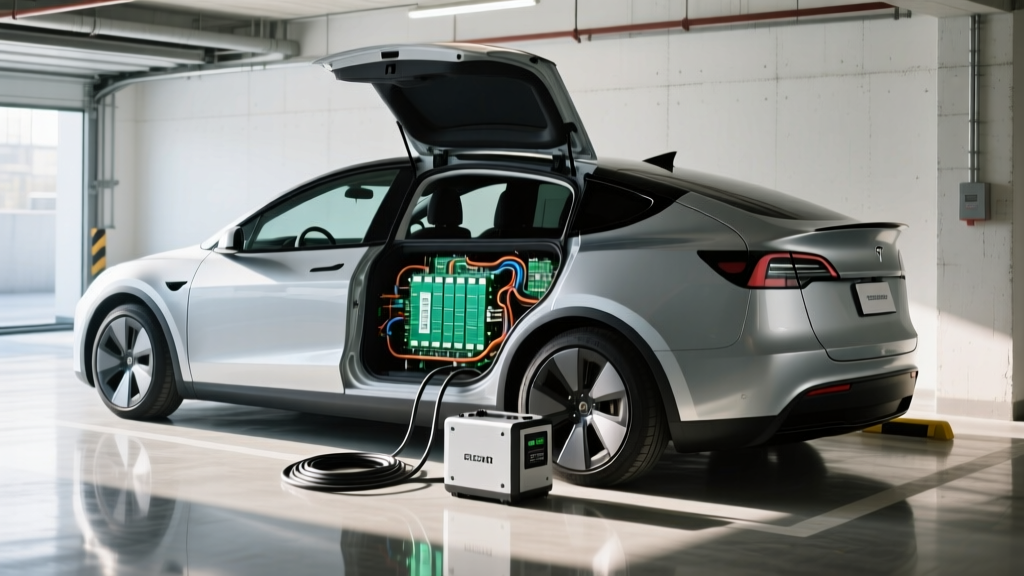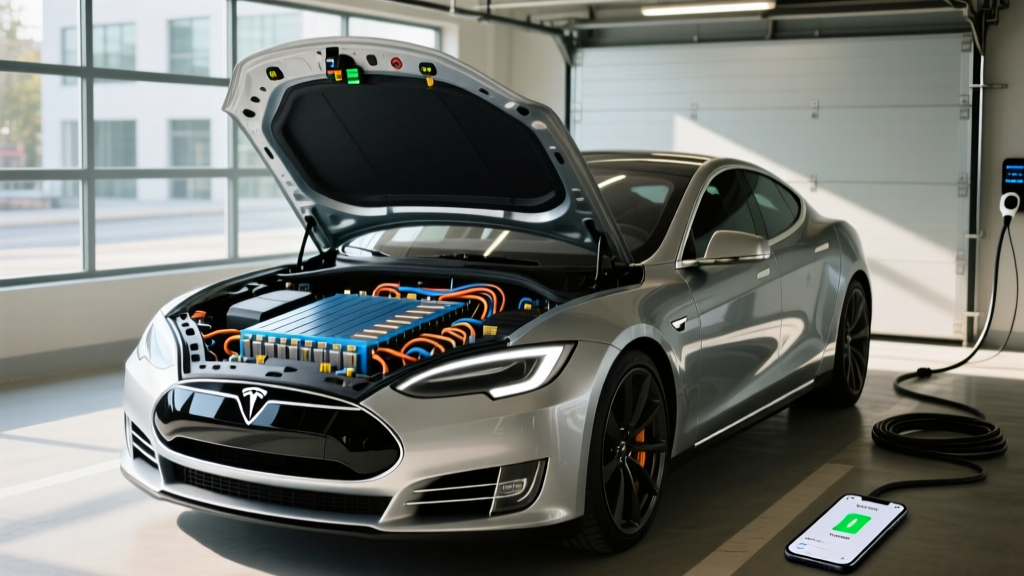
If you're researching a Tesla — whether new or used — one question dominates: how long will the battery actually last? Unlike a gas car's engine, an EV's high-voltage traction battery is its most expensive component, and its health directly determines range, performance, and resale value.
The short answer: Tesla battery packs routinely outlast 200,000 miles with meaningful capacity remaining. But the real story depends on which chemistry your Tesla uses, how you charge it, and what climate you live in. This guide breaks down the data behind battery life in Tesla vehicles across the Model 3, Model Y, Model S, and Model X lineup — with exact degradation figures, warranty terms, and replacement costs.
How Long Do Tesla Batteries Last?
Tesla's high-voltage traction battery is engineered to last the usable life of the vehicle. In Tesla's 2023 Impact Report, the company stated that Model 3 and Model Y battery packs retain approximately 88% of original capacity at 200,000 miles — meaning roughly 12% degradation over that distance. Model S and Model X data showed approximately 88% retention at 150,000 miles.
Independent fleet data corroborates this. Tesloop, a high-mileage Tesla fleet operator, reported a Model S that reached 400,000 miles with approximately 18% degradation before requiring a pack replacement. Recurrent Auto, which tracks over 15,000 Tesla vehicles in real-world conditions, has found that most Teslas lose between 5% and 10% of range in the first 50,000 miles, after which the degradation curve flattens significantly.
Typical Tesla Battery Degradation Curve
| Mileage | Approx. Capacity Retained (Model 3/Y) | Approx. Capacity Retained (Model S/X) |
|---|---|---|
| 0 miles (new) | 100% | 100% |
| 25,000 miles | ~95% | ~94% |
| 50,000 miles | ~93% | ~91% |
| 100,000 miles | ~92% | ~90% |
| 150,000 miles | ~90% | ~88% |
| 200,000 miles | ~88% | ~85% |
Sources: Tesla Impact Report, Recurrent Auto fleet data. Individual results vary based on charging habits, climate, and battery chemistry.
The takeaway: most Tesla owners will sell or trade their vehicle long before the battery reaches end-of-life. A 12% loss on a Model 3 Long Range (EPA 341 miles) still leaves roughly 300 miles of real-world range at 200,000 miles — more than adequate for daily driving and road trips.
LFP vs NMC: Which Battery Chemistry Does Your Tesla Have?
Tesla uses two distinct lithium-ion chemistries across its lineup, and the difference has a direct impact on battery life, charging habits, and cold-weather performance.
- LFP (Lithium Iron Phosphate): Used in Model 3 Rear-Wheel Drive and Model Y Rear-Wheel Drive (Standard Range). LFP cells are manufactured primarily by CATL.
- NMC/NCA (Nickel Manganese Cobalt / Nickel Cobalt Aluminum): Used in all Long Range and Performance variants of Model 3, Model Y, Model S, and Model X. Suppliers include Panasonic (NCA, produced at the Gigafactory in Nevada) and LG Energy Solution (NMC).
| Attribute | LFP (Model 3 RWD / Model Y RWD) | NMC/NCA (Long Range / Performance) |
|---|---|---|
| Energy Density | Lower (~160 Wh/kg cell-level) — slightly heavier pack for same kWh | Higher (~250-270 Wh/kg) — more range in a lighter pack |
| Cycle Life | 3,000-5,000+ cycles to 80% SoH | 1,000-2,000 cycles to 80% SoH |
| Recommended Daily Charge | 100% (Tesla recommends charging to full at least weekly) | 80% daily; 100% for trips only |
| Cold-Weather Performance | More range loss in freezing temps (~30-40% reduction) | Better cold performance (~20-30% reduction) |
| Cost | Lower — no cobalt or nickel | Higher — dependent on commodity metals |
| Typical Usable Capacity | 57.5 kWh (Model 3 RWD) | 75-100 kWh depending on model |
Which is better? It depends on your use case. LFP is the longevity champion — its cycle life is roughly 2-3x that of NMC, meaning it can endure far more charge-discharge cycles before meaningful degradation. If you drive high annual miles and charge daily, LFP is ideal. However, NMC delivers more range per kWh, charges faster in cold weather, and powers the Long Range models that road-trippers prefer. Neither is universally "better" — they serve different buyer priorities.
What Does the Tesla Battery Warranty Cover?
Tesla's battery and drive unit warranty is one of the strongest in the EV industry, covering both capacity retention and defects. Here's the breakdown by model:
| Model | Warranty Period | Mileage Limit | Minimum Capacity Retention |
|---|---|---|---|
| Model 3 Rear-Wheel Drive | 8 years | 100,000 miles | 70% |
| Model 3 Long Range / Performance | 8 years | 120,000 miles | 70% |
| Model Y Rear-Wheel Drive | 8 years | 100,000 miles | 70% |
| Model Y Long Range / Performance | 8 years | 120,000 miles | 70% |
| Model S | 8 years | 150,000 miles | 70% |
| Model X | 8 years | 150,000 miles | 70% |
What this means in practice: If your Tesla battery drops below 70% of its original capacity within the warranty period, Tesla will repair or replace it at no cost. The replacement pack may be new or reconditioned but will have at least 70% capacity. In reality, warranty claims for battery degradation are rare — Tesla's own data shows the vast majority of packs remain well above the 70% threshold at the warranty mileage limit.
The warranty also covers manufacturing defects, including cell imbalance, BMS (Battery Management System) failures, and coolant leaks that damage the pack. It does not cover damage from accidents, flooding, fire, or modifications. According to Tesla's official warranty documentation, normal wear (gradual capacity loss above 70%) is expected and not warrantable.
How Much Does It Cost to Replace a Tesla Battery?
This is the question that generates the most anxiety — and the most misinformation. Let's ground it in data.
| Model | Battery Size (Usable) | Estimated Replacement Cost | When Typically Needed |
|---|---|---|---|
| Model 3 RWD (LFP) | 57.5 kWh | $12,000 - $16,000 | Rarely before 250,000+ miles |
| Model 3 LR / Performance | 75 kWh | $14,000 - $18,000 | Rarely before 200,000+ miles |
| Model Y RWD (LFP) | 57.5 kWh | $12,000 - $16,000 | Rarely before 250,000+ miles |
| Model Y LR / Performance | 75 kWh | $14,000 - $18,000 | Rarely before 200,000+ miles |
| Model S (current gen) | 100 kWh | $18,000 - $22,000 | Rarely before 200,000+ miles |
| Model X (current gen) | 100 kWh | $18,000 - $22,000 | Rarely before 200,000+ miles |
Important context: These figures include the battery pack and labor but can vary based on whether Tesla uses a new, remanufactured, or refurbished pack. Third-party EV repair shops are increasingly offering module-level repairs for $5,000-$8,000, replacing only the degraded cell modules rather than the entire pack.
The critical point: most Tesla batteries never need replacement during the vehicle's ownership life. The average American drives roughly 14,000 miles per year (per FHWA data), meaning a Tesla would need 14+ years to reach 200,000 miles. By that time, most owners have long since upgraded. Full battery replacement is primarily a concern for high-mileage fleet vehicles, not typical consumer owners.
Factors That Affect Battery Life in Tesla Vehicles
Battery degradation is not random — it's driven by specific, controllable factors. Understanding them is the single most effective way to maximize your Tesla's battery life.
1. State of Charge (SoC) Habits
Lithium-ion batteries degrade fastest at the extremes: sitting at 100% SoC or near 0% SoC for extended periods. For NMC/NCA batteries (Long Range and Performance models), Tesla recommends setting the daily charge limit to 80% and only charging to 100% when you need maximum range for a trip. For LFP batteries (RWD models), Tesla actually recommends charging to 100% at least once per week — this is because LFP cells have a flatter voltage curve, and the BMS needs full charges to accurately calibrate SoC readings.
2. DC Fast Charging Frequency
Supercharging at 150-250 kW generates significant heat within the battery cells. While Tesla's thermal management system actively cools the pack during fast charging, frequent reliance on DC fast charging (multiple times per week over years) has been correlated with slightly accelerated degradation. Recurrent Auto's research found that Teslas that fast-charge more than 90% of the time show approximately 2-3% more degradation at 100,000 miles compared to those that primarily charge on Level 2 at home. The difference is measurable but not dramatic.
3. Extreme Temperatures
Heat is the primary enemy of lithium-ion longevity. Sustained exposure to ambient temperatures above 95°F (35°C) — particularly when combined with high SoC — accelerates chemical degradation. Tesla's liquid-cooled thermal management mitigates this, but owners in hot climates (Arizona, Texas, Southern California) may see slightly faster degradation over 10+ years. Cold weather doesn't permanently damage batteries but does temporarily reduce range by 20-40% in sub-freezing conditions due to increased internal resistance and energy used for cabin and battery heating.
4. Driving and Discharge Patterns
Aggressive acceleration and sustained high-speed driving generate more heat in the cells, contributing marginally to degradation. However, this effect is minor compared to SoC and temperature factors. Tesla's regenerative braking system actually reduces mechanical brake wear while generating modest heat in the pack — a negligible longevity factor.
Battery Care Checklist for Tesla Owners
- NMC/NCA (Long Range / Performance): Set daily charge limit to 80%. Charge to 100% only before long trips, and avoid leaving the car at 100% for more than a few hours.
- LFP (RWD models): Charge to 100% at least once per week for BMS calibration. Daily 100% charging is acceptable for LFP chemistry.
- Minimize DC fast charging when Level 2 home charging is available. Use Superchargers for road trips, not daily commuting.
- Avoid prolonged storage at low SoC. If leaving your Tesla for more than two weeks, set charge limit to 50% and plug in (the car will maintain optimal SoC).
- Use Scheduled Departure / preconditioning in extreme cold to warm the battery before driving, reducing strain and recovering regenerative braking.
- Keep Sentry Mode usage moderate in hot climates — it draws continuous power and can keep the thermal management system active.
How to Check and Monitor Tesla Battery Health
Tesla doesn't display a simple "battery health percentage" on the touchscreen the way some competitors do. But there are several reliable methods to assess your pack's State of Health (SoH):
Method 1: Range Comparison at Full Charge
Charge your Tesla to 100% (or for NMC owners, charge to your known max and extrapolate). Compare the displayed estimated range to the original EPA range for your model year and trim. For example, if your 2023 Model 3 Long Range (EPA 341 miles) displays 310 miles at 100%, that's approximately 91% SoH. Note that the displayed range is based on EPA test cycles, not your driving style.
Method 2: Tesla Service Mode (Energy Screen)
Navigate to Controls → Software → press and hold the model name to access Service Mode. The Energy screen shows detailed consumption data and, in some firmware versions, a battery health metric. This is not officially documented by Tesla and may vary by software version.
Method 3: Third-Party Apps
Apps like TeslaFi, Tessie, and Stats (iOS) pull data from the Tesla API and can track battery health trends over time. Tessie, for example, calculates SoH by comparing your battery's actual energy capacity (measured during full charge-discharge cycles) to the original factory capacity. These tools are generally more reliable than a single snapshot because they average data over weeks or months.
Method 4: OBD-II Diagnostic Tools
Devices like the OBDLink SX paired with apps such as Scan My Tesla can read cell-level voltage data, pack temperature, and BMS-reported capacity. This is the most granular method available to consumers and can identify individual weak cell modules before they cause significant range loss.
Emerging Battery Technologies: What's Next for Tesla?
Tesla's current battery lineup uses proven, mass-produced lithium-ion technology. But the company — and the broader industry — is actively developing next-generation chemistries. Here's what's on the horizon, with realistic timelines:
4680 Cells (Current Rollout)
Tesla's larger-format 4680 cylindrical cells are already in production at Giga Texas for Model Y vehicles built there. These cells use a dry-electrode manufacturing process and a structural battery pack design that reduces weight and cost. Early 4680 packs show similar or slightly improved degradation characteristics compared to 2170 cells, but long-term fleet data is still accumulating. Expect broader adoption across the lineup through 2026-2027.
Silicon Anode Technology
Replacing graphite anodes with silicon can increase energy density by 20-40%. Tesla has invested in silicon anode startups, and incremental silicon blending is already present in some current cells. Full silicon anodes face challenges with volumetric expansion during cycling, but companies like Sila Nanotechnologies and Group14 are working toward commercial viability, likely in the 2027-2030 timeframe.
Solid-State Batteries
Solid-state technology replaces the liquid electrolyte with a solid conductor, promising higher energy density, faster charging, and improved safety. Toyota, Samsung SDI, and QuantumScape are among the leaders. However, solid-state batteries remain in pre-commercial stages for automotive applications. Realistic mass-production timelines for affordable EVs are 2029-2032 at the earliest. Tesla has not announced a solid-state program, though it monitors the space closely. Per U.S. Department of Energy research, solid-state batteries have the potential to enable faster charging and longer range but face significant manufacturing cost hurdles before reaching consumer vehicles.
The practical takeaway: If you're buying a Tesla today, you're getting mature, well-understood battery technology with strong longevity data. Waiting for solid-state means waiting 5+ years for vehicles that will initially carry a premium price.
Frequently Asked Questions
How long do Tesla batteries last in years?
Based on Tesla's fleet data and independent tracking by Recurrent Auto, most Tesla batteries retain 85-90% of original capacity after 8-10 years of typical use (10,000-15,000 miles/year). The battery will remain functional well beyond the warranty period — it simply holds less energy. A 10-year-old Model 3 Long Range with 88% SoH still delivers roughly 300 miles of EPA-rated range.
Is it bad to Supercharge a Tesla every day?
Daily Supercharging is not catastrophic, but it does slightly accelerate degradation compared to Level 2 home charging. Recurrent Auto found a 2-3% difference in capacity retention at 100,000 miles between heavy Supercharger users and home-charging users. If your commute requires daily DC fast charging, the impact is modest — but home Level 2 charging at 7-11 kW is gentler on the cells and significantly cheaper per kWh.
Does cold weather permanently damage a Tesla battery?
No. Cold weather causes temporary range reduction (20-40% in sub-freezing temps) due to higher internal resistance and energy used for heating. This is not permanent degradation — range recovers as temperatures rise. However, charging a cold battery at high power without preconditioning can cause lithium plating, which is damaging. Tesla's software prevents this by limiting charge rate until the battery warms up. Always use Scheduled Departure or navigate to a Supercharger to trigger preconditioning.
Should I buy a used Tesla with high mileage?
A high-mileage Tesla with a well-maintained battery can be an excellent value. Focus on the battery's State of Health (SoH), not just the odometer. A 100,000-mile Model 3 with 92% SoH has decades of useful life remaining. Request a third-party battery health report (via Tessie or OBD-II scan) before purchase. Verify the battery warranty status — Long Range models have coverage up to 120,000 miles or 8 years, whichever comes first.
Can I upgrade my Tesla's battery to a larger capacity?
Tesla does not offer official battery upgrades for existing vehicles. Third-party shops have performed swaps in rare cases, but this voids the warranty, may cause software compatibility issues, and is not cost-effective. If you need more range, trading in for a Long Range model is the practical path.
What's the difference between the 12V battery and the high-voltage battery?
Tesla vehicles have two batteries: the high-voltage traction battery (57.5-100 kWh) that powers the motors and determines range, and a 12V auxiliary battery (lithium-ion in current models, lead-acid in older vehicles) that powers the computer, lights, and accessories. The 12V battery may need replacement every 4-6 years and costs $300-$500 — it is not the expensive traction battery discussed in this guide. Current-model Teslas use a 12V lithium-ion auxiliary battery that typically lasts the life of the vehicle.
The Bottom Line on Tesla Battery Longevity
The data is clear: battery life in Tesla vehicles is not the ownership risk many prospective buyers fear. With typical degradation of 1-2% per year under normal use, a Tesla battery will deliver 85-90% of its original range after a decade of driving. The 8-year / 100,000-150,000-mile warranty provides a strong safety net, and actual warranty claims for degradation are rare.
Choose LFP if you prioritize maximum cycle life and plan to keep the car 10+ years with daily charging. Choose NMC/NCA (Long Range) if you need maximum range per charge and better cold-weather performance. Either way, follow the SoC and charging best practices above, and your Tesla's battery will very likely outlast your ownership of the car.