That Battery Icon on Car Dashboards: Traction Pack or 12V?
Modern electric vehicles display a surprising number of dashboard warnings, and one of the most misunderstood is the battery icon on car instrument clusters. For EV owners, this symbol can trigger immediate concern about the high-voltage traction battery — the massive, expensive pack that powers the vehicle. But before you panic, it is essential to distinguish between two entirely different systems that share similar iconography.
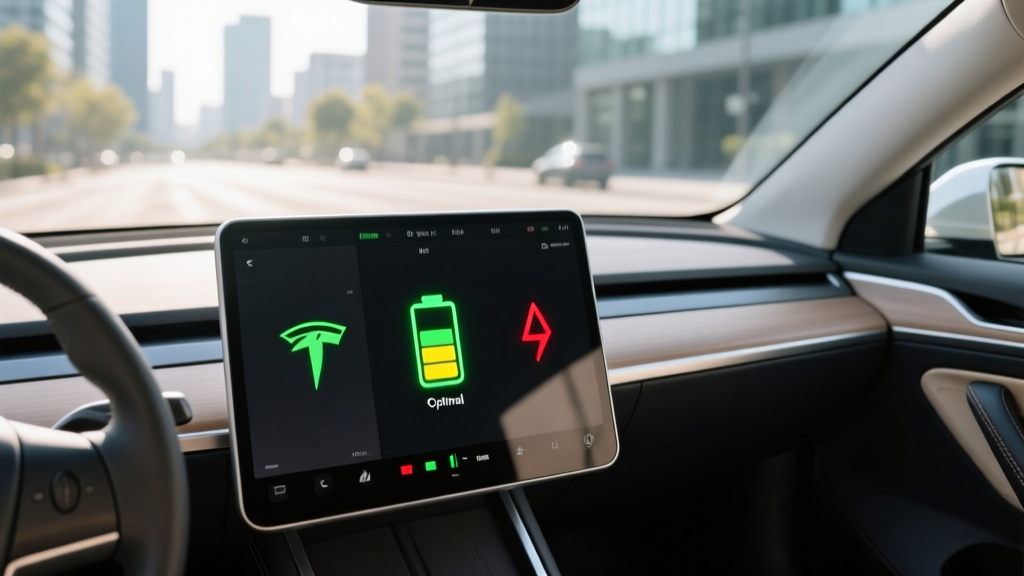
The 12V auxiliary battery warning (typically a red battery symbol with plus/minus terminals) indicates a problem with the small lead-acid or lithium 12V battery that runs the vehicle's computers, lights, and accessories. This is the same warning gas-car drivers see. A failing 12V battery can prevent an EV from starting even when the main traction pack is fully charged — a common and inexpensive fix.
The traction battery warning (often amber or red, sometimes labeled "EV System Warning," "Check EV System," or accompanied by a turtle-mode icon) signals an issue with the high-voltage battery pack or power electronics. This is the one that demands immediate attention from a certified EV technician. Depending on the manufacturer, it may indicate cell imbalance, thermal management failure, contactor issues, or a high-voltage isolation fault.
This guide focuses on the high-voltage traction battery — the component that stores between 50 and 120+ kWh of energy, determines your vehicle's range, and represents the single most expensive part of any electric vehicle. Understanding its chemistry, degradation behavior, warranty coverage, and care requirements is the most important thing an EV owner or prospective buyer can do.
EV Battery Chemistry: LFP vs NMC/NCA Explained
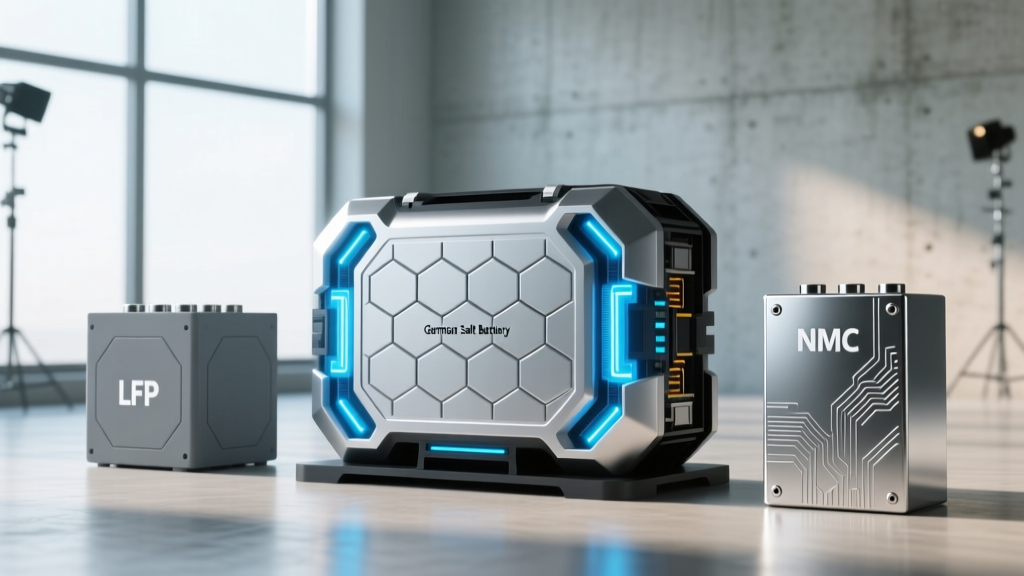
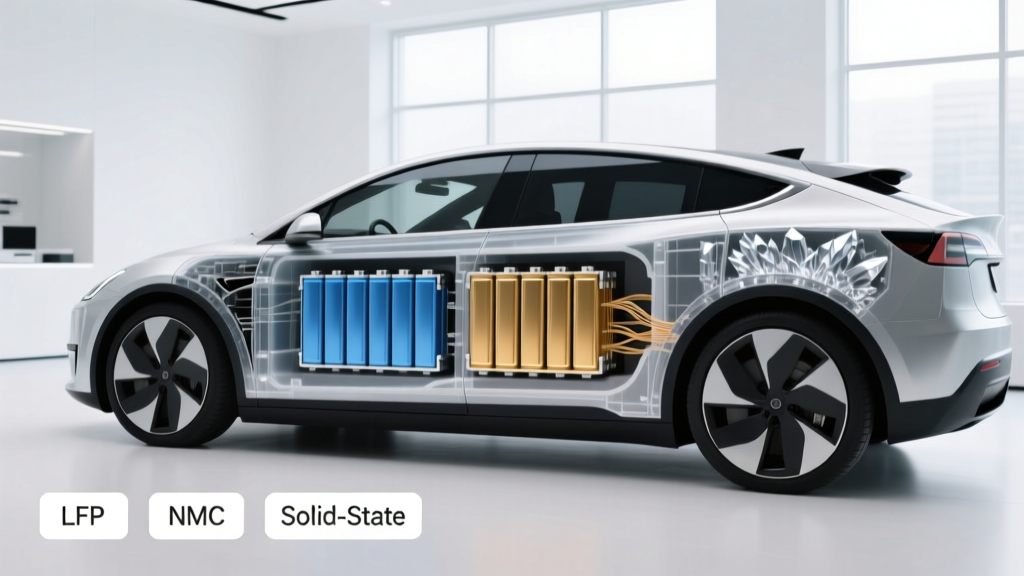
The two dominant lithium-ion chemistries in 2026 EV battery packs are LFP (lithium iron phosphate) and NMC/NCA (nickel manganese cobalt / nickel cobalt aluminum). The chemistry inside your pack fundamentally shapes your vehicle's range, longevity, charging behavior, and cost. Here is how they compare in practice:
| Attribute | LFP (Lithium Iron Phosphate) | NMC/NCA (Nickel-Based) |
|---|---|---|
| Energy Density | Lower (~150-180 Wh/kg cell-level) | Higher (~220-300 Wh/kg cell-level) |
| Typical Use | Standard-range models (Tesla Model 3 RWD, Ford Mustang Mach-E SR, base Chevy Equinox EV) | Long-range and performance models (Tesla Model Y LR, Hyundai Ioniq 5 LR, Rivian R1T) |
| Cycle Life | 3,000-5,000+ full cycles before 80% capacity | 1,000-2,000 full cycles before 80% capacity |
| Recommended Daily SoC | 100% daily charging is fine; manufacturers encourage it | 80% for daily use; 100% only before long trips |
| Cold-Weather Performance | Weaker — more range loss below freezing | Better low-temperature discharge and charge acceptance |
| Cost | Lower per kWh — no cobalt or nickel | Higher per kWh — commodity-sensitive metals |
| Thermal Stability | Superior — higher thermal runaway threshold | Good with active thermal management, but lower margin |
The practical takeaway: LFP packs sacrifice some range-per-pound for dramatically longer cycle life and simpler ownership habits (charge to 100% daily without worry). NMC/NCA packs deliver more range in a lighter, more compact package — critical for long-range and performance trims — but require more mindful charging habits to maximize longevity. Neither chemistry is universally "better"; the right choice depends on your driving patterns and range needs.
How Long Do EV Batteries Actually Last? Real Degradation Data
Battery degradation — the gradual, irreversible loss of usable capacity — is the number-one long-term concern for EV owners. The good news: real-world data from hundreds of thousands of vehicles shows that modern EV batteries degrade far more slowly than early pessimistic projections suggested.
Typical Degradation Curve (NMC/NCA Packs, 2020-2026 Models):
- Year 1 / 15,000 miles: 2-4% capacity loss (initial "break-in" degradation)
- Year 3 / 45,000 miles: 5-8% total loss
- Year 5 / 75,000 miles: 8-12% total loss
- Year 8 / 120,000 miles: 10-15% total loss
- Year 10+ / 150,000+ miles: 12-20% total loss (varies widely by use pattern)
Sources: Recurrent Auto battery health reports, Geotab fleet data analysis, manufacturer warranty thresholds.
LFP-equipped vehicles show even slower degradation in many cases. Tesla's 2025 Impact Report noted that Model 3 RWD vehicles (LFP) retained an average of 92% capacity at 100,000 miles. Hyundai/Kia's LFP-equipped models have demonstrated similarly strong retention in early fleet data.
The degradation curve is not linear. Most lithium-ion packs experience a steeper drop in the first 20,000-30,000 miles as the solid electrolyte interphase (SEI) layer forms and stabilizes on the anode. After that, degradation slows considerably, entering a long, gradual decline that can extend well beyond 200,000 miles before reaching 70-80% of original capacity.
For context: a 2026 Tesla Model Y Long Range with an EPA-rated 330 miles of range and an NMC pack might realistically show 290-300 miles of range at 80,000 miles — still more than adequate for most daily driving and road trips.
EV Battery Warranty Coverage: What Is Actually Protected
Federal law mandates that EV battery warranties cover a minimum of 8 years or 100,000 miles (whichever comes first). In California Air Resources Board (CARB) states — which include California, New York, Massachusetts, Oregon, Washington, and several others — the requirement extends to 10 years or 150,000 miles. Most major manufacturers meet or exceed these minimums, and the warranty typically guarantees that the battery will retain a specified percentage of its original capacity.
| Manufacturer | Warranty Period | Capacity Retention Threshold | Notes |
|---|---|---|---|
| Tesla (Model 3/Y) | 8 yr / 120,000 mi (LR/AWD); 8 yr / 100,000 mi (RWD) | 70% | Includes drive unit |
| Hyundai / Kia | 10 yr / 100,000 mi | 70% | Among the longest coverage |
| General Motors (Ultium) | 8 yr / 100,000 mi | 70% | Covers battery and electric propulsion components |
| Ford | 8 yr / 100,000 mi | 70% | Covers battery and unique EV components |
| Rivian | 8 yr / 175,000 mi | 70% | Higher mileage threshold for adventure use |
| BMW | 8 yr / 100,000 mi | 70% | Includes high-voltage battery and related components |
Critical detail: the 70% threshold means the manufacturer will repair or replace the battery only if its capacity drops below 70% of the original usable capacity during the warranty period. Gradual degradation above that threshold is considered normal wear and is not covered. In practice, very few modern EV batteries fall below 70% within the warranty window — the chemistry and thermal management have advanced significantly since the early Nissan Leaf era.
Warranty coverage typically includes defects in materials and workmanship, cell failures, and excessive degradation. It generally does not cover damage from accidents, flooding, improper modifications, or use of non-approved charging equipment. Always review the specific warranty booklet for your vehicle — terms vary, and some manufacturers offer extended coverage packages.
EV Battery Replacement Cost: What Owners Actually Pay
This is the question that generates the most anxiety, and it deserves an honest, data-grounded answer. Full traction battery replacement is rare — far rarer than engine or transmission replacement in ICE vehicles — but when it is needed (due to defect, damage, or extreme degradation outside warranty), the costs are significant.
| Vehicle | Battery Size (kWh usable) | Chemistry | Estimated Replacement Cost (parts + labor) |
|---|---|---|---|
| Tesla Model 3 RWD | 57.5 kWh | LFP | $12,000 - $16,000 |
| Tesla Model Y Long Range | 75 kWh | NMC | $16,000 - $22,000 |
| Hyundai Ioniq 5 Long Range | 77.4 kWh | NMC | $18,000 - $24,000 |
| Ford F-150 Lightning (Extended) | 131 kWh | NMC | $28,000 - $38,000 |
| Chevy Equinox EV | 85 kWh | NMC (Ultium) | $18,000 - $25,000 |
| Rivian R1T (Max Pack) | 141 kWh | NMC | $30,000 - $40,000 |
| Nissan Ariya | 87 kWh | NMC | $20,000 - $28,000 |
Important context: these are worst-case, full-pack replacement figures. In practice, most battery-related repairs involve replacing individual modules or addressing peripheral components (contactors, sensors, thermal management parts) at a fraction of these costs — typically $2,000-$6,000. And the vast majority of EVs will never need a traction battery replacement during their ownership life. Data from Recurrent Auto shows that fewer than 1.5% of EVs in their dataset of 15,000+ vehicles required battery replacement, and most of those were covered under warranty.
Replacement costs are also trending downward. Cell prices have fallen from over $1,000/kWh in 2010 to roughly $100-130/kWh in 2026, according to BloombergNEF. As packs become more modular and the aftermarket for refurbished packs grows, out-of-pocket costs for out-of-warranty replacements will continue to decline.
Factors That Accelerate (or Slow) Battery Degradation
Not all EV batteries age at the same rate. How you charge, drive, and store your vehicle has a measurable impact on long-term capacity retention. Here are the primary factors, ranked by impact:
Battery Care Best Practices
- State of Charge habits: For NMC/NCA packs, avoid routinely charging to 100% and sitting at full charge for extended periods. Set your daily charge limit to 80% and charge to 100% only when needed for a trip. LFP packs are exempt — charge to 100% regularly, as recommended by Tesla and other LFP-vehicle manufacturers.
- DC fast-charging frequency: Occasional DC fast charging (1-2 times per week) has minimal impact on modern, thermally-managed packs. Daily reliance on 150+ kW DC fast charging does accelerate degradation slightly — studies show an additional 1-3% loss over 100,000 miles compared to primarily Level 2 home charging. Use fast charging when you need it, but rely on Level 2 for daily charging.
- Extreme heat exposure: Sustained high battery temperatures (above 104°F / 40°C) accelerate chemical degradation. Park in shade or garages when possible in hot climates. Modern thermal management systems mitigate this, but they cannot eliminate physics.
- Extreme cold: Cold temperatures temporarily reduce available range (15-30% loss at 20°F / -7°C is typical) but do not cause permanent degradation as long as the vehicle's thermal management system is active. Avoid DC fast charging a cold-soaked battery without preconditioning — the vehicle will limit charge speed to protect the cells.
- Deep discharge: Avoid letting the battery sit at 0% or near-zero SoC for extended periods (days or weeks). If storing the vehicle, set the charge level to 50-60%.
- Preconditioning: Use your vehicle's scheduled departure or preconditioning feature to warm the battery before driving and charging in cold weather. This improves efficiency, regenerative braking availability, and charge speed.
The single most impactful habit? Avoiding sustained high SoC for NMC packs. A study published in the Journal of Energy Storage found that storing an NMC cell at 100% SoC at 40°C for one year resulted in roughly 8% capacity loss, compared to just 2% when stored at 50% SoC at 25°C. Your vehicle's battery management system (BMS) includes buffers and protections, but owner habits still matter.
Monitoring Battery Health: Checking Your State of Health (SoH)
State of Health (SoH) is the metric that tells you what percentage of the battery's original usable capacity remains available. A new EV has an SoH of 100%. If your 75 kWh pack now holds 67.5 kWh of usable energy, its SoH is 90%.
Unlike the 12V battery, there is no single standardized "battery health" gauge on every EV dashboard. Here is how owners can monitor SoH across different platforms:
- Manufacturer apps and in-car displays: Tesla's app does not display a direct SoH percentage, but you can estimate it by comparing your current maximum rated range at 100% charge against the original EPA-rated range. Hyundai's Bluelink and Kia's UVO apps on newer models provide a battery health indicator. BMW's iDrive includes a battery health readout in the service menu.
- OBD-II diagnostic tools: Third-party tools like the OBD-II adapter paired with apps such as LeafSpy (Nissan), Scan My Tesla, or ABRP's OBD integration can read detailed battery data including cell voltages, pack temperature, and estimated SoH. These tools access the vehicle's CAN bus data, which contains far more information than the dashboard displays.
- Third-party services: Companies like Recurrent Auto offer free battery health reports that compare your vehicle's range and charging data against a large fleet dataset, providing a percentile-ranked health score.
- Dealer diagnostics: During routine service visits, dealerships can run a full battery health diagnostic that provides a detailed SoH report — useful for warranty claims or pre-purchase inspections on used EVs.
A practical rule: check your SoH at least twice per year, and always before a warranty period milestone (e.g., at 95,000 miles on an 8-year/100,000-mile warranty) so you can file a claim if degradation is approaching the threshold.
The Future: Solid-State and Silicon-Anode Batteries
Next-generation battery technologies are advancing, but realistic timelines matter more than laboratory breakthroughs. Here is where things stand in 2026:
Solid-state batteries replace the liquid electrolyte with a solid material, promising higher energy density (potentially 400+ Wh/kg at the cell level), faster charging, and improved safety. Toyota has announced limited production of solid-state-equipped EVs for 2027-2028, and Samsung SDI and QuantumScape are supplying prototype cells to automakers. However, manufacturing scale, cost, and cycle-life validation remain unresolved. Widespread availability in mainstream, affordably-priced EVs is realistically 2029-2032.
Silicon-anode batteries replace the graphite anode with silicon, which can store roughly 10x more lithium ions per gram. Companies like Sila Nanotechnologies and Group14 Technologies are already supplying silicon-dominant anode materials for some 2025-2026 EV models, yielding 10-20% energy density improvements over conventional graphite anodes. This technology is here now and expanding — expect it in an increasing number of models through 2027.
Sodium-ion batteries offer a lower-cost, cobalt-free alternative for budget and urban-range EVs. CATL and BYD have begun mass production, with early deployments in Chinese-market vehicles. US-market adoption is expected in entry-level models by 2027-2028, offering 150-200 miles of range at significantly lower pack cost.
None of these technologies will require current EV owners to feel buyer's remorse. Today's lithium-ion packs are mature, reliable, and well-supported by warranty infrastructure. The next generation will offer incremental improvements, not a reason to delay a purchase if you need a vehicle now.
Frequently Asked Questions
What does the battery icon on car dashboards mean in an EV?
It depends on the specific icon and vehicle. A standard red battery symbol (with +/- terminals) typically indicates a 12V auxiliary battery issue — the same as in a gas car. An amber or red "EV System Warning," "Check EV Battery," or turtle-mode icon indicates a fault in the high-voltage traction battery or power electronics. Consult your owner's manual for your specific vehicle's iconography, and have any traction-battery warning diagnosed by a certified EV technician promptly.
How long do EV batteries last in years and miles?
Modern EV traction batteries are designed to last the life of the vehicle. Real-world fleet data shows most packs retain 85-90% of their original capacity at 100,000 miles and 80-88% at 150,000 miles. Many EVs reach 200,000+ miles on their original battery with 75-85% capacity remaining. Full replacement within the first 10 years is rare — well under 2% of vehicles based on current fleet data.
How much does an EV battery cost to replace?
Full traction battery replacement costs range from approximately $12,000 for a smaller LFP pack (e.g., Tesla Model 3 RWD) to $38,000+ for a large pack (e.g., Ford F-150 Lightning Extended Range). However, most battery-related repairs involve individual modules or components at $2,000-$6,000, and the vast majority of replacements are covered under the 8-year/100,000-mile federal warranty minimum. Cell pricing continues to decline, and refurbished pack options are expanding.
What does the EV battery warranty actually cover?
The federal minimum is 8 years or 100,000 miles (10 years / 150,000 miles in CARB states), guaranteeing the battery retains at least 70% of its original capacity. Coverage includes defects, cell failures, and excessive degradation below the threshold. It does not cover accident damage, flooding, or unauthorized modifications. Review your specific manufacturer's warranty booklet for exact terms.
LFP vs NMC — which battery chemistry is better for me?
Choose LFP if you prioritize longevity, want the simplicity of daily 100% charging, mostly drive in moderate climates, and do not need maximum range. Choose NMC/NCA if you need the longest possible range per charge, frequently drive in cold weather, or want a performance-oriented vehicle. Both chemistries are proven, reliable, and well-supported by warranty coverage.
Does frequent DC fast charging damage the battery?
On modern, thermally-managed EV battery packs, occasional DC fast charging (a few times per week) causes minimal additional degradation — studies show roughly 1-3% more capacity loss over 100,000 miles compared to exclusive Level 2 charging. Daily reliance on 150+ kW fast charging does accelerate wear slightly. For optimal longevity, use Level 2 home charging as your primary method and reserve DC fast charging for road trips and occasions when you need it.
Can I check my EV battery's health myself?
Yes, though the method varies by vehicle. You can estimate SoH by comparing your current maximum rated range at 100% charge to the original EPA-rated range. OBD-II diagnostic tools paired with apps like Scan My Tesla or LeafSpy provide detailed cell-level data. Third-party services like Recurrent Auto offer free health reports. Dealerships can run full diagnostics during service visits. Check at least twice per year and before any warranty milestone.