If a battery icon in your car's dashboard has lit up, your first instinct might be to assume the worst — a failing high-voltage pack and a five-figure repair bill. In reality, that icon can signal anything from a routine state-of-charge alert to a thermal management notification, and understanding the difference is one of the most important skills an EV owner can develop.
This guide breaks down everything you need to know about the high-voltage traction battery powering your electric vehicle: the chemistry inside it, how it degrades over time, what the warranty actually covers, what replacement costs if you ever need one, and the daily habits that determine whether your pack lasts 150,000 miles or 300,000 miles.
Decoding the Battery Icon in Your Car's Dashboard
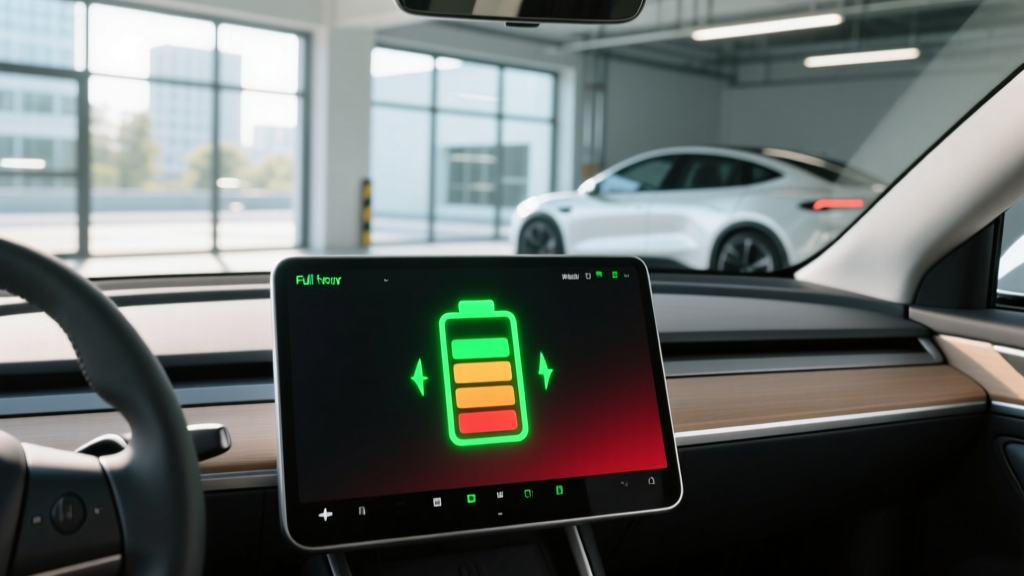
Modern EVs use a cluster of dashboard indicators to communicate battery status. Unlike a gas car's simple "check engine" light, EV battery icons carry specific meanings tied to the high-voltage traction system — the large lithium-ion pack that propels the vehicle, not the small 12V auxiliary battery that powers the infotainment and lights.
Here's what common battery-related icons typically indicate:
- Green battery icon: Normal operation, adequate state of charge (SoC).
- Yellow/amber battery icon: Reduced capacity detected, thermal management active, or SoC is low — schedule a diagnostic if it persists.
- Red battery icon with exclamation: High-voltage system fault — pull over safely and contact roadside assistance. Do not continue driving.
- Battery icon with thermometer: Battery temperature is outside optimal range; the thermal management system is preconditioning or limiting power.
- Battery icon with plug: Charge connector is not fully seated or the vehicle is plugged in — not a fault condition.
The critical distinction: these icons relate to the traction battery — typically a 50–120 kWh lithium-ion pack operating at 400V or 800V. The 12V auxiliary battery, which powers electronics and starts the vehicle's computers, has its own separate indicator and is a far more common (and cheaper) failure point.
LFP vs NMC: The Two Chemistries Powering Today's EVs
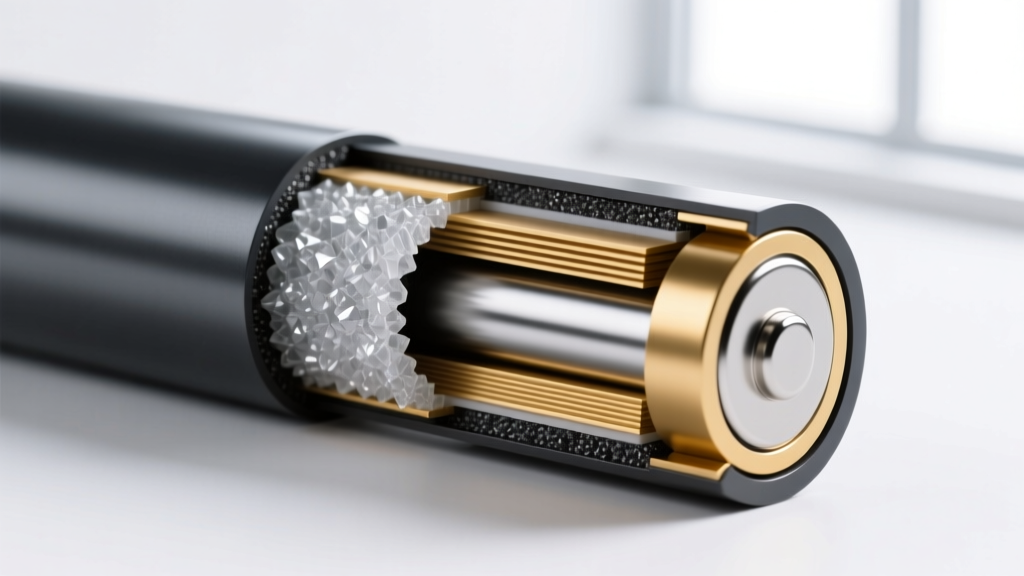
Not all EV batteries are built the same. The two dominant lithium-ion chemistries in 2026 model-year vehicles are LFP (Lithium Iron Phosphate) and NMC (Nickel Manganese Cobalt), with NCA (Nickel Cobalt Aluminum) used in some Tesla and Rivian applications. The chemistry choice affects your range, longevity, charging behavior, and even how you should charge at home.
| Attribute | LFP (LiFePO₄) | NMC / NCA |
|---|---|---|
| Energy density | ~160–200 Wh/kg (lower) | ~220–300 Wh/kg (higher) |
| Cycle life | 3,000–6,000+ cycles | 1,000–2,500 cycles |
| Cold-weather performance | Moderate — slower charge acceptance below 32°F | Better low-temp charge/discharge |
| Thermal stability | Excellent — less prone to thermal runaway | Good — requires robust BMS/cooling |
| Optimal daily SoC | 100% is fine (recommended periodically) | 20–80% for daily; 100% for trips only |
| Cost per kWh | ~$80–100 (lower) | ~$110–140 (higher) |
| Common in | Tesla Model 3/Y RWD, Ford Mustang Mach-E Select, BYD models | Long-range/performance trims, Hyundai Ioniq 5/6, Rivian, BMW iX |
| Cobalt content | None | Varies — low-cobalt formulations increasing |
Which is better? It depends on your use case. If you prioritize maximum range in a lighter package and don't mind managing charge levels, NMC delivers. If you want a battery you can charge to 100% every night without degradation worry, plan to own the car for 15+ years, or want a lower purchase price, LFP is the pragmatic pick. LFP's lower energy density means slightly less range in the same physical pack size — a Tesla Model 3 RWD with LFP gets an EPA-estimated 272 miles versus the Long Range NMC variant's 363 miles — but LFP's cycle life advantage means the pack will likely outlast the vehicle's body and chassis.
How Long Do EV Batteries Actually Last?
The fear that EV batteries need replacement every few years is one of the most persistent myths in the industry. Real-world data from millions of vehicles on the road tells a different story.
Based on fleet data from sources like Geotab's analysis of over 10,000 EVs and manufacturer-reported warranty claims, here is what typical degradation looks like:
| Vehicle Age / Mileage | Average Capacity Retained | Notes |
|---|---|---|
| Year 1 / 15,000 mi | 96–98% | Initial "break-in" loss — steepest early drop |
| Year 3 / 45,000 mi | 92–95% | Degradation rate slows significantly |
| Year 5 / 75,000 mi | 88–93% | Linear decline phase — ~0.5–1.0% per year |
| Year 8 / 120,000 mi | 84–90% | Warranty threshold period — most packs well above 70% |
| Year 10 / 150,000 mi | 80–88% | Still functional; reduced range but drivable |
| Year 15 / 200,000+ mi | 72–82% | LFP packs often still above 80%; NMC more variable |
A few important caveats: these are fleet averages. Individual results vary based on climate (extreme heat accelerates degradation more than cold), charging habits (frequent DC fast charging to 100% is harder on NMC packs), and thermal management system quality. Tesla's 2025 Impact Report noted that Model S/X vehicles showed an average of only 12% battery degradation after 200,000 miles. Hyundai/Kia's e-GMP platform vehicles have shown similarly strong retention in early data.
The bottom line: the vast majority of EV batteries will outlast the vehicle's useful economic life. According to Consumer Reports, the average EV battery should last well beyond 150,000 miles with normal use, and many will exceed 200,000 miles before falling below 70% capacity.
What the EV Battery Warranty Actually Covers
Federal law mandates that EV batteries carry a minimum warranty of 8 years or 100,000 miles (whichever comes first). In California Air Resources Board (CARB) states — which include California, Colorado, Connecticut, Maine, Massachusetts, New Jersey, New York, Oregon, Rhode Island, Vermont, Virginia, and Washington — that mandate extends to 10 years or 150,000 miles.
| Manufacturer | Warranty Period | Capacity Threshold | What Triggers a Claim |
|---|---|---|---|
| Tesla (Model 3/Y RWD — LFP) | 8 yr / 120,000 mi | 70% retention | SoH drops below 70% under normal use |
| Tesla (Model 3/Y LR/Perf — NMC) | 8 yr / 120,000 mi | 70% retention | SoH drops below 70% under normal use |
| Hyundai / Kia (e-GMP) | 10 yr / 100,000 mi | 70% retention | Measured capacity below 70% of original |
| Ford (Mach-E, F-150 Lightning) | 8 yr / 100,000 mi | 70% retention | Battery capacity below 70% of original |
| GM (Ultium platform) | 8 yr / 100,000 mi | 70% retention | Verified capacity loss exceeding 30% |
| BMW (i4, iX, i7) | 8 yr / 100,000 mi | 70% retention | Net capacity below 70% of new |
| Rivian (R1T, R1S) | 8 yr / 175,000 mi | 70% retention | Capacity below 70% — notable for higher mileage cap |
What's covered: Battery capacity loss below the stated threshold (typically 70% of original capacity), manufacturing defects, and cell/module failures. Some warranties also cover the battery management system (BMS) and associated cooling hardware.
What's NOT covered: Damage from accidents, flooding, or modifications; capacity loss from consistently ignoring manufacturer charging guidelines (though this is very difficult for a manufacturer to prove); and normal degradation above the threshold. A battery at 72% capacity at year 9 is not a warranty claim — it's a battery performing within expectations.
EV Battery Replacement Cost: What You'd Actually Pay
If your battery does fall below the warranty threshold or is damaged outside warranty coverage, replacement is the most expensive single repair an EV can require. However, context matters: full pack replacement is rare, and most out-of-warranty failures involve individual module replacement at a fraction of the cost.
| Vehicle / Pack Size | Full Pack (Parts + Labor) | Module Repair (if applicable) | Typical Replacement Trigger |
|---|---|---|---|
| Tesla Model 3 RWD (~60 kWh LFP) | $8,000–$12,000 | $2,000–$4,000 per module | Post-warranty degradation, collision damage |
| Tesla Model Y LR (~82 kWh NMC) | $12,000–$16,000 | $3,000–$5,000 per module | Cell imbalance, coolant intrusion |
| Hyundai Ioniq 5 (~77.4 kWh) | $11,000–$15,000 | $2,500–$4,500 per module | Post-warranty, manufacturing defect |
| Ford F-150 Lightning Ext. Range (~131 kWh) | $18,000–$25,000 | $3,500–$6,000 per module | Collision, flood, extreme degradation |
| Chevrolet Silverado EV (~200 kWh) | $25,000–$35,000 | $4,000–$7,000 per module | Major damage — largest consumer packs |
| Nissan Leaf (40–62 kWh) | $6,500–$9,000 | Limited module availability | Air-cooled packs degrade faster in hot climates |
Several trends are working in owners' favor. Battery pack prices have fallen roughly 80% since 2013 on a per-kWh basis. Third-party remanufacturers like Redwood Materials and Cirba Solutions are building supply chains for refurbished modules. And most critically, the vast majority of EV owners will never need a battery replacement — they'll sell or trade the vehicle long before the pack reaches end-of-life. According to data from fueleconomy.gov, modern EVs are retaining strong battery health well past the 100,000-mile mark.
Five Factors That Accelerate (or Slow) Battery Degradation
Your battery's lifespan isn't predetermined — it's heavily influenced by how you use and charge it. Here are the five factors with the greatest impact, ranked by influence:
1. Sustained high state of charge (SoC)
Storing an NMC battery at 100% SoC for extended periods accelerates electrolyte decomposition and cathode wear. For NMC packs, daily charging to 80% and reserving 100% for road trips can meaningfully extend life. LFP packs are more tolerant of 100% SoC and manufacturers actually recommend periodic full charges for accurate BMS calibration.
2. Extreme heat exposure
Sustained battery temperatures above 95°F (35°C) — whether from Arizona summers or repeated high-rate DC fast charging without adequate cooling — accelerate degradation more than equivalent cold exposure. Vehicles with active liquid cooling (Tesla, Hyundai e-GMP, GM Ultium) handle this far better than passively cooled packs (older Nissan Leaf).
3. Frequent DC fast charging at high power
Occasional DC fast charging is fine — it's built into the battery's design. But daily use of 150–350 kW chargers, especially without preconditioning the battery, stresses cells through rapid lithium-ion intercalation. Charging at home on Level 2 (7–11 kW) for daily needs and reserving DCFC for road trips is the longevity-optimal strategy.
4. Deep discharge cycles
Regularly driving the battery below 10% SoC stresses cells similarly to holding at 100%. The 20–80% range is the "happy zone" for NMC chemistry. Most modern BMS systems include a buffer — the displayed 0% isn't truly empty — but habitually running the pack to near-zero still isn't ideal.
5. Cold-weather fast charging without preconditioning
Charging a cold battery at high power can cause lithium plating on the anode — a permanent and irreversible form of degradation. Always use your vehicle's preconditioning feature (often activated by navigating to a charger in the nav system) to warm the pack before DC fast charging in cold weather.
EV Battery Care Checklist
- ☐ Set daily charge limit to 80% for NMC; 100% is fine for LFP (with periodic full charge for calibration)
- ☐ Use Level 2 home charging as your primary routine; DCFC for road trips
- ☐ Enable battery preconditioning before fast charging in cold weather
- ☐ Park in shade or a garage during sustained high-heat periods when possible
- ☐ Avoid letting SoC sit below 10% for more than a few hours
- ☐ If storing the vehicle for weeks, leave it plugged in with a 50–70% charge limit
- ☐ Keep up with BMS software updates — they often include improved charge algorithms
How to Check Your EV's Battery Health (State of Health)
State of Health (SoH) is the metric that tells you how much of your battery's original capacity remains. A new battery is at 100% SoH; a battery that held 75 kWh when new but now holds 67.5 kWh is at 90% SoH.
Here's how to check it across major platforms:
- Tesla: Not displayed natively in the app as of early 2026, but you can estimate SoH by charging to 100% and comparing the displayed range to the original EPA figure. Third-party tools like TeslaFi or Scan My Tesla (via OBD-II adapter) pull SoH directly from the BMS.
- Hyundai / Kia: Available in the infotainment system under EV → Battery → State of Health on most 2024+ models, or via the dealer diagnostic tool.
- Ford: The FordPass app shows battery health status on Mach-E and Lightning models. A more granular reading requires a dealer visit.
- GM (Ultium): The myChevrolet/myCadillac app provides battery health status. OnStar diagnostics can provide a detailed SoH report.
- Universal method: An OBD-II dongle paired with apps like Car Scanner or ABRP (A Better Route Planner) can read SoH from the BMS on most vehicles. A full charge-and-measure test — charging from a known low SoC to 100% and tracking kWh delivered — gives a practical estimate.
Most owners should check SoH twice a year and before any private-party sale. A healthy SoH reading above 90% at 50,000 miles is typical and nothing to worry about. Anything below 85% at that mileage warrants a dealer diagnostic.
What's Next: Solid-State, Silicon Anode, and Beyond
The next generation of battery technology is in active development, but it's important to separate announcements from availability.
Solid-state batteries replace the liquid electrolyte with a solid material (ceramic, sulfide, or polymer), promising higher energy density (~400+ Wh/kg), faster charging, and improved safety. Toyota has announced a commercialization target of 2027–2028 for limited production, while QuantumScape is working with Volkswagen on pilot cells. However, manufacturing scalability and cost remain unsolved challenges. Expect solid-state to appear first in premium, low-volume applications before reaching mainstream pricing — realistically 2029 or later for sub-$50,000 vehicles.
Silicon anode technology is closer to market. Companies like Sila Nanotechnologies and Group14 are supplying silicon-dominant anode materials that boost energy density by 10–20% over conventional graphite anodes. Mercedes-Benz's next-generation EQ models and some 2027 GM Ultium variants are expected to incorporate silicon anode cells. This is an incremental but meaningful improvement, not a revolution.
Sodium-ion batteries are entering production in China (CATL, BYD) for lower-range, budget EVs. They use no lithium, cobalt, or nickel — dramatically reducing material costs — but offer lower energy density (~120–160 Wh/kg). They could appear in US-market compact EVs or as stationary storage by 2028.
None of these technologies should factor into a 2026 purchase decision. Today's LFP and NMC packs are mature, well-understood, and backed by extensive warranties. Waiting for solid-state is like waiting for a hypothetical next-gen gasoline engine — the current technology already works well enough for the vast majority of drivers.
Frequently Asked Questions
How long do EV batteries last in years and miles?
Most modern EV batteries are designed to last 15–20 years or 200,000+ miles before degrading below 70–80% of original capacity. Fleet data shows an average degradation rate of roughly 1–2% per year under normal use, with LFP chemistry lasting significantly longer in cycle count terms. The battery will almost certainly outlast the rest of the vehicle.
How much does it cost to replace an EV battery?
A full pack replacement ranges from roughly $6,500 for a smaller pack (Nissan Leaf 40 kWh) to $25,000–$35,000 for the largest packs (Chevrolet Silverado EV 200 kWh). Most common mid-size packs (Tesla Model 3, Hyundai Ioniq 5) fall in the $8,000–$16,000 range including labor. However, full replacements are rare — individual module repairs cost $2,000–$7,000 and are far more common. And most owners never need either, as the battery is covered under warranty for 8–10 years.
What does the EV battery warranty cover?
Federal law requires a minimum 8-year/100,000-mile warranty on EV batteries (10 years/150,000 miles in CARB states). Coverage applies if the battery's capacity drops below a stated threshold — typically 70% of original capacity — under normal use. Manufacturing defects and BMS failures are also covered. The warranty does not cover physical damage from accidents, flooding, or unauthorized modifications.
How do I check and maximize my EV battery health?
Check State of Health (SoH) through your vehicle's app, infotainment system, or an OBD-II scanner app like Car Scanner. To maximize longevity: charge NMC to 80% daily (LFP to 100% is fine), use Level 2 home charging as your primary method, enable preconditioning before DC fast charging in cold weather, avoid prolonged storage at very high or very low SoC, and park in shade during extreme heat.
LFP vs NMC — which battery chemistry is better?
Neither is universally better. LFP offers longer cycle life (3,000–6,000+ cycles vs 1,000–2,500), better thermal safety, no cobalt, lower cost, and the convenience of 100% daily charging — but sacrifices energy density (meaning less range for the same pack weight). NMC delivers higher energy density for longer range and better cold-weather charge acceptance but requires more careful SoC management and costs more per kWh. For a commuter who charges nightly at home and wants maximum longevity, LFP is the practical choice. For road-trip-heavy drivers who need maximum range, NMC is the better fit.
Why did the battery icon light up in my car?
A battery icon on your EV dashboard can indicate several things: low state of charge, active thermal management (battery warming or cooling), a high-voltage system fault, or a charge connector issue. A green icon is normal. A yellow icon usually means the system is managing temperature or capacity is slightly reduced. A red icon with an exclamation mark means a high-voltage fault — stop driving and contact service. Always consult your owner's manual for the specific icon definitions for your vehicle, as they vary by manufacturer.