Whether you're shopping for a plug-in hybrid (PHEV), a conventional hybrid (HEV), or a full battery electric vehicle (BEV), the high-voltage traction battery is the single most expensive component in the powertrain. It's also the one buyers worry about most. The good news, backed by over a decade of real-world data, is that modern lithium-ion packs are lasting longer than most owners keep their vehicles. But understanding what's inside that pack — and what degrades it — is the difference between confident ownership and expensive surprises.
This guide breaks down the chemistry, degradation patterns, warranty protections, replacement economics, and daily habits that determine how long your battery for hybrid or EV use will actually last.
LFP vs NMC vs NCA: Which Battery Chemistry Powers Your Hybrid or EV?
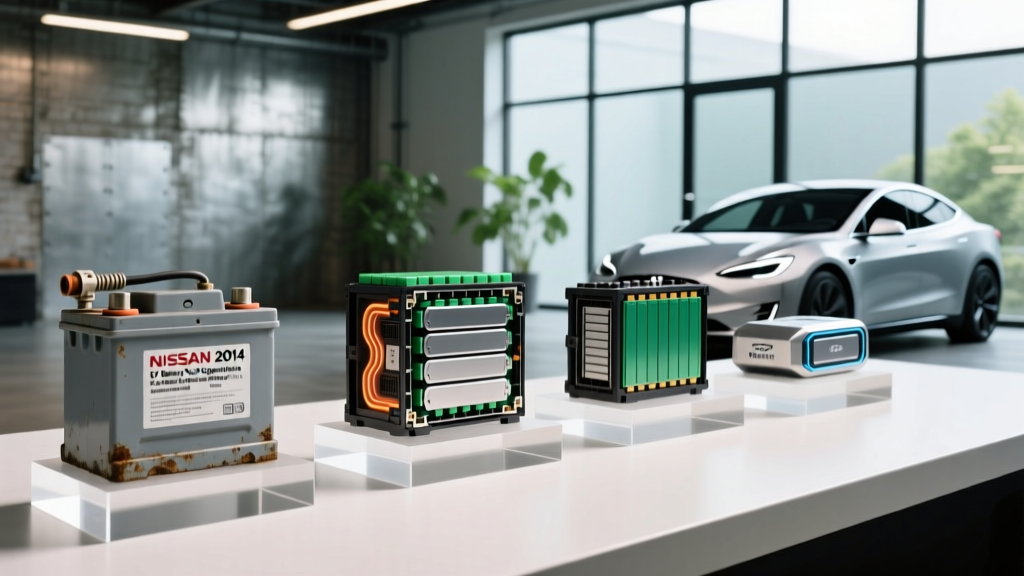
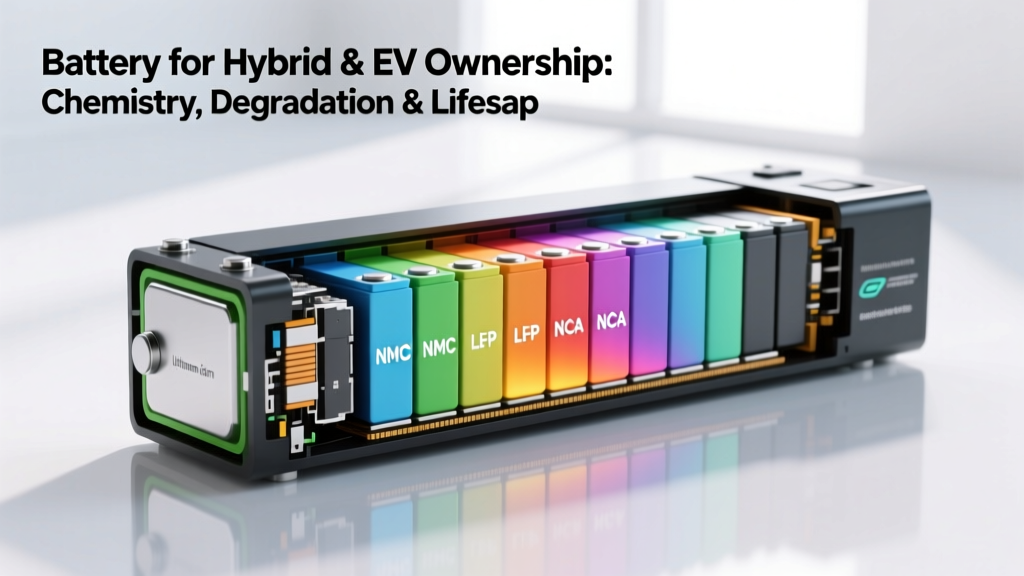
Not all lithium-ion batteries are the same. The cathode chemistry determines energy density, longevity, cold-weather behavior, and cost. In 2026, three chemistries dominate the electrified vehicle market:
- NMC (Nickel Manganese Cobalt): The mainstream choice for most BEVs and many PHEVs. Offers high energy density (more range per kilogram) but at a higher raw-material cost and slightly faster degradation at high states of charge.
- NCA (Nickel Cobalt Aluminum): Used primarily by Tesla and a few other manufacturers. Similar energy-density advantages to NMC, with slightly better thermal stability.
- LFP (Lithium Iron Phosphate): The fast-growing challenger. Lower energy density means heavier packs for the same range, but LFP delivers far longer cycle life, better thermal safety, lower cost, and tolerance for daily 100% charging.
| Attribute | LFP | NMC | NCA |
|---|---|---|---|
| Energy density (Wh/kg, cell-level) | 160–180 | 220–260 | 240–270 |
| Cycle life (to 80% SoH) | 3,000–5,000+ | 1,000–2,000 | 1,000–1,500 |
| Cold-weather performance | Moderate (greater range loss below 32°F) | Better (lower internal resistance) | Good |
| Cost per kWh (pack-level, 2026 est.) | $85–$105 | $110–$140 | $115–$145 |
| Daily charging to 100% OK? | Yes — recommended for calibration | No — 80% daily max recommended | No — 80% daily max recommended |
| Thermal runaway risk | Very low | Moderate | Moderate |
| Common in | Tesla Model 3/Y RWD, Ford Mustang Mach-E Select (LFP trims), BYD, Rivian Standard | Hyundai Ioniq 5/6, Kia EV6/EV9, VW ID.4, most PHEVs | Tesla Long Range/Performance, Lucid Air |
Which is better? It depends on your use case. If you drive a PHEV with a small 15–25 kWh pack that cycles daily and you want maximum calendar life, NMC remains common because the pack is small enough that cost is manageable and energy density matters for packaging. For a full BEV where you plan to keep the car 10+ years, LFP's cycle-life advantage is substantial — you could theoretically drive 300,000+ miles before hitting 80% capacity retention. The trade-off is slightly less range in a given vehicle footprint and more pronounced winter range loss.
How Long Do EV and Hybrid Batteries Actually Last?
The short answer: far longer than most buyers assume. Data aggregated from fleet operators, manufacturer warranty claims, and independent testing organizations like Recurrent shows that the average modern lithium-ion pack loses roughly 5–8% of its original capacity in the first two years (a phenomenon called the "initial drop"), then degrades at a much slower linear rate of approximately 1–2% per year thereafter.
Typical Degradation Curve (NMC, Moderate Climate)
| Age / Mileage | Average Capacity Retained (SoH) | Notes |
|---|---|---|
| Year 1 / 12,000 mi | 95–97% | Initial formation loss |
| Year 3 / 36,000 mi | 92–94% | Curve flattens significantly |
| Year 5 / 60,000 mi | 89–92% | Still well within warranty threshold |
| Year 8 / 96,000 mi | 85–90% | Federal warranty minimum benchmark |
| Year 10 / 120,000 mi | 82–88% | Most packs still functional for daily use |
| Year 15 / 180,000 mi | 75–85% | Noticeable range reduction but drivable |
Sources: Recurrent fleet data (2025), Geotab battery health study, manufacturer warranty claim rates. LFP packs typically retain 2–5% more capacity at equivalent age.
For PHEVs specifically, the battery for hybrid use is smaller (typically 10–25 kWh) and cycles more frequently in daily commuting. However, PHEV battery management systems (BMS) are conservative — they use a larger buffer (the difference between gross and net kWh) to protect the cells. A Toyota RAV4 Prime's 18.1 kWh pack, for example, has roughly 14.5 kWh usable, leaving a ~3.6 kWh buffer split between top and bottom. This buffer strategy is why PHEV batteries routinely outlast 150,000 miles with minimal degradation.
What Does the Battery Warranty Actually Cover?
Federal law mandates a minimum battery warranty of 8 years / 100,000 miles for all electrified vehicles sold in the US (10 years / 150,000 miles in CARB states like California, New York, and Massachusetts). But the details matter enormously.
| Manufacturer | Warranty Term | Capacity Threshold | What Triggers a Claim |
|---|---|---|---|
| Tesla (Model 3/Y LFP) | 8 yr / 120,000 mi | 70% retention | SoH below 70% as measured by Tesla diagnostics |
| Tesla (Model 3/Y LR NCA) | 8 yr / 120,000 mi | 70% retention | Same — diagnostic-verified |
| Hyundai / Kia (BEV) | 10 yr / 100,000 mi | 70% retention | Capacity below threshold per dealer scan tool |
| Toyota (PHEV/HEV) | 10 yr / 150,000 mi | Varies by model | Hybrid system malfunction or capacity loss |
| Ford (Mach-E, F-150 Lightning) | 8 yr / 100,000 mi | 70% retention | SoH below 70% per Ford diagnostic |
| GM (Ultium-platform BEVs) | 8 yr / 100,000 mi | 70% retention (60% for Bolt EUV) | Verified capacity loss below threshold |
| BMW / Mercedes (PHEV) | 8 yr / 80,000–100,000 mi | 70% retention | Capacity below threshold, dealer-verified |
Key caveats: The warranty covers defects and premature degradation — not normal wear that stays above the threshold. A pack at 71% SoH at year 7 is functioning "as designed" under warranty terms. Also, most warranties void coverage if the vehicle has a salvage title or if the battery was modified or opened by a non-authorized shop. Always check the specific language in your owner's manual or the manufacturer's warranty guide.
For the federal §30D tax credit, battery sourcing and critical-mineral requirements apply to new-vehicle purchases — not to replacement batteries. If you need a replacement battery out of warranty, it's an out-of-pocket expense, not a credit-eligible event.
How Much Does an EV or Hybrid Battery Cost to Replace?
This is the question that generates the most anxiety — and the most misinformation. Replacement is rarely needed during a vehicle's useful life, but when it is, costs vary enormously by pack size and chemistry.
| Vehicle Type | Example Models | Pack Size (kWh) | Replacement Cost (Parts + Labor) | When Typically Needed |
|---|---|---|---|---|
| HEV (conventional hybrid) | Toyota Prius, Honda Accord Hybrid | 1.0–1.8 | $2,000–$4,000 | 150,000–200,000+ mi (if at all) |
| PHEV (plug-in hybrid) | RAV4 Prime, Jeep Wrangler 4xe | 14–25 | $6,000–$12,000 | 150,000–200,000+ mi |
| BEV (standard range, LFP) | Tesla Model 3 RWD | 55–65 | $8,000–$14,000 | 200,000+ mi (rarely needed) |
| BEV (long range, NMC/NCA) | Ioniq 5, Model Y LR, EV6 | 72–84 | $12,000–$20,000 | 200,000+ mi (rarely needed) |
| BEV (large pack, luxury/truck) | F-150 Lightning Ext., Rivian R1T, Lucid Air | 100–135 | $18,000–$30,000+ | Extremely rare within vehicle life |
Costs reflect 2026 estimates including OEM or OEM-equivalent remanufactured packs plus dealer or specialist installation. Third-party repair shops and refurbished packs can reduce costs 20–40%. Module-level repair (replacing individual bad modules rather than the full pack) is increasingly available for $2,000–$6,000 on many models.
The critical context: according to data from fueleconomy.gov and warranty claim records, fewer than 2% of BEVs and PHEVs sold since 2018 have required a full battery replacement outside of warranty. The vast majority of packs outlive the vehicle's first ownership cycle. When replacements do occur, they're most often due to manufacturing defects caught under warranty — not end-of-life degradation.
Five Factors That Accelerate (or Protect) Battery Health
Your daily habits have a measurable impact on how quickly your battery for hybrid or EV use degrades. Here are the factors that matter most, ranked by impact:
Battery Care Priorities — Ranked by Impact
- 1. Extreme heat exposure (HIGH IMPACT): Sustained ambient temperatures above 95°F, especially combined with high state of charge, accelerate electrolyte decomposition. If you live in Phoenix or Las Vegas, parking in shade or a garage and avoiding charging to 100% unless needed makes a real difference. Data from Geotab shows vehicles in hot climates degrade 1.5–2x faster than those in moderate climates over 5 years.
- 2. Sustained high state of charge (HIGH IMPACT for NMC/NCA): Storing an NMC or NCA battery at 100% SoC for days at a time stresses the cathode. Set your charge limit to 80% for daily use and only charge to 100% when you need the full range for a trip. LFP owners: you can (and should) charge to 100% regularly for cell-balancing calibration.
- 3. Frequent DC fast charging (MODERATE IMPACT): Occasional fast charging is fine. But if you rely on DC fast charging (50–350 kW) as your primary charging method — say, five or more times per week — expect an additional 1–3% degradation over 5 years compared to Level 2 home charging. The heat generated during high-C-rate charging is the culprit. Modern thermal management systems mitigate this substantially, but physics still applies.
- 4. Deep discharges to near 0% (MODERATE IMPACT): Regularly running the battery below 10% SoC stresses the anode. The BMS buffer protects against true 0% (the car will stop driving before the cells are truly empty), but habitually arriving at destinations with single-digit percentages isn't ideal. Charge when you hit 15–20%.
- 5. Cold-weather fast charging without preconditioning (LOW-MODERATE IMPACT): Charging a cold battery at high power causes lithium plating on the anode — a permanent capacity loss mechanism. Always use your vehicle's preconditioning feature (or navigation-to-charger automatic preconditioning) before DC fast charging in temperatures below 40°F.
How to Check and Monitor Your Battery's State of Health
State of Health (SoH) is the percentage of original capacity your battery can still hold. A new battery is 100% SoH; a battery that held 75 kWh when new but now holds 67.5 kWh is at 90% SoH. Here's how to check it:
Method 1: In-Vehicle Diagnostics
Some manufacturers display SoH or a battery health indicator directly in the infotainment system. Nissan Leaf has long shown a "battery health bar" (though it's a rough estimate). Hyundai/Kia's infotainment systems on newer models include an EV battery health screen. Tesla does not display SoH directly in the car, but third-party apps like Tessie or TeslaFi can estimate it from charge/discharge data.
Method 2: OBD-II Dongle + App
For any OBD-II-equipped electrified vehicle (essentially all models from 2015+), an OBD-II Bluetooth dongle paired with an app like Car Scanner, ABRP (A Better Route Planner), or manufacturer-specific tools can read the BMS-reported SoH directly. This is the most accurate consumer-accessible method and costs $20–$50 for the hardware.
Method 3: Dealer Diagnostic Scan
Request a battery health report from your dealer. They can pull a detailed SoH reading, cell voltage balance data, and internal resistance measurements. Some manufacturers charge a diagnostic fee ($50–$150) if the vehicle isn't under warranty, but it's worth it before purchasing a used EV or PHEV.
Method 4: Manual Calculation
Charge to 100% (or your known max), drive until the battery is near empty, and note the kWh consumed (from the trip computer or your charger's metered data). Compare this to the original usable capacity. Example: if your Ioniq 5 originally had 72.6 kWh usable and you measure 64 kWh on a full-to-near-empty cycle, your SoH is approximately 88%. This method has ±2–3% error due to temperature and driving-style variables but requires no special equipment.
What's Next: Solid-State, Silicon Anodes, and Beyond
Next-generation battery technologies are in active development, but it's important to separate lab announcements from showroom reality:
Solid-state batteries: Toyota, Samsung SDI, and QuantumScape are targeting limited production in 2027–2029. These promise 30–50% higher energy density, faster charging (potentially 10–80% in under 10 minutes), and improved safety. However, manufacturing scalability and cost remain significant hurdles. Expect solid-state to debut in low-volume luxury or performance models before reaching mainstream pricing — likely not before 2030 for volume production.
Silicon-dominant anodes: Companies like Sila Nanotechnologies and Group14 are already shipping silicon-blend anode materials that increase energy density by 10–20%. These are appearing in limited 2026 model-year applications (notably in some premium BEVs) and will expand through 2028. This is an incremental improvement, not a revolution, but it's real and shipping.
Sodium-ion batteries: CATL and BYD have begun producing sodium-ion cells for lower-cost, lower-range applications. These are unlikely to appear in US-market vehicles before 2028–2029 due to supply-chain and regulatory timelines, but they could eventually power entry-level EVs and PHEVs at significantly lower cost.
None of these technologies should factor into a 2026 purchase decision. Today's lithium-ion packs — whether LFP or NMC — are mature, well-understood, and backed by extensive warranty coverage and real-world longevity data.
EV and Hybrid Battery FAQ
How long do EV batteries last in years and miles?
Based on fleet data from Recurrent and Geotab, the average modern EV or PHEV battery retains 85–90% of its original capacity at 8 years / 100,000 miles. Most packs remain functional well beyond 200,000 miles, though with noticeable range reduction (15–25% loss) by that point. LFP chemistries tend to outlast NMC/NCA by a meaningful margin over the same period.
How much does an EV battery cost to replace?
Full pack replacement costs range from $2,000–$4,000 for a conventional hybrid (HEV) to $12,000–$20,000 for a mainstream BEV with a 72–84 kWh pack. Large-pack vehicles (100+ kWh) can exceed $25,000. However, fewer than 2% of vehicles require out-of-warranty replacement. Module-level repair, where available, can cost $2,000–$6,000.
What does the battery warranty cover?
Federal law requires a minimum 8-year / 100,000-mile battery warranty (10/150k in CARB states). The warranty covers capacity loss below a stated threshold (typically 70% SoH) and manufacturing defects. It does not cover damage from accidents, modifications, or normal degradation that remains above the threshold.
How do I check my battery's State of Health?
The most accurate consumer method is an OBD-II Bluetooth dongle paired with an app like Car Scanner or ABRP, which reads SoH directly from the BMS. Dealer diagnostic scans provide the most detailed report. Some vehicles display health metrics in the infotainment system. Manual calculation via full-charge-to-near-empty kWh measurement is also possible with ±3% accuracy.
LFP vs NMC — which is better for my hybrid or EV?
Neither is universally "better." LFP offers longer cycle life (3,000–5,000+ cycles vs 1,000–2,000), lower cost, better safety, and tolerance for daily 100% charging — making it ideal for daily commuters who plan to keep their vehicle long-term. NMC/NCA offers higher energy density (more range in a lighter, smaller pack) and better cold-weather performance — making it better for long-range BEVs and vehicles in cold climates. For most PHEVs, NMC remains standard because the small pack size makes cost and energy density the priority.
Does fast charging damage my battery?
Occasional DC fast charging has a minimal impact on battery health. However, relying on DC fast charging as your primary method (5+ sessions per week) can add 1–3% additional degradation over 5 years compared to Level 2 home charging. The heat generated during high-power charging is the primary factor. Using your vehicle's preconditioning feature and avoiding fast charging in extreme heat helps mitigate this.
Can I replace just one bad module instead of the whole pack?
Yes, on many models. Independent EV repair shops increasingly offer module-level diagnostics and replacement for $2,000–$6,000 — a fraction of full-pack cost. This is most common on older Nissan Leafs, Chevy Bolts, and Tesla Model S/X packs with modular designs. Not all packs are easily serviceable at the module level; consult a specialist for your specific model.
For official warranty terms, consult your vehicle's warranty booklet. For tax credit eligibility on new electrified vehicle purchases, see the IRS §30D guidance. For EPA range and efficiency data, visit fueleconomy.gov.