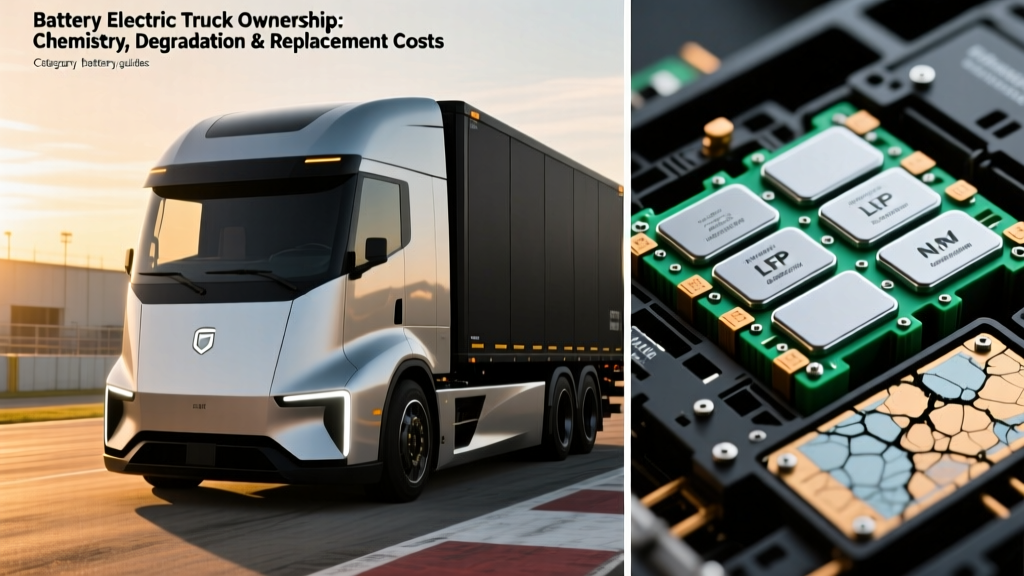
Buying a battery electric truck means committing to a high-voltage traction battery that can weigh over 1,000 pounds and store 100+ kWh of energy. That pack is the single most expensive component in the vehicle, and its health dictates range, towing capability, and resale value for a decade or more. Yet most truck shoppers focus on EPA range and towing capacity while glossing over the chemistry, degradation curve, and warranty fine print that determine long-term satisfaction.
This guide dissects what powers today's electric pickups — the Ford F-150 Lightning, Chevrolet Silverado EV, and Rivian R1T — and gives you the exact numbers on degradation, replacement cost, and daily habits that extend or shorten pack life.
What's Inside a Battery Electric Truck Pack?
A battery electric truck's traction battery is not a single cell but a pack composed of thousands of lithium-ion cells wired in series and parallel, managed by a Battery Management System (BMS). The BMS balances cell voltages, monitors temperature, and enforces charge/discharge limits to prevent damage. The usable capacity — the kWh you can actually draw — is always lower than the gross capacity because the BMS reserves a top and bottom buffer (typically 3–8%) to protect the cells.
For example, the Ford F-150 Lightning Extended Range carries a gross pack capacity of roughly 131 kWh, with about 123 kWh usable. The Rivian R1T Max Pack uses a 149 kWh gross pack. The Silverado EV 4WT tops out at a massive 200+ kWh gross pack for the longest-range commercial configurations.
LFP vs NMC: Which Chemistry Powers Electric Trucks?
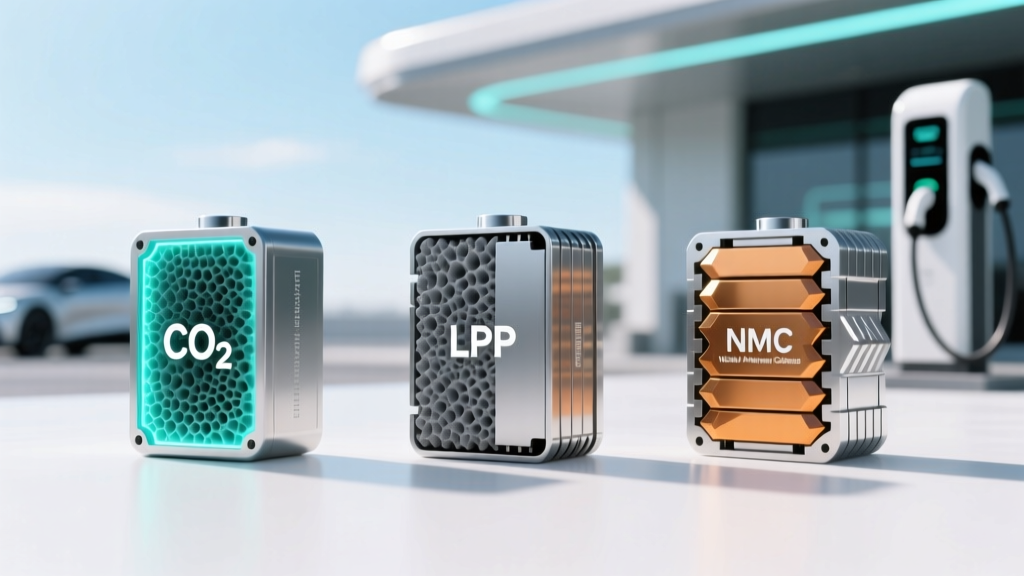
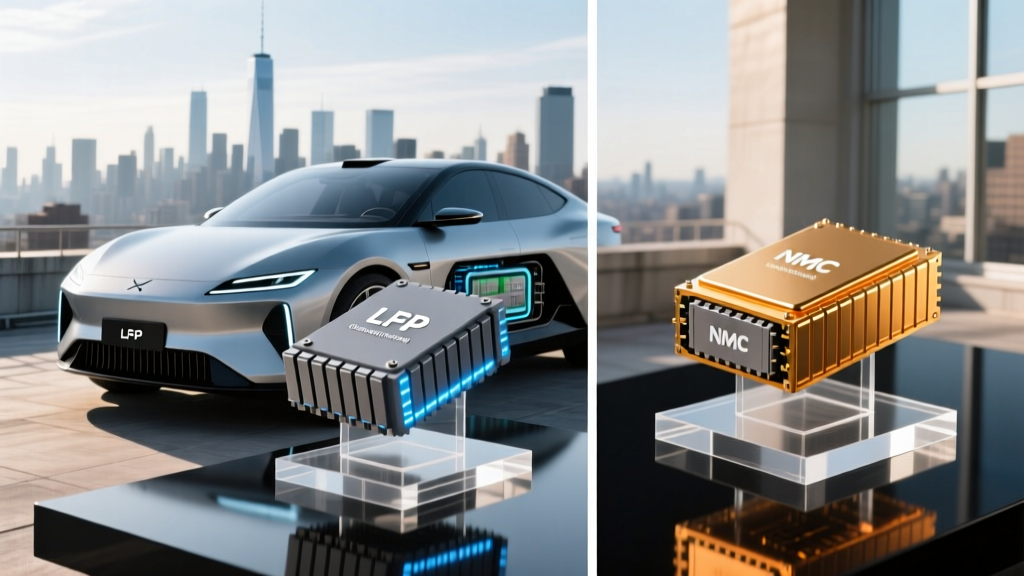
Two lithium-ion chemistries dominate today's battery electric truck market: NMC (nickel-manganese-cobalt) and LFP (lithium iron phosphate). The choice between them involves real engineering trade-offs that affect range, longevity, cold-weather behavior, and price.
| Attribute | LFP (Lithium Iron Phosphate) | NMC / NCA (Nickel-based) |
|---|---|---|
| Energy Density | Lower (~160–200 Wh/kg cell-level) | Higher (~220–300 Wh/kg cell-level) |
| Typical Truck Range Impact | Shorter range or heavier pack for same range | Longer range with lighter, more compact pack |
| Cycle Life | 3,000–5,000+ cycles to 80% capacity | 1,500–2,500 cycles to 80% capacity |
| Cold-Weather Performance | Weaker below freezing; slower charge acceptance | Better low-temp discharge and regen capability |
| Thermal Stability | Excellent; very low risk of thermal runaway | Good but requires more active thermal management |
| Cost (per kWh) | ~$90–$110 (2025–2026 pack-level) | ~$120–$145 (2025–2026 pack-level) |
| State of Charge Recommendation | Can charge to 100% daily without significant harm | Best kept at 80–90% daily; 100% for trips only |
| Current Truck Applications | Standard-range commercial vans; some future truck plans | F-150 Lightning, Silverado EV, Rivian R1T (current) |
The bottom line: If you need maximum range and towing from a battery electric truck, NMC dominates current offerings because its higher energy density lets automakers pack more kWh into a manageable footprint. LFP is attractive for fleet buyers prioritizing cycle life and lower cost over maximum range, and we expect LFP options in standard-range truck trims by the 2027–2028 model years.
How Long Do EV Batteries Last? Real Degradation Data
The most common question from battery electric truck buyers is lifespan. Based on aggregated fleet data, owner reports, and manufacturer testing, here is what degradation actually looks like in practice.
Typical EV Battery Degradation Curve (NMC packs, liquid-cooled):
- Year 1 / 15,000 miles: 2–5% capacity loss (initial break-in drop)
- Year 3 / 45,000 miles: 6–10% total loss
- Year 5 / 75,000 miles: 9–13% total loss
- Year 8 / 120,000 miles: 12–18% total loss
- Year 10 / 150,000 miles: 15–22% total loss
The curve is non-linear: the steepest drop occurs in the first year, then degradation slows to roughly 1–2% annually. Most modern liquid-cooled packs retain 75–85% of original capacity at 150,000 miles. Data from Recurrent Auto's fleet studies of over 15,000 EVs supports these ranges.
For a battery electric truck like the F-150 Lightning with an EPA-estimated 320 miles of range (Extended Range), a 15% degradation at 120,000 miles means real-world range drops from roughly 280–300 highway miles to about 240–255 highway miles. For towing a 6,000-pound trailer — where range already halves — that difference is meaningful and worth planning around.
Battery Warranty Terms: What's Actually Covered?
Federal law mandates a minimum 8-year/100,000-mile warranty on EV battery packs for emissions-related components, but manufacturers have largely adopted this as the standard coverage period for capacity retention as well. Here is how the major battery electric truck warranties compare:
| Vehicle | Warranty Period | Capacity Retention Threshold | What Triggers a Claim |
|---|---|---|---|
| Ford F-150 Lightning | 8 years / 100,000 miles | 70% of original capacity | BMS-reported SoH below 70% under diagnostic test |
| Rivian R1T | 8 years / 175,000 miles | 70% of original capacity | Verified capacity loss below threshold via Rivian service |
| Chevrolet Silverado EV | 8 years / 100,000 miles | 70% of original capacity (estimated, confirm with dealer) | Diagnostic-confirmed degradation below threshold |
Critical fine print: Warranty coverage applies to defects and excessive degradation — not to normal wear that stays above the threshold. If your pack drops to 72% capacity at year 9, you are out of luck unless you can prove a manufacturing defect. The warranty also typically excludes damage from improper charging, accidents, or modifications. Always read the specific warranty booklet for your model year, as terms can shift annually.
EV Battery Replacement Cost: What You'll Actually Pay
If your battery electric truck's pack falls outside warranty coverage and needs replacement, the cost is substantial — but full replacements remain rare. According to data tracked by fueleconomy.gov and manufacturer service bulletins, most packs outlast the vehicle's useful life. When replacement is necessary, here are the current ranges:
| Vehicle | Pack Size (Usable kWh) | Estimated Replacement Cost | Typical Replacement Scenario |
|---|---|---|---|
| Ford F-150 Lightning (Standard Range) | ~93 kWh | $15,000–$20,000 | Post-warranty failure or physical damage |
| Ford F-150 Lightning (Extended Range) | ~123 kWh | $20,000–$28,000 | Post-warranty failure or physical damage |
| Rivian R1T (Large Pack) | ~128 kWh | $20,000–$25,000 | Post-warranty; Rivian offers module-level repair |
| Rivian R1T (Max Pack) | ~141 kWh | $25,000–$35,000 | Post-warranty; limited availability of replacement packs |
| Chevrolet Silverado EV (200+ kWh) | ~200 kWh | $30,000–$40,000+ | Commercial fleet use; GM Ultium modular architecture may reduce cost |
Two factors are working in owners' favor. First, pack prices continue to decline — BloombergNEF reports average lithium-ion pack prices fell below $130/kWh in 2025, down from over $200/kWh in 2022. Second, several manufacturers (Rivian and GM among them) are developing module-level repair capabilities, where a faulty cell module can be replaced for $2,000–$5,000 rather than swapping the entire pack.
Factors That Kill (or Extend) Your Truck's Battery Life
Degradation is not purely a function of time. How you charge, drive, and store your battery electric truck has a measurable impact on how many kWh the pack holds five or ten years from now.
Battery Care Checklist for Electric Truck Owners
- Limit DC fast charging to road trips. Frequent use of 150–350 kW DC fast chargers accelerates degradation by 1–3% over the pack's life versus primarily Level 2 home charging. The F-150 Lightning can accept up to 150 kW peak (Extended Range), but sustained sessions generate significant heat.
- Set daily charge limits to 80% (NMC packs). Storing an NMC pack at 100% SoC for extended periods stresses the cathode. Use your vehicle's scheduled charging or charge-limit feature to stop at 80–90% for daily driving.
- LFP owners: charge to 100% at least weekly. LFP's flat voltage curve means the BMS needs regular full charges to accurately calibrate SoC. Not doing so can cause range estimation errors.
- Precondition the battery before fast charging. Most battery electric trucks will warm the pack to optimal temperature (~77–95°F) when you navigate to a DC fast charger. This prevents lithium plating and speeds charging. Skipping preconditioning in cold weather forces the pack to charge at drastically reduced kW.
- Avoid extended storage at 0% or 100%. If storing your truck for more than two weeks, leave the pack at 40–60% SoC in a temperature-controlled environment if possible.
- Use a heat pump and garage when possible. Extreme cold (below 20°F) temporarily reduces range by 20–30% and slows regenerative braking. A garage and preconditioning mitigate this. Extreme heat (above 100°F sustained) accelerates chemical degradation; liquid-cooled packs handle this better than passively cooled ones.
How to Monitor Battery Health (SoH) in Your Electric Truck
State of Health (SoH) is the percentage of original capacity your pack currently holds. A new pack is 100% SoH; at 70% SoH, your 320-mile EPA truck now effectively has a 224-mile ceiling.
Here is how to check it on current battery electric trucks:
- Ford F-150 Lightning: The FordPass app displays estimated range trends but does not expose a direct SoH percentage. For a precise reading, request a battery health report from a Ford EV-certified dealer. Third-party OBD-II tools like OBDLink with apps such as EVNotify or Car Scanner can read BMS-reported SoH on the Lightning.
- Rivian R1T: The Rivian app and in-vehicle display provide range estimates based on recent driving patterns but do not show SoH directly. Rivian service centers can pull a detailed battery diagnostic on request. Some owners have accessed SoH via the service menu or third-party OBD tools.
- Chevrolet Silverado EV: GM's myChevrolet app provides battery-related diagnostics. For Ultium-based trucks, GM has indicated dealer-level battery health reports will be available; confirm with your dealer for model-year specifics.
For all trucks, a practical SoH check is to fully charge to 100%, note the displayed range, and compare it to the EPA sticker (adjusted for your typical driving conditions). If your truck displayed 305 miles at 100% when new and now shows 265 miles at 100%, that's roughly a 13% degradation — consistent with 80,000–100,000 miles of typical use.
What's Next: Solid-State and Silicon-Anode Batteries
Several next-generation battery technologies are in active development, but none are available in production battery electric trucks as of 2026:
- Solid-state batteries: Toyota, Samsung SDI, and QuantumScape are targeting 2027–2030 production timelines. Solid-state cells promise 30–50% higher energy density and faster charging (potentially 10–80% in under 10 minutes). However, manufacturing scale-up remains the primary bottleneck, and initial deployment will likely appear in passenger sedans before heavy truck packs.
- Silicon-anode cells: Companies like Sila Nanotechnologies and Group14 are supplying silicon-dominant anode materials to battery makers, offering 10–20% energy-density gains over graphite anodes. These are closer to commercialization and may appear in 2027–2028 model-year trucks.
- Sodium-ion batteries: CATL and others are producing sodium-ion cells for lower-cost applications. Energy density is too low for long-range trucks, but sodium-ion could power future entry-level commercial truck variants where cost matters more than range.
These technologies are forward-looking and should not factor into a current purchase decision. Today's liquid-cooled NMC packs are mature, well-understood, and backed by real-world data spanning hundreds of thousands of miles.
Frequently Asked Questions
How long do EV batteries last in a battery electric truck?
Based on current data, a liquid-cooled NMC pack in a battery electric truck will retain 75–85% of its original capacity after 150,000 miles or 10 years. The pack is not "dead" at that point — it simply holds fewer kWh, reducing range proportionally. Many packs will serve 200,000+ miles before reaching 70% capacity.
How much does it cost to replace an EV truck battery?
Full pack replacement runs $15,000–$40,000 depending on pack size and vehicle, but most packs never need replacement during the vehicle's life. Module-level repairs, where available, cost $2,000–$5,000. Pack prices continue to decline year over year.
What does the battery warranty cover?
Federal minimum is 8 years / 100,000 miles. Most battery electric truck manufacturers guarantee the pack will retain at least 70% of original capacity during that period. The warranty covers defects and excessive degradation but not damage from misuse, accidents, or unauthorized modifications. Rivian stands out with 8 years / 175,000 miles on the R1T.
How do I check and maximize my truck's battery health?
Use OBD-II diagnostic tools or request a dealer battery health report to check SoH. To maximize longevity: charge to 80% daily (NMC), limit DC fast charging to road trips, precondition the pack before fast charging, avoid storing at extreme SoC levels, and garage the truck in extreme temperatures when possible.
LFP vs NMC — which is better for an electric truck?
For maximum range and towing in a battery electric truck, NMC is the current standard because its higher energy density allows larger kWh packs in a practical footprint. LFP offers superior cycle life (3,000–5,000 cycles vs. 1,500–2,500), lower cost, and the ability to charge to 100% daily, but its lower energy density means shorter range or a heavier pack. LFP makes sense for fleet and commercial trucks where daily routes are predictable and maximum range is less critical. As of 2026, nearly all consumer electric trucks use NMC/NCA chemistry.
Does frequent DC fast charging damage the battery?
Exclusively relying on DC fast charging can accelerate degradation by 1–3 percentage points over the pack's life compared to primarily Level 2 (7–11 kW) home charging. Modern BMS and liquid cooling mitigate this significantly, but for optimal longevity, treat DC fast charging as a road-trip tool, not a daily routine.
Can I still tow with a degraded battery?
Yes — degradation reduces range, not towing capability. A battery electric truck at 80% SoH will still deliver its rated torque and towing capacity; it just won't go as far between charges. For a Lightning Extended Range with 15% degradation towing a 6,000-lb trailer, expect roughly 100–120 miles of range instead of 120–140 miles when new.
Sources: EPA fuel economy data at fueleconomy.gov; IRS §30D tax credit guidelines for electric vehicle eligibility; manufacturer specification pages for Ford, Rivian, and General Motors.