What "Battery Charging" Actually Means for Your EV
When new EV owners search for the battery charging meaning, they're usually trying to answer a cluster of practical questions: How does charging affect my battery's lifespan? What chemistry is inside my pack? How much degradation is normal? And what happens if the battery eventually needs replacement?
This guide addresses all of those questions with real data — not marketing claims. We'll cover the two dominant battery chemistries (LFP and NMC/NCA), cite degradation figures from actual fleet data, break down federal warranty requirements, and explain the daily habits that meaningfully extend (or shorten) your battery's usable life.
First, a critical distinction: when we say "EV battery," we mean the high-voltage traction battery — the 50–120+ kWh pack that powers the drive motors. This is entirely separate from the 12V auxiliary battery that runs your infotainment, lights, and door locks. The 12V battery is inexpensive and easily replaced; the traction battery is the engineering heart of the vehicle and the focus of this guide.
LFP vs NMC/NCA: Which Chemistry Is in Your EV?
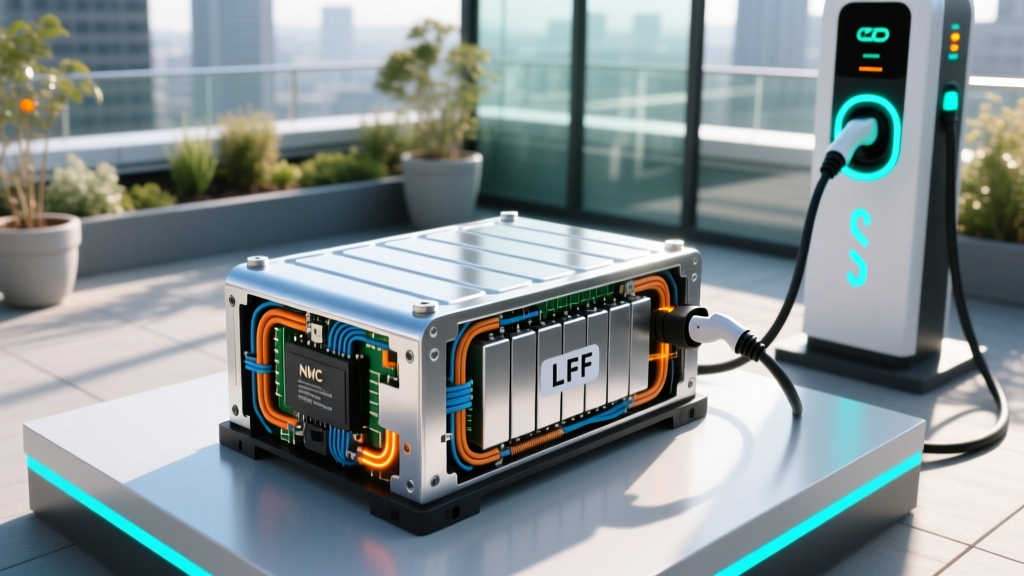
Not all EV batteries are the same. The two dominant cathode chemistries in 2026 passenger EVs are LFP (lithium iron phosphate) and NMC/NCA (nickel manganese cobalt / nickel cobalt aluminum). The chemistry inside your pack determines its energy density, cycle life, cold-weather behavior, and cost. Here's how they compare:
| Attribute | LFP (LiFePO₄) | NMC / NCA |
|---|---|---|
| Energy Density | Lower (~160 Wh/kg cell-level) | Higher (~250–300 Wh/kg cell-level) |
| Typical Cycle Life | 3,000–5,000+ cycles | 1,000–2,000 cycles |
| Cold-Weather Performance | Weaker below 32°F; slower charging | Better low-temp discharge and charge acceptance |
| Cost per kWh (2026) | ~$75–95/kWh at pack level | ~$110–140/kWh at pack level |
| Thermal Stability | Excellent — less prone to thermal runaway | Good but requires more active thermal management |
| State of Charge Recommendation | Can be charged to 100% regularly | Best kept at 80% daily; 100% for trips only |
| Common Applications (2026) | Tesla Model 3/Y RWD, Ford Mustang Mach-E Select (LFP trims), BYD models, Rivian Standard | Long-range/performance trims, Hyundai Ioniq 5/6, BMW iX, most luxury EVs |
Which is better? It depends on your use case. If you prioritize maximum range per charge, tow frequently, or live in a cold climate, NMC/NCA's higher energy density and better cold performance make it the stronger choice. If you want the longest possible cycle life, lower cost, and the simplicity of charging to 100% daily without degradation anxiety, LFP is ideal — provided you can accept slightly less range for a given pack size.
Many automakers now offer both chemistries across their lineup. Tesla, for example, uses LFP in its standard-range Model 3 and Model Y variants while reserving NMC for Long Range and Performance trims. This lets buyers choose based on their priorities rather than accepting a one-size-fits-all solution.
How Long Do EV Batteries Last? Real-World Degradation Data
The short answer: most EV traction batteries will outlast the useful life of the vehicle itself. But "outlast" doesn't mean "zero degradation." Every lithium-ion battery loses capacity over time and use. The question is how much, and how fast.
Based on fleet data from sources like Recurrent Auto and manufacturer telemetry, here's what typical degradation looks like in practice:
| Timeframe / Mileage | Typical Capacity Retention (NMC) | Typical Capacity Retention (LFP) | Notes |
|---|---|---|---|
| Year 1 / ~12,000 mi | 95–97% | 97–99% | Initial "break-in" loss; steepest part of the curve |
| Year 3 / ~36,000 mi | 90–94% | 93–97% | Degradation rate slows significantly |
| Year 5 / ~60,000 mi | 86–92% | 90–95% | Most owners barely notice the range difference |
| Year 8 / ~100,000 mi | 80–88% | 86–93% | Warranty threshold period; most packs still above 70% |
| Year 10+ / 150,000+ mi | 75–85% | 82–90% | Pack is still functional; range reduction noticeable but manageable |
Key takeaways from this data:
- Degradation is non-linear. Most capacity loss occurs in the first 12–18 months (the "break-in" period), after which the curve flattens considerably.
- LFP degrades more slowly than NMC under equivalent conditions, largely due to its more stable cathode structure.
- A pack at 80% capacity after 8 years still delivers usable range. A 300-mile EPA-rated EV at 80% health still provides ~240 miles — enough for most daily driving and road trips with brief charging stops.
- Catastrophic failure is rare. Unlike a timing belt or transmission, EV batteries rarely "die" suddenly. They fade gradually over hundreds of thousands of miles.
What Does the Battery Warranty Cover?
Federal law mandates that EV battery warranties cover a minimum of 8 years or 100,000 miles (whichever comes first) in most states, and 10 years or 150,000 miles in California Air Resources Board (CARB) states including California, New York, Massachusetts, Oregon, and Washington. This is a legal floor — some manufacturers exceed it.
The warranty doesn't cover all capacity loss. It covers degradation below a specific capacity retention threshold, typically 70% of original capacity. If your 75 kWh pack can no longer hold at least 52.5 kWh within the warranty period, the manufacturer must repair or replace it at no cost to you.
| Manufacturer (2026 Models) | Battery Warranty | Capacity Retention Threshold |
|---|---|---|
| Tesla (Model 3/Y) | 8 yr / 100,000 mi (RWD); 8 yr / 120,000 mi (LR/Perf) | 70% |
| Hyundai / Kia | 10 yr / 100,000 mi | 70% |
| Ford (Mach-E, F-150 Lightning) | 8 yr / 100,000 mi | 70% |
| BMW (i4, iX) | 8 yr / 100,000 mi | 70% |
| Rivian (R1T, R1S) | 8 yr / 175,000 mi | 70% |
| Chevrolet (Equinox EV, Blazer EV) | 8 yr / 100,000 mi | 60% (some trims 70%) |
What's covered: Battery cell defects, module failures, excessive degradation below the threshold, battery management system (BMS) faults, and thermal management system failures related to the pack.
What's typically NOT covered: Damage from accidents, flooding, or improper modifications; capacity loss from consistently ignoring manufacturer charging guidelines (though this is difficult for manufacturers to enforce); and the 12V auxiliary battery, which carries its own separate (shorter) warranty.
EV Battery Replacement Cost: What to Expect
This is the question that generates the most anxiety — and the most misinformation. Let's put it in context: the vast majority of EV batteries never need full replacement during the vehicle's ownership life. But if yours does fall below the warranty threshold or sustains physical damage, here's what the economics look like in 2026:
| Vehicle / Pack Size | Battery Chemistry | Estimated Replacement Cost (Parts + Labor) | When Typically Needed |
|---|---|---|---|
| Tesla Model 3 RWD (~60 kWh) | LFP | $8,000–$12,000 | Rarely before 200,000+ mi |
| Tesla Model Y LR (~82 kWh) | NMC | $12,000–$16,000 | Rarely before 180,000+ mi |
| Hyundai Ioniq 5 (~77.4 kWh) | NMC | $11,000–$15,000 | Rarely before 180,000+ mi |
| Ford F-150 Lightning Ext. Range (~131 kWh) | NMC | $18,000–$25,000 | Rarely before 150,000+ mi |
| Chevrolet Equinox EV (~85 kWh) | NMC | $12,000–$16,000 | Rarely before 180,000+ mi |
| Rivian R1T Max Pack (~149 kWh) | NMC | $20,000–$28,000 | Rarely before 150,000+ mi |
Several factors are working in owners' favor:
- Cell prices continue to fall. Pack-level pricing has dropped from ~$200/kWh in 2020 to roughly $85–130/kWh in 2026, and the trend continues downward.
- Module-level repair is increasingly common. Many shops can replace individual modules (a fraction of the full pack) rather than the entire assembly, cutting costs by 60–70%.
- Warranty coverage is robust. If degradation falls below the threshold within the warranty window, you pay nothing.
- Used and refurbished packs are becoming available as early EVs reach end-of-life, offering a lower-cost replacement path for older vehicles.
The realistic scenario: if you buy a new EV in 2026 and drive it for 10 years / 120,000 miles, you will almost certainly never pay for a battery replacement out of pocket. The pack will still hold 80–90% of its original capacity.
Factors That Affect Battery Life — and What You Can Control
Not all miles are created equal when it comes to battery wear. Research from the National Renewable Energy Laboratory (NREL) and real-world fleet data point to several factors that accelerate or decelerate degradation:
Fast-Charging Frequency
DC fast charging (50–350 kW) generates significant heat inside the cells. Occasional use on road trips has negligible impact, but daily fast-charging — especially at 250+ kW — accelerates degradation modestly. If you have home Level 2 access, use DCFC primarily for trips, not daily top-ups. A reasonable guideline: keep DC fast charging to 20% or fewer of your total charging sessions.
State of Charge Habits
For NMC/NCA batteries, the electrochemical stress is highest at the extremes — below 10% and above 90% SoC. The practical sweet spot is keeping your daily charge between 20% and 80%. LFP batteries are more tolerant of high SoC, and manufacturers like Tesla and BYD actually recommend periodic 100% charges for LFP packs to help the BMS calibrate cell balancing.
Temperature Extremes
Batteries degrade faster when consistently exposed to high temperatures (above 95°F ambient, or internal cell temps above 113°F). Cold temperatures (below 20°F) don't cause permanent damage but temporarily reduce range by 20–40% and slow charge acceptance. Vehicles with active thermal management (liquid cooling/heating) — which includes virtually all 2026 EVs — mitigate this substantially. If you live in a hot climate, parking in shade or a garage meaningfully extends pack life.
Depth of Discharge
Shallow cycles (e.g., using 30% of the pack daily and recharging) are gentler than deep cycles (draining from 90% to 10% regularly). This is another reason the 20–80% daily window is ideal for NMC packs.
Battery Care Checklist for Maximum Longevity
- Set your daily charge limit to 80% (NMC/NCA) or 100% (LFP — follow your manufacturer's guidance)
- Use Level 2 home charging as your primary method; reserve DCFC for road trips
- Avoid letting the pack sit at 100% SoC for extended periods — charge to 100% only when you'll drive soon after
- Don't routinely drain below 10% — charge when you hit 15–20% for daily driving
- Use preconditioning before fast-charging in cold weather (most EVs do this automatically when a charger is set in the navigation)
- Park in shade or a garage during hot weather when possible
- Keep your EV's software updated — BMS improvements are delivered over-the-air and can optimize charge profiles
- If storing the vehicle for weeks, leave SoC around 50% and plug in if possible (the vehicle will maintain the battery)
How to Check Your Battery's State of Health (SoH)
State of Health (SoH) is a percentage representing your battery's current maximum capacity relative to its original capacity when new. A brand-new pack is 100% SoH; a pack that can hold only 65 kWh of its original 75 kWh is at ~87% SoH.
Here's how to monitor it in 2026:
Manufacturer apps and in-vehicle displays. Most automakers now provide SoH estimates through their companion apps or vehicle settings. Tesla shows it indirectly via the estimated range at 100% charge (compare this to the original EPA range). Hyundai/Kia's Bluelink app provides a battery health percentage. BMW's iDrive includes a battery health readout in the service menu.
OBD-II diagnostic tools. Third-party tools like the OBDLink MX+ paired with apps such as EVNotify or Car Scanner can read the BMS directly, giving you a precise SoH figure, cell voltage variance, and pack temperature data. This is the most accurate consumer-accessible method and costs under $60 for the hardware.
Third-party services. Companies like Recurrent offer battery health reports based on your vehicle's telematics data, providing a detailed degradation curve and comparison to similar vehicles in their fleet. Some dealerships and used-EV certification programs now include a formal SoH report as part of the sale process.
The manual method. Charge your EV to 100% (on a slow Level 2 charger for accuracy), note the displayed estimated range, and compare it to the original EPA-rated range. If your 300-mile EPA vehicle now shows 265 miles at 100%, your SoH is approximately 88%. This method is imprecise (displayed range is affected by recent driving patterns and temperature) but gives a reasonable ballpark.
Emerging Battery Tech: What's Coming (and When)
Several next-generation battery technologies are in advanced development. It's important to understand their realistic timelines — none of these are available in production vehicles as of 2026:
Solid-state batteries replace the liquid electrolyte with a solid material, promising higher energy density (potentially 400+ Wh/kg at cell level), faster charging, and improved safety. Toyota has announced solid-state production for limited models around 2027–2028, and Samsung SDI targets 2027 for initial production. However, manufacturing scale-up remains a significant challenge. Expect solid-state to appear first in limited, premium applications before reaching mainstream pricing — likely not before 2030 for volume production.
Silicon-dominant anodes replace graphite anodes with silicon, which can store roughly 10x more lithium ions per unit mass. Companies like Sila Nanotechnologies and Group14 Technologies are supplying early silicon-anode materials to automakers, with initial production vehicles expected around 2027–2028. This technology can be integrated into existing manufacturing processes more easily than solid-state, making it a nearer-term improvement.
Sodium-ion batteries use abundant sodium instead of lithium, dramatically reducing material costs. CATL has begun limited production for Chinese-market vehicles. While energy density is lower than LFP (~140 Wh/kg), the cost advantage is compelling for budget EVs and stationary storage. US-market availability is likely 2028+ at the earliest.
For buyers shopping today: current lithium-ion technology (both LFP and NMC) is mature, well-understood, and backed by extensive warranty coverage. Waiting for next-generation chemistry means waiting at least 3–5 years for mainstream availability and likely paying an early-adopter premium. The batteries in 2026 EVs are already excellent.
Frequently Asked Questions
How long do EV batteries last in years and miles?
Most EV batteries retain 80–90% of their original capacity after 8–10 years and 100,000–150,000 miles. Based on fleet data, many packs remain functional well past 200,000 miles, albeit with reduced range. Catastrophic failure before the warranty period is statistically rare — well under 1% of vehicles according to manufacturer and third-party data.
How much does an EV battery cost to replace in 2026?
Full pack replacement costs range from approximately $8,000 for smaller LFP packs (e.g., Tesla Model 3 RWD) to $25,000+ for large NMC packs (e.g., F-150 Lightning Extended Range, Rivian Max Pack). However, most replacements are covered under warranty, and module-level repairs — replacing only the degraded sections — can reduce out-of-pocket costs to $2,000–$5,000 when warranty doesn't apply. Cell pricing continues to decline year over year.
What does the EV battery warranty actually cover?
Federal law requires at minimum 8 years / 100,000 miles of coverage (10 years / 150,000 miles in CARB states). The warranty covers defects and degradation below a specified capacity threshold — typically 70% of original capacity. If your battery drops below this threshold within the warranty period, the manufacturer must repair or replace it at no cost. Damage from accidents, flooding, or unauthorized modifications is excluded.
How do I check and maximize my EV battery health?
Check SoH through your manufacturer's app, an OBD-II diagnostic tool (like OBDLink MX+ with EVNotify), or by comparing your 100%-charge range to the original EPA estimate. Maximize health by charging to 80% daily (NMC) or 100% (LFP), favoring Level 2 home charging over frequent DC fast charging, avoiding prolonged storage at high SoC, and parking in moderate temperatures when possible.
LFP vs NMC — which battery chemistry is better for me?
Choose LFP if: you want the longest cycle life, plan to keep the vehicle 10+ years, prefer the simplicity of daily 100% charging, live in a mild climate, and can accept slightly less range per kWh. Choose NMC/NCA if: you need maximum range, tow heavy loads, regularly drive in sub-freezing temperatures, or want the fastest DC charging speeds. Both chemistries are proven and reliable — neither is a wrong choice.
Does fast charging damage my EV battery?
Occasional DC fast charging has a negligible effect on battery health. However, daily use of 150–350 kW chargers generates sustained heat that modestly accelerates degradation over time. For optimal longevity, use Level 2 (7–19 kW) for daily charging and reserve DCFC for road trips. Most modern EVs have sophisticated thermal management that preconditions the battery before fast charging, significantly reducing heat stress.
What is the battery charging meaning in terms of kW vs kWh?
kW (kilowatts) measures the rate of energy flow — think of it as the "speed" of charging. kWh (kilowatt-hours) measures total energy stored — think of it as the "size" of the battery. A 75 kWh battery charged at 11 kW (Level 2) takes roughly 7 hours from empty to full. That same battery charged at 150 kW (DCFC) can go from 10% to 80% in about 20–25 minutes, depending on the charge curve. Understanding this distinction is essential for evaluating both your EV's range and its charging speed.
For official warranty details and tax credit eligibility related to battery sourcing requirements under the §30D federal credit, consult IRS.gov's clean vehicle credits page. For efficiency and range data on specific models, the EPA's fueleconomy.gov database remains the authoritative source.