The Companies Behind Your EV's Most Expensive Component
The high-voltage traction battery pack represents 30–40% of an electric vehicle's total manufacturing cost. Yet most buyers focus on the badge on the hood rather than the company that built the cells inside. Understanding which automotive battery manufacturers supply your EV — and what chemistry they use — directly impacts the range you'll see on a cold January morning, how quickly the pack degrades over a decade, and what you'll pay if something goes wrong out of warranty.
As of 2026, the global EV cell market is dominated by a handful of manufacturers, each with distinct chemistry strategies, energy-density targets, and supply-chain footprints. This guide breaks down who makes what, the real engineering trade-offs between LFP and NMC/NCA chemistries, what degradation data actually shows, and how to monitor and maximize the lifespan of your pack.
Major Automotive Battery Manufacturers in 2026
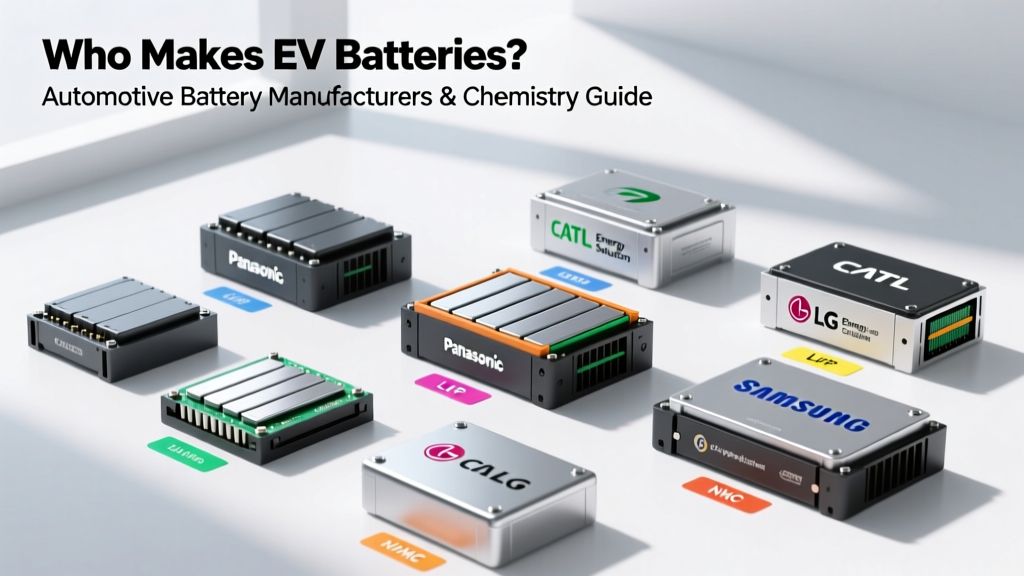
The EV battery supply chain has consolidated around several key players. Here's who supplies whom and what chemistries they favor:
- CATL (Contemporary Amperex Technology Co. Limited) — Headquartered in Ningde, China, CATL is the world's largest EV battery maker by volume. They supply Tesla (Model 3/Y Standard Range with LFP), BMW, Volkswagen, Hyundai, and others. CATL pioneered the cell-to-pack (CTP) architecture and produces both LFP and NMC cells. Their Shenxing LFP cells support 4C fast charging (10–80% in roughly 10 minutes under optimal conditions).
- LG Energy Solution — South Korea-based LGES supplies General Motors (Ultium platform), Ford, Hyundai/Kia, Stellantis, and previously Tesla. They specialize in NMC pouch and cylindrical cells with high nickel content (NCMA — nickel, cobalt, manganese, aluminum). Their joint venture Ultium Cells with GM produces packs for the Chevrolet Silverado EV, Cadillac Lyriq, and GMC Hummer EV.
- Panasonic Energy — Panasonic remains Tesla's longest-standing cell partner, producing 2170-format NCA (nickel-cobalt-aluminum) cylindrical cells at the Gigafactory Nevada. They also supply the 4680-format cells for the Cybertruck and refreshed Model Y. Panasonic is known for industry-leading energy density and low defect rates.
- BYD (Build Your Dreams) — The Chinese automaker-battery maker vertically integrates its own Blade Battery (LFP in a cell-to-pack configuration). BYD also supplies Tesla for certain European-market Model Y vehicles and has begun external supply agreements with Toyota and Kia. The Blade Battery's structural design improves pack-level safety and thermal stability.
- SK On — A subsidiary of South Korea's SK Innovation, SK On supplies Ford (F-150 Lightning, Mustang Mach-E), Hyundai, and Mercedes-Benz. They focus on NMC pouch cells and are scaling production through the BlueOval SK joint venture with Ford in Kentucky and Tennessee.
- Samsung SDI — Supplies BMW, Rivian, and Stellantis with NMC prismatic and cylindrical cells. Samsung SDI is investing heavily in solid-state battery pilot lines, though commercial production remains years away.
The key takeaway: your EV's brand doesn't make its cells. A Tesla Model 3 Standard Range uses CATL LFP cells, while a Long Range uses Panasonic NCA or LG NMC cells depending on the production batch. A Ford F-150 Lightning uses SK On NMC pouches. Knowing the cell supplier and chemistry tells you more about long-term behavior than the automaker's marketing.
LFP vs NMC/NCA: Chemistry Trade-Offs That Matter
Lithium iron phosphate (LFP) and nickel-manganese-cobalt / nickel-cobalt-aluminum (NMC/NCA) are the two dominant cathode chemistries in 2026 EVs. Neither is universally "better" — the right choice depends on your driving patterns, climate, and ownership timeline.
| Attribute | LFP (Lithium Iron Phosphate) | NMC / NCA (Nickel-based) |
|---|---|---|
| Energy Density (cell-level) | 160–180 Wh/kg | 230–300 Wh/kg |
| Typical EPA Range (same vehicle platform) | ~10–15% less than NMC variant | Higher range per kWh of pack weight |
| Cycle Life | 3,000–5,000+ full cycles to 80% SoH | 1,000–2,000 full cycles to 80% SoH |
| Cold-Weather Performance | More range loss below 32°F (~30–40% loss at 0°F) | Better cold performance (~20–30% loss at 0°F) |
| Recommended Daily Charge Limit | 100% (no degradation penalty) | 80% for daily use; 100% only for trips |
| Thermal Stability / Safety | Excellent — higher thermal runaway threshold | Good — requires more active thermal management |
| Cost per kWh (pack-level) | ~$90–$110 | ~$120–$150 |
| Cobalt Content | None | Low (NMC 811) to moderate (NMC 532) |
| Common In 2026 Models | Tesla Model 3/Y RWD, BYD lineup, base Ford Mustang Mach-E, Rivian Standard | Tesla LR/Performance, GM Ultium, Hyundai Ioniq 5/6 LR, Kia EV6/EV9, F-150 Lightning Extended |
The practical decision framework: If you primarily commute under 80 miles daily, can charge at home, and live in a moderate climate, LFP offers superior longevity and the convenience of charging to 100% every day without guilt. If you need maximum range, frequently road-trip in cold weather, or tow, NMC/NCA's energy density and cold-weather advantage justify the higher cost and stricter charge-limit discipline.
One nuance often missed: LFP cells have a very flat voltage curve, which makes state-of-charge estimation harder for the battery management system (BMS). This means your range estimate may fluctuate more than with NMC, and the BMS occasionally needs a full 100% charge to recalibrate. This is normal and not a defect.
Battery Degradation: What the Data Actually Shows
EV battery degradation follows a non-linear curve: a steeper initial drop in the first 1–2 years (roughly 2–5%), then a long, slow linear decline. Most modern packs are engineered to retain 70–80% of original capacity after 150,000–200,000 miles.
Observed Degradation Benchmarks (aggregated fleet data):
- Tesla Model 3/Y (NMC/NCA, Panasonic/LG): ~5% loss at 50,000 miles, ~8–10% loss at 100,000 miles, ~12–15% at 150,000 miles. Tesla's 2025 Impact Report states average fleet data shows approximately 85% capacity retention at 200,000 miles. (Source: Tesla Impact Report)
- Chevrolet Bolt EV/EUV (NMC, LG Chem): Earlier model years (2017–2019) experienced some packs with higher-than-expected degradation and recall-related replacements. Post-recall replacement packs and 2022+ models show ~7–10% loss at 80,000 miles.
- Hyundai Ioniq 5 / Kia EV6 (NMC, SK On): Fleet data suggests ~4–6% loss at 50,000 miles. Hyundai's battery management is conservative, limiting usable capacity buffer to protect longevity.
- LFP packs (CATL Blade, BYD): Early fleet data from high-mileage taxi and ride-hail vehicles in China shows 5–8% loss at 100,000 miles, with projections of 80%+ retention at 300,000 miles due to the chemistry's superior cycle life.
The critical insight: degradation is measured in cycles and calendar age, not just miles. A vehicle that is 8 years old with 40,000 miles may show similar capacity loss to one that is 4 years old with 80,000 miles. Calendar degradation — caused by electrolyte decomposition and solid-electrolyte interphase (SEI) layer growth — happens regardless of use.
Battery Warranty Terms: What's Actually Covered
Federal law mandates that EV batteries carry a minimum warranty of 8 years or 100,000 miles (whichever comes first). In California Air Resources Board (CARB) states, the requirement extends to 10 years or 150,000 miles. Most manufacturers meet or exceed these minimums, but the details matter.
| Manufacturer | Warranty Period | Capacity Retention Threshold | Notes |
|---|---|---|---|
| Tesla (Model 3/Y RWD — LFP) | 8 yr / 100,000 mi | 70% | Covers defects and capacity below threshold |
| Tesla (Model 3/Y LR/Perf, S/X) | 8 yr / 120,000 mi (S/X: 150,000 mi) | 70% | Longer mileage for larger packs |
| Hyundai / Kia | 10 yr / 100,000 mi | 70% | Among the longest coverage periods |
| General Motors (Ultium) | 8 yr / 100,000 mi | 70% | Covers battery and electric propulsion components |
| Ford | 8 yr / 100,000 mi | 70% | Covers high-voltage battery and BEV components |
| BMW | 8 yr / 100,000 mi | 70% | Transferable to subsequent owners |
| Rivian | 8 yr / 175,000 mi (R1T/R1S) | 70% | Higher mileage threshold reflects truck use case |
| Volkswagen (ID.4) | 8 yr / 100,000 mi | 70% | Net usable capacity below threshold triggers claim |
What the warranty covers: Defects in materials or workmanship, and capacity loss below the stated retention threshold (typically 70% of original net kWh). If your 82 kWh pack drops below ~57.4 kWh of usable capacity within the warranty window, the manufacturer will repair or replace modules or the full pack to bring it above the threshold.
What it doesn't cover: Gradual degradation above the threshold, damage from accidents, improper charging equipment, unauthorized modifications, or using the vehicle as a stationary power source beyond V2L/V2H specifications. Read your specific warranty booklet — terms vary.
EV Battery Replacement Cost: Realistic Numbers and Context
This is the most anxiety-inducing topic in EV ownership, and the one most distorted by headlines. Here's the data-driven reality:
| Vehicle | Pack Size (usable kWh) | Chemistry | Estimated Replacement Cost |
|---|---|---|---|
| Tesla Model 3 RWD | ~57 kWh | LFP (CATL) | $10,000–$13,000 |
| Tesla Model Y Long Range | ~75 kWh | NMC/NCA | $14,000–$18,000 |
| Chevrolet Equinox EV | ~85 kWh | NMC (Ultium) | $15,000–$20,000 |
| Hyundai Ioniq 5 Long Range | ~77.4 kWh | NMC (SK On) | $13,000–$17,000 |
| Ford F-150 Lightning Extended | ~131 kWh | NMC (SK On) | $22,000–$30,000 |
| Rivian R1T Large Pack | ~128 kWh | NMC (Samsung SDI) | $20,000–$28,000 |
| BMW iX xDrive50 | ~105 kWh | NMC (Samsung SDI/CATL) | $22,000–$30,000 |
Context that matters: The vast majority of EV batteries never need full replacement during the vehicle's useful life. Based on current degradation data, a well-maintained NMC pack retains 75–85% capacity at 150,000 miles, and LFP packs may retain 85–90%+ at the same mileage. Full-pack failures due to manufacturing defects typically occur within the first 2–3 years and are covered under warranty.
When replacements are needed out of warranty, module-level repair is increasingly common. Rather than replacing the entire pack, specialized EV shops can identify and swap degraded or failed modules for $3,000–$7,000, depending on the vehicle. This option is more available for Tesla, Nissan Leaf, and Chevrolet Bolt platforms where aftermarket support is mature.
Pack-level pricing continues to decline. Cell-level costs have fallen from ~$180/kWh in 2020 to approximately $95–$110/kWh in 2026, and this trend is expected to continue as manufacturing scales and LFP adoption grows. (Source: BloombergNEF Battery Price Survey)
Factors That Accelerate (or Slow) Battery Degradation
Battery longevity is not purely a function of time and miles. Your charging habits and environmental conditions meaningfully influence how quickly capacity fades.
Practices that accelerate degradation:
- Frequent DC fast charging to high SoC: Repeatedly charging above 80% on DC fast chargers (150+ kW) generates significant heat and stresses the cathode lattice. Occasional road-trip fast charges are fine; daily fast-charging to 100% is not.
- Prolonged storage at 100% or below 10% SoC: Sitting at extreme states of charge accelerates electrolyte decomposition and SEI layer growth. If storing for more than a week, aim for 50–60% SoC.
- Extreme heat exposure: Sustained ambient temperatures above 95°F (35°C), especially combined with high SoC, are the single biggest degradation accelerant. Garage parking in hot climates meaningfully extends pack life.
- Aggressive acceleration and track use: High C-rate discharges (hard launches, sustained high-speed driving) generate internal cell heat that contributes to degradation over time.
Practices that maximize longevity:
- Daily charge limit of 80% for NMC/NCA; 100% is fine for LFP: This is the single most impactful habit. Set your charge limit and leave it.
- Precondition the battery before DC fast charging: Most EVs do this automatically when a Supercharger or fast-charger is set as your navigation destination. Preconditioning brings cells to the optimal ~95–104°F (35–40°C) temperature for accepting high power without stress.
- Use Level 2 home charging as your primary method: Slow charging at 7–11 kW generates minimal heat and is the gentlest way to replenish the pack.
- Keep the vehicle plugged in during extreme cold: The thermal management system will maintain battery temperature, preventing low-temperature lithium plating during charging.
Monitoring Battery Health: How to Check State of Health
State of Health (SoH) is the percentage of your battery's current maximum capacity relative to its original capacity. A new pack is 100% SoH; a pack that held 82 kWh when new but now holds 72 kWh is at ~87.8% SoH.
Methods to check SoH:
- In-vehicle displays: Tesla provides a battery health percentage in the Service menu (software 2024.26+). Hyundai/Kia's infotainment system includes an EV battery diagnostics screen showing SoH. BMW's iDrive displays battery health under the vehicle status menu. Not all manufacturers expose this directly — Ford and GM have been less transparent in-vehicle, though dealer scan tools can read it.
- OBD-II diagnostic apps: Tools like OBD2 Scanner paired with apps such as Car Scanner, ABRP (A Better Route Planner), or manufacturer-specific tools can read the BMS-reported SoH. For Tesla owners, the third-party app Tessie or Stats pulls SoH data via the Tesla API.
- Dealer diagnostic reports: Requesting a battery health check during service visits gives you an official SoH reading. This is especially useful pre-warranty-expiration to establish a baseline and file a claim if you're near or below the 70% threshold.
- Manual calculation: Charge to 100% (or your known maximum), note the displayed range, and compare it to the original EPA-rated range adjusted for your typical efficiency. This is imprecise but directionally useful. For example, if your Model 3 LR originally displayed 330 miles at 100% and now shows 290 miles, that's roughly 88% SoH — though temperature and recent driving patterns affect this reading.
When to be concerned: If your SoH drops below 75% within the warranty period, schedule a dealer diagnostic immediately. A sudden capacity drop (more than 3–4% in a single month) can indicate a failing module rather than normal degradation and warrants prompt investigation.
Emerging Battery Technology: Solid-State, Silicon Anodes, and Timelines
Several next-generation battery technologies are in development, but it's critical to separate pilot-line announcements from production reality.
Solid-state batteries replace the liquid electrolyte with a solid ceramic, polymer, or sulfide-based conductor. The theoretical advantages are significant: higher energy density (potentially 400–500 Wh/kg at the cell level), faster charging, improved safety (no flammable electrolyte), and longer cycle life. Toyota, Samsung SDI, and QuantumScape have all demonstrated prototype cells with promising lab results.
Realistic timeline: Toyota has announced limited solid-state EV production for 2027–2028, initially in low volumes and likely restricted to the Japanese market. Samsung SDI targets 2027 for sample production. QuantumScape is shipping prototype cells to automotive partners but has not announced a commercial vehicle application. Widespread, affordable solid-state EVs in the US market are unlikely before 2030–2032. (Source: Reuters)
Silicon-dominant anodes are closer to commercialization. Companies like Sila Nanotechnologies and Group14 Technologies are supplying silicon-carbon composite anode materials that boost energy density by 15–25% over conventional graphite anodes. The Mercedes-Benz G-Class EV (announced for 2025–2026) was among the first vehicles to incorporate silicon-anode cells from Sila. Expect this technology to proliferate through premium EVs over the next 2–3 years before reaching mainstream price points.
Sodium-ion batteries are emerging as a low-cost alternative for entry-level and urban EVs. CATL has begun producing sodium-ion cells for Chinese-market vehicles. While energy density is lower (~120–150 Wh/kg), the raw materials are abundant and inexpensive. Sodium-ion may appear in US-market budget EVs by 2028–2029.
The bottom line: current LFP and NMC chemistries will remain dominant through at least 2030. If you're buying an EV in 2026, you're buying proven, well-understood technology with predictable degradation curves and established supply chains for service and replacement.
Frequently Asked Questions
How long do EV batteries actually last in years and miles?
Based on fleet data across major manufacturers, most EV batteries retain 75–85% of original capacity at 150,000 miles and 8–10 years of age. LFP packs typically outlast NMC packs in cycle life. Full battery failure requiring replacement during the vehicle's first 15 years is uncommon — well under 5% of vehicles based on warranty claim data. Many first-generation Nissan Leafs and Tesla Model S vehicles from 2012–2014 are still running on their original packs, albeit with 20–30% capacity loss.
How much does it cost to replace an EV battery out of warranty?
Full-pack replacement costs range from approximately $10,000 for a smaller LFP pack (Tesla Model 3 RWD, ~57 kWh) to $28,000–$30,000 for a large NMC pack (Ford F-150 Lightning Extended, ~131 kWh). Module-level repair, where only degraded cells are replaced, costs $3,000–$7,000 and is increasingly available through independent EV shops. Prices continue to decline as cell costs fall.
What does the EV battery warranty actually cover?
Federally mandated minimum coverage is 8 years / 100,000 miles. The warranty covers manufacturing defects and capacity loss below a specified threshold — typically 70% of original usable capacity. If your battery's net usable capacity falls below this threshold within the warranty period, the manufacturer repairs or replaces modules or the full pack at no cost. The warranty does not cover gradual degradation above the threshold, accident damage, or misuse.
How do I check and maximize my EV battery's health?
Check SoH through your vehicle's built-in diagnostics screen, OBD-II apps, or a dealer diagnostic report. To maximize longevity: set daily charge limits to 80% for NMC/NCA (100% is fine for LFP), rely on Level 2 home charging, avoid frequent DC fast charging to high SoC, precondition before fast charging, garage-park in hot climates, and avoid prolonged storage at extreme states of charge.
LFP vs NMC — which chemistry is better for me?
Choose LFP if you commute under 80 miles daily, charge primarily at home, live in a moderate-to-warm climate, want maximum cycle life, and prefer the convenience of charging to 100% daily. Choose NMC/NCA if you need maximum range per charge, regularly drive in sub-freezing temperatures, tow frequently, or take long road trips where energy density matters. Neither is universally superior — the right choice depends on your specific use case.
Does fast charging damage my EV battery?
Occasional DC fast charging (a few times per month on road trips) has a negligible impact on long-term degradation for modern packs with active thermal management. Daily fast charging to high SoC, especially in hot weather without preconditioning, does accelerate degradation measurably. The heat generated at 150–350 kW charge rates stresses cell chemistry. Use Level 2 home charging as your daily routine and reserve DC fast charging for trips.
Will solid-state batteries make current EVs obsolete?
Not in the near term. Solid-state batteries remain in pilot production with limited commercial availability projected for 2027–2028 in select markets. Widespread, cost-competitive solid-state EVs in the US are unlikely before 2030–2032. Current LFP and NMC chemistries offer proven reliability, predictable degradation, and declining costs. Waiting for solid-state means waiting 4–6+ years for uncertain pricing and availability.