Today's EV Batteries: The Baseline Before Silicon
If you own or are shopping for an electric vehicle in 2026, the high-voltage traction battery under the floor is almost certainly one of two lithium-ion chemistries: NMC (nickel-manganese-cobalt) or LFP (lithium iron phosphate). Both have proven capable of delivering 200,000+ miles of service with manageable degradation. But the industry is chasing the next leap in energy density — and Amprius Technologies silicon anode batteries represent one of the most credible paths to get there.
Before examining what silicon anodes could change, it helps to ground ourselves in the numbers that define today's EV battery landscape: how much energy they store (kWh), how fast they charge (kW), how quickly they degrade, and what it costs when they eventually need replacement.
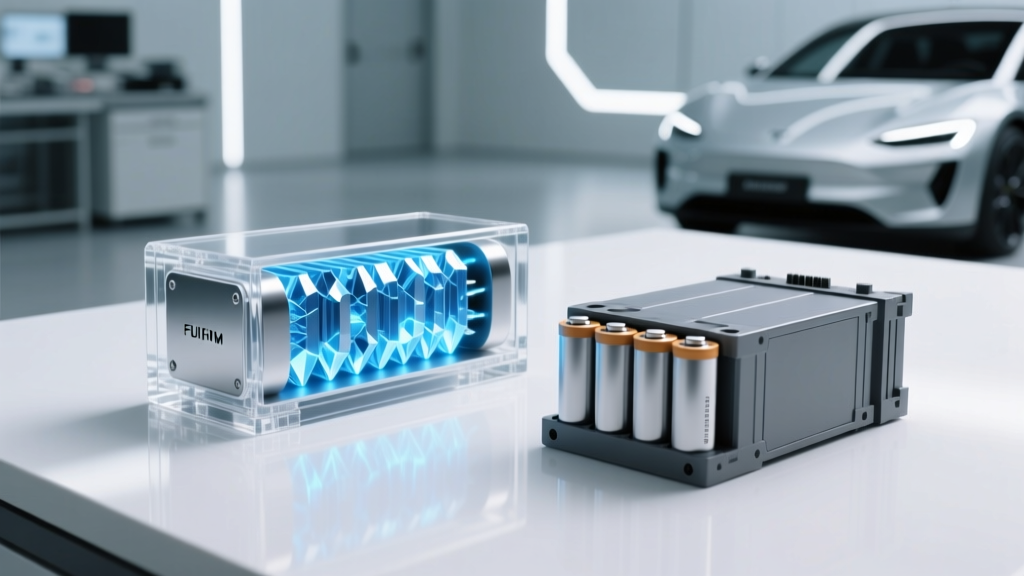
LFP vs NMC: The Chemistry Trade-Offs That Matter
Every EV battery pack is built from individual cells, and the cathode chemistry inside those cells determines the pack's fundamental character. Here is how the two dominant chemistries compare on the metrics that affect your ownership experience.
| Attribute | LFP (Lithium Iron Phosphate) | NMC / NCA (Nickel-based) |
|---|---|---|
| Energy Density (cell-level) | 160–180 Wh/kg | 220–300 Wh/kg |
| Typical Cycle Life | 3,000–6,000+ cycles | 1,000–2,500 cycles |
| Cold-Weather Performance | Moderate; more range loss below 32°F | Better low-temp conductivity |
| Thermal Stability | Excellent; higher runaway threshold | Good; requires robust BMS |
| Cobalt Content | None | Varies (reduced in newer formulations) |
| Cost per kWh (pack-level) | ~$80–$100 | ~$110–$140 |
| Charging to 100% Regularly | Recommended for calibration | 80% daily limit recommended |
| Notable 2026 Applications | Tesla Model 3/Y RWD, Ford Mustang Mach-E Select, many Chinese-market EVs | Hyundai Ioniq 5/6, Tesla Long Range, Rivian R1T/R1S, BMW iX |
The practical takeaway: LFP wins on longevity and cost — ideal for standard-range models and drivers who charge daily to 100%. NMC wins on energy density, giving longer range in the same physical pack volume — the better choice for long-range trims and cold-climate drivers. Neither is universally "better." Your choice depends on whether you prioritize maximum range (NMC) or maximum calendar life and lower cost (LFP).
How Long Do EV Batteries Actually Last?
The short answer: longer than most buyers expect, and in many cases longer than the rest of the vehicle. But "last" needs a precise definition. An EV battery rarely fails catastrophically; instead, it gradually loses capacity — a process called degradation.
Real-World Degradation Data
Based on aggregated fleet data and long-term owner reports through 2025–2026:
- Year 1: 1–3% capacity loss (initial SEI layer formation — this is normal and expected)
- Years 2–5: Roughly 0.5–1.5% additional loss per year under normal use
- Year 8 / 100,000 miles: Typical packs retain 85–92% of original capacity
- Year 10 / 150,000 miles: Average retention 80–88%
- Year 15 / 200,000+ miles: Many NMC packs still at 75–82%; LFP packs often above 85%
Geotab's long-term fleet study of over 10,000 EVs found an average annual degradation rate of approximately 1.8% across all chemistries, with LFP-equipped vehicles trending toward the lower end of that range. A Tesla Model 3 owner who starts with an EPA-rated 341 miles of range can realistically expect roughly 290–310 miles of usable range at the 100,000-mile mark — still very livable.
According to data compiled by the U.S. Department of Energy via fueleconomy.gov, modern thermal management systems have significantly reduced degradation rates compared to early-generation EVs from 2011–2016.
Factors That Accelerate Degradation
- Avoid sustained 100% SoC: For NMC packs, charge to 80% daily; reserve 100% for road trips. LFP packs should be charged to 100% at least once weekly for BMS calibration.
- Limit DC fast charging frequency: Occasional 150–250 kW DC fast charges are fine. Daily DCFC sessions, especially in hot weather, accelerate wear. Aim for Level 2 home charging as your primary routine.
- Precondition before fast charging: Most 2026 EVs automatically warm or cool the battery when you navigate to a charger. This keeps the cell temperature in the 68–95°F optimal window and protects the anode.
- Avoid extreme SoC in extreme heat: A fully charged battery sitting in 110°F ambient heat is under maximum stress. If parking in summer heat, 50–60% SoC is ideal.
- Don't baby it too much: Modern battery management systems (BMS) include top and bottom buffers (typically 3–5% of gross kWh). You don't need to obsess — just avoid the worst-case scenarios.
What Does the EV Battery Warranty Actually Cover?
Federal law mandates a minimum battery warranty of 8 years / 100,000 miles (10 years / 150,000 miles in CARB states like California, New York, and Massachusetts). Most manufacturers exceed the minimum on paper, but the critical detail is the capacity retention threshold — the point at which the manufacturer agrees the battery has degraded beyond acceptable limits.
| Manufacturer | Warranty Period | Mileage Limit | Capacity Threshold |
|---|---|---|---|
| Tesla (Model 3/Y LFP) | 8 years | 100,000 miles | 70% retention |
| Tesla (Model S/X, LR AWD) | 8 years | 120,000–150,000 miles | 70% retention |
| Hyundai / Kia | 10 years | 100,000 miles | 70% retention |
| Ford (Mach-E, F-150 Lightning) | 8 years | 100,000 miles | 70% retention |
| BMW (i4, iX) | 8 years | 100,000 miles | 70% retention |
| Rivian (R1T / R1S) | 8 years | 175,000 miles | 70% retention |
| GM (Ultium-based) | 8 years | 100,000 miles | 70% retention (some models 60%) |
What triggers a warranty claim: If your battery's State of Health (SoH) drops below the stated threshold within the warranty period, the manufacturer will repair or replace modules (or the full pack) to bring capacity above the threshold. This is not a "free new battery" — it's a restoration to above-threshold capacity.
What's NOT covered: Gradual degradation above the threshold, damage from accidents, modifications, or using non-approved charging equipment. Normal capacity loss of 10–15% over eight years is considered expected wear, not a defect.
How Much Does an EV Battery Replacement Cost?
This is the question that generates the most anxiety — and the most misinformation. Let's put real numbers to it.
| Vehicle / Pack Size | Battery Capacity | Replacement Cost Range | Typical Need Timeline |
|---|---|---|---|
| Tesla Model 3 RWD (LFP) | ~60 kWh | $8,000 – $12,000 | 15+ years / 200k+ mi (if ever) |
| Tesla Model Y Long Range | ~75 kWh | $12,000 – $16,000 | 15+ years / 200k+ mi |
| Hyundai Ioniq 5 | 77.4 kWh | $11,000 – $18,000 | 15+ years |
| Ford F-150 Lightning Ext. Range | 131 kWh | $20,000 – $32,000 | 15+ years |
| Rivian R1T (Large Pack) | ~135 kWh | $18,000 – $28,000 | 15+ years |
| Chevrolet Bolt EV (older gen) | 65 kWh | $9,000 – $14,000 | 12–15 years |
Key context most coverage omits:
- Most EV batteries outlive the car. The average age of a scrapped vehicle in the U.S. is roughly 15 years. Given current degradation curves, the majority of 2026 EVs will still have 75%+ battery capacity at that point.
- Module-level repair is increasingly common. Many packs (especially Hyundai/Kia, GM Ultium, BMW) allow individual module replacement rather than full-pack swaps, reducing out-of-warranty costs to $2,000–$6,000.
- Prices are declining. Pack-level costs have fallen from over $400/kWh in 2015 to approximately $110–$130/kWh in 2026, per BloombergNEF. Replacement costs in 2035 will likely be substantially lower than today's figures.
- A refurbished/remanufactured pack is often available for 40–60% of the new-pack price.
Monitoring Your Battery's State of Health (SoH)
State of Health (SoH) is a percentage representing your battery's current maximum capacity relative to its original capacity when new. A brand-new pack is 100% SoH; a pack that can only hold 51 kWh of its original 60 kWh is at 85% SoH.
How to Check SoH in 2026 EVs
- In-vehicle displays: Tesla (under Service mode), Hyundai/Kia (via the EV battery diagnostic screen), and BMW (iDrive battery health menu) now provide SoH estimates directly in the vehicle's software.
- OBD-II dongles + apps: Tools like OBDLink SX paired with apps such as EV Bat Mon or Car Scanner can read SoH data from the battery management system on most 2026 models.
- Dealer diagnostic reports: Request a battery health report during routine service. This is particularly useful before a warranty claim or when buying a used EV.
- Charging data analysis: By comparing the kWh dispensed during a 10–100% Level 2 charge session against the pack's rated capacity, you can estimate SoH. If your 77.4 kWh Ioniq 5 accepts only 67 kWh from 10% to 100% (accounting for ~90% charging efficiency ≈ ~60 kWh into the pack), your SoH is roughly 85–88%.
Amprius Technologies Silicon Anode Batteries: The Next Energy-Density Leap
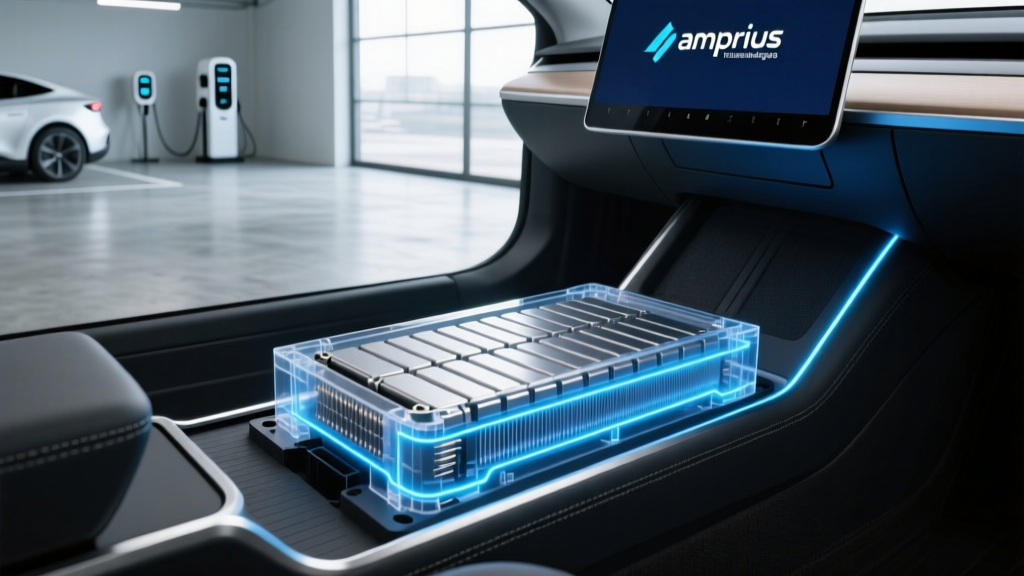
Here is where the forward-looking technology enters the picture. Amprius Technologies (NYSE American: AMPX) has been developing and shipping silicon anode battery cells that promise a step-change improvement in energy density — the single metric that determines how far an EV can go on a given pack weight and volume.
What Is a Silicon Anode, and Why Does It Matter?
In a conventional lithium-ion cell, the anode (the negative electrode that stores lithium ions during charging) is made of graphite. Graphite has a theoretical specific capacity of about 372 mAh/g. Silicon, by contrast, has a theoretical specific capacity of roughly 4,200 mAh/g — more than 10 times higher.
The challenge has always been that silicon expands by up to 300% in volume when it absorbs lithium ions during charging. This swelling causes the anode to crack, pulverize, and lose electrical contact — killing cycle life after just a few dozen charges. For over a decade, this expansion problem kept silicon anodes confined to lab prototypes.
Amprius's Approach: Silicon Nanowire Anodes
Amprius Technologies has pursued a specific architecture: silicon nanowire anodes grown directly on a conductive substrate. The nanowire structure provides room for silicon to expand radially without cracking, because each nanowire has free space around it. This is fundamentally different from simply mixing silicon particles into a graphite slurry (the approach used in today's 5–10% silicon-blend anodes from Panasonic and CATL).
As of 2026, Amprius has reported cell-level energy densities exceeding 450 Wh/kg and 1,150 Wh/L in their SiCore cells — figures that represent roughly 50–70% more energy per kilogram than the best NMC cells currently in EV production (roughly 260–300 Wh/kg at the cell level).
Where Amprius Silicon Anode Batteries Stand Today
It is critical to separate what is shipping from what is projected:
- Currently shipping (2026): Amprius SiCore cells are in production for non-automotive applications — aviation, high-altitude pseudo-satellites (HAPS), drones, and defense/aerospace. These are low-volume, high-cost applications where energy density matters far more than cost per kWh.
- Automotive timeline (announced/preliminary): Amprius has stated goals to scale production for electric vehicle applications, targeting automotive-grade volumes by the late 2020s. Specific OEM partnerships for passenger EVs have not been publicly confirmed as of early 2026.
- Cost challenge: Silicon nanowire anodes are currently far more expensive to manufacture than graphite at scale. Achieving the $80–$100/kWh pack-level cost needed for mass-market EVs will require significant manufacturing scale-up and yield improvements.
What Silicon Anodes Would Mean for Your Next EV
If and when silicon anode cells reach automotive production scale, the implications are concrete:
- Same pack weight, 40–60% more range: A 75 kWh pack that currently weighs ~480 kg could store 105–120 kWh at the same mass, pushing sedan ranges past 500 miles EPA.
- Same range, lighter and smaller pack: Alternatively, automakers could shrink the pack to 50 kWh for a 250-mile vehicle, reducing vehicle weight, cost, and raw material consumption.
- Faster charging potential: Silicon's higher lithium diffusivity could support higher C-rates, though thermal management at those power levels remains an engineering challenge.
Silicon Anodes in the Broader Battery Landscape
Amprius is not the only player pursuing silicon. Group14 Technologies (backed by Porsche), Sila Nanotechnologies (partnered with Mercedes-Benz and Panasonic), and Enovix are all developing silicon-dominant or silicon-blend anodes. The broader industry trend is a gradual increase in silicon content in anodes — from today's 5–10% silicon-graphite blends toward higher percentages — rather than a single overnight revolution.
Solid-state batteries (which pair a solid electrolyte with a lithium-metal or silicon anode) remain the longer-term aspiration, with Toyota, Samsung SDI, and QuantumScape targeting limited production in the 2028–2030 window. Silicon anode cells like Amprius's may serve as a bridge technology — compatible with existing liquid-electrolyte manufacturing while delivering a meaningful energy-density bump.
Frequently Asked Questions
How long do EV batteries last in years and miles?
Most 2026 EV batteries are designed to retain 70–85% of their original capacity after 15 years or 200,000 miles. LFP chemistries tend toward the higher end of that range. Catastrophic failure is rare; gradual capacity loss is the norm. The battery will likely still function — with reduced range — well beyond 200,000 miles.
How much does an EV battery cost to replace?
Full pack replacement ranges from approximately $8,000 for a 60 kWh LFP pack (Tesla Model 3 RWD) to $20,000–$32,000 for a 131 kWh pack (Ford F-150 Lightning Extended Range). However, most packs never need full replacement during the vehicle's useful life, and module-level repairs cost $2,000–$6,000. Pack prices continue to decline year over year.
What does the EV battery warranty cover?
Federal law requires a minimum 8-year/100,000-mile warranty (10 years/150,000 miles in CARB states). Coverage applies when the battery's capacity drops below the manufacturer's stated threshold — typically 70% of original capacity. The warranty covers repair or replacement to restore capacity above that threshold. It does not cover normal gradual degradation above the threshold or damage from accidents or misuse.
How do I check and maximize my EV battery health?
Check SoH through your vehicle's built-in diagnostics (Tesla Service mode, Hyundai EV diagnostic screen), an OBD-II reader with an EV-compatible app, or a dealer diagnostic report. To maximize longevity: charge NMC packs to 80% daily (LFP to 100% weekly), rely on Level 2 home charging rather than daily DC fast charging, precondition the battery before fast charging, and avoid leaving the vehicle at 100% SoC in extreme heat.
LFP vs NMC — which battery chemistry is better for me?
Choose LFP if you prioritize long cycle life, lower cost, and cobalt-free sourcing, and you're satisfied with standard-range models (220–270 miles EPA). Choose NMC if you need maximum range (300–400+ miles EPA), better cold-weather performance, or are buying a long-range or performance trim. Both chemistries are proven and reliable through 200,000+ miles.
Will Amprius silicon anode batteries be in EVs I can buy soon?
Not immediately. As of 2026, Amprius Technologies silicon anode batteries are shipping in aerospace, drone, and defense applications where extreme energy density justifies high cost. Automotive applications are targeted for the late 2020s but require significant manufacturing scale-up and cost reduction. Meanwhile, incremental silicon-blend anodes (5–15% silicon content) from suppliers like Sila Nanotechnologies and Group14 are expected to appear in production EVs sooner, offering a 10–20% energy density improvement over pure graphite anodes.