Why Energy Density (Wh/kg) Is the Number That Matters Most
Every EV buyer focuses on range, but the engineering metric that ultimately determines range, weight, and cost is energy density measured in watt-hours per kilogram (Wh/kg). In early 2026, Amprius Technologies announced its SiCore silicon-anode cells achieving up to 450 Wh/kg at the cell level — roughly double the gravimetric energy density of the best nickel-rich NMC cells in production vehicles today. That headline number raises an obvious question: how close are silicon-anode batteries to reaching your next EV, and how do they stack up against the chemistries currently on dealer lots?
This guide breaks down Amprius cell-level claims against the NMC and LFP packs powering 2026 EVs, explains the degradation and warranty realities every owner should know, and maps out a realistic timeline for next-generation battery tech.
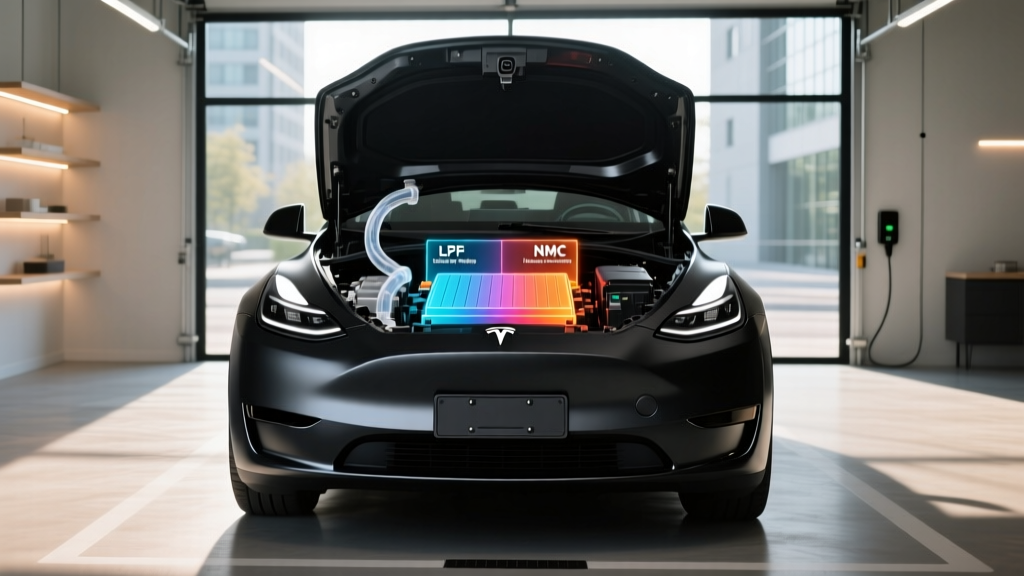
Current EV Battery Chemistries: NMC, LFP, and the Trade-Off Matrix
Before evaluating Amprius, it helps to understand the two chemistries dominating 2026 EV production. Nearly every battery-electric vehicle sold in the U.S. uses either NMC (nickel manganese cobalt) or LFP (lithium iron phosphate) cathode chemistry paired with a graphite-based anode.
| Attribute | NMC 811 (Graphite Anode) | LFP (Graphite Anode) | Amprius SiCore (Silicon Anode, Announced) |
|---|---|---|---|
| Cell-level energy density | 250–300 Wh/kg | 160–200 Wh/kg | ~450 Wh/kg (lab/samples) |
| Pack-level energy density | 160–210 Wh/kg | 120–160 Wh/kg | Not yet published (pack integration TBD) |
| Cycle life (to 80% SoH) | 1,000–2,000 cycles | 3,000–6,000+ cycles | 500–1,000 cycles (early data) |
| Cold-weather performance | Moderate (~15–25% range loss at 20°F) | Poor-to-moderate (~20–35% loss at 20°F) | Unverified at scale |
| Cost per kWh (cell, est.) | $110–$140 | $80–$110 | Significantly higher (specialty market) |
| Thermal stability | Moderate (requires robust BMS) | High (inherently stable cathode) | Unknown at pack scale |
| Notable 2026 vehicles | Hyundai Ioniq 5, BMW iX, Rivian R1S | Tesla Model 3 RWD, Ford Mustang Mach-E Select (LFP option) | Aviation/drones only (no EVs) |
The trade-off is straightforward: NMC offers higher energy density for longer range in a lighter pack, while LFP sacrifices some Wh/kg for dramatically longer cycle life, lower cost, and better thermal safety. Amprius's silicon-anode approach targets the NMC side of the equation — pushing energy density far beyond current graphite-anode limits — but faces its own cycle-life and manufacturing-scale challenges.
Amprius Silicon-Anode Cells: What 450 Wh/kg Actually Means
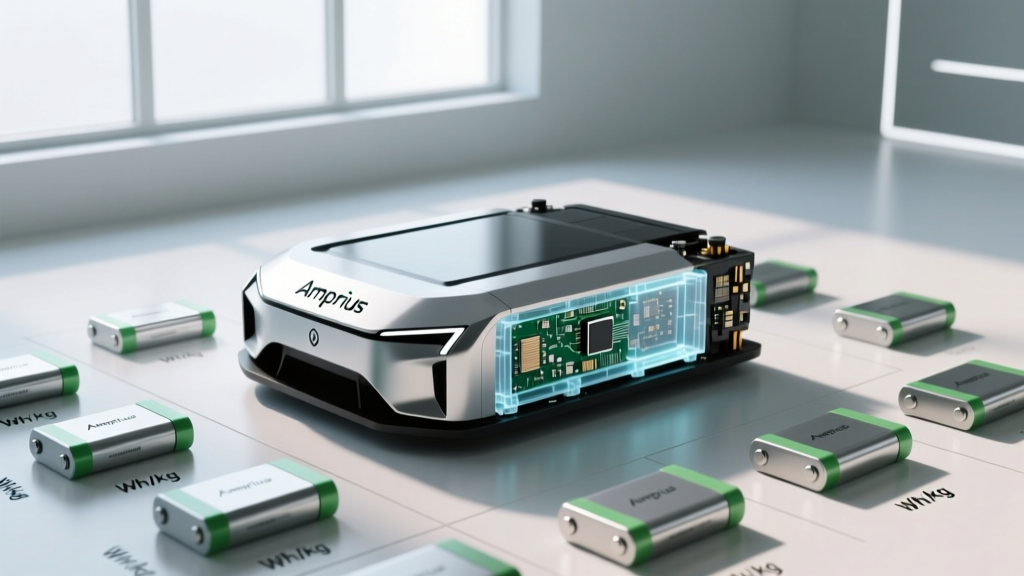
Amprius Technologies, headquartered in Fremont, California, manufactures cells using 100% silicon nanowire anodes (their SiMaxx line) and, more recently, a silicon-core (SiCore) composite anode designed for higher-volume, lower-cost production. The company has demonstrated cells exceeding 450 Wh/kg and 1,150 Wh/L at the cell level, figures validated in independent testing for aerospace and defense applications.
To put that in perspective:
- A 2026 Tesla Model 3 Long Range uses roughly 75 kWh of usable NMC capacity in a pack weighing approximately 440 kg — about 170 Wh/kg at the pack level.
- A 2026 Hyundai Ioniq 5 (84 kWh usable, NMC) carries a pack near 480 kg — approximately 175 Wh/kg pack-level.
- If Amprius SiCore cells could be integrated into a pack at even 60% of their cell-level density (~270 Wh/kg pack-level), a 100 kWh pack would weigh roughly 370 kg instead of 500+ kg, shaving meaningful mass and improving efficiency.
The catch: silicon anodes swell significantly during lithiation (up to 300% volume expansion in pure silicon). Amprius's nanowire architecture mitigates this by giving silicon room to expand without pulverizing, but manufacturing yield, cost, and long-term cycle life at automotive volumes remain the barriers. As of 2026, Amprius cells ship primarily for high-altitude drones, electric aviation, and defense platforms — markets where $/kWh matters far less than Wh/kg.
How Long Do EV Batteries Last? Degradation Data by the Numbers
Battery degradation is measured as the percentage of original capacity retained — called State of Health (SoH). A battery at 90% SoH holds 90% of its original kWh. Most manufacturers warranty batteries down to 70% SoH.
Typical Degradation Curves (Real-World Owner Data, 2026)
Based on aggregated fleet data from sources including Recurrent Auto and owner-reported telemetry:
- Year 1: 2–5% loss (initial SEI formation, steepest part of the curve)
- Years 2–4: ~1% per year (linear, slow degradation)
- Years 5–8: ~1–1.5% per year
- Year 10 (est.): 85–92% SoH for most NMC packs; 90–95% for LFP
Example: A 2020 Tesla Model 3 Long Range (NMC, 75 kWh) at 80,000 miles typically shows 88–92% SoH — meaning roughly 66–69 kWh usable. An LFP-equipped 2022 Model 3 RWD at 60,000 miles often reads 93–96% SoH.
The key insight: degradation is non-linear. You lose the most capacity early, then the curve flattens. Most 2026 EV batteries are engineered to retain 80%+ capacity well past 150,000 miles — far exceeding the point where most first owners sell or trade in.
What the Battery Warranty Actually Covers (and What It Doesn't)
Federal law (EPA emissions warranty requirements) effectively mandates that EV battery warranties cover a minimum of 8 years / 100,000 miles. In California and states adopting CARB standards, that extends to 10 years / 150,000 miles. Here is how major manufacturers structure coverage in 2026:
| Manufacturer | Warranty Period | Capacity Threshold | Notes |
|---|---|---|---|
| Tesla (Model 3/Y NMC) | 8 yr / 120,000 mi | 70% SoH | Long Range & Performance trims |
| Tesla (Model 3 RWD LFP) | 8 yr / 100,000 mi | 70% SoH | Lower mileage cap on LFP |
| Hyundai / Kia | 10 yr / 100,000 mi | 70% SoH | Among the longest coverage |
| Ford (Mach-E, F-150 Lightning) | 8 yr / 100,000 mi | 70% SoH | Standard across BEV lineup |
| BMW (iX, i4) | 8 yr / 100,000 mi | 70% SoH | Transferable to second owner |
| Rivian | 8 yr / 175,000 mi | 70% SoH | Higher mileage cap for adventure use |
Critical nuance: the warranty covers defects and abnormal degradation below the threshold. It does not cover gradual, normal capacity loss above 70%. If your 5-year-old EV shows 78% SoH, that is functioning as designed — not a warranty claim. Per fueleconomy.gov, most modern EV batteries are projected to outlast the vehicle's useful life under normal use.
EV Battery Replacement Cost: When, Why, and How Much
Full battery replacement is rare and typically only needed after catastrophic damage (collision, flood) or extreme out-of-warranty degradation. Here is what replacements cost in 2026:
| Vehicle | Battery Size (Usable kWh) | Chemistry | Replacement Cost (Parts + Labor) |
|---|---|---|---|
| Tesla Model 3 RWD | 57 kWh | LFP | $8,000–$12,000 |
| Tesla Model 3 Long Range | 75 kWh | NMC | $12,000–$16,000 |
| Hyundai Ioniq 5 | 77.4 kWh | NMC | $11,000–$15,000 |
| Ford F-150 Lightning (Ext.) | 131 kWh | NMC | $20,000–$28,000 |
| Chevrolet Silverado EV | 200 kWh | NMC | $30,000–$38,000 |
Two things to note: (1) cell prices have dropped roughly 80% since 2013, and replacement costs continue declining as LFP adoption grows and second-life battery markets mature. (2) Module-level repair is increasingly common — a technician can replace a single degraded or failed module for $1,500–$4,000 rather than swapping the entire pack. Most 2026 packs are designed with serviceable modules for this reason.
Factors That Accelerate (or Preserve) Battery Health
Battery longevity is not purely a function of time and miles. Your charging and driving habits significantly influence the degradation rate. Here is the evidence-based hierarchy of stress factors:
Battery Care Best Practices (Ranked by Impact)
- Avoid sustained 100% SoC (high impact): Store NMC batteries between 20–80%. Daily charging to 100% accelerates electrolyte oxidation. LFP is more tolerant of 100% storage and benefits from periodic full charges for BMS calibration.
- Minimize DC fast-charging frequency (moderate impact): Occasional road-trip fast charging is fine. Daily 150+ kW DC charging adds thermal stress. Data from Recurrent shows fleets that primarily L2-charge degrade ~2–3% less over 4 years than those relying heavily on DCFC.
- Precondition before fast charging (moderate impact): Cold batteries charged at high power experience lithium plating. Most 2026 EVs automatically precondition when you navigate to a charger — use the built-in nav for this reason.
- Avoid extreme heat exposure (moderate impact): Parking in 100°F+ ambient for weeks at high SoC accelerates calendar aging. Shade, garages, and thermal management systems mitigate this.
- Don't baby it too much (low impact): Driving hard and using regen braking are well within design parameters. The BMS protects against dangerous conditions. Use the car normally.
How to Check Your Battery's State of Health (SoH)
Most 2026 EVs expose SoH through one or more methods:
- In-car menus: Tesla, Hyundai, and BMW offer battery health readouts in the service or energy menus. Tesla's "Battery Health" percentage appears under Service → Battery Health (introduced in 2024 software updates).
- OBD-II dongles + apps: Tools like OBDeleven, Leaf Spy (Nissan), or Scan My Tesla read the BMS directly for precise SoH, cell voltage deltas, and pack imbalance data.
- Manufacturer service centers: A service visit can generate a full battery health report with per-module voltage and resistance data.
- Third-party services: Companies like Recurrent and Geotab offer fleet-level SoH tracking; some provide individual reports for a fee.
For used-EV buyers, requesting a BMS SoH readout before purchase is as important as a compression test was for gas cars. A 3-year-old EV showing 94% SoH is healthy; one showing 83% warrants investigation or price negotiation.
Beyond Amprius: Solid-State, Sodium-Ion, and Realistic Timelines
Silicon anodes are one of several next-generation technologies in development. Here is where each stands as of 2026:
- Silicon-anode cells (Amprius, Sila Nanotechnologies, Enovix): In production for specialty/aerospace applications. Automotive-scale production is expected in the 2028–2030 timeframe, likely debuting in premium vehicles first. Sila's partnership with Mercedes-Benz (announced for the G-Class EV) targets 2028–2029.
- Solid-state batteries (Toyota, QuantumScape, Samsung SDI): Toyota has announced limited solid-state production for 2027–2028, but at very low volumes and high cost. QuantumScape cells are in A-sample testing with Volkswagen. Widespread, affordable solid-state EVs remain a 2030+ prospect.
- Sodium-ion batteries (CATL, HiNA): Already in limited production in Chinese-market micro-EVs. Energy density (~120–160 Wh/kg cell-level) limits them to short-range urban vehicles, but cost and cold-weather performance are advantages. U.S. market entry is uncertain before 2028.
- LFP continued evolution: CATL's "Shenxing" LFP cells support 4C+ charging rates (10–80% in ~10 minutes) and are entering European and U.S. supply chains in 2026. LFP remains the most practical near-term chemistry for affordable, long-lasting EVs.
The realistic takeaway: Amprius's 450 Wh/kg silicon-anode cells represent genuine engineering progress, but the path from aerospace niche to automotive volume production is measured in years, not months. For 2026 buyers, NMC and LFP remain the proven options, with pack-level densities of 160–210 Wh/kg delivering 250–400 miles of EPA range in current vehicles.
Frequently Asked Questions
How long do EV batteries last in years and miles?
Most 2026 EV batteries are designed to retain 80%+ of original capacity at 150,000–200,000 miles or 12–15 years of typical use. LFP chemistries often exceed this, with some fleet data showing 90%+ SoH at 150,000 miles. Complete failure before 100,000 miles is rare and typically covered under warranty.
How much does an EV battery cost to replace in 2026?
Full pack replacement ranges from roughly $8,000 for a small LFP pack (Tesla Model 3 RWD) to $30,000+ for a 200 kWh truck pack (Chevrolet Silverado EV). However, most out-of-warranty repairs involve single-module replacement at $1,500–$4,000. Full replacements are uncommon — the vast majority of EV batteries outlive the vehicle.
What does the battery warranty cover?
Federally mandated minimum coverage is 8 years / 100,000 miles (10/150,000 in CARB states). Warranties cover defects and degradation below a stated threshold (typically 70% SoH). Normal gradual capacity loss above that threshold is not covered. Check your specific manufacturer's warranty terms, as mileage caps and SoH thresholds vary.
LFP vs NMC — which battery chemistry is better?
Neither is universally better. Choose NMC if you need maximum range in a lighter vehicle (300+ mile EVs, performance models, towing). Choose LFP if you prioritize longevity, lower cost, and daily-driving durability (commuter vehicles, fleet use, warm climates). LFP's lower energy density means heavier packs for the same range, but its 3,000–6,000 cycle life and thermal stability are significant advantages for most owners.
Will Amprius silicon-anode batteries be in EVs soon?
Not in the immediate term. Amprius cells are currently produced for aviation, drones, and defense applications where extreme energy density justifies high cost. Automotive partnerships and volume manufacturing are in development, but consumer EVs with silicon-anode cells are realistically a 2028–2030+ prospect. The technology is promising but has not yet been validated at automotive scale, cost, or cycle-life requirements.
How do I maximize my EV battery's lifespan?
Charge NMC batteries to 80% for daily use (100% only for road trips). LFP owners can charge to 100% regularly and should do so weekly for BMS calibration. Minimize exclusive reliance on DC fast charging. Precondition the battery before fast charging in cold weather. Park in shade or garages when possible in extreme heat. Modern BMS systems handle most protection automatically — these habits provide incremental long-term benefit.