Why an AGM Battery Tender Matters for EV Owners
If you've ever opened the hood or frunk of your electric vehicle and spotted a small, familiar-looking 12-volt battery, you're not alone. Nearly every EV and PHEV on the road in 2026 — from the Tesla Model Y to the Hyundai Ioniq 5 to the Ford F-150 Lightning — still carries a 12V auxiliary battery alongside its massive high-voltage traction pack. That 12V battery is typically an AGM (Absorbent Glass Mat) unit, and keeping it healthy with an AGM battery tender is one of the most overlooked pieces of EV ownership maintenance.
Here's why it matters: the 12V system powers your EV's computers, door locks, lights, infotainment, and — critically — the contactors that connect the high-voltage traction battery to the drivetrain. If the 12V battery dies, the car is effectively bricked, even if the main pack is at 100% State of Charge (SoC). Tesla issued a service bulletin in 2023 acknowledging that 12V battery failures were among the most common warranty claims on the Model 3 and Model Y. Many EV owners who let their vehicles sit for weeks without driving have returned to a dead 12V and a vehicle that won't start.
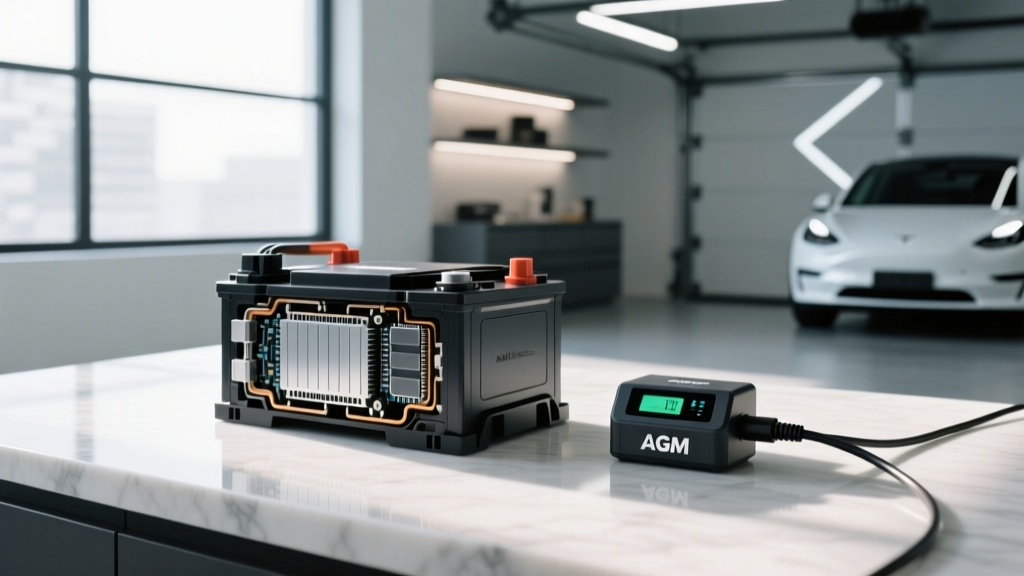
An AGM battery tender — a smart, microprocessor-controlled trickle charger designed specifically for AGM chemistry — maintains the 12V battery at optimal voltage (typically 13.2–13.8V for float maintenance) without overcharging. Popular units like the Battery Tender Plus or NOCO GENIUS series deliver 1–5 amps with AGM-specific charge profiles. But maintaining the 12V system is just one piece of the battery puzzle. The real conversation for EV buyers and owners centers on the high-voltage traction battery — its chemistry, its degradation curve, its warranty, and its eventual replacement cost.
This guide covers both: practical AGM battery tender usage for your EV's 12V system, and a deep, data-driven look at the traction battery that actually powers your car.
High-Voltage Traction Battery Chemistry: LFP vs NMC vs NCA
The high-voltage traction battery in your EV — typically between 50 kWh and 130+ kWh of usable capacity — uses one of two dominant lithium-ion chemistries in 2026: LFP (Lithium Iron Phosphate, LiFePO4) or NMC/NCA (Nickel Manganese Cobalt / Nickel Cobalt Aluminum). Your choice of chemistry affects range, longevity, charging behavior, and cold-weather performance.
| Attribute | LFP (LiFePO4) | NMC / NCA |
|---|---|---|
| Energy Density | ~160–180 Wh/kg (cell level) | ~220–280 Wh/kg (cell level) |
| Cycle Life | 3,000–5,000+ cycles to 80% SoH | 1,000–2,000 cycles to 80% SoH |
| Cold Performance | Moderate — range loss ~30–40% below 20°F | Better — range loss ~20–30% below 20°F |
| Recommended Daily SoC | 100% (LFP benefits from full charges) | 80% (daily); 100% only for trips |
| Cost per kWh (pack level) | ~$100–$120/kWh | ~$130–$160/kWh |
| Cobalt Content | None | Contains cobalt/nickel |
| Common 2026 Vehicles | Tesla Model 3 RWD, Model Y RWD, Ford Mustang Mach-E Select (LFP option), BYD models | Hyundai Ioniq 5/6, Kia EV6/EV9, Chevy Equinox EV, Rivian, BMW iX, Porsche Taycan |
The bottom line: LFP is the durability and cost champion — it lasts more charge cycles, costs less, and avoids critical-mineral sourcing issues (relevant for IRS §30D tax credit battery-component rules). NMC/NCA wins on energy density, giving more range in a lighter, smaller package, and handles cold weather better. Neither is universally "better" — the right choice depends on your climate, driving habits, and how long you plan to keep the vehicle.
How Long Do EV Batteries Actually Last?
The short answer: far longer than most buyers fear. Real-world fleet data from 2024–2026 consistently shows that modern EV traction batteries lose roughly 5–10% of their original capacity in the first 100,000 miles, with degradation slowing significantly after the initial break-in period.
Typical Degradation Curve (NMC 75–82 kWh pack, moderate climate):
- Year 1 / 15,000 mi: ~2–4% loss (initial formation loss)
- Year 3 / 45,000 mi: ~6–8% total loss
- Year 5 / 75,000 mi: ~8–10% total loss
- Year 8 / 120,000 mi: ~10–14% total loss
- Year 10 / 150,000 mi: ~12–18% total loss
Data synthesized from fleet reports by Recurrent Auto, Geotab, and manufacturer warranty claim rates. Individual results vary based on climate, charging habits, and chemistry.
A Tesla Model 3 Long Range with its 75 kWh (usable) NCA pack and an EPA range of 341 miles might realistically show ~300 miles of range at the 100,000-mile mark — still well above what most daily commutes require. LFP packs, with their 3,000+ cycle life, are projected to outlast 200,000+ miles before hitting the 80% State of Health (SoH) threshold. According to fueleconomy.gov, modern thermal management systems (liquid cooling and heating) have been the single biggest factor in reducing degradation rates compared to early EVs like the 2011–2017 Nissan Leaf, which lacked active thermal management and saw 20–30% loss in hot climates within 5 years.
Most EV batteries will outlive the vehicle they're installed in. The average age of a scrapped passenger vehicle in the US is roughly 15–17 years, and by that point, a well-maintained EV pack should still retain 75–85% of its original capacity.
What Does the EV Battery Warranty Actually Cover?
Federal law mandates that EV battery warranties cover a minimum of 8 years / 100,000 miles (or 10 years / 150,000 miles in California Air Resources Board states). But the details — specifically the capacity-retention threshold — matter enormously.
| Manufacturer | Warranty Term | Capacity Threshold | Chemistry |
|---|---|---|---|
| Tesla (Model 3/Y RWD) | 8 yr / 100,000 mi | 70% retention | LFP |
| Tesla (Model 3/Y LR/Perf) | 8 yr / 120,000 mi | 70% retention | NCA/NMC |
| Hyundai / Kia | 10 yr / 100,000 mi | 70% retention | NMC |
| Ford (Mach-E, F-150 Lightning) | 8 yr / 100,000 mi | 70% retention | NMC / LFP |
| GM (Ultium-based) | 8 yr / 100,000 mi | 70% retention (60% on some commercial) | NMC |
| BMW | 8 yr / 100,000 mi | 70% retention | NMC |
| Rivian | 8 yr / 175,000 mi (R1T/R1S) | 70% retention | NMC |
What's covered: Capacity loss below the stated threshold (e.g., if your 82 kWh pack drops below 57.4 kWh usable within 8 years/100,000 miles, the manufacturer must repair or replace it). Manufacturing defects, cell imbalance, and BMS failures are also covered.
What's NOT covered: Gradual degradation above the threshold, damage from accidents, improper charging equipment, or aftermarket modifications. Some warranties exclude damage from repeated DC fast charging to 100% SoC in extreme heat — though this is rarely enforced in practice.
EV Battery Replacement Cost: What to Expect
If your traction battery does fail outside of warranty, replacement is expensive — but the costs have dropped substantially since the early 2010s, and most replacements happen due to manufacturing defects (covered under warranty) rather than end-of-life degradation.
| Vehicle / Pack Size | Battery Cost (Parts) | Labor | Total Estimate |
|---|---|---|---|
| Tesla Model 3 RWD (~60 kWh LFP) | $6,000–$8,000 | $1,500–$2,500 | $7,500–$10,500 |
| Hyundai Ioniq 5 (~77.4 kWh NMC) | $9,000–$12,000 | $2,000–$3,000 | $11,000–$15,000 |
| Ford F-150 Lightning Extended (~131 kWh) | $15,000–$20,000 | $2,500–$4,000 | $17,500–$24,000 |
| Chevy Equinox EV (~85 kWh) | $9,500–$13,000 | $2,000–$3,000 | $11,500–$16,000 |
| Rivian R1T Max Pack (~149 kWh) | $18,000–$24,000 | $3,000–$5,000 | $21,000–$29,000 |
These figures represent out-of-warranty, full-pack replacements at OEM dealerships. Third-party EV repair shops and refurbished packs can reduce costs by 30–50%. Module-level repair (replacing only the degraded or failed modules within a pack) is increasingly available for $2,000–$6,000 depending on the vehicle, though not all manufacturers support this approach.
When is replacement typically needed? For the vast majority of owners: never. Fleet data from Recurrent Auto (2025 report covering 15,000+ EVs) showed a battery replacement rate of less than 2.5% across all model years, and the majority of those replacements occurred under warranty for manufacturing defects, not degradation. Pack-level failure from normal wear is rare before 200,000+ miles on liquid-cooled systems.
Factors That Accelerate (or Preserve) Battery Life
Battery degradation is not purely a function of time — it's heavily influenced by how you charge, drive, and store your EV. Here are the factors that matter most, ranked by impact:
High Impact
- Extreme heat exposure: Sustained ambient temperatures above 95°F with high SoC (above 90%) accelerate electrolyte decomposition. If you live in Phoenix or Houston, avoid parking at 100% SoC in direct sun for days. Preconditioning and garage parking help enormously.
- Consistent 100% SoC on NMC/NCA: Nickel-rich chemistries experience cathode micro-cracking at high voltages. Daily charging to 80% instead of 100% can double cycle life. LFP is exempt — it actually benefits from periodic 100% charges for cell balancing and BMS calibration.
- Frequent DC fast charging in extreme heat: Charging at 150–250 kW generates significant internal heat. Modern thermal management mitigates this, but daily fast-charging in 100°F+ weather without preconditioning will accelerate wear. Most owners who fast-charge 2–3 times per week see no measurable difference vs. Level 2 charging.
Moderate Impact
- Deep discharge cycles (below 10% SoC): Regularly draining the pack to near-zero stresses the anode. Try to keep SoC between 20–80% for daily use on NMC/NCA.
- Long-term storage at high or zero SoC: If storing an EV for 30+ days, leave it at ~50% SoC. Storage at 100% or below 5% for weeks causes calendar degradation.
Lower Impact (But Worth Knowing)
- Regenerative braking intensity: High regen settings cause brief high-current pulses into the pack, but BMS limits keep this within safe C-rates. No measurable impact on long-term health.
- Cold-weather charging without preconditioning: Charging a cold battery (below 32°F) without preconditioning can cause lithium plating on the anode. Always use your vehicle's preconditioning feature before DC fast charging in winter.
Monitoring Your Battery's State of Health (SoH)
State of Health (SoH) is the percentage of your battery's original capacity that remains usable. A new EV starts at 100% SoH; at 70–80% SoH, you'll notice meaningful range reduction, and most warranties use the 70% threshold as their trigger point.
How to check SoH in 2026:
- In-vehicle displays: Tesla, Hyundai/Kia, BMW, and GM now include SoH or estimated range-at-full-charge indicators in their infotainment or service menus. Tesla's service mode (accessible via the software screen) shows estimated capacity in kWh.
- OBD-II apps: Tools like Scan My Tesla, Car Scanner ELM OBD2, or Leaf Spy (for Nissan) read the BMS directly and report SoH, cell voltage spread, and pack temperature. A $15–30 Bluetooth OBD-II dongle plus a free/low-cost app is the most accurate DIY method.
- Dealer diagnostic: Any authorized service center can run a full pack health report. Request one before purchasing a used EV — it's the single most important data point.
- Third-party services: Companies like Recurrent and AVILOO offer remote SoH monitoring via connected-car APIs, generating battery health certificates useful for resale.
A healthy used EV should show SoH above 90% at under 60,000 miles and above 85% at 100,000 miles. Anything below 80% before the warranty period expires should trigger a warranty claim.
AGM Battery Tender Best Practices for Your EV's 12V System
Now, back to the 12V system — the reason you searched for an AGM battery tender in the first place. Here's how to use one correctly on an electrified vehicle:
- Confirm your 12V battery type: Most 2020–2026 EVs use AGM batteries (e.g., Tesla switched to a 12V lithium-iron-phosphate auxiliary battery in late 2021 Model 3/Y builds — these require a different maintainer, NOT a standard AGM tender). Check your owner's manual or the battery label before connecting anything.
- Use an AGM-specific charge profile: AGM batteries require a slightly higher absorption voltage (14.4–14.7V) and a lower float voltage (13.2–13.6V) compared to flooded lead-acid. A tender without an AGM mode may under-charge or over-charge. Recommended units: Battery Tender Plus 021-0123 (1.25A), NOCO GENIUS5 (5A, multi-chemistry), or CTEK MXS 5.0 (5A, AGM-optimized).
- Connect correctly: Attach the tender's positive clamp to the 12V battery's positive terminal (or designated jump-start positive post — see your manual) and the negative clamp to a clean, unpainted chassis ground. Do NOT connect to the high-voltage system or orange cabling.
- When to use it: If your EV sits undriven for more than 2–3 weeks, connect the tender. This is especially important for PHEVs that may sit in EV-only mode without the engine cycling to charge the 12V. EVs with lithium 12V batteries (Tesla post-2021, some Hyundai models) typically manage their own 12V charging from the traction pack and don't need an external tender.
- Don't confuse this with traction battery care: An AGM battery tender does nothing for your high-voltage pack. It solely maintains the 12V auxiliary battery that powers the vehicle's electronics and contactors.
Emerging Battery Technology: What's Next (and When)
Several next-generation battery technologies are in development, but none are commercially available in production vehicles as of 2026. Here's a realistic timeline based on manufacturer announcements and industry analysis:
- Solid-state batteries: Toyota has announced a solid-state battery targeting 745 miles (WLTP) range and 10-minute 10–80% charging, with initial production expected in 2027–2028 for limited models. Samsung SDI and QuantumScape are also in pilot production. Realistic mass-market availability: 2029–2031. These promise higher energy density (~350–400 Wh/kg cell level), faster charging, and improved safety (no liquid electrolyte = no thermal runaway risk), but manufacturing cost and scalability remain significant hurdles.
- Silicon-dominant anodes: Companies like Sila Nanotechnologies and Group14 are replacing graphite anodes with silicon composites, boosting energy density by 20–40%. Early versions are appearing in premium models (Mercedes-Benz G-Class EV uses silicon-anode cells from Sila). Expect broader adoption by 2027–2028.
- Sodium-ion batteries: CATL and BYD are producing sodium-ion cells for low-cost, short-range EVs (primarily in China). Energy density is lower (~120–150 Wh/kg), but cost is 30–40% less than LFP. US-market availability is uncertain but possible in budget segments by 2028.
None of these technologies should factor into a 2026 purchase decision. Current LFP and NMC/NCA packs are mature, well-warrantied, and proven to last 150,000–200,000+ miles with proper care. Waiting for solid-state is waiting for a vehicle that doesn't yet exist at a price nobody has announced.
Frequently Asked Questions
Can I use an AGM battery tender on my EV's high-voltage traction battery?
No. An AGM battery tender is designed exclusively for 12V lead-acid (AGM) auxiliary batteries. The high-voltage traction battery (400V–900V) is managed by the vehicle's onboard Battery Management System (BMS) and charges only via Level 1, Level 2, or DC fast charging equipment. Never attempt to connect any external charger to the high-voltage system.
How long do EV batteries last in years and miles?
Modern liquid-cooled EV batteries (2020–2026 model years) typically retain 85–92% of their original capacity at 100,000 miles and 78–88% at 150,000 miles. In calendar years, most packs outlast 12–15 years before degradation becomes practically limiting. LFP chemistries generally outlast NMC/NCA in cycle count, though NMC/NCA handles cold climates better.
How much does it cost to replace an EV battery?
Out-of-warranty replacement costs range from approximately $7,500 for a Tesla Model 3 RWD LFP pack to $24,000+ for a Ford F-150 Lightning extended-range pack, including labor. However, fleet data shows fewer than 2.5% of EVs require battery replacement, and the vast majority of those are covered under the 8-year/100,000-mile minimum warranty. Module-level repairs, where available, cost $2,000–$6,000.
What does the EV battery warranty cover?
Federal law requires a minimum 8-year/100,000-mile warranty (10 years/150,000 miles in CARB states) covering capacity loss below a stated threshold (typically 70% of original capacity). Manufacturing defects, cell failures, and BMS malfunctions are included. Damage from accidents, improper aftermarket modifications, or extreme abuse is excluded.
How do I check my EV battery's health?
Use your vehicle's built-in service/energy menu, an OBD-II Bluetooth adapter with an app like Scan My Tesla or Car Scanner, or request a dealer diagnostic report. For used-EV purchases, always obtain a battery health report showing SoH percentage and cell voltage spread before committing.
LFP vs NMC — which battery chemistry should I choose?
Choose LFP if you prioritize longevity (3,000+ cycle life), lower cost, and don't need maximum range or cold-weather performance. Charge LFP to 100% regularly. Choose NMC/NCA if you need maximum range per kWh, better cold-weather efficiency, and faster DC charging speeds — but limit daily SoC to 80% for best longevity. For most daily commuters in moderate climates, LFP is the practical winner.
Does frequent DC fast charging damage my EV battery?
Modern thermal management systems make moderate DC fast charging (2–3 sessions per week) essentially harmless to long-term battery health. The risk increases with daily fast charging in extreme heat (95°F+) without preconditioning. For daily charging, Level 2 home charging at 7–11 kW remains the gentler, more economical option.
Should I use a battery tender if I have a Tesla with a lithium 12V battery?
No. Tesla vehicles built from late 2021 onward use a 12V lithium-iron-phosphate auxiliary battery that is maintained by the vehicle's DC-DC converter from the traction pack. An external AGM tender is unnecessary and potentially incompatible. If your EV uses a traditional AGM 12V battery (most non-Tesla EVs through 2026), a smart AGM tender is recommended for extended parking periods.
Sources: U.S. Department of Energy / fueleconomy.gov — EV technology and battery information; IRS.gov — §30D clean vehicle credit eligibility and battery sourcing requirements; manufacturer warranty documentation (Tesla, Hyundai, Ford, GM, BMW, Rivian — 2026 model year).