The single most expensive component in any electric vehicle is its high-voltage traction battery. Yet for most buyers, battery technology remains the biggest unknown: How long will it last? How much does replacement cost? Does chemistry matter? This guide breaks down the advanced battery technology powering today's EVs — from the lithium iron phosphate (LFP) packs in the Tesla Model 3 Standard Range to the nickel manganese cobalt (NMC) cells in the Hyundai Ioniq 5 — with real data on degradation, warranties, ownership costs, and the solid-state horizon.
LFP vs NMC/NCA: The Chemistry Decision That Shapes Your EV
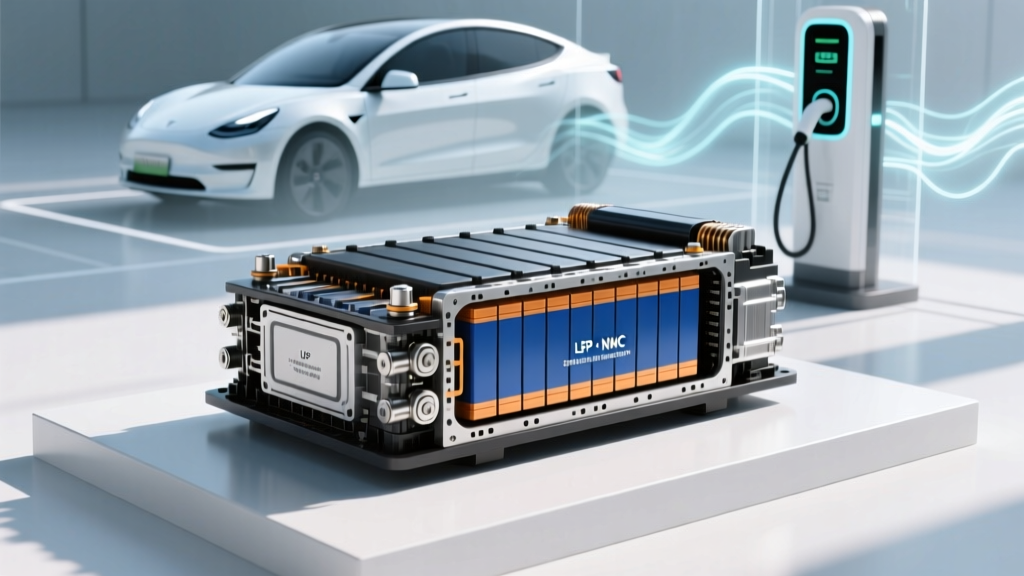
Not all lithium-ion batteries are built the same. The cathode chemistry determines energy density, lifespan, cold-weather performance, and cost. In 2026, two chemistries dominate the US market: LFP (lithium iron phosphate) and NMC/NCA (nickel manganese cobalt / nickel cobalt aluminum). Understanding the trade-offs is essential before you buy.
| Attribute | LFP (LiFePO4) | NMC / NCA |
|---|---|---|
| Energy Density | Lower (~160 Wh/kg cell-level) | Higher (~250–300 Wh/kg cell-level) |
| Cycle Life | 3,000–5,000+ cycles | 1,000–2,000 cycles |
| Cold-Weather Performance | Weaker — more range loss below freezing | Better — retains more capacity in cold |
| Cost (per kWh) | Lower — no cobalt or nickel | Higher — commodity-sensitive materials |
| Thermal Stability | Excellent — highly resistant to thermal runaway | Good — requires more active thermal management |
| Recommended Charge Habit | Can charge to 100% daily without harm | Best kept 20–80% daily; 100% for trips only |
| Typical Vehicles (2026) | Tesla Model 3 RWD, Model Y RWD, Ford Mustang Mach-E Select (LFP option), Rivian Standard pack | Hyundai Ioniq 5, Kia EV6, Tesla Long Range/Performance, BMW i4, Ford Mach-E Extended Range |
Which is better? It depends on your use case. If you want maximum range in a lighter package and drive in cold climates, NMC delivers higher energy density and better winter performance. If you prioritize longevity, lower cost, and plan to keep the vehicle 10+ years, LFP's superior cycle life and tolerance for daily 100% charging make it the pragmatic choice. Tesla's shift to LFP in its standard-range vehicles reflects this exact calculus: most daily drivers don't need 350 miles of range — they need a battery that lasts 300,000+ miles with minimal degradation.
How Long Do EV Batteries Actually Last?
The short answer: almost certainly longer than you think. Data from fleet operators, manufacturer reports, and independent testing consistently shows that modern EV batteries lose roughly 5–10% of their original capacity in the first 100,000 miles, then degrade at a much slower, nearly linear rate for the remainder of their life.
Typical Degradation Curve (NMC, liquid-cooled, moderate climate):
- Year 1 / 15,000 mi: ~2–4% loss (initial formation drop)
- Year 3 / 45,000 mi: ~5–7% total loss
- Year 5 / 75,000 mi: ~7–9% total loss
- Year 8 / 120,000 mi: ~10–13% total loss
- Year 10 / 150,000 mi: ~12–16% total loss
Sources: Geotab fleet data (6,300+ EVs), Tesla Impact Reports, Recurrent Auto battery studies.
LFP batteries tend to show even slower degradation in calendar and cycle life, though they may exhibit slightly more variance in early state-of-charge estimation. A Tesla Model 3 RWD with an LFP pack can realistically retain 88–92% of its original capacity after 150,000 miles under normal use — meaning a 272-mile EPA range when new becomes roughly 240–250 miles at that mileage. That's still more than adequate for daily driving and most road trips.
The key insight: most EV batteries will outlast the vehicle itself. The average age of a scrapped car in the US is roughly 12 years and 150,000–180,000 miles. A well-maintained modern EV battery at that point still holds 80–88% of its original capacity — far from "dead."
What Does the Battery Warranty Actually Cover?
Federal law mandates that EV batteries carry a minimum warranty of 8 years / 100,000 miles. In California Air Resources Board (CARB) states — which include California, Colorado, Maine, Massachusetts, New York, Oregon, Vermont, Virginia, and Washington — the mandate extends to 10 years / 150,000 miles. Most manufacturers meet or exceed these minimums.
| Manufacturer | Warranty Term | Capacity Retention Threshold | Notes |
|---|---|---|---|
| Tesla (Model 3/Y RWD — LFP) | 8 yr / 100,000 mi | 70% | Long Range/Performance: 8 yr / 120,000 mi |
| Hyundai / Kia (Ioniq 5, EV6) | 10 yr / 100,000 mi | 70% | Among the longest terms in the industry |
| Ford (Mach-E, F-150 Lightning) | 8 yr / 100,000 mi | 70% | Covers battery components + capacity |
| BMW (i4, iX) | 8 yr / 100,000 mi | 70% | Transferable to subsequent owners |
| Rivian (R1T, R1S) | 8 yr / 175,000 mi | 70% | Higher mileage cap reflects truck use case |
| GM (Ultium-based: Equinox EV, Blazer EV, Silverado EV) | 8 yr / 100,000 mi | 70% | Covers module-level replacement |
The critical detail is the capacity retention threshold — typically 70% of original capacity. If your battery drops below that threshold within the warranty period, the manufacturer will repair or replace it (often at the module level, not the full pack). In practice, warranty claims are rare: the degradation data above shows most packs stay well above 70% even at 200,000 miles.
EV Battery Replacement Cost: What It Actually Takes
This is where fear-mongering runs rampant. Headlines cite $20,000 battery swaps without context. Here's the reality for 2026:
| Vehicle | Battery Size (kWh, usable) | Chemistry | Estimated Replacement Cost |
|---|---|---|---|
| Tesla Model 3 RWD | ~57 kWh | LFP | $8,000–$12,000 |
| Tesla Model Y Long Range | ~75 kWh | NMC | $12,000–$16,000 |
| Hyundai Ioniq 5 (Long Range) | ~77.4 kWh | NMC | $11,000–$15,000 |
| Ford F-150 Lightning (Extended) | ~131 kWh | NMC | $18,000–$25,000 |
| Chevrolet Equinox EV | ~85 kWh | NMC (Ultium) | $12,000–$16,000 |
| Rivian R1T (Large Pack) | ~128 kWh | NMC | $17,000–$22,000 |
Several important caveats:
- Full-pack replacement is rare. Most EV batteries use modular designs. If one module degrades or fails, a technician can replace just that module for a fraction of the full-pack cost — often $2,000–$5,000.
- Costs are falling. Battery pack prices have dropped from over $1,000/kWh in 2010 to roughly $130–$140/kWh in 2026 (source: BloombergNEF). That trend continues.
- You'll likely never pay this. The vast majority of EV batteries never need replacement during typical ownership. If a failure occurs, it almost always happens within the warranty period.
- Refurbished packs are an option. Third-party shops and OEM remanufacturing programs offer refurbished battery packs at 30–50% below new-pack pricing.
Factors That Accelerate (or Slow) Battery Degradation
Your habits matter. While modern battery management systems (BMS) do an excellent job protecting the pack, certain behaviors measurably accelerate wear:
What Hurts Battery Longevity
- Frequent DC fast charging: Regularly using 150+ kW DC fast chargers generates significant heat. Occasional road-trip fast charging is fine, but daily reliance on DCFC (instead of Level 2 home charging) accelerates degradation by an estimated 1–3% over 100,000 miles.
- Sustained high state of charge (NMC/NCA): Leaving an NMC battery at 100% for days at a time stresses the cathode. Charge to 100% only when you'll drive soon.
- Deep discharges to 0%: Letting the battery sit at or near 0% SoC for extended periods can cause copper dissolution in the anode.
- Extreme heat exposure: Parking in sustained 100°F+ ambient temperatures without thermal management active accelerates calendar aging. (Most EVs run cooling even when parked, but it draws from the pack.)
- Repeated high-C-rate discharges: Constant hard launches and track driving generate internal heat. This is a minor factor for most owners but relevant for performance-oriented drivers.
What Preserves Battery Health
- Charge to 80% daily (NMC/NCA) — use the car's built-in charge limit setting
- Charge to 100% freely (LFP) — LFP chemistry tolerates full charges and actually benefits from periodic 100% sessions for BMS cell-balancing calibration
- Use Level 2 home charging as your primary method — slower charging generates less heat
- Keep SoC between 20–80% for storage — if leaving the car for a week or more, aim for ~50%
- Precondition the battery before DC fast charging — most EVs do this automatically when you navigate to a charger; it warms the pack to optimal charging temperature, reducing stress
- Don't obsess about 1–2% differences — modern BMS systems manage cell balancing and thermal limits automatically
How to Monitor Your Battery's State of Health (SoH)
State of Health (SoH) is expressed as a percentage of the battery's original usable capacity. A new battery is 100% SoH; a battery that has degraded to hold only 65 kWh of its original 75 kWh is at ~87% SoH. Here's how to check it:
Manufacturer Apps and In-Car Displays
Some automakers display SoH directly. Hyundai/Kia EVs show a battery health indicator in the infotainment system under EV settings. BMW provides a battery health readout in the iDrive menu. Tesla does not natively display SoH as a percentage — instead, the car estimates range at 100% charge, which you can compare to the original EPA figure to approximate degradation.
Third-Party Tools
- OBD-II dongles + apps: Devices like the OBDLink MX+ paired with apps such as EVNotify or LeafSpy (Nissan Leaf) can read the BMS directly and report SoH with reasonable accuracy.
- Recurrent Auto: This service connects to your EV's telematics and provides ongoing battery health reports, comparing your degradation to a fleet-wide dataset of identical vehicles.
- Dealer diagnostics: A service center can run a full battery health report, often free during routine service visits.
Pro tip: Track your range at 100% charge over time. If your Tesla Model 3 Long Range showed 334 miles at 100% when new and now shows 305 miles at 100% after 40,000 miles, that's roughly 8.7% degradation — right in line with expected NMC curves.
Emerging Battery Technology: Solid-State, Silicon Anodes, and What's Real
Advanced battery technology extends beyond today's lithium-ion cells. Several next-generation technologies are in development, but timelines matter — here's what's real versus what's still on the horizon as of 2026:
Solid-State Batteries
Solid-state batteries replace the liquid electrolyte with a solid material (ceramic, sulfide, or polymer), promising higher energy density (potentially 400–500 Wh/kg), faster charging, and improved safety. Current status: Toyota has announced a solid-state EV prototype targeting 2027–2028 production with an estimated 620-mile range. Samsung SDI and QuantumScape are also advancing prototypes. However, manufacturing scalability and cost remain significant barriers. Realistic consumer availability: limited-production vehicles in 2028–2030; mainstream adoption likely not before 2032+. These are announced/preliminary — no solid-state EV is currently available for purchase in the US.
Silicon Anode Batteries
Replacing graphite anodes with silicon can increase energy density by 20–40%. Companies like Sila Nanotechnologies and Group14 are supplying silicon-dominant anode materials to battery manufacturers. Current status: Mercedes-Benz's G-Class EV (announced for 2025–2026) was among the first to incorporate silicon anode cells from Factorial Energy. Expect gradual integration into premium vehicles through 2027–2028, with cost reductions enabling broader adoption by 2030.
Sodium-Ion Batteries
Sodium-ion chemistry eliminates lithium entirely, using abundant, inexpensive materials. Energy density is lower (~120–150 Wh/kg), making it best suited for short-range urban EVs and energy storage. Current status: BYD and CATL are producing sodium-ion cells in China for budget EVs. US-market availability is unlikely before 2028, and initial applications will be in commercial/fleet vehicles rather than consumer cars.
The bottom line: today's LFP and NMC batteries are mature, well-understood, and backed by extensive real-world data. Next-generation chemistries will eventually offer meaningful improvements, but they are years away from mainstream US-market availability. Buying an EV today does not mean accepting obsolete technology — it means adopting a proven, continuously improving platform.
Frequently Asked Questions
How long do EV batteries last in years and miles?
Modern liquid-cooled EV batteries typically last 15–20 years and 200,000–300,000+ miles before degrading to 70–80% of original capacity. Data from Geotab's fleet study of over 6,300 EVs shows average annual degradation of roughly 1.8% per year under mixed use. Most batteries will outlive the vehicle they're installed in.
How much does an EV battery cost to replace?
Out-of-warranty replacement costs range from approximately $8,000 for a smaller LFP pack (e.g., Tesla Model 3 RWD, ~57 kWh) to $25,000 for a large NMC pack (e.g., Ford F-150 Lightning Extended Range, ~131 kWh). However, full-pack replacement is rare — most repairs involve individual module replacement at $2,000–$5,000. The vast majority of EV batteries never require replacement during typical ownership.
What does the EV battery warranty cover?
Federal law requires a minimum 8-year / 100,000-mile battery warranty (10 years / 150,000 miles in CARB states). Coverage includes defects in materials and workmanship, plus capacity loss below a specified threshold — typically 70% of original capacity. Some manufacturers (Hyundai, Kia, Rivian) offer longer terms. The warranty covers repair or replacement of the battery pack or individual modules at no cost to the owner.
How do I check and maximize my EV battery health?
Check SoH via your vehicle's infotainment system (Hyundai, Kia, BMW), third-party OBD-II tools (OBDLink MX+ with EVNotify), or services like Recurrent Auto. To maximize longevity: charge to 80% daily for NMC/NCA (100% is fine for LFP), use Level 2 home charging as your primary method, avoid frequent DC fast charging, don't let the battery sit at 0% or 100% for extended periods, and precondition before fast charging.
LFP vs NMC — which battery chemistry is better for me?
Choose LFP if: you want maximum longevity (3,000–5,000+ cycle life), prefer to charge to 100% daily without worry, prioritize lower cost, and live in a moderate climate. Choose NMC/NCA if: you need maximum range in a lighter vehicle, regularly drive in cold weather (better low-temperature performance), or want the highest available energy density. Neither is universally "better" — the right choice depends on your driving patterns, climate, and ownership timeline.
Does DC fast charging damage my battery?
Occasional DC fast charging (road trips, a few times per month) has a negligible effect on battery health. However, daily or near-daily DCFC use at 150+ kW does measurably accelerate degradation — studies suggest an additional 1–3% capacity loss over 100,000 miles compared to primarily Level 2 charging. Modern BMS systems manage charge rates and temperatures to minimize harm, but heat is the enemy of lithium-ion longevity. Use Level 2 for daily charging and DCFC when you need it.
Will solid-state batteries make my current EV obsolete?
Not anytime soon. Solid-state batteries remain in prototype and limited-production stages as of 2026, with mainstream US consumer availability not expected before 2030–2032. Even when available, they will debut in premium vehicles at high prices. Today's LFP and NMC batteries offer proven performance, extensive real-world data, and continuously declining costs. There is no practical reason to delay an EV purchase waiting for solid-state technology.
Sources referenced: fueleconomy.gov (EPA), Geotab EV Battery Degradation Study, manufacturer warranty documentation (Tesla, Hyundai, Ford, BMW, Rivian, GM), BloombergNEF Battery Price Survey.