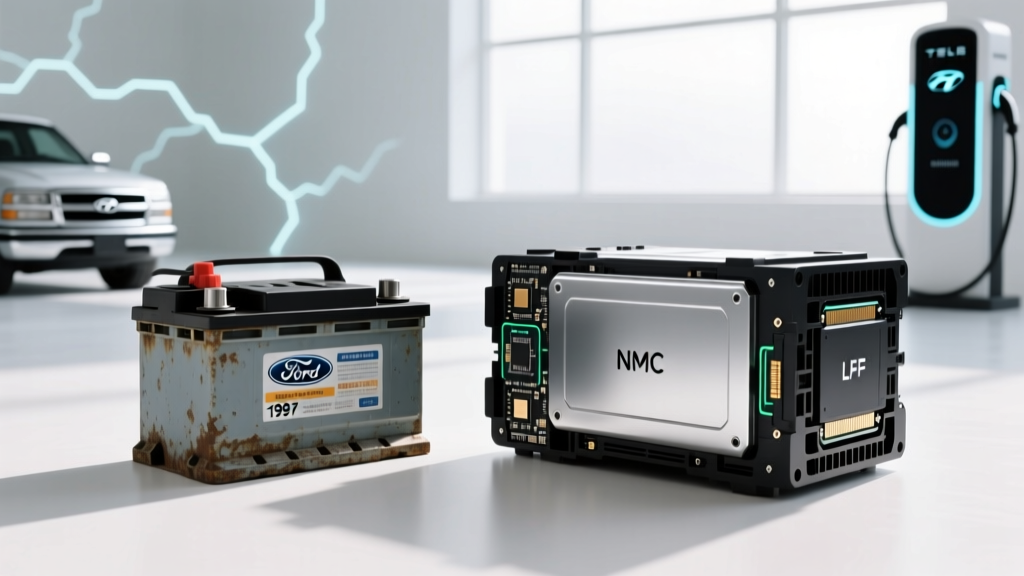
If you've ever searched for a 97 Ford F-150 battery, you were likely looking for a 12-volt lead-acid SLI (Starting, Lighting, Ignition) battery — the kind that cranks a 4.9L inline-six or 5.0L V8 on a cold morning. That battery costs around $120-$180, weighs about 40 pounds, stores roughly 0.6 kWh of energy, and typically lasts 3-5 years before it needs replacing.
Fast-forward to 2026, and the word "battery" in an automotive context means something radically different: a high-voltage lithium-ion traction pack storing 60-150 kWh, weighing 800-2,000 pounds, and engineered to outlast the vehicle it powers. The gulf between a 1997 F-150's 12V battery and a modern EV's traction battery isn't just generational — it's a completely different engineering discipline.
This guide breaks down exactly how modern EV batteries work, how long they last, what they cost to replace, and what's coming next — with the hard numbers and real-world data that matter to buyers and owners.
What a 97 Ford F-150 Battery Actually Is (and Isn't)
The 1997 Ford F-150 used a Group 65 12V lead-acid battery rated at approximately 750 cold-cranking amps (CCA). Its job was simple: spin the starter motor, power lights and accessories when the engine was off, and stabilize the electrical system. The alternator handled sustained electrical load once the engine was running.
Key specs of that 1997-era battery:
- Capacity: ~0.6 kWh (roughly 50 Ah at 12V)
- Weight: 35-45 lbs
- Chemistry: Flooded lead-acid
- Lifespan: 3-5 years / 300-500 deep cycles
- Replacement cost (2026): $120-$180 at any auto parts store
That battery has zero connection to an EV's traction battery beyond sharing the word "battery." Modern EVs also carry a separate 12V or 16V auxiliary battery (or lithium-ion equivalent) to run computers, lights, and accessories — but the traction battery is the core energy store that propels the vehicle.
EV Battery Chemistry in 2026: LFP vs NMC vs NCA
The two dominant lithium-ion chemistries in 2026 EV batteries are LFP (Lithium Iron Phosphate) and NMC/NCA (Nickel Manganese Cobalt / Nickel Cobalt Aluminum). Each has distinct trade-offs that affect range, longevity, cost, and cold-weather performance.
| Attribute | LFP (LiFePO4) | NMC / NCA |
|---|---|---|
| Energy density | 160-200 Wh/kg (cell-level) | 220-300 Wh/kg (cell-level) |
| Cycle life | 3,000-5,000+ cycles to 80% SoH | 1,000-2,000 cycles to 80% SoH |
| Cost per kWh | ~$80-$100 (pack-level, 2026) | ~$110-$140 (pack-level, 2026) |
| Cold-weather performance | Weaker — more range loss below 32°F | Better low-temp discharge capability |
| Thermal stability | Excellent — higher runaway threshold | Good — requires more active cooling |
| Recommended daily SoC | 100% OK (LFP tolerates full charge) | 80-90% daily; 100% for trips only |
| Typical applications | Standard-range models (Tesla Model 3 RWD, Ford Mustang Mach-E Select) | Long-range / performance models (Tesla Model S, BMW iX, Rivian R1T Dual-Motor Max) |
| Cobalt content | Zero | Varies (reduced-cobalt NMC trending) |
Which Chemistry Is Better?
Neither is universally superior — it depends on your use case:
- Choose LFP if: You want maximum cycle life, can charge to 100% without worry, prioritize lower cost, and don't frequently drive in extreme cold. LFP is ideal for daily commuters and high-mileage drivers.
- Choose NMC/NCA if: You need maximum range per pound, regularly drive in cold climates, or want a performance-oriented pack. NMC/NCA suits road-trippers and cold-weather owners who need every available mile of range.
How Long Do EV Batteries Actually Last?
The short answer: far longer than most buyers assume. Real-world degradation data from 2024-2026 fleet analyses shows that most modern EV batteries lose 5-10% of their original capacity over the first 100,000 miles, with degradation slowing significantly after the initial break-in period.
Here's what the data actually shows across major platforms:
| Vehicle / Platform | Mileage | Avg. Capacity Retention | Source / Notes |
|---|---|---|---|
| Tesla Model 3/Y (NMC/NCA) | 100,000 mi | ~90-92% | Tesla 2024 Impact Report; fleet telemetry |
| Tesla Model 3 RWD (LFP) | 100,000 mi | ~93-95% | Fleet data; LFP shows slower degradation |
| Chevrolet Bolt EV/EUV (NMC) | 80,000 mi | ~91-93% | Owner-reported via Recurrent Auto |
| Hyundai Ioniq 5 (NMC) | 60,000 mi | ~94-96% | Recurrent Auto fleet study, 2025 |
| Ford Mustang Mach-E ER (NMC) | 75,000 mi | ~92-94% | Ford warranty claim data; owner surveys |
| Nissan Leaf (LMO/NMC, passively cooled) | 100,000 mi | ~80-85% | Older passive-cooling designs degrade faster, especially in hot climates |
Sources: Recurrent Auto, Tesla Impact Report, manufacturer fleet data.
The critical insight: liquid-cooled battery packs (standard on virtually every 2026 EV except some budget models) dramatically outperform the passively cooled packs of the early 2010s. The Nissan Leaf's air-cooled design is a cautionary tale — active thermal management is non-negotiable for longevity.
For a typical driver covering 12,000-15,000 miles per year, a modern EV battery should retain 85-90%+ of its original capacity at 150,000 miles (roughly 10-12 years of use). Most EV batteries will outlast the vehicle's economic life.
EV Battery Warranty Terms: What's Actually Covered
Federal law mandates a minimum EV battery warranty of 8 years / 100,000 miles (in California Air Resources Board states, it extends to 10 years / 150,000 miles). But the details matter enormously.
| Manufacturer | Warranty Period | Mileage Cap | Capacity Threshold | Notes |
|---|---|---|---|---|
| Tesla (Model 3/Y RWD — LFP) | 8 years | 100,000 mi | 70% retention | Shorter mileage than LR/Performance |
| Tesla (Model 3/Y LR, Model S/X) | 8 years | 120,000 mi | 70% retention | Higher mileage cap for NMC packs |
| Hyundai / Kia | 10 years | 100,000 mi | 70% retention | Industry-leading duration |
| Ford (Mach-E, F-150 Lightning) | 8 years | 100,000 mi | 70% retention | Includes battery components |
| GM (Chevrolet, Cadillac) | 8 years | 100,000 mi | 70% retention (60% for Bolt) | Ultium platform; Bolt had extended coverage post-recall |
| Rivian | 8 years | 175,000 mi | 70% retention | Highest mileage cap in the segment |
| BMW | 8 years | 100,000 mi | 70% retention | Transferable to second owner |
What the warranty covers: Defects in materials/workmanship AND capacity loss below the stated threshold. If your pack drops below 70% of original capacity within the warranty window, the manufacturer must repair or replace it — typically with a refurbished or remanufactured unit of equivalent capacity.
What it doesn't cover: Damage from accidents, flooding, improper modifications, or using non-approved charging equipment. Normal degradation above the threshold (say, dropping to 75% over 8 years) is expected and not warrantable.
EV Battery Replacement Cost: The Real Numbers
This is where the comparison to a 97 F-150 battery becomes stark. Replacing an EV's high-voltage traction battery is a major service event — but it's also exceedingly rare within the first decade of ownership.
| Vehicle | Battery Size (kWh) | Chemistry | Replacement Cost Range |
|---|---|---|---|
| Tesla Model 3 RWD | 57-60 kWh | LFP | $8,000 - $12,000 |
| Tesla Model Y Long Range | 75-82 kWh | NMC | $12,000 - $16,000 |
| Ford F-150 Lightning (Extended Range) | 131 kWh | NMC | $18,000 - $28,000 |
| Chevrolet Equinox EV | 85 kWh | NMC (Ultium) | $12,000 - $16,000 |
| Hyundai Ioniq 5 | 77.4 kWh | NMC | $10,000 - $15,000 |
| Rivian R1T (Max Pack) | 149 kWh | NMC | $22,000 - $32,000 |
| BMW i4 eDrive40 | 81.5 kWh | NMC | $14,000 - $19,000 |
These figures include the battery pack and labor but can vary by region, dealer vs. independent shop, and whether the replacement is a new, remanufactured, or refurbished unit. Module-level repair — replacing only the degraded cell modules rather than the entire pack — is increasingly available and can reduce costs to $3,000-$8,000 for many platforms.
The context that matters: Recurrent Auto's fleet data shows that fewer than 3% of EV batteries in their study of 15,000+ vehicles required out-of-warranty replacement. Most packs are outliving the vehicles around them.
Factors That Accelerate (or Preserve) Battery Life
Not all miles are equal when it comes to battery wear. The following factors have the most significant impact on long-term State of Health (SoH):
Hurts Your Battery
- Frequent DC fast charging to 100%: Sustained high-voltage states stress NMC cells. Occasional fast charging is fine; daily 150 kW sessions to full accelerate degradation.
- Extreme heat exposure: Parking in 110°F+ desert heat without thermal management active is the single worst environmental factor. Liquid-cooled packs mitigate this significantly.
- Storing at 100% SoC for days/weeks: High state of charge + high temperature = accelerated calendar degradation. If leaving the car for a week, store at 50-60% SoC.
- Repeated deep discharge to 0%: Running the pack to true zero (not the displayed zero, which has a buffer) damages cells.
- Aftermarket modifications to the electrical system: Non-approved V2H/V2L setups or third-party charging equipment can void warranty coverage.
Helps Your Battery
- Level 2 home charging at moderate rates (7-11 kW): Gentle on cells, generates minimal heat.
- Keeping SoC between 20-80% for NMC: The "middle half" of the battery is the comfort zone. LFP is less sensitive to this.
- Preconditioning before fast charging: Warming the battery to optimal temperature (most EVs do this automatically when you navigate to a charger) reduces stress and improves charge speed.
- Regular driving: Batteries that sit unused for months degrade faster than those used regularly. Calendar aging is real.
- Garage parking in extreme climates: Even an unheated garage keeps the pack out of peak summer sun and extreme winter cold.
How to Check Your EV Battery's State of Health (SoH)
State of Health (SoH) is the percentage of original capacity your battery can still hold. A new battery is 100% SoH; a battery that held 80 kWh when new but now holds 72 kWh is at 90% SoH.
Here's how to monitor it across different platforms in 2026:
- Tesla: No native SoH display in the app, but third-party tools like TeslaFi or Stats can calculate SoH by comparing energy added during a known charge session against the battery management system's reported capacity. Service centers can run a formal health check.
- Hyundai / Kia: The infotainment system includes a battery health diagnostic under EV settings. Dealers can pull detailed SoH reports via the diagnostic port.
- Ford: The FordPass app provides battery health status. A "Battery Health" report is available through authorized dealers using Ford's diagnostic tools.
- GM (Ultium platform): The myChevrolet/myCadillac app shows battery health status. OnStar diagnostics can provide detailed SoH reports.
- OBD-II scanners: Tools like the OBDLink MX+ paired with apps such as EV Battery Health or Car Scanner can read BMS-reported SoH on most EVs. This is the most accessible DIY method.
Pro tip: Track your SoH quarterly by noting how many kWh it takes to charge from 10% to 90% on a Level 2 charger. Compare that to the original usable capacity. If your 77 kWh pack now accepts only 68 kWh over that range, you're at roughly 88% SoH. This manual method works across any EV brand.
What's Coming Next: Solid-State and Silicon-Anode Batteries
The battery landscape is evolving, but timelines matter more than headlines. Here's a realistic look at emerging technologies from a 2026 vantage point:
Solid-State Batteries
Solid-state batteries replace the liquid electrolyte with a solid material (ceramic, sulfide, or polymer), promising higher energy density (potentially 400+ Wh/kg at cell level), faster charging, and improved safety. However:
- Current status (2026): Limited production runs by Toyota (prototype demonstration vehicles), QuantumScape (Volkswagen-backed, pre-commercial), and Samsung SDI. No mass-market EV currently on sale uses a full solid-state pack.
- Realistic timeline: Low-volume production in premium vehicles expected 2027-2029; cost-competitive mass adoption not before 2030-2032.
- Remaining challenges: Manufacturing yield, solid electrolyte cracking under thermal cycling, and cost per kWh still significantly above liquid lithium-ion.
Silicon-Anode Batteries
Replacing graphite anodes with silicon (or silicon-carbon composites) can increase energy density by 20-40%. Companies like Sila Nanotechnologies and Group14 Technologies are supplying silicon-anode materials to battery manufacturers.
- Current status (2026): Partial silicon anodes are appearing in some premium cells (e.g., Mercedes-Benz EQXX prototype, some Porsche Taycan cells). Blend ratios of 10-20% silicon are becoming common in high-energy-density NMC cells.
- Realistic timeline: Increasing silicon content in anodes is a gradual evolution, not a revolution. Expect 30-50% silicon anodes in mainstream EVs by 2028-2030.
From Lead-Acid to Lithium-Ion: The Big Picture
The distance between a 97 Ford F-150 battery and a 2026 EV traction pack illustrates just how far automotive energy storage has come:
| Attribute | 97 Ford F-150 (12V Lead-Acid) | 2026 Tesla Model Y LR (NMC) | 2026 Ford F-150 Lightning ER (NMC) |
|---|---|---|---|
| Voltage | 12V | ~400V | ~400V |
| Energy capacity | ~0.6 kWh | ~75 kWh | ~131 kWh |
| Weight | ~40 lbs | ~1,000 lbs | ~1,800 lbs |
| Chemistry | Lead-acid | NMC lithium-ion | NMC lithium-ion |
| Cycle life | 300-500 | 1,500-2,000+ | 1,500-2,000+ |
| Lifespan | 3-5 years | 15+ years (projected) | 15+ years (projected) |
| Replacement cost | $120-$180 | $12,000-$16,000 | $18,000-$28,000 |
| Warranty | 1-3 years | 8 yr / 120,000 mi | 8 yr / 100,000 mi |
The modern EV battery is a precision-engineered, actively managed energy system — not a consumable you swap every few years like the lead-acid unit in that '97 F-150. Understanding the chemistry, monitoring health, and following basic care practices ensures that your EV's battery will likely outlast your ownership of the vehicle.
Frequently Asked Questions
How long do EV batteries last in years and miles?
Based on 2024-2026 fleet data, modern liquid-cooled EV batteries typically retain 85-90%+ of their original capacity at 150,000 miles (10-15 years for average drivers). The U.S. Department of Energy projects that current-generation packs should last the useful life of the vehicle — typically 200,000+ miles — before degradation makes the vehicle impractical for primary use.
How much does an EV battery cost to replace?
Full pack replacement ranges from approximately $8,000 for smaller LFP packs (Tesla Model 3 RWD) to $28,000+ for large NMC packs (Ford F-150 Lightning Extended Range, Rivian Max Pack). Module-level repair — replacing only degraded sections — can cost $3,000-$8,000. However, fewer than 3% of EVs require out-of-warranty battery replacement based on current fleet data.
What does the EV battery warranty actually cover?
Federal law requires a minimum of 8 years / 100,000 miles of battery warranty coverage. Most manufacturers guarantee that the battery will retain at least 70% of its original capacity during this period. If it falls below the threshold, the manufacturer replaces or repairs the pack at no cost. The warranty covers defects and abnormal degradation but not accident damage, flooding, or unauthorized modifications.
How do I check and maximize my EV battery health?
Check SoH via your manufacturer's app, dealer diagnostic tools, or an OBD-II scanner with EV-compatible software. To maximize longevity: charge primarily on Level 2, keep NMC packs between 20-80% SoC for daily use (LFP can charge to 100%), precondition before DC fast charging, avoid storing at full charge in hot weather, and drive regularly rather than letting the vehicle sit for weeks.
LFP vs NMC — which battery chemistry is better for me?
LFP offers longer cycle life (3,000-5,000 cycles), lower cost, and the ability to charge to 100% daily without concern — ideal for commuters and high-mileage drivers. NMC delivers higher energy density (more range per pound) and better cold-weather performance — better for road-trippers and cold-climate owners. Neither is universally superior; the right choice depends on your driving patterns and climate.
Is a 97 Ford F-150 battery the same type as an EV battery?
No. The 1997 Ford F-150 uses a 12V lead-acid SLI battery (~0.6 kWh) designed to start a combustion engine. An EV traction battery is a 400V+ lithium-ion pack (60-150 kWh) that stores all the energy needed to propel the vehicle. They share the word "battery" but are entirely different technologies, chemistries, and scales. Even modern EVs carry a separate 12V auxiliary battery for accessories — which is the true descendant of the 97 F-150's battery.