The 2022 Tesla Model 3 Long Range Battery: Capacity, Chemistry, and Real-World Context
The 2022 Tesla Model 3 Long Range ships with a lithium-ion traction battery pack rated at approximately 82 kWh gross / 75 kWh usable. That usable figure is what matters for daily driving and range calculations. Tesla buffers roughly 7 kWh at the top and bottom of the pack to protect the cells from deep-discharge and over-charge stress — a practice common across the industry but rarely disclosed on window stickers.
Paired with dual motors and an EPA-rated 358 miles of range, this pack delivers a combined efficiency of about 26 kWh/100 mi (roughly 132 MPGe) per fueleconomy.gov. Real-world highway driving at 70-75 mph typically yields 290–320 miles before the buffer is exhausted, and cold-weather conditions (below 32°F) can shave another 15–30% off that figure due to cabin heating demands and increased internal cell resistance.
NMC/NCA vs LFP: Understanding the Model 3 Long Range Chemistry
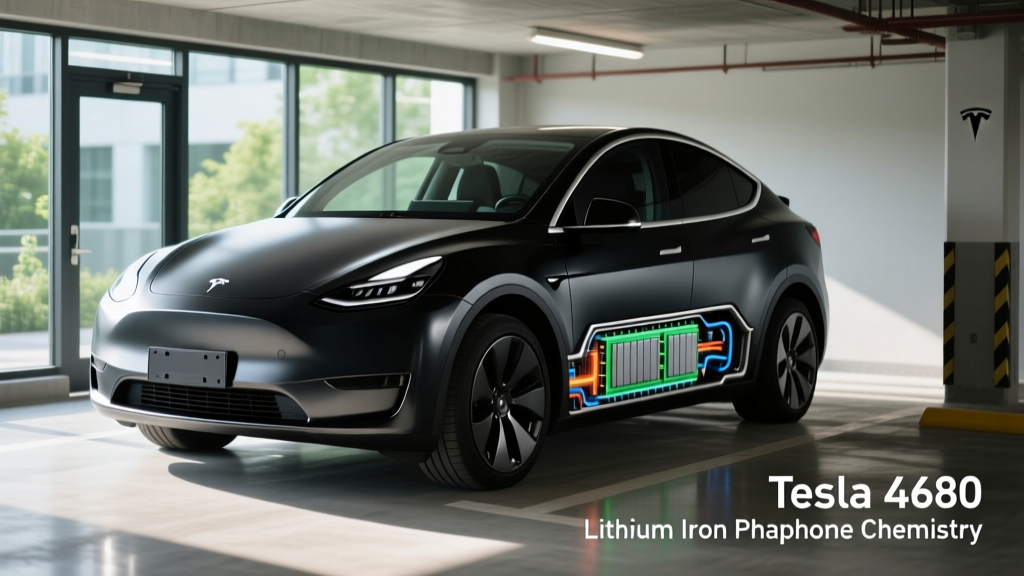
The 2022 Model 3 Long Range uses NMC (nickel manganese cobalt) cathode cells supplied primarily by Panasonic at Giga Nevada, with some packs incorporating LG Energy Solution NMC cells. This is a deliberate engineering choice: Tesla reserves LFP (lithium iron phosphate) chemistry for the Model 3 Rear-Wheel Drive (Standard Range) trim.
Why the split? NMC offers higher energy density — critical for the Long Range's 358-mile EPA target — while LFP excels in cycle life and cost but sacrifices roughly 10–15% energy density per kilogram. Here's how the two chemistries compare across the metrics that matter to owners:
| Metric | NMC/NCA (Long Range) | LFP (Rear-Wheel Drive) |
|---|---|---|
| Energy Density | ~260 Wh/kg (cell-level) | ~170-190 Wh/kg (cell-level) |
| Typical Cycle Life | 1,000–1,500 full cycles to 80% SoH | 3,000–5,000+ full cycles to 80% SoH |
| Cold Performance | Better low-temp discharge & regen | Reduced regen & range below 32°F |
| Recommended Daily Charge Limit | 80% (for longevity) | 100% (weekly at minimum) |
| Cost (per kWh, pack-level) | ~$130–$150 | ~$90–$110 |
| Thermal Runaway Risk | Higher (managed by BMS/cooling) | Significantly lower |
The practical takeaway: NMC gives you the range. But it demands more careful charging habits — specifically, avoiding sustained storage at 100% state of charge (SoC). Tesla's onboard Battery Management System (BMS) recommends an 80% daily charge limit for NMC packs, reserving 100% for road trips where you'll begin driving shortly after reaching full charge.
Battery Degradation: What the Data Actually Shows
One of the most persistent myths in EV ownership is that batteries "die" after a few years. The data from high-mileage Tesla fleets tells a different story. According to Tesla's 2023 Impact Report and aggregated fleet data from sources like Recurrent Auto, NMC-based Model 3 and Model Y packs show the following degradation curve:
- Year 1 / 15,000 mi: ~2–4% capacity loss (initial formation stabilization)
- Year 3 / 45,000 mi: ~6–8% total loss from new
- Year 5 / 75,000 mi: ~8–12% total loss
- Year 8 / 120,000 mi: ~10–15% total loss (approaching warranty threshold)
The degradation curve is not linear. Most capacity loss occurs in the first 20,000–30,000 miles as the solid electrolyte interphase (SEI) layer stabilizes on the anode. After that, degradation slows to roughly 1–2% per year under normal use. A 2022 Model 3 Long Range driven an average of 12,000 miles per year should retain approximately 85–90% of its original capacity at the 8-year warranty mark — well above the 70% threshold.
Outlier cases of accelerated degradation (15%+ loss before 100,000 miles) typically correlate with specific abuse patterns: exclusive DC fast charging at 250 kW without preconditioning, frequent storage at 100% SoC in hot climates, or repeated deep discharges below 5% SoC.
Tesla's Battery Warranty: What's Covered and What Isn't
Tesla covers the 2022 Model 3 Long Range battery with an 8-year / 120,000-mile limited warranty, whichever comes first. The key provision: Tesla guarantees the pack will retain at least 70% of its original capacity during the warranty period. If measured capacity falls below that threshold (verified through Tesla Service diagnostics), Tesla will repair or replace the pack at no cost.
| Warranty Element | 2022 Model 3 Long Range |
|---|---|
| Coverage Period | 8 years or 120,000 miles (whichever first) |
| Capacity Retention Threshold | ≥ 70% of original capacity |
| What's Covered | Defects, premature degradation below 70% |
| What's NOT Covered | Damage from accidents, floods, unauthorized modifications, or aftermarket charging equipment causing faults |
| Transferability | Yes — warranty follows the VIN, transfers to subsequent owners |
| Drive Unit Warranty | 8 years / 120,000 miles (same terms) |
An important nuance: the warranty covers capacity degradation, not range degradation specifically. Since range is affected by tire condition, alignment, climate, and driving style, Tesla evaluates the battery's measured kWh capacity through internal diagnostics rather than a road test. Owners who suspect excessive degradation can request a battery health report from Tesla Service, though the company does not expose a granular State of Health (SoH) percentage in the app or on the touchscreen the way some competitors (BMW, Hyundai) do.
Battery Replacement Cost: The Numbers Nobody Wants to Hear (But Should Know)
Out-of-warranty battery replacement for a Model 3 Long Range currently ranges between $12,000 and $16,000 including parts and labor at a Tesla Service Center. This figure covers a refurbished or new 82 kWh pack, coolant flush, high-voltage system re-commissioning, and calibration.
| Scenario | Estimated Cost | Notes |
|---|---|---|
| In-warranty replacement (below 70% SoH) | $0 | Covered under 8yr/120k warranty |
| Out-of-warranty full pack (Long Range, NMC) | $12,000–$16,000 | Refurbished or new pack from Tesla |
| Individual module replacement | $3,000–$5,000 | Only if isolated module failure; Tesla typically replaces full packs |
| Third-party refurbished pack | $8,000–$11,000 | Limited availability; may void remaining warranty |
Context matters here. The vast majority of 2022 Model 3 Long Range batteries will never need replacement during the vehicle's practical life. Fleet data from Recurrent Auto indicates that fewer than 1.5% of Tesla battery packs have required replacement due to degradation — most replacements stem from physical damage or manufacturing defects caught under warranty. At an average degradation rate, the battery in a 2022 Model 3 Long Range is statistically likely to outlast the car's body, suspension, and interior.
Maximizing Battery Life: A Practical Care Checklist
For NMC-based Model 3 Long Range owners, the following habits measurably extend pack life based on published cell-testing data and fleet observations:
- Set daily charge limit to 80%: Use the Tesla app to cap charging at 80% for daily commuting. Reserve 90–100% for trips where you'll depart immediately.
- Precondition before DC fast charging: Navigate to a Supercharger via the car's built-in navigation. This triggers battery preconditioning — warming the pack to ~95°F to accept peak charge rates and reduce lithium plating risk.
- Avoid storage above 80% SoC: If the car will sit unused for more than 48 hours, keep SoC between 40–60%. Calendar degradation accelerates significantly above 80% SoC, especially in hot climates.
- Minimize 250 kW V3 Supercharging when 150 kW suffices: Peak charge rate generates more heat. On a 30-minute stop, a 150 kW stall adds nearly as much range with less thermal stress. The charge curve tapers sharply above 60% SoC regardless — the time savings from V3 diminish in the upper SoC range.
- Use regenerative braking in standard mode: One-pedal driving reduces friction brake wear and recovers energy efficiently. In freezing temperatures, note that regen may be limited until the pack warms through driving.
- Keep the car plugged in during extreme cold: The BMS will use shore power to maintain pack temperature, preventing cold-induced capacity loss and preserving 12V battery health.
Checking Battery Health: What Owners Can and Can't See
Tesla does not provide a direct State of Health (SoH) percentage on the Model 3 touchscreen. However, owners can estimate pack health through a simple manual method:
- Charge the car to 100% (do this only for testing, not as a daily habit with NMC chemistry).
- Note the displayed range at 100% SoC.
- Compare it to the original EPA rating of 358 miles.
- A reading of 315–340 miles at 100% after 2–3 years is normal (~5–12% degradation).
- A reading below 250 miles at 100% suggests approaching the 70% warranty threshold and warrants a Tesla Service visit.
Third-party tools like TeslaFi and Tessie can log charge sessions and calculate estimated capacity over time by comparing energy added during a known SoC window (e.g., 20% to 80%) against the expected kWh for that range. These estimates carry a ±3% margin of error but are useful for tracking trends. For a definitive measurement, a Tesla Service Center can run a full-capacity diagnostic that measures actual kWh delivered from the pack under controlled discharge conditions.
Looking Ahead: Solid-State and Silicon-Anode Batteries
Next-generation battery technologies are frequently cited as imminent breakthroughs, but realistic timelines matter for current buyers. Here's where the leading candidates stand as of 2026:
Solid-state batteries (replacing liquid electrolyte with a solid ceramic or polymer) promise 30–40% higher energy density and improved safety. Toyota, Samsung SDI, and QuantumScape have demonstrated prototype cells, but manufacturing yield challenges and cost remain barriers. Volume production for passenger vehicles is not expected before 2028–2030 at the earliest, with initial deployment likely in premium models.
Silicon-anode cells (replacing graphite anodes with silicon to boost lithium-ion storage) are closer to commercialization. Companies like Sila Nanotechnologies and Group14 are supplying silicon-dominant anode materials to battery manufacturers, with early automotive deployments expected in 2026–2027 model-year vehicles. These cells offer 15–20% energy density improvement over conventional graphite anodes but face cycle-life challenges that are being incrementally resolved.
For a 2022 Model 3 Long Range owner, these technologies are relevant only as context: your NMC pack is a mature, well-understood chemistry with a proven degradation profile. Waiting for solid-state is not a practical purchase strategy — it's a 3–5 year horizon technology that will debut at premium price points.
Frequently Asked Questions
How long do EV batteries actually last in years and miles?
Modern NMC lithium-ion packs like the one in the 2022 Model 3 Long Range are engineered for 1,000–1,500 full charge cycles before reaching 80% capacity. At an average of 250 miles per full cycle, that translates to 250,000–375,000 miles before significant degradation. In calendar years, most EV batteries remain functional well beyond 15 years, though capacity gradually declines. Fleet data shows the majority of Tesla packs retain 85–90% capacity at the 8-year warranty mark under normal use.
How much does it cost to replace a Tesla Model 3 battery out of warranty?
A full out-of-warranty battery replacement for a Model 3 Long Range runs $12,000–$16,000 at a Tesla Service Center. However, statistically fewer than 1.5% of Tesla packs have required replacement due to degradation. Most replacements occur under warranty due to manufacturing defects or early failures. The pack is far more likely to outlast the vehicle's useful economic life than to require a cash replacement.
What exactly does the Tesla battery warranty cover?
Tesla's battery warranty for the 2022 Model 3 Long Range covers 8 years or 120,000 miles, whichever comes first. The warranty guarantees the pack will retain at least 70% of its original usable capacity. It covers defects in materials and workmanship, as well as premature degradation below the 70% threshold. It does not cover damage from accidents, flooding, unauthorized modifications, or use of non-compliant charging equipment that causes electrical faults.
LFP vs NMC — which battery chemistry is better for me?
Neither is universally "better" — they serve different use cases. NMC (used in the Model 3 Long Range) offers higher energy density, enabling 358 miles of EPA range in a lighter pack, and performs better in cold weather. It requires an 80% daily charge limit for longevity. LFP (used in the Model 3 Rear-Wheel Drive) offers dramatically longer cycle life (3,000–5,000+ cycles), lower cost, and can be charged to 100% daily without harm — but it sacrifices range (~272 miles EPA) and cold-weather performance. If you need maximum range and drive in varied climates, NMC is the right choice. If you commute short distances and want maximum battery longevity with simpler charging habits, LFP wins.
Does frequent Supercharging damage the battery?
Exclusively relying on DC fast charging does accelerate degradation compared to predominantly using Level 2 home charging, but the effect is smaller than commonly feared. Tesla's thermal management system actively cools the pack during Supercharging. Fleet data shows that vehicles Supercharging 2–3 times per week show roughly 1–2% additional capacity loss over 100,000 miles compared to vehicles that primarily charge at home on Level 2. The key mitigations: always precondition by navigating to the Supercharger, and avoid charging to 100% at DC fast chargers unless immediately departing on a long drive.
Can I check my Model 3's battery State of Health myself?
Tesla does not display a direct SoH percentage, but you can estimate it by charging to 100% and comparing the displayed range to the original 358-mile EPA figure. Third-party apps like TeslaFi and Tessie track estimated capacity over time by logging charge session data. For a precise measurement, a Tesla Service Center can run a controlled-discharge diagnostic. Most owners find that tracking the 100% range reading once every 3–6 months is sufficient to identify any concerning degradation trends.