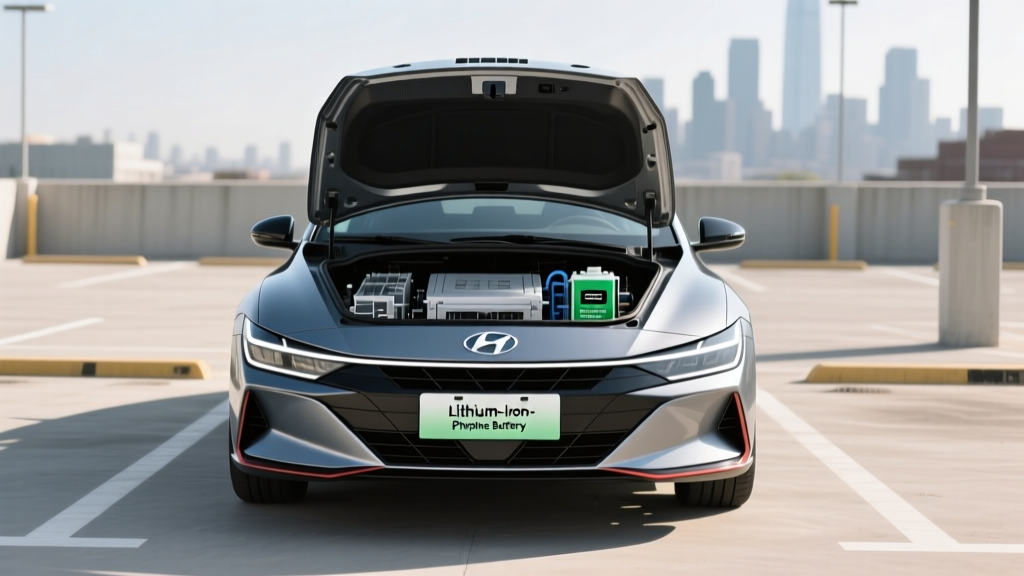
If you own or are shopping for a 2022 Hyundai Elantra—whether the hybrid (HEV) or a comparable Hyundai EV like the Kona Electric—you likely have questions about the high-voltage battery. How long will it last? What does the warranty actually cover? And if the worst happens, what does a replacement cost? This guide answers those questions with real data, covering the Elantra Hybrid's lithium-ion polymer pack alongside broader Hyundai EV battery technology so you know exactly what to expect over the life of the car.
2022 Hyundai Elantra Hybrid Battery: Specs at a Glance
The 2022 Elantra Hybrid pairs a 1.6-liter four-cylinder engine with an electric motor and a compact lithium-ion polymer battery pack. Here are the key figures:
| Specification | 2022 Hyundai Elantra Hybrid |
|---|---|
| Battery Type | Lithium-Ion Polymer |
| Battery Capacity | 1.32 kWh (nominal) |
| Battery Location | Under rear seat |
| Electric Motor Output | 32 kW (43 hp) |
| Combined System Output | 139 hp |
| EPA Combined MPG | 54 MPG (Blue trim) / 50 MPG (Limited) |
| EPA Combined Range | ~590 miles (Blue trim, 11-gal tank) |
| Battery Warranty | 10 years / 100,000 miles (original owner) |
Because the Elantra Hybrid's 1.32 kWh pack is small—used for assist and brief electric-only motoring rather than sustained EV driving—it experiences far less stress than a full BEV battery. This translates to excellent longevity in practice.
How Long Do Hyundai Hybrid and EV Batteries Last?
For the 2022 Hyundai Elantra Hybrid battery, the realistic lifespan is the life of the car. Hyundai's hybrid battery packs are designed to outlast 150,000–200,000 miles with minimal capacity loss. Real-world data from Hyundai's hybrid lineup (Ioniq Hybrid, Sonata Hybrid) shows degradation of roughly 5–8% over 100,000 miles—meaning a pack that started with 1.32 kWh might hold ~1.22 kWh after a decade of typical driving. For a hybrid, this is functionally unnoticeable; the gasoline engine compensates seamlessly.
For Hyundai's full battery-electric vehicles (like the Kona Electric or Ioniq 5), the data is more extensively tracked:
- Kona Electric (28 kWh, early models): ~5–7% capacity loss over 60,000 miles / 4 years (fleet data)
- Ioniq 5 (77.4 kWh, NMC): ~3–5% loss over first 50,000 miles based on owner-reported State of Health (SoH) readings
- General industry average (all BEVs): ~10–12% degradation at 100,000 miles / 8 years, per Geotab's large-scale fleet study
The takeaway: modern lithium-ion packs—especially Hyundai's, which use conservative thermal management and buffer strategies—rarely need replacement during typical ownership. Catastrophic failure is exceedingly rare; gradual capacity loss is the norm, and it's slow enough that most owners never notice it day-to-day.
Hyundai Battery Warranty: What's Covered and for How Long
Hyundai provides one of the strongest battery warranties in the industry. Here's how coverage breaks down:
| Vehicle Type | Warranty Period | Capacity Threshold | Notes |
|---|---|---|---|
| Elantra Hybrid (HEV) | 10 years / 100,000 miles | Below ~70% capacity | Original owner; may differ for second owner in some states |
| Hyundai BEVs (Kona Electric, Ioniq 5) | 10 years / 100,000 miles | Below 70% capacity | Original owner; CARB states may get 10yr/150,000mi |
| 12V Auxiliary Battery | 3 years / 36,000 miles | N/A — standard defect coverage | This is the small under-hood battery, NOT the traction pack |
What triggers a warranty claim? Hyundai will replace or refurbish the high-voltage battery if its capacity falls below approximately 70% of original capacity within the warranty period, or if a cell/module defect causes a malfunction. The diagnostic is performed at a Hyundai dealership using proprietary battery management system (BMS) tools.
Second-owner note: In California Air Resources Board (CARB) states—California, New York, Massachusetts, and others that adopt CARB emissions standards—the hybrid/EV battery warranty may transfer to subsequent owners for the full 10-year/150,000-mile term. In non-CARB states, second owners typically receive a reduced 10-year/100,000-mile warranty from the original in-service date. Always verify with Hyundai's official warranty page or your dealer.
How Much Does a Hyundai Battery Replacement Cost?
This is the question that causes the most anxiety, so let's ground it in real numbers. Replacement costs vary dramatically by battery size and chemistry:
| Model / Battery Size | Chemistry | Estimated Replacement Cost (Parts + Labor) | Typical Replacement Timeline |
|---|---|---|---|
| Elantra Hybrid (1.32 kWh) | Li-Ion Polymer | $2,000 – $3,500 | Rarely needed; 150,000+ mi lifespan typical |
| Kona Electric (64 kWh) | NMC | $12,000 – $18,000 | 10–15 years / 150,000+ mi |
| Ioniq 5 (77.4 kWh) | NMC | $14,000 – $22,000 | 10–15 years / 150,000+ mi |
Battery Chemistry: LFP vs NMC — Which Does Hyundai Use?
The 2022 Elantra Hybrid uses a lithium-ion polymer cell configuration, which is a packaging variant of NMC-style chemistry optimized for Hyundai's compact hybrid applications. For Hyundai's BEVs, the chemistry story is more nuanced:
| Factor | NMC (Nickel Manganese Cobalt) | LFP (Lithium Iron Phosphate) |
|---|---|---|
| Energy Density | Higher (~250 Wh/kg cell-level) — more range in less space | Lower (~160 Wh/kg) — heavier pack for same range |
| Cycle Life | ~1,000–1,500 full cycles to 80% SoH | ~3,000–5,000 full cycles to 80% SoH |
| Cold-Weather Performance | Better low-temp conductivity; less range loss below freezing | More sluggish in cold; greater range penalty below 32°F |
| Cost | Higher (cobalt and nickel are expensive) | Lower (iron and phosphate are abundant) |
| Safety / Thermal Stability | Good with active thermal management | Excellent — inherently more stable chemistry |
| Charging to 100% | Best kept at 80% daily; 100% for trips only | Can be charged to 100% regularly without harm |
| Hyundai Usage | Ioniq 5, Ioniq 6, Kona Electric (Long Range) | Kona Electric (Standard Range, select markets) |
Which is better? It depends on your priorities. NMC wins on range-per-pound and cold-weather usability—critical for US buyers in northern states. LFP wins on longevity, cost, and daily convenience (no need to baby the charge limit). Hyundai has begun offering LFP packs in standard-range models globally, and this trend will expand through 2026–2027 model years.
Factors That Affect Battery Life (and What You Can Control)
Whether you're driving the Elantra Hybrid or a Hyundai BEV, these factors influence long-term battery health:
- Minimize DC fast charging: Occasional use is fine, but daily fast-charging accelerates degradation. For BEVs, aim for Level 2 home charging as your primary method.
- Avoid extreme State of Charge: For NMC packs, keep daily SoC between 20–80%. For LFP, charging to 100% regularly is acceptable and even recommended for SoC calibration.
- Precondition in cold weather: Use Hyundai's scheduled departure or remote preconditioning to warm the battery before driving. This reduces stress and improves regen braking performance.
- Don't let the car sit at 0% or 100%: If storing for more than a week, aim for ~50% SoC. The BMS draws a small parasitic load even when parked.
- Keep up with software updates: Hyundai periodically refines BMS algorithms via dealership or OTA updates. These can improve charge curves and thermal management.
- For the Elantra Hybrid specifically: The small pack is managed automatically—you don't need to micromanage SoC. Just drive normally; the hybrid system handles the rest.
Temperature is the single biggest factor you can't fully control. Batteries degrade faster in sustained heat (above 95°F ambient, common in Arizona/Texas summers) than in cold. Hyundai's active thermal management in its BEVs mitigates this, but the Elantra Hybrid's small pack relies on passive cooling—which is adequate given the low energy throughput.
How to Check Your Hyundai Battery's State of Health (SoH)
For the 2022 Elantra Hybrid, battery health monitoring is handled internally by the hybrid control unit. There is no owner-facing SoH percentage on the dashboard. If you suspect an issue—unusual fuel economy drops, reduced electric assist, or a hybrid system warning light—a Hyundai dealer can pull a full BMS diagnostic report showing cell voltages, internal resistance, and estimated capacity.
For Hyundai BEV owners (Kona Electric, Ioniq 5), there are more options:
- Hyundai Bluelink app: Some model years display estimated battery health or range-vs-new comparisons.
- OBD-II diagnostic tools: Devices like the OBDeleven or Carista adapter, paired with apps such as EVBatMon or Car Scanner, can read the BMS-reported SoH percentage directly from the vehicle's CAN bus.
- Dealer diagnostic: A Hyundai service center can perform a full capacity test, typically as part of a warranty claim assessment.
- Range tracking: The simplest method—compare your current full-charge range to the EPA sticker. A 2022 Ioniq 5 that originally showed 303 miles at 100% but now shows 280 miles has roughly 92% SoH. Factor in temperature (winter range drops 15–30% regardless of degradation).
What's Next: Solid-State and Silicon Anode Batteries
Hyundai Motor Group has invested heavily in next-generation battery technology, but it's important to separate announcements from availability:
- Solid-state batteries: Hyundai has demonstrated prototype solid-state cells and targets limited production in the 2027–2028 timeframe. Solid-state promises higher energy density (~400+ Wh/kg), faster charging, and improved safety—but manufacturing scale and cost remain significant hurdles. No Hyundai vehicle currently on sale uses solid-state cells.
- Silicon anode technology: Hyundai-backed startups (including partnerships with Northvolt and others) are developing silicon-dominant anodes that could boost energy density by 20–30%. Expect initial deployment in limited models around 2026–2027, likely in premium Genesis or Ioniq N performance variants first.
- Sodium-ion batteries: A lower-cost alternative to lithium for budget EVs. Hyundai has not announced specific sodium-ion vehicle plans, but industry-wide adoption is expected in entry-level models by 2028+.
For current buyers, these technologies are forward-looking. The lithium-ion (NMC and LFP) batteries in today's Hyundai vehicles are mature, well-understood, and backed by extensive warranty coverage. There is no reason to delay a purchase waiting for solid-state.
Frequently Asked Questions
How long does the 2022 Hyundai Elantra Hybrid battery last?
Based on Hyundai's track record with hybrid battery packs (Ioniq, Sonata), expect the Elantra Hybrid's 1.32 kWh lithium-ion polymer battery to last 150,000–200,000+ miles with only 5–8% capacity loss. It is covered by a 10-year/100,000-mile warranty. Full replacement during typical ownership is rare.
How much does a 2022 Elantra Hybrid battery replacement cost?
Estimated at $2,000–$3,500 for parts and labor at a Hyundai dealership. This is rarely needed—the pack is small, lightly stressed, and warranty-covered for a decade. For comparison, a Hyundai BEV battery replacement (Kona Electric, Ioniq 5) runs $12,000–$22,000 but is needed even less frequently.
Does the Elantra Hybrid battery warranty transfer to a second owner?
In CARB states (California, New York, Massachusetts, and others), the 10-year/100,000-mile (or 150,000-mile) battery warranty typically transfers. In non-CARB states, coverage may be reduced for subsequent owners. Check with Hyundai's warranty page or your local dealer for your state's specific terms.
Can I check the Elantra Hybrid battery health myself?
Not directly through the dashboard—there's no owner-facing SoH readout. A Hyundai dealer can run a full BMS diagnostic. If you notice declining fuel economy or reduced electric assist, that's the time to schedule a check. For Hyundai BEVs, OBD-II tools like Car Scanner can read SoH percentage at home.
Is the 2022 Elantra Hybrid battery the same as a full EV battery?
No. The Elantra Hybrid uses a small 1.32 kWh pack that assists the gasoline engine—it cannot drive the car on electricity alone for meaningful distances. Full EVs like the Kona Electric or Ioniq 5 use 64–77.4 kWh packs (50–60x larger) that power the vehicle entirely. The Elantra's pack is far less expensive, less stressed, and simpler to replace.
LFP vs NMC: which battery chemistry is better for daily driving?
For daily commuting with home charging, LFP is arguably better—you can charge to 100% without worry, it lasts more cycles, and it costs less. For road-trippers and cold-climate drivers, NMC offers more range per pound and better winter performance. Hyundai uses NMC in most US-market BEVs, with LFP appearing in select standard-range models.