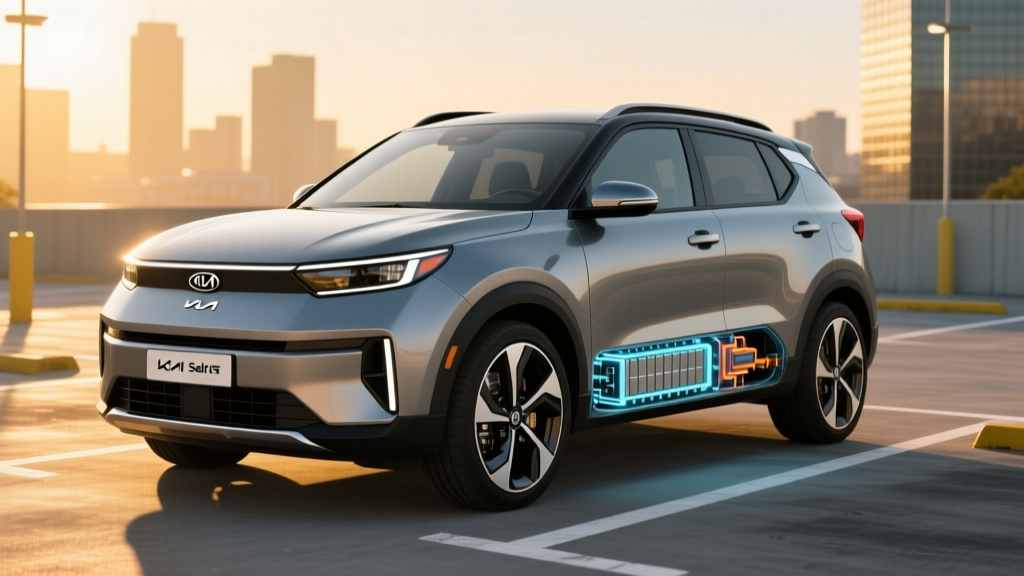
If you've searched for a 2021 Kia Seltos battery, you likely discovered a critical detail: the 2021 Seltos is a conventional gas-powered subcompact SUV, not an electric vehicle. It has no high-voltage traction battery — only a standard 12V auxiliary battery for starting and electronics. Kia introduced the EV9 three-row SUV in 2024 and the compact EV3 in select markets, but as of early 2026, no fully electric Seltos variant has been released in the United States.
However, Kia's EV lineup is expanding rapidly, and understanding EV battery technology — chemistry, degradation, warranty coverage, and replacement economics — is essential for any buyer considering Kia's current EVs (EV6, EV9, Niro EV) or future models that may carry the Seltos nameplate. This guide breaks down everything you need to know about modern EV batteries using Kia's current platform as a reference.
EV Battery Chemistry: LFP vs NMC Explained
Every EV battery pack is built from lithium-ion cells, but the cathode chemistry determines energy density, lifespan, cold-weather performance, and cost. Two chemistries dominate the market: NMC (Nickel Manganese Cobalt) and LFP (Lithium Iron Phosphate).
Kia's current US-market EVs — including the EV6 and EV9 — use NMC cells supplied primarily by SK On. NMC delivers higher energy density, meaning more range per kilogram of battery weight. This is why the EV6 GT-Line with its 77.4 kWh usable battery achieves an EPA-estimated 310 miles of range.
LFP chemistry, used by Tesla in Model 3/Y Standard Range and increasingly adopted by Ford, Hyundai (in some markets), and Chinese OEMs, trades some energy density for dramatically longer cycle life, better thermal stability, and lower raw-material cost. LFP cells tolerate regular charging to 100% without accelerated degradation — something NMC owners should avoid.
| Attribute | NMC (Nickel Manganese Cobalt) | LFP (Lithium Iron Phosphate) |
|---|---|---|
| Energy Density | High (~250 Wh/kg cell-level) | Moderate (~170 Wh/kg cell-level) |
| Typical Cycle Life | 1,000–2,000 full cycles | 3,000–5,000+ full cycles |
| Cold-Weather Performance | Better low-temp conductivity | More range loss below freezing |
| Charging to 100% | Accelerates degradation above 80% | Tolerates regular 100% SoC |
| Cost per kWh (2026) | ~$110–130/kWh pack-level | ~$80–100/kWh pack-level |
| Thermal Stability | Good with active cooling | Excellent — lower runaway risk |
| Used In (US Market) | Kia EV6, EV9, Hyundai Ioniq 5/6 | Tesla Model 3 RWD, Ford Mustang Mach-E Select |
Which is better? It depends on your usage pattern. If you need maximum range and frequently drive in cold climates, NMC's energy density and cold-weather edge matter. If you mostly commute, can charge at home daily, and want the longest possible battery lifespan, LFP's cycle-life advantage and 100% charge tolerance make it the pragmatic choice.
How Long Do EV Batteries Actually Last?
The short answer: most EV batteries outlast the car they're installed in. Real-world fleet data from Tesla, Hyundai/Kia, and independent testing organizations show that modern liquid-cooled battery packs retain 85–92% of original capacity after 100,000 miles and 5–8 years of use.
Kia's current battery management systems (BMS) in the EV6 and EV9 maintain a protective buffer — typically 4–6 kWh of the total pack capacity is reserved and inaccessible to the driver. This buffer prevents the cells from experiencing the extreme high and low states of charge that accelerate degradation.
| Milestone | Typical Capacity Retained (NMC) | Typical Capacity Retained (LFP) | Context |
|---|---|---|---|
| 1 year / 15,000 mi | 96–98% | 98–99% | Initial settling; mostly calendar aging |
| 3 years / 45,000 mi | 92–95% | 95–97% | Noticeable but minor range reduction |
| 5 years / 75,000 mi | 88–92% | 92–96% | Within warranty threshold for most brands |
| 8 years / 120,000 mi | 82–88% | 88–94% | Warranty period end; still functional |
| 10 years / 150,000 mi | 78–85% | 85–92% | Most vehicles retired before this point |
Data compiled from fueleconomy.gov owner reports, Tesla Impact Reports, and Geotab fleet studies. Individual results vary significantly based on charging habits, climate, and thermal management quality.
A Kia EV6 owner who charges primarily at home on Level 2, limits fast-charging to road trips, and lives in a temperate climate can realistically expect 90%+ capacity retention at 100,000 miles. The battery will not "die" — it will gradually hold less energy, reducing range proportionally.
Kia's Battery Warranty: What's Covered
Kia offers one of the strongest EV battery warranties in the industry. For the EV6, EV9, and Niro EV, the high-voltage battery is covered for 10 years or 100,000 miles (whichever comes first) with a capacity retention threshold of 70%.
| Coverage Item | Kia EV Battery Warranty | Industry Average |
|---|---|---|
| Duration | 10 years / 100,000 miles | 8 years / 100,000 miles |
| Capacity Threshold | 70% of original capacity | 70% of original capacity |
| What Triggers Claim | SoH drops below 70% within term | Same |
| Remedy | Module or pack replacement at no cost | Varies — some replace modules, some full pack |
| Transferable | Yes, to subsequent owners | Varies by manufacturer |
| Exclusions | Physical damage, flooding, unauthorized modification | Similar across brands |
This means that if your EV6's battery degrades to below 70% of its original 77.4 kWh usable capacity (approximately 54.2 kWh) within 10 years or 100,000 miles, Kia will repair or replace the battery at no charge. In practice, very few owners hit this threshold under normal use — degradation curves tend to flatten after the first 20,000–30,000 miles.
EV Battery Replacement Cost: When and How Much
Out-of-warranty battery replacement is the single largest potential EV ownership expense. However, it's important to contextualize: the vast majority of EV batteries never need replacement during the vehicle's useful life. Most EVs are retired due to body damage, technology obsolescence, or owner preference before the battery fails catastrophically.
When replacement is needed — typically after 12–15 years or 200,000+ miles, or due to manufacturing defect outside warranty — costs vary by pack size and chemistry.
| Battery Pack Size | Chemistry | Replacement Cost Range (2026) | Example Vehicles |
|---|---|---|---|
| 40–50 kWh | NMC | $6,000–$9,000 | Nissan Leaf, older Chevy Bolt |
| 58–65 kWh | NMC | $8,000–$12,000 | VW ID.4, Hyundai Kona Electric |
| 72–80 kWh | NMC | $10,000–$16,000 | Kia EV6, Tesla Model Y LR |
| 80–100 kWh | NMC | $13,000–$20,000 | Kia EV9, Tesla Model S, Ford F-150 Lightning ER |
| 50–60 kWh | LFP | $5,000–$8,000 | Tesla Model 3 RWD |
These figures include parts and labor at authorized dealerships. Independent EV shops and refurbished pack options are emerging and can reduce costs by 30–40%. Module-level repair — replacing only the degraded cell modules rather than the entire pack — is increasingly available and typically costs $2,000–$5,000.
Battery costs have declined roughly 80% since 2010 and continue falling. By the time a 2026 EV actually needs a replacement pack (likely 2038–2040), prices will be substantially lower than today's figures.
Factors That Accelerate Battery Degradation
Not all miles are equal when it comes to battery wear. Understanding what stresses lithium-ion cells lets you maximize your pack's lifespan.
What Accelerates Degradation
- Frequent DC fast charging: Repeated high-power sessions (150+ kW) generate heat that stresses cells. Occasional road-trip fast charging is fine; daily reliance on DCFC measurably accelerates wear.
- Sustained high state of charge: Storing an NMC battery at 90–100% SoC for days or weeks accelerates calendar aging. Charge to 80% for daily use; save 100% for when you need the full range.
- Deep discharges: Regularly draining below 10% SoC stresses cells. Try to plug in before the pack drops below 15–20%.
- Extreme heat exposure: Parking in direct sun in 100°F+ climates for extended periods without thermal management active. Kia's liquid-cooled system mitigates this, but garage parking helps.
- Extreme cold charging: Charging at high power when the battery is below freezing without preconditioning can cause lithium plating. Always use the vehicle's preconditioning feature before fast charging in cold weather.
Best Practices for Longevity
- Charge primarily on Level 2 (7–11 kW) at home — gentle on cells
- Set daily charge limit to 80% for NMC, 100% is fine for LFP
- Use DC fast charging for road trips, not daily commuting
- Enable battery preconditioning when navigating to a charger
- Avoid leaving the vehicle at very low or very high SoC for weeks
- Drive and charge in moderate temperatures when possible
Monitoring Your Battery's State of Health
State of Health (SoH) is the percentage of original capacity your battery currently holds. A new EV starts at 100% SoH; at 70% SoH, the battery still functions but delivers only 70% of its original range.
Kia owners can check battery health through several methods:
- Kia Access app: The connected-services app displays estimated battery health and charging statistics on EV6 and EV9 models. Check under the "Vehicle Status" or "EV" section.
- OBD-II diagnostic tools: Third-party apps like EV Health, LeafSpy (for Nissan), or Torque Pro paired with an OBD-II Bluetooth adapter can read the BMS-reported SoH directly. This gives a more precise reading than dashboard estimates.
- Dealer diagnostic check: Any Kia dealer can run a full battery diagnostic that reads individual cell voltages, internal resistance, and overall SoH. Request this during routine service visits, especially before the warranty period expires.
- Range tracking: The simplest method — track your real-world range at a consistent SoC over time. If your EV6 consistently delivered 250 real-world miles at 80% SoC in year one but now delivers 230 miles at the same SoC and similar conditions, that's roughly an 8% degradation indicator.
Looking Ahead: Solid-State and Next-Gen Batteries
Several next-generation battery technologies are in development, though none are commercially available in production vehicles as of early 2026.
Solid-state batteries replace the liquid electrolyte with a solid conductor, promising higher energy density (potentially 400+ Wh/kg at the cell level), faster charging, and improved safety. Toyota has announced a solid-state battery targeting 2027–2028 production, and Samsung SDI is developing cells for potential Hyundai/Kia use. However, manufacturing scale-up remains a significant challenge, and initial deployments will likely be limited to premium, low-volume models.
Silicon-dominant anodes are closer to commercialization. Companies like Sila Nanotechnologies and Group14 are supplying silicon-anode materials that increase energy density by 20–40% compared to graphite anodes. These are expected to appear in production EVs by 2027–2028.
Sodium-ion batteries are emerging as a low-cost alternative for entry-level EVs and stationary storage. CATL has begun production, and these cells could appear in budget EVs by 2027, though with lower energy density than lithium-ion.
For buyers today, current NMC and LFP batteries are mature, well-tested, and backed by extensive warranties. Waiting for next-gen tech means waiting 3–5+ years for mainstream availability at scale.
Frequently Asked Questions
Does the 2021 Kia Seltos have an EV battery?
No. The 2021 Kia Seltos is a gasoline-powered subcompact SUV with a 2.0L or 1.6L turbocharged engine. It has a standard 12V lead-acid auxiliary battery for starting and electronics but no high-voltage traction battery. Kia's current US-market EVs include the EV6, EV9, and Niro EV.
How long do EV batteries last in years and miles?
Modern liquid-cooled EV batteries typically retain 85–92% capacity after 100,000 miles and 5–8 years. Most will function adequately for 150,000–200,000+ miles before degradation makes the vehicle impractical for daily use. Kia warranties its EV batteries for 10 years/100,000 miles at 70% capacity retention.
How much does an EV battery cost to replace?
Out-of-warranty replacement for a mid-size EV pack (72–80 kWh, like the Kia EV6) ranges from $10,000–$16,000 in 2026. Smaller packs cost $6,000–$9,000; larger packs (100 kWh+) cost $13,000–$20,000. Module-level repair can reduce this to $2,000–$5,000. Most EV batteries never need replacement during the vehicle's useful life.
What does Kia's EV battery warranty cover?
Kia covers the high-voltage battery for 10 years or 100,000 miles with a 70% capacity retention threshold. If the battery's State of Health drops below 70% within that period, Kia will repair or replace it at no cost. The warranty is transferable to subsequent owners and excludes physical damage, flooding, and unauthorized modifications.
Is LFP or NMC better for my EV?
LFP offers longer cycle life (3,000–5,000+ cycles vs. 1,000–2,000 for NMC), better thermal stability, lower cost, and tolerance for daily 100% charging — ideal for commuters and daily drivers. NMC provides higher energy density (more range per pound) and better cold-weather performance — better for long-range needs and cold climates. Kia's current US EVs use NMC.
How do I check my EV battery's health?
Use the manufacturer's connected app (Kia Access), an OBD-II diagnostic tool with EV-specific software, or request a dealer diagnostic check. You can also track real-world range at a consistent state of charge over time — declining range under similar conditions indicates degradation.
Does fast charging damage my EV battery?
Occasional DC fast charging on road trips has minimal impact. However, daily reliance on high-power DCFC (150+ kW) generates sustained heat that measurably accelerates cell degradation over time. For daily charging, Level 2 home charging at 7–11 kW is the gentlest option and recommended for maximum battery longevity.