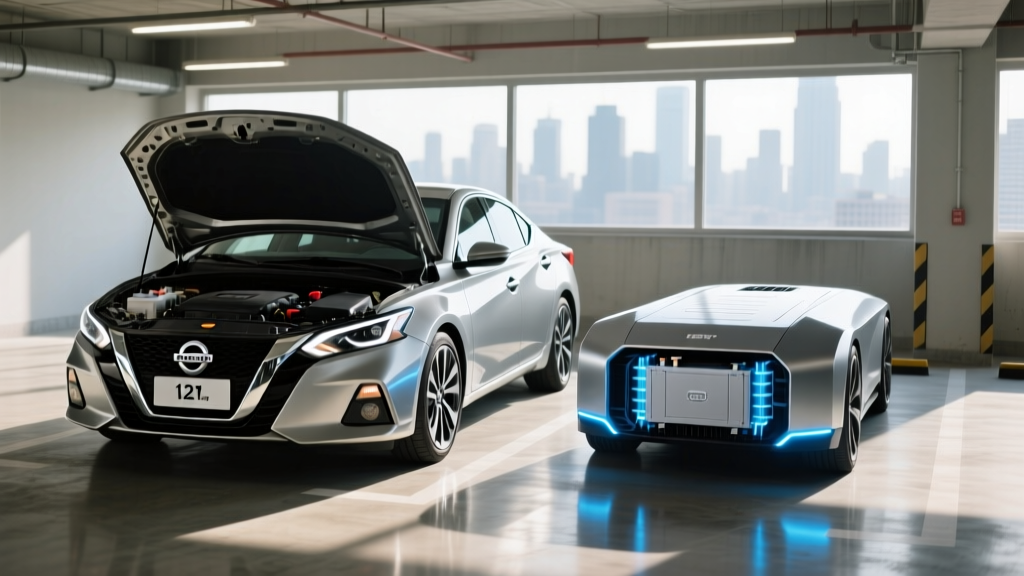
If you're searching for a battery for 2019 Nissan Altima, you're almost certainly looking for a conventional 12-volt lead-acid or AGM auxiliary battery — the 2019 Altima is a gasoline-powered sedan with no high-voltage traction pack. But that search often lands on pages about electric-vehicle batteries, and the two technologies are fundamentally different in chemistry, cost, lifespan, and purpose. This guide clarifies exactly what a 2019 Altima needs, then provides a deep-dive into EV traction battery technology so you understand what's changing across the industry — and what you'd be signing up for if your next car is electric.
2019 Nissan Altima Battery: What You Actually Need
The 2019 Nissan Altima (2.5L 4-cylinder and 2.0L VC-Turbo trims) uses a standard Group 35 12V lead-acid battery, typically rated at around 550–640 cold cranking amps (CCA). This battery powers the starter motor, ECU, infotainment, and lighting — it has nothing to do with propulsion. Average replacement cost at an auto-parts store in 2026 runs $140–$230 for the battery itself, with a typical lifespan of 3–5 years depending on climate and driving habits.
By contrast, an electric vehicle carries two battery systems:
- 12V auxiliary battery — same concept as the Altima's, though often a smaller lithium-iron-phosphate (LiFePO4) unit in newer EVs (Tesla, Rivian, Hyundai Ioniq 5/6).
- High-voltage traction battery — the large pack (40–120+ kWh) that actually drives the wheels. This is what people mean when they discuss "EV batteries."
The rest of this article focuses on the traction battery — the expensive, complex, and often misunderstood component that defines EV ownership.
LFP vs. NMC vs. NCA: EV Battery Chemistry Explained
Not all EV batteries are the same. The two dominant lithium-ion chemistries in 2026 are LFP (lithium iron phosphate) and NMC/NCA (nickel manganese cobalt / nickel cobalt aluminum). The chemistry you get depends on the model and trim — and it affects range, longevity, cold-weather behavior, and price.
| Attribute | LFP (LiFePO₄) | NMC / NCA |
|---|---|---|
| Energy density | ~160–180 Wh/kg (lower) | ~220–300 Wh/kg (higher) |
| Typical cycle life | 3,000–6,000+ cycles | 1,000–2,000 cycles |
| Cold-weather performance | Weaker below 32°F; slower charging | Better low-temp output |
| Cost per kWh (pack-level) | ~$90–$110 | ~$120–$150 |
| Thermal stability / safety | Excellent; very low fire risk | Good with active management |
| Recommended charge habit | Can charge to 100% daily | Best kept 20–80% daily; 100% for trips |
| Common in (2026 examples) | Tesla Model 3/Y RWD, BYD, base Ford Mustang Mach-E Select | Tesla Long Range, Hyundai Ioniq 5/6, Rivian, Lucid, Porsche Taycan |
Which is better? For daily commuters who charge at home and don't regularly face sub-freezing winters, LFP offers superior longevity and lower cost. For road-trippers, cold-climate drivers, and performance-oriented buyers, NMC/NCA delivers more range per kilogram and better winter output. Neither is universally "best" — it depends on your use case.
How Long Do EV Batteries Actually Last?
Replacement fear is the single biggest barrier to EV adoption, and it's mostly overblown. Modern liquid-cooled traction batteries routinely outlast the vehicles they're installed in. Here's what real-world data shows:
Observed degradation benchmarks (fleet and owner data):
- Tesla Model 3/Y (NMC & LFP): ~5–8% capacity loss at 100,000 miles; ~10–12% at 200,000 miles, per Tesla's 2024 Impact Report and aggregated Recurrent data.
- Nissan Leaf (passively cooled, older chemistry): 15–25% loss by 100,000 miles on 2013–2017 models — the cautionary tale that pushed the industry toward active thermal management.
- Hyundai/Kia E-GMP (Ioniq 5, EV6): ~4–7% loss at 80,000 miles in early fleet reporting.
- Chevrolet Bolt EV/EUV: ~6–10% at 100,000 miles post-recall replacement packs.
A well-designed 2026 pack is engineered for 1,500–3,000 equivalent full cycles before hitting 80% state of health (SoH). For a 250-mile-range EV, that translates to 375,000–750,000 miles of theoretical life before significant degradation. Most vehicles are scrapped for other reasons long before the pack wears out.
Battery Warranty Terms: What's Actually Covered
Federal law (EPA Title II) mandates a minimum 8 years / 80,000 miles warranty on EV battery packs for emissions-related components, and California Air Resources Board (CARB) states extend this to 10 years / 150,000 miles. Most automakers exceed these minimums voluntarily. Here's a snapshot:
| Manufacturer | Warranty Period | Capacity Retention Threshold |
|---|---|---|
| Tesla (Model 3/Y) | 8 yr / 120,000 mi (LR); 8 yr / 100,000 mi (RWD) | 70% SoH |
| Hyundai / Kia | 10 yr / 100,000 mi | 70% SoH |
| Ford (Mach-E, F-150 Lightning) | 8 yr / 100,000 mi | 70% SoH |
| General Motors (Ultium) | 8 yr / 100,000 mi | 70% SoH |
| BMW | 8 yr / 100,000 mi | 70% SoH |
| Rivian | 8 yr / 175,000 mi (Max pack) | 70% SoH |
Key caveat: The warranty covers defects and excessive degradation below the threshold — not gradual normal loss. If your pack is at 74% SoH at year 7, you're within spec and not eligible for a claim. Read the fine print: some manufacturers prorate coverage or exclude damage from improper charging, flood, or collision.
EV Battery Replacement Cost: The Real Numbers
Out-of-warranty replacement is rare but worth budgeting for on high-mileage used EVs. Costs scale with pack size and chemistry:
| Vehicle / Pack Size | Approx. Replacement Cost (parts + labor) |
|---|---|
| Nissan Leaf 40 kWh | $6,500–$9,000 |
| Chevrolet Bolt 65 kWh | $9,000–$14,000 |
| Tesla Model 3 (60–82 kWh) | $12,000–$16,000 |
| Hyundai Ioniq 5 (77.4 kWh) | $14,000–$18,000 |
| Ford F-150 Lightning (131 kWh Extended) | $20,000–$28,000 |
| Lucid Air (112 kWh) | $22,000–$30,000+ |
When is replacement typically needed? Almost never during the warranty period. The few packs that do fail early are usually manufacturing defects (covered) or collision/fire damage (insurance). Pack prices have fallen roughly 80% since 2013 on a per-kWh basis, per Our World in Data, and are projected to continue declining. For comparison, a major ICE powertrain failure (transmission, engine rebuild) also runs $4,000–$9,000 — EVs aren't uniquely expensive to repair catastrophically.
Factors That Accelerate (or Preserve) Battery Life
Chemistry sets the ceiling, but owner behavior determines how close you get to it. Here are the five biggest levers:
- State of charge habits: For NMC/NCA, daily charging to 80% (not 100%) dramatically slows calendar aging. LFP owners can — and should — charge to 100% regularly to keep the BMS calibrated.
- DC fast-charging frequency: Occasional Supercharging is fine; daily 250 kW sessions on a hot pack accelerate degradation. Use Level 2 at home as your primary method.
- Temperature extremes: Sustained heat (above 95°F ambient with a hot-soaked pack) is worse than cold. Precondition the battery before fast-charging in cold weather; park in shade/garage when possible in summer.
- Storage state: Leaving an EV at 100% SoC for weeks in heat, or at 0% for weeks in cold, causes permanent loss. For long storage, target ~50% SoC and keep plugged in with charge limit set.
- Deep discharges: Regularly running to 0% stresses cells. Treat 10% as your practical floor.
Monitoring State of Health (SoH) as an Owner
You don't have to guess how your pack is aging. Most 2026 EVs expose SoH data through the vehicle's infotainment or companion app, and third-party tools offer deeper reads:
- OEM apps: Tesla, Hyundai, Ford, BMW, and Rivian all show estimated range trends or SoH percentage in-app.
- OBD-II dongles + apps: Tools like OBDLink MX+ paired with apps such as LeafSpy (Nissan), Scan My Tesla, or Car Scanner pull raw BMS data including cell voltages, degradation %, and cycle count.
- Recurrent / Geotab fleet reports: Aggregated, anonymized data you can compare your vehicle against.
- Dealer diagnostic: A service-department printout is the gold standard for a pre-purchase inspection on a used EV — always request one.
Emerging Tech: Solid-State, Silicon Anodes, and What's Real
Headlines promise revolution; timelines tell a slower story. Here's where next-gen tech actually stands as of 2026:
- Silicon-dominant anodes: Already shipping in limited applications (Amprius cells for specialty uses; early automotive adoption by GM/Ultium and Mercedes via Sila Nanotechnologies in the 2026–2027 G-Wagen EV). Expect ~10–20% energy-density gains before mainstream rollout.
- Semi-solid-state: NIO's 150 kWh semi-solid pack is in limited Chinese-market service; U.S. availability remains announced/preliminary for 2027+ programs.
- True solid-state: Toyota, Samsung SDI, and QuantumScape target 2027–2029 production. These promise 2× energy density, 10-minute charging, and dramatically improved safety — but remain in pilot and validation phases, not currently available in any production vehicle sold in the U.S.
- Sodium-ion: CATL and BYD are deploying sodium-ion packs in budget Chinese-market EVs. Lower energy density but excellent cold performance and no lithium/cobalt. U.S. consumer availability is 2027+ at the earliest.
For buyers shopping today, current lithium-ion packs (LFP and NMC) are mature, well-warrantied, and demonstrably long-lived. Waiting for solid-state means waiting years — and paying a premium when it arrives.
Frequently Asked Questions
Can I put an EV traction battery in a 2019 Nissan Altima?
No. The 2019 Altima is a conventional gasoline vehicle with no high-voltage architecture, electric motor, or inverter. You need a Group 35 12V lead-acid or AGM battery, available at any auto-parts retailer for $140–$230.
How long do EV batteries last in years and miles?
Modern liquid-cooled EV packs typically retain 80–90% of original capacity at 100,000 miles and 8–10 years. Many will outlast the vehicle's useful life. Passively cooled older packs (early Nissan Leaf) degraded faster.
How much does an EV battery cost to replace?
Between $6,500 and $30,000 depending on pack size and vehicle, with most mainstream models (Model 3, Ioniq 5, Mach-E) falling in the $12,000–$18,000 range including labor. Full replacements are rare — most packs outlive their cars.
What does the battery warranty actually cover?
Defects and capacity loss below a stated threshold (typically 70% SoH) within 8 years / 100,000 miles (10 years in CARB states). It does not cover normal gradual degradation above the threshold, collision damage, or abuse.
How do I check my EV battery's health?
Use the OEM app, an OBD-II reader with EV-specific software (LeafSpy, Scan My Tesla, Car Scanner), or request a dealer diagnostic printout. SoH percentage and cell-voltage delta are the key metrics.
LFP vs NMC — which should I choose?
LFP for daily commuting, long cycle life, and lower cost if you charge at home and don't face harsh winters. NMC/NCA for maximum range, cold-climate performance, and road-trip flexibility. Both are proven and well-warrantied in 2026.
Does fast charging damage the battery?
Occasional DC fast charging is fine. Daily high-power (250+ kW) sessions on a hot pack accelerate degradation. Preconditioning and favoring Level 2 home charging extend pack life.
Sources: fueleconomy.gov (EPA range/efficiency data), IRS §30D clean vehicle credit guidance, manufacturer warranty documentation, Recurrent Auto battery fleet data, Our World in Data battery pricing.