If you own or are shopping for a 2019 Hyundai Tucson battery vehicle — whether the standard hybrid (HEV) or the Tucson Plug-In Hybrid variant sold in select markets — you likely have questions about long-term battery durability, replacement cost, and what degradation actually looks like after six or seven years on the road. This guide breaks down the real data on Hyundai's hybrid battery packs, how they compare to full BEV chemistry, and what the broader EV battery landscape means for your ownership costs in 2026.
Before we get into specifics, an important distinction: the 2019 Tucson sold in the United States was available as a conventional gasoline model and, in some markets, as a mild-hybrid or full hybrid. The Tucson PHEV and fully electric variants arrived in later model years. This article covers the hybrid traction battery in the 2019 Tucson, then broadens to EV battery technology principles — chemistry, degradation, warranty, replacement, and care — that apply to any electrified Hyundai you might cross-shop today.
2019 Hyundai Tucson Hybrid Battery: What's Under the Floor
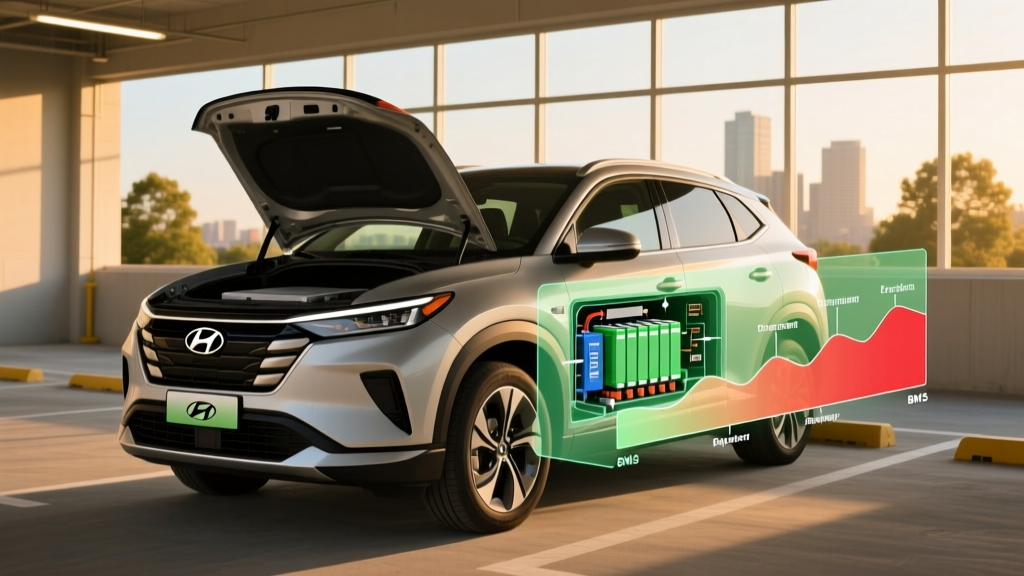
The 2019 Hyundai Tucson hybrid (sold primarily in international markets as the Tucson Hybrid or as a 48V mild-hybrid in Europe) uses a lithium-ion polymer traction battery. In the full-hybrid variant, the pack is typically rated around 1.56 kWh of total capacity, paired with a 1.6-liter gasoline engine. The mild-hybrid version uses a smaller 48V lithium-ion pack (approximately 0.44 kWh) that assists the engine during acceleration and enables extended stop-start functionality.
These are not the large 60–100 kWh packs you find in battery-electric vehicles like the Ioniq 5 or Kona Electric. Hybrid batteries are designed for frequent shallow cycling — absorbing regenerative braking energy and disbursing it in short bursts — rather than deep discharge cycles. That design philosophy has a direct impact on longevity.
Chemistry: Lithium-ion polymer (NMC-type cathode)
Capacity: ~1.56 kWh (full HEV) / ~0.44 kWh (48V mild-hybrid)
Function: Regenerative braking buffer + electric motor assist
Cooling: Passive/air-cooled (varies by market)
LFP vs NMC: Understanding EV Battery Chemistry Trade-Offs
Whether you're evaluating a 2019 Tucson hybrid battery or a 2026 Ioniq 5 BEV, the cathode chemistry inside the pack determines energy density, lifespan, cold-weather behavior, and cost. The two dominant chemistries in 2026 are NMC (nickel-manganese-cobalt) and LFP (lithium iron phosphate).
The 2019 Tucson hybrid uses an NMC-type chemistry, which was the industry standard for Hyundai's hybrid and electric lineup at the time. Here's how the two chemistries compare across the metrics that matter to owners:
| Metric | NMC / NCA | LFP |
|---|---|---|
| Energy density | Higher (250–300 Wh/kg cell-level) — more range per pound | Lower (160–200 Wh/kg) — heavier pack for same range |
| Cycle life | ~1,000–2,000 full cycles to 80% SoH | ~3,000–5,000+ full cycles to 80% SoH |
| Cold-weather performance | Better low-temp conductivity; ~20–30% range loss at 20°F | More resistive in cold; ~30–40% range loss at 20°F without active heating |
| Cost per kWh | Higher ($120–$150/kWh cell-level in 2026) | Lower ($80–$100/kWh cell-level in 2026) |
| Thermal stability | Good, but requires robust BMS and cooling | Excellent — inherently more stable chemistry |
| Typical applications | Long-range BEVs, performance models, hybrids (incl. 2019 Tucson) | Standard-range BEVs, fleet vehicles, home storage |
Which is better? It depends on your use case. NMC wins on energy density — critical for vehicles where pack weight and volume are constrained, like hybrids with small battery enclosures. LFP wins on longevity and cost, making it ideal for standard-range EVs and drivers who plan to keep their vehicle past 150,000 miles. Hyundai has increasingly adopted LFP for standard-range trims of models like the 2026 Kona Electric, while reserving NMC for long-range and performance variants.
How Long Do EV and Hybrid Batteries Actually Last?
This is the single most common question from EV shoppers and hybrid owners alike. The data, now spanning over a decade of real-world deployments, is reassuring:
- Hybrid batteries (HEV/PHEV): Most modern lithium-ion hybrid packs, including those in the 2019 Tucson hybrid, are designed to last the life of the vehicle — typically 150,000–200,000 miles or 10–15 years — with minimal capacity loss. Hyundai's hybrid batteries typically show 10–15% degradation over 100,000 miles based on fleet data from models like the Ioniq Hybrid and Sonata Hybrid.
- Battery-electric vehicles (BEV): Data from Recurrent Auto, which tracks over 15,000 EVs in real-world conditions, shows that the average BEV battery retains approximately 90–95% of original capacity at 50,000 miles and 85–90% at 100,000 miles. Catastrophic failure before 150,000 miles is rare — well under 5% of packs.
- Outliers exist: Early Nissan Leaf models (2011–2015) with passive air-cooling showed accelerated degradation in hot climates, losing 20–30% capacity within 5 years. Modern thermal management systems (liquid cooling) have largely eliminated this problem.
For the 2019 Tucson hybrid specifically, the small battery pack operates in a narrow state-of-charge window (typically 40–80% SoC) managed by the vehicle's battery management system (BMS). This shallow-cycling strategy is one of the most effective ways to preserve lithium-ion cell health, and it's why hybrid batteries routinely outlast their gas-engine counterparts without needing replacement.
Hyundai Battery Warranty: What's Covered and for How Long
Hyundai backs its hybrid and EV battery packs with one of the strongest warranties in the industry. Here's the breakdown as it applies to the 2019 Tucson hybrid and comparable Hyundai electrified models:
| Coverage | Hybrid (HEV/PHEV) Battery | BEV Traction Battery |
|---|---|---|
| Duration | 10 years / 100,000 miles (whichever comes first) | 10 years / 100,000 miles |
| Capacity retention threshold | Typically 70% of original capacity | Typically 70% of original capacity |
| What's covered | Defects, premature capacity loss below threshold | Defects, premature capacity loss below threshold |
| Transferable? | Yes, to subsequent owners (check with dealer) | Yes, to subsequent owners |
| Exclusions | Damage from accidents, flooding, unauthorized modifications | Same exclusions apply |
For a 2019 Tucson hybrid purchased new, the factory battery warranty would extend through approximately 2029 or 100,000 miles. If you're buying one used in 2026, verify the remaining warranty with a Hyundai dealer using the VIN — the hybrid battery coverage typically transfers to second owners, though the powertrain warranty portion may reduce to 5 years/60,000 miles for subsequent owners per Hyundai's warranty terms.
The 70% capacity retention threshold is important context: a warranty claim requires the battery to have degraded below 70% of its original capacity within the warranty period. Given that real-world data shows most Hyundai packs retaining 85–90% at 100,000 miles, hitting that threshold under normal use is unlikely.
EV and Hybrid Battery Replacement Cost: What to Budget
The fear of a $20,000 battery replacement bill is one of the most persistent barriers to EV and hybrid adoption. Let's put actual numbers to it:
| Vehicle / Battery Type | Pack Size | Replacement Cost Range (2026) | Typical Replacement Timeline |
|---|---|---|---|
| 2019 Tucson Hybrid (HEV) | ~1.56 kWh | $2,000–$4,000 (parts + labor) | Rarely needed before 150K+ miles |
| 48V Mild-Hybrid pack | ~0.44 kWh | $800–$1,500 | Rarely needed before 150K+ miles |
| Hyundai Kona Electric (BEV) | 64 kWh | $10,000–$16,000 | Rarely needed; most packs outlive the car |
| Hyundai Ioniq 5 (BEV) | 77.4 kWh | $12,000–$20,000 | Rarely needed; liquid-cooled packs last 200K+ mi |
| Tesla Model 3/Y (BEV) | 60–82 kWh | $12,000–$18,000 | Rarely needed before 200K miles |
The critical takeaway: for the 2019 Tucson hybrid, a battery replacement is a $2,000–$4,000 affair — comparable to a transmission rebuild on a conventional car, and far less catastrophic than the five-figure BEV pack replacement headlines suggest. For BEVs, replacement costs have dropped roughly 40% since 2020 as cell prices have fallen and refurbishment/remanufacturing programs have matured. Many shops now offer refurbished packs at 40–60% of new-pack cost.
Most importantly, the vast majority of EV and hybrid batteries never need replacement during typical ownership. Data from Consumer Reports and fleet operators consistently shows that fewer than 5% of modern lithium-ion traction batteries require replacement before 150,000 miles.
Factors That Affect Battery Life — and What You Can Control
Battery degradation is not random. It follows predictable electrochemical patterns driven by temperature, charge habits, and usage patterns. Here's what accelerates wear and what you can do about it:
- Avoid sustained 100% SoC: For NMC packs, daily charging to 80–90% is optimal. Hybrids manage this automatically (the BMS keeps the pack between ~40–80%), but BEV owners should set a charge limit.
- Minimize DC fast charging when possible: Frequent use of 150+ kW DC fast charging generates heat that accelerates electrolyte decomposition. For daily driving, Level 2 home charging (7–11 kW) is gentler. Save DCFC for road trips.
- Precondition in extreme cold: If your vehicle offers battery preconditioning (most modern BEVs do; the 2019 Tucson hybrid does not have active preconditioning), use it before fast charging in sub-40°F weather. Cold lithium-ion cells accept charge slower and experience more stress.
- Avoid prolonged storage at extremes: If storing the vehicle for weeks, aim for ~50% SoC and a moderate-temperature environment. Storing at 100% or near 0% for extended periods accelerates calendar aging.
- Drive it regularly: Lithium-ion cells prefer regular cycling to prolonged dormancy. Even short daily drives are better for battery health than weeks of sitting.
For 2019 Tucson hybrid owners, the good news is that the vehicle's BMS handles most of these optimizations automatically. The hybrid system never fully charges or fully depletes the pack during normal operation, which is inherently protective. Your main responsibility is simply to drive the car and follow the scheduled maintenance intervals.
How to Check Your Battery's State of Health (SoH)
State of Health (SoH) is the percentage of original battery capacity that remains usable. A new battery is 100% SoH; a battery that can only hold 85% of its original energy is at 85% SoH. Here's how to monitor it:
For the 2019 Hyundai Tucson Hybrid
- Dealer diagnostic scan: A Hyundai service center can pull the battery's SoH reading via the OBD-II diagnostic port using Hyundai's GDS (Global Diagnostic System). Request this during routine service visits — it takes about 5 minutes.
- OBD-II scanner apps: Third-party tools like Car Scanner ELM OBD2 or Hyundai-specific diagnostic apps can read hybrid battery voltage, cell balance data, and estimated SoH. A basic ELM327 Bluetooth adapter costs $15–$30.
- Fuel economy as a proxy: If your Tucson hybrid's real-world MPG drops significantly (e.g., from 32 MPG combined down to 26–28 MPG) without changes in driving habits or tire condition, it may indicate battery degradation reducing regenerative braking effectiveness and electric-assist contribution.
For BEV Owners (Ioniq 5, Kona Electric, etc.)
- In-vehicle displays: Many modern EVs show estimated range at full charge, which you can compare to the original EPA rating as a rough SoH proxy.
- Manufacturer apps: Hyundai's Bluelink app provides battery status and charging data, though it doesn't display a direct SoH percentage.
- Third-party services: Companies like Recurrent offer free battery health reports that compare your pack's degradation curve against a database of identical vehicles.
Emerging Battery Technology: Solid-State and Beyond
The battery landscape is evolving rapidly, though it's important to separate production reality from press-release promises:
- Solid-state batteries: These replace the liquid electrolyte with a solid conductor, promising 30–50% higher energy density, faster charging, and improved safety. Toyota, Samsung SDI, and QuantumScape have announced pilot production, but commercial-scale solid-state packs are not expected in consumer vehicles before 2028–2030. Hyundai's partnership with SolidEnergy Systems (SES) is targeting prototype demonstrations, not near-term production.
- Silicon-dominant anodes: Replacing graphite anodes with silicon can boost energy density by 20–40%. Companies like Sila Nanotechnologies and Group14 are shipping early products, but cost and cycle-life challenges remain. Expect limited adoption in premium models by 2027–2028.
- Sodium-ion batteries: CATL and other Chinese manufacturers have begun shipping sodium-ion packs for low-cost, short-range EVs. These trade energy density for lower material cost and better cold performance. Unlikely to appear in US-market Hyundais in the near term.
- Cell-to-pack and cell-to-chassis designs: Eliminating module-level packaging increases pack-level energy density by 15–25% without changing cell chemistry. Hyundai's E-GMP platform (Ioniq 5/6) already uses a form of this approach.
For 2019 Tucson hybrid owners, these advances are forward-looking and won't affect your current vehicle. But if you're planning your next electrified purchase in 2027 or beyond, these technologies will meaningfully shift the range, cost, and longevity equations.
Frequently Asked Questions
How long does a 2019 Hyundai Tucson hybrid battery last?
Based on fleet data from Hyundai's hybrid lineup, the Tucson hybrid's lithium-ion traction battery is designed to last 150,000–200,000 miles or 10–15 years with normal use. The vehicle's battery management system keeps the pack in a shallow charge window (approximately 40–80% SoC), which significantly extends cell life. Most Tucson hybrid batteries will outlast the vehicle itself without needing replacement.
How much does it cost to replace a 2019 Tucson hybrid battery?
A replacement hybrid traction battery for the 2019 Tucson runs approximately $2,000–$4,000 including parts and labor at a Hyundai dealership. Independent hybrid specialists may offer refurbished packs at the lower end of that range. This is far less than the $10,000–$20,000 associated with full BEV battery replacements, because the hybrid pack is much smaller (~1.56 kWh vs. 60–80 kWh).
Is the 2019 Tucson hybrid battery covered under warranty?
Yes. Hyundai's hybrid battery warranty covers 10 years or 100,000 miles from the original in-service date, whichever comes first. The warranty covers defects and capacity loss below approximately 70% of original capacity. For a 2019 model, factory warranty coverage extends through roughly 2029. Verify remaining coverage with a Hyundai dealer using your VIN.
How do I maximize the life of my hybrid or EV battery?
For hybrids like the Tucson, the BMS handles most optimization automatically. For BEVs: set daily charge limits to 80–90%, minimize DC fast charging, precondition the battery in cold weather, avoid storing at 100% or near 0% SoC, and drive regularly. Level 2 home charging at 7–11 kW is gentler on cells than frequent 150+ kW DC fast charging.
LFP vs NMC — which battery chemistry should I choose?
NMC (used in the 2019 Tucson hybrid) offers higher energy density and better cold-weather performance, making it ideal for long-range and performance applications. LFP offers longer cycle life (3,000–5,000+ cycles vs. 1,000–2,000), lower cost, and superior thermal stability, making it better for standard-range EVs and high-mileage drivers. Neither is universally "better" — the right choice depends on your driving patterns, climate, and budget.
Can I check my Tucson hybrid battery health myself?
Yes, with limitations. An OBD-II Bluetooth adapter ($15–$30) paired with a compatible app can show battery voltage, cell balance, and estimated SoH. For a definitive reading, request a GDS diagnostic scan at a Hyundai service center during your next oil change or scheduled maintenance visit. Monitoring real-world MPG trends is also a useful proxy — significant drops may indicate battery degradation.
Will a degraded hybrid battery affect my Tucson's fuel economy?
Yes. As the hybrid battery loses capacity, it stores less energy from regenerative braking and provides less electric motor assist. This forces the gasoline engine to work harder, reducing fuel economy. A Tucson hybrid with a significantly degraded battery might drop from ~32 MPG combined to 26–28 MPG. If you notice this pattern, a dealer diagnostic scan can confirm whether the battery is the cause.