If you've searched for "2018 Nissan Sentra battery" recently, you're likely dealing with one of two situations: replacing the 12-volt auxiliary battery in a gasoline-powered Sentra, or comparing that experience to what electric-vehicle owners face with their high-voltage traction batteries. The gap between the two is enormous — in cost, chemistry, lifespan, and the anxiety each generates. This guide bridges that gap with hard data.
We'll use the 2018 Nissan Sentra's conventional 12V battery as a baseline, then dive deep into modern EV battery technology: LFP versus NMC chemistry, real-world degradation curves, warranty coverage, replacement economics, and the habits that extend (or destroy) pack life. Whether you're maintaining a Sentra or shopping for a new EV in 2026, these numbers matter.
The 2018 Nissan Sentra Battery: What You're Actually Replacing
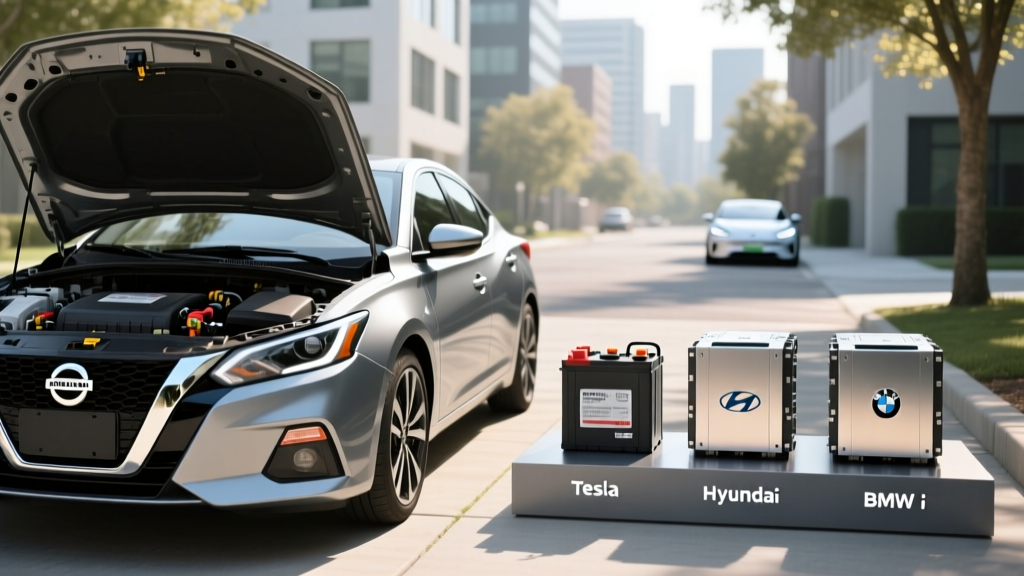
The 2018 Nissan Sentra uses a conventional Group 35 or 24F lead-acid 12V battery — typically rated around 550-650 cold cranking amps (CCA). It powers the starter motor, lights, infotainment, and ECU. It has nothing to do with propulsion.
- Typical lifespan: 3-5 years depending on climate and usage
- Replacement cost: $120-$220 for the battery; installation often free at parts stores
- Failure mode: Sudden — the car won't start, often on a cold morning
- Warranty: Usually 2-3 years free replacement from the battery manufacturer
This is a wear item, like brake pads. Every Sentra owner will replace it at least once during the car's life. Now contrast that with the high-voltage traction battery in a battery-electric vehicle, which is engineered to outlast most other drivetrain components.
EV Traction Battery Chemistry: LFP vs NMC/NCA Explained
Modern EVs use one of two dominant lithium-ion chemistries in their high-voltage traction packs. The choice affects range, longevity, cold-weather behavior, and price. Here's how they compare:
| Attribute | LFP (Lithium Iron Phosphate) | NMC/NCA (Nickel Manganese Cobalt / Nickel Cobalt Aluminum) |
|---|---|---|
| Energy Density | Lower (~160 Wh/kg cell-level) | Higher (~250-300 Wh/kg cell-level) |
| Cycle Life | 3,000-5,000+ cycles to 80% SoH | 1,000-2,000 cycles to 80% SoH |
| Cold Performance | Reduced — slower charging below 32°F, ~15-25% range loss | Better low-temp discharge, ~10-20% range loss |
| Cost (per kWh) | Lower — no cobalt or nickel | Higher — commodity-sensitive metals |
| State of Charge Habit | Can charge to 100% daily without harm | Best kept 20-80% for daily use |
| Thermal Stability | Excellent — very low thermal runaway risk | Good, but requires robust BMS and cooling |
| Common 2026 Applications | Tesla Model 3 RWD, Ford Mustang Mach-E Select (LFP option), BYD models | Hyundai Ioniq 5, Tesla Model Y LR, Rivian R1S, most long-range models |
The trade-off is simple: NMC/NCA gives you more range per kilogram of battery, making it ideal for long-range and performance vehicles. LFP gives you dramatically longer cycle life and lower cost, making it ideal for standard-range daily drivers. Neither is universally "better" — the right choice depends on your driving pattern.
If you regularly charge to 100% and drive shorter daily distances, LFP is the pragmatic pick. If you need 300+ miles of EPA range and take frequent road trips, NMC/NCA's energy density is hard to beat. According to IEA Global EV Outlook data, LFP market share in new EVs has risen sharply, now accounting for roughly 40% of global EV battery installations.
How Long Do EV Batteries Actually Last? Degradation Data
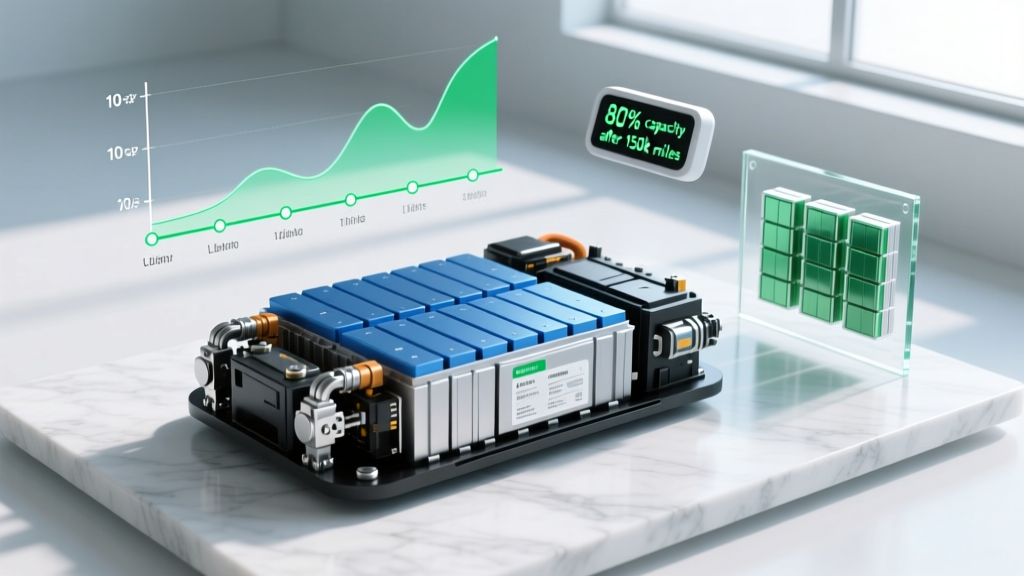
EV battery degradation is not linear. Most packs lose capacity quickly in the first year or two (typically 2-5%), then the curve flattens significantly. Here's what real-world fleet and owner data shows:
| Vehicle / Chemistry | Age / Mileage | Average Capacity Retained | Source |
|---|---|---|---|
| Tesla Model 3/Y (NMC/NCA) | 100,000 miles | ~88-92% | Tesla Impact Report 2024 |
| Nissan Leaf (NMC, passive air cooling) | 100,000 miles | ~75-85% (varies by climate) | Owner surveys, Plug In America |
| Chevrolet Bolt EV (NMC, liquid-cooled) | 100,000 miles | ~90-94% | Recurrent Auto fleet data |
| Hyundai Ioniq 5 (NMC, liquid-cooled) | 50,000 miles | ~94-97% | Owner-reported SoH via OBD |
| BYD / LFP-equipped models | 150,000+ miles | ~90-95% | Fleet operator data, Recurrent |
Context matters enormously. The early Nissan Leaf (2011-2017) used passive air cooling and was deployed heavily in hot climates like Arizona, leading to accelerated degradation. Modern liquid-cooled packs from Hyundai, Tesla, GM, and Ford manage temperature far more effectively, and their degradation curves reflect that. A 2026-model liquid-cooled NMC pack losing 10% capacity before 150,000 miles would be considered below average.
Real-world translation: A vehicle with 300 miles of EPA range that retains 88% capacity after 100,000 miles still delivers roughly 264 miles. For most drivers, that's still entirely usable — the car doesn't become "unusable" the way a dead 12V battery strands a Sentra.
EV Battery Warranty Terms: What's Covered and What's Not
Federal law (EPA emissions warranty requirements) effectively mandates that EV battery packs carry at minimum 8 years/100,000 miles of coverage, though many manufacturers exceed this. Here's how major warranties compare:
| Manufacturer | Warranty Period | Capacity Retention Threshold | What Triggers a Claim |
|---|---|---|---|
| Tesla (Model 3/Y RWD — LFP) | 8 yr / 100,000 mi | 70% | Battery drops below 70% capacity as measured by BMS |
| Tesla (Model 3/Y LR — NMC) | 8 yr / 120,000 mi | 70% | Same threshold, longer mileage coverage |
| Hyundai / Kia | 10 yr / 100,000 mi | 70% | Measured SoH below threshold via dealer diagnostic |
| GM (Chevrolet / Cadillac) | 8 yr / 100,000 mi | 60-70% (varies by model) | Diagnostic-confirmed capacity loss |
| Ford (Mustang Mach-E, F-150 Lightning) | 8 yr / 100,000 mi | 70% | BMS-confirmed degradation below threshold |
| Rivian | 8 yr / 120,000 mi (or 175,000 mi Max Pack) | 70% | Capacity below threshold per Rivian diagnostic |
Key nuance: Warranties cover defective or prematurely degraded batteries, not normal gradual wear above the threshold. If your pack retains 72% capacity at year 9, the manufacturer has no warranty obligation even though range has noticeably dropped. This is why the threshold number matters — and why most modern packs, degrading only 8-12% over the warranty period, never approach a claim.
Warranty claims typically result in module-level repair (replacing individual bad modules rather than the entire pack) or full pack replacement, at no cost to the owner. According to Recurrent Auto's battery longevity research, fewer than 1.5% of modern EVs have required a warranty battery replacement — a dramatically lower failure rate than conventional automatic transmissions.
EV Battery Replacement Cost: The Numbers Without the Fear
Out-of-warranty battery replacement is the single most cited fear among prospective EV buyers. Here's what it actually costs in 2026, and how often it's needed:
| Vehicle / Pack Size | Battery Capacity | Estimated Replacement Cost (2026) | Typical Replacement Trigger |
|---|---|---|---|
| Nissan Leaf (40 kWh pack) | 40 kWh | $6,500 - $9,000 | Capacity below ~60% after 150k+ miles |
| Chevrolet Bolt EV / EUV | 65 kWh | $9,000 - $14,000 | Rare — most packs outlive vehicle |
| Tesla Model 3 (LFP, ~60 kWh) | 60 kWh | $8,000 - $12,000 | Very rare before 200k+ miles |
| Tesla Model Y LR (NMC, ~75 kWh) | 75 kWh | $12,000 - $16,000 | Extremely rare; module repair more common |
| Hyundai Ioniq 5 (77.4 kWh) | 77.4 kWh | $11,000 - $16,000 | Very rare; strong degradation record |
| Ford F-150 Lightning Extended Range | 131 kWh | $18,000 - $28,000 | Extremely rare; largest packs degrade slowest |
Critical context: Battery prices per kWh have fallen roughly 90% since 2010 (from ~$1,100/kWh to ~$115-130/kWh at the pack level in 2025-2026, per BloombergNEF). Replacement costs will continue declining. More importantly, the vast majority of EV batteries never need replacement during the vehicle's usable life. A 2018 Nissan Sentra owner will almost certainly replace their 12V battery at least twice before a comparable-age EV needs traction battery service.
When replacement is needed, independent EV shops increasingly offer refurbished packs or module-level repairs at 40-60% of OEM pricing, particularly for older, high-volume models like the Leaf and Bolt.
Factors That Accelerate (or Preserve) EV Battery Health
Unlike the Sentra's 12V battery — which fails largely due to age and temperature regardless of owner behavior — EV traction battery lifespan is significantly influenced by how you charge and drive. Here's the hierarchy of impact:
- Charging to 100% daily (NMC/NCA): High state of charge stresses NMC/NCA cathodes. Charge to 80% for daily use; reserve 100% for road trips. LFP packs don't have this limitation — charge to 100% freely.
- Frequent DC fast charging: Repeated high-power DC charging (150+ kW) generates heat. Occasional road-trip fast charging is fine; relying on it daily instead of Level 2 home charging accelerates degradation by roughly 1-3% over 100k miles vs. L2-only charging.
- Extreme heat exposure: Sustained ambient temperatures above 95°F with a high state of charge is the single worst combination for battery health. Park in shade or a garage when possible. Liquid-cooled packs mitigate this significantly.
- Extreme cold charging: Charging (especially fast charging) below 25°F without preconditioning can cause lithium plating on the anode. Always use your vehicle's preconditioning feature before charging in cold weather.
- Deep discharge (below 10%): Letting the pack sit at very low SoC for extended periods stresses the cells. If storing the vehicle, leave it at 40-60% SoC.
- Aggressive driving / towing: High sustained discharge rates generate heat. Occasional hard acceleration is negligible; constant high-load driving (towing, mountain passes daily) adds up over years.
The most impactful single habit? Home Level 2 charging at moderate speeds (7-11 kW) with an 80% charge limit for NMC/NCA. This is the EV equivalent of never redlining a gas engine — the battery barely notices it's working.
How to Check and Monitor EV Battery State of Health (SoH)
State of Health (SoH) is the percentage of original capacity your battery retains. A new pack is 100% SoH; a pack that now holds 85 kWh out of its original 100 kWh is at 85% SoH. Here's how to check it:
- In-vehicle displays: Many EVs (Hyundai Ioniq 5, Kia EV6, some Tesla software versions) show SoH directly in the settings or service menu.
- OBD-II dongle + app: Tools like OBDeleven, Leaf Spy (for Nissan Leaf), or Scan My Tesla read the BMS-reported SoH directly. These cost $30-60 and provide the most accurate consumer-accessible reading.
- Manufacturer app: Some brands (Tesla, Ford, Hyundai) surface battery health data in their mobile apps or through dealer diagnostics upon request.
- Third-party services: Companies like Recurrent Auto offer free battery health reports by connecting to your vehicle's telematics data, providing degradation curves compared to similar vehicles.
- Manual calculation: Charge to a known SoC (e.g., 100% for LFP), note the displayed range, and compare to original EPA range adjusted for the SoC percentage. Less precise but free.
For used-EV buyers, requesting an SoH reading is as essential as checking a Carfax report. A 2022 model with 93% SoH at 40,000 miles tells you the battery was well-cared-for; one at 82% suggests heavy fast-charging or hot-climate storage. According to fueleconomy.gov's EV technology resources, the EPA considers battery degradation a factor in long-term EV value and efficiency calculations.
Emerging Battery Technology: What's Coming (and When)
Several next-generation battery technologies are in development. None are available in production vehicles as of 2026, but their timelines are becoming clearer:
- Solid-state batteries: Replace liquid electrolyte with a solid conductor, promising 30-50% higher energy density and improved safety. Toyota has announced limited production in select 2027-2028 models; Samsung SDI targets 2027 mass production. Expect early adoption in premium vehicles at significant price premiums.
- Silicon-dominant anodes: Replace graphite anodes with silicon, boosting energy density 20-40%. Companies like Sila Nanotechnologies and Group14 are supplying early-production cells to Mercedes-Benz and others for 2026-2027 model-year vehicles. Early deployments are limited in volume.
- Sodium-ion batteries: Use abundant sodium instead of lithium, dramatically reducing cost. CATL has begun production in China for low-cost city EVs. US-market adoption is likely 2028+ for budget-oriented models with lower energy density.
- LFP improvements: Manganese-enhanced LFP (LMFP) from CATL and others adds 15-20% energy density over current LFP while retaining cycle-life advantages. Expected in US-market vehicles by 2027.
Practical advice: Don't delay an EV purchase waiting for solid-state. Current NMC and LFP batteries already deliver 250-350+ miles of range, 150,000+ mile lifespans with minimal degradation, and 8-10 year warranties. The improvements coming are incremental for most buyers, not transformational.
Frequently Asked Questions
How long do EV batteries last in years and miles?
Modern liquid-cooled EV batteries (2020+) routinely last 150,000-200,000+ miles while retaining 80%+ of original capacity. In years, most manufacturers warranty them for 8-10 years. Real-world data from Tesla, Hyundai, and GM fleets shows that the majority of packs outlast the vehicle's body and interior. The 2018 Nissan Sentra's 12V battery, by contrast, lasts 3-5 years before needing replacement — and it only costs $150.
How much does an EV battery cost to replace?
Out-of-warranty replacement ranges from roughly $6,500 for a 40 kWh Nissan Leaf pack to $18,000-$28,000 for a 131 kWh Ford F-150 Lightning Extended Range pack. However, fewer than 1.5% of modern EVs require full pack replacement during their useful life. Module-level repairs cost significantly less ($1,500-$5,000). For comparison, replacing the engine in a 2018 Sentra would cost $3,000-$5,000 — and unlike the engine, the EV battery is covered by an 8-year/100,000-mile federal-mandated warranty.
What does the EV battery warranty actually cover?
Manufacturer warranties cover battery capacity loss below a defined threshold (typically 70% of original capacity) within the warranty period (typically 8 years/100,000 miles, or 10 years/100,000 miles for Hyundai/Kia). They also cover manufacturing defects, module failures, and BMS malfunctions. They do not cover gradual capacity loss above the threshold, physical damage from accidents, or damage from aftermarket modifications. Always check your specific owner's manual for exact terms.
How do I check my EV battery health?
The most reliable method is an OBD-II diagnostic tool (Leaf Spy, Scan My Tesla, OBDeleven) that reads the BMS-reported State of Health percentage. Many newer vehicles also display SoH in the infotainment settings. You can also request a battery health report from your dealer or use a free service like Recurrent Auto. Check SoH at least annually, and always before buying a used EV.
LFP vs NMC — which battery chemistry is better for me?
Choose LFP if you want maximum longevity, lower cost, plan to charge to 100% daily, drive shorter distances (under 250 miles/day), and live in a moderate climate. Choose NMC/NCA if you need maximum range (300+ miles), take frequent long road trips, live in a very cold climate, or prioritize performance. Both chemistries in 2026 are mature and reliable — the right choice depends entirely on your driving pattern, not on one being objectively superior.
Does fast charging damage my EV battery?
Occasional DC fast charging (road trips, a few times per month) has a negligible effect on modern liquid-cooled batteries. Daily fast charging without preconditioning can accelerate degradation by an estimated 1-3% over 100,000 miles compared to exclusive Level 2 home charging. The bigger risk is fast charging in extreme cold without preconditioning, which can cause lithium plating. Use your vehicle's built-in preconditioning feature whenever navigating to a fast charger.