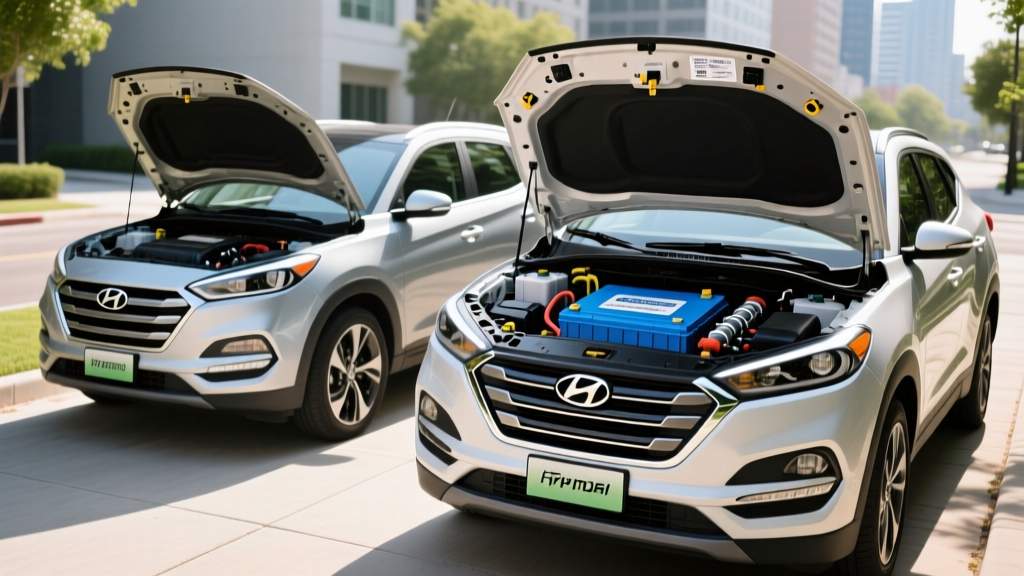
If you own or are considering a used 2018 Hyundai Tucson, the word "battery" can mean two very different things depending on which powertrain is under the hood. The standard 2018 Tucson was sold as a conventional gasoline SUV with a 12V starter battery — no high-voltage traction pack at all. But the 2018 Hyundai Tucson Hybrid (sold in select global markets and as a carryover before the US-spec hybrid arrived in 2022) uses a high-voltage lithium-ion traction battery that powers its electric motor alongside the 2.0L gasoline engine.
This guide covers what you need to know about the 2018 Hyundai Tucson battery system — the hybrid traction pack, its chemistry, degradation expectations in 2026, warranty coverage, replacement costs, and best practices for maximizing its lifespan. We'll also explain how these principles apply broadly across Hyundai's electrified lineup, giving you a framework for evaluating any used hybrid or EV battery.
Which Battery Does the 2018 Hyundai Tucson Actually Have?
Before discussing degradation or replacement, it's critical to identify what you're working with. The 2018 Tucson came in three powertrain configurations globally:
- 2018 Tucson ICE (gasoline): Standard 2.0L or 1.6L turbo engine with a conventional 12V lead-acid auxiliary battery. No high-voltage traction battery. This is the most common US-spec model.
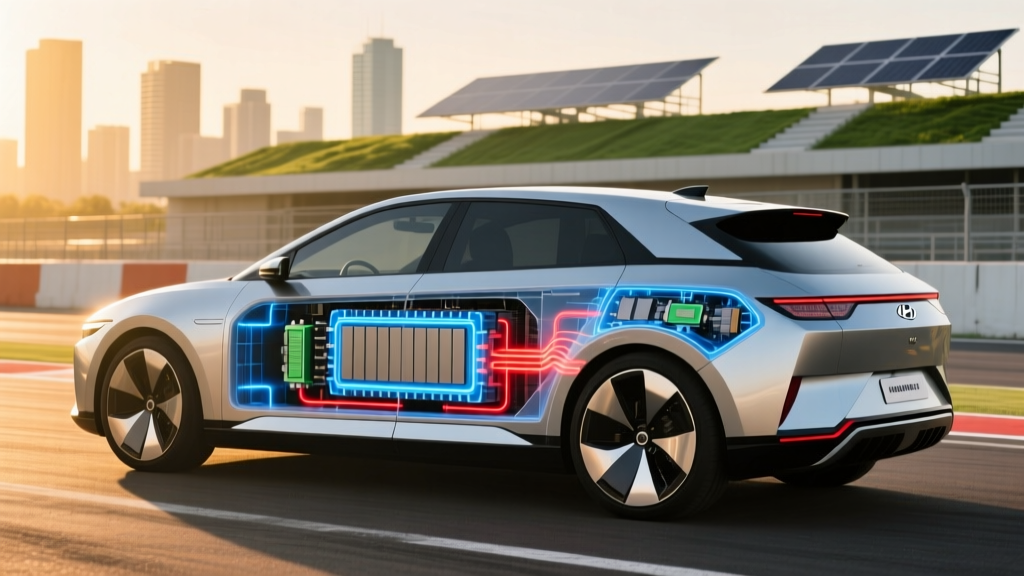
- 2018 Tucson Hybrid (HEV): Available in Korea and select European/Asian markets. Uses a 1.56 kWh lithium-ion polymer traction battery paired with a 2.0L GDI engine and a 38 kW (51 hp) electric motor. This is a self-charging hybrid — no plug, no EV-only range beyond low-speed crawling.
- 2018 Tucson Fuel Cell (FCEV): Hydrogen-powered variant sold in limited markets with a small 1.56 kWh buffer battery. Extremely rare outside Korea and California pilot programs.
For US buyers in 2026, the most relevant discussion is the HEV traction battery, as the plug-in hybrid (PHEV) and full EV (Ioniq 5-based Tucson EV) variants arrived in later model years. If you're looking at a 2018 Tucson sold in the United States, it almost certainly has only a 12V battery unless it was a gray-market import.
Hyundai's Hybrid Battery Chemistry: NMC vs LFP Explained
The 2018 Tucson Hybrid uses a lithium nickel manganese cobalt (NMC) pouch-cell battery manufactured by Hyundai Mobis in partnership with LG Energy Solution (then LG Chem). This was the dominant chemistry for Hyundai/Kia hybrids and EVs of that era, including the Kona Electric and Ioniq Hybrid.
Understanding NMC chemistry matters because it determines your battery's energy density, degradation behavior, cold-weather performance, and eventual replacement cost. Here's how NMC compares to the other major chemistry, lithium iron phosphate (LFP), which Hyundai has begun using in some newer models:
| Attribute | NMC (2018 Tucson HEV) | LFP (Newer Hyundai Models) |
|---|---|---|
| Energy Density | Higher (~200–250 Wh/kg cell-level) | Lower (~150–180 Wh/kg) |
| Cycle Life | ~1,000–2,000 full cycles to 80% SoH | ~3,000–5,000+ full cycles to 80% SoH |
| Cold Performance | Better low-temp discharge capability | Reduced performance below 0°C / 32°F |
| Cost per kWh | Higher (cobalt/nickel supply chain) | Lower (iron/phosphate, no cobalt) |
| Thermal Stability | Good, but requires active management | Excellent, inherently more stable |
| State of Charge Sensitivity | Degrades faster if held at 100% long-term | Tolerates 100% SoC storage better |
| Typical Application | HEVs, PHEVs, long-range BEVs (2018–2023) | Standard-range BEVs, newer HEVs (2024+) |
Which is better? For the 2018 Tucson's small 1.56 kWh hybrid pack, NMC was the right choice — its higher energy density keeps the pack compact and light, critical for a hybrid that doesn't need large energy reserves. LFP's cycle-life advantage matters more in full EVs with 60–100 kWh packs that undergo thousands of deep cycles. In a self-charging hybrid, the battery operates in a narrow state-of-charge window (typically 30–70% SoC), which dramatically reduces stress regardless of chemistry.
How Long Do EV and Hybrid Batteries Last? Real Degradation Data
The most common question from used-Tucson buyers: "Will I need a new battery, and when?" The answer depends on powertrain type, but the data is reassuring.
Hybrid (HEV) Battery Degradation — The 2018 Tucson Case
Because the Tucson HEV's 1.56 kWh pack operates in a narrow SoC band and never deep-cycles (the engine manages charge levels automatically), degradation is minimal compared to full EVs. Based on fleet data from Hyundai service bulletins and third-party analysis by sources like Geotab's battery health study:
- Year 1–3 (0–60,000 miles): ~2–5% capacity loss. Barely perceptible — fuel economy may drop by 1–2 MPG combined at worst.
- Year 4–7 (60,000–120,000 miles): ~5–10% total capacity loss. The battery management system (BMS) compensates by adjusting charge/discharge limits.
- Year 8–10+ (120,000–180,000+ miles): ~10–18% total capacity loss. Some owners may notice reduced electric-motor assist at low speeds, but the vehicle remains fully drivable as the gasoline engine compensates.
Full EV (BEV) Degradation for Context
If you're comparing the Tucson Hybrid to Hyundai's full EVs (like the Kona Electric or Ioniq 5), degradation data from Recurrent Auto's 2025 fleet analysis shows modern NMC packs losing approximately 5–8% capacity over 100,000 miles, with most retaining above 90% State of Health (SoH) at 8 years. LFP packs in newer models show even less degradation. The industry-wide fear of catastrophic battery failure at 100,000 miles is not supported by data — the U.S. Department of Energy's EV battery research confirms that most modern packs are designed to outlast the vehicle's economic life.
| Powertrain | Battery Size | Avg. Loss at 5 yr / 75K mi | Avg. Loss at 10 yr / 150K mi | Failure Rate (warranty claim) |
|---|---|---|---|---|
| HEV (e.g., Tucson Hybrid) | 1–2 kWh | 5–8% | 10–18% | <2% |
| PHEV (e.g., Tucson PHEV 2022+) | 10–14 kWh | 5–10% | 10–15% | <3% |
| BEV (e.g., Kona Electric) | 60–77 kWh | 4–8% | 8–14% | <1.5% |
What Does the Hyundai Hybrid Battery Warranty Cover?
Hyundai provides one of the strongest hybrid/EV battery warranties in the industry. For the 2018 Tucson Hybrid, the high-voltage traction battery is covered under Hyundai's 10-year / 100,000-mile powertrain warranty in the United States (and equivalent terms in most markets).
| Coverage Item | Term | Details |
|---|---|---|
| High-Voltage Battery | 10 years / 100,000 miles | Defects in materials/workmanship; capacity below threshold |
| Capacity Retention Threshold | ~70% of original capacity | If SoH drops below ~70% within warranty period, Hyundai replaces or refurbishes |
| Hybrid System Components | 10 years / 100,000 miles | Inverter, electric motor, BMS, wiring harness |
| 12V Auxiliary Battery | 3 years / 36,000 miles | Standard limited warranty; considered a wear item |
| Transferability | Varies by state | In most US states, the 10yr/100K powertrain warranty is NOT transferable to second owners (drops to 5yr/60K for subsequent owners). Check your state's rules. |
How Much Does a 2018 Hyundai Tucson Battery Replacement Cost?
If your Tucson Hybrid's traction battery does fail outside warranty — typically at 150,000+ miles or 12+ years — here's what replacement looks like in 2026:
| Component | OEM Dealer Cost | Independent/Refurbished | Notes |
|---|---|---|---|
| HEV Traction Battery (1.56 kWh) | $2,800–$4,200 | $1,800–$2,800 | Small pack = lower cost than EVs. Refurbished modules available from hybrid specialists. |
| Labor | $400–$800 | $300–$600 | 2–4 hours at dealer; independents may be faster with hybrid experience. |
| 12V Auxiliary Battery | $180–$280 | $120–$200 | Standard AGM or flooded lead-acid. DIY-friendly. |
| BMS Reprogramming | $100–$200 | Included or $80–$150 | Required after traction battery swap to recalibrate SoH readings. |
For context: A full EV battery replacement (e.g., 64 kWh Kona Electric) runs $8,000–$15,000+ at OEM pricing. The Tucson Hybrid's small pack is far less expensive to replace, and because it rarely fails catastrophically, most high-mileage owners never face this cost.
When is replacement typically needed? For the Tucson HEV, traction battery replacement is uncommon before 180,000–200,000 miles. Many first-generation Hyundai/Kia hybrids from 2011–2015 are still running on original packs at 200,000+ miles. The most common trigger for replacement is individual cell-module imbalance rather than total pack failure — and in some cases, a specialist can replace individual modules for $500–$1,200 rather than the entire pack.
Factors That Affect Your Tucson Hybrid Battery's Lifespan
While the 2018 Tucson HEV's battery management system handles most of the heavy lifting, your habits still influence long-term health. Here are the factors ranked by impact:
- Avoid prolonged storage at extreme SoC: If parking for 2+ weeks, try to leave the vehicle with the hybrid system having recently run (the BMS targets ~50% SoC automatically, so normal driving handles this).
- Minimize extreme heat exposure: Parking in shade or a garage in hot climates (Arizona, Texas, Middle East) reduces thermal stress. The Tucson HEV uses passive air cooling for its small pack, unlike the active liquid cooling in Hyundai's EVs.
- Don't ignore warning lights: A hybrid system warning or check-engine light can indicate BMS faults, cooling fan failures, or cell imbalance. Address these promptly — running a hybrid with a cooling fault can accelerate degradation.
- Drive it regularly: Hybrid batteries prefer regular use over long-term sitting. A weekly 20-minute drive keeps cells balanced and the BMS calibrated.
- Maintain the cooling system: The Tucson HEV's battery cooling fan and air intake (usually behind the rear seat) should be kept free of debris. A clogged intake forces the battery to run hotter.
- Use the recommended 12V battery: A weak 12V battery can cause hybrid system startup errors and place unusual loads on the DC-DC converter, indirectly stressing the traction battery.
The Fast-Charging Question (for PHEV and EV Owners)
While the 2018 Tucson Hybrid doesn't plug in and therefore doesn't face DC fast-charging stress, this is worth noting for anyone considering upgrading to a Tucson PHEV (2022+) or Ioniq 5. Frequent DC fast charging above 150 kW does accelerate NMC degradation — studies show approximately 2–4% additional capacity loss over 100,000 miles for vehicles that fast-charge daily vs. primarily Level 2 charging. Hyundai's BMS mitigates this by tapering charge speed above 80% SoC and preconditioning the battery when navigation is set to a charger.
How to Check Your Tucson Hybrid Battery's State of Health (SoH)
Unlike full EVs, which often display SoH through diagnostic menus or apps, the 2018 Tucson Hybrid doesn't provide a direct SoH percentage to the driver. Here's how to assess battery health:
Option 1: Dealer Diagnostic Scan
Any Hyundai dealer can run a hybrid battery diagnostic using the GDS (Global Diagnostic System) tool. This reads individual cell voltages, internal resistance, and calculated SoH. Ask specifically for a "hybrid battery health report" during a service visit. Cost: typically $50–$100 if not part of a warranty claim, sometimes free during scheduled maintenance.
Option 2: OBD-II Scanner with Hybrid Support
Advanced OBD-II tools like the Carista, OBDeleven, or Hyundai-specific tools (e.g., G-Scan) can read hybrid battery parameters including cell voltage spread and estimated SoH. Look for:
- Cell voltage delta: All cells should be within 0.1–0.2V of each other at rest. A spread greater than 0.3V suggests module imbalance.
- Charge/discharge power limits: The BMS reduces max charge/discharge kW as the battery degrades. Comparing your readings to factory specs (approximately 38 kW peak discharge) gives a health indicator.
Option 3: Fuel Economy as a Proxy
The simplest indicator: track your real-world city MPG over time. The Tucson Hybrid's electric motor assist is most valuable in stop-and-go driving. If your city fuel economy drops significantly (e.g., from 35 MPG to 28 MPG) while highway MPG stays stable, the hybrid battery may be losing its ability to deliver peak assist power — a sign of degradation or cell imbalance.
What's Next in Battery Tech? Solid-State and Beyond
If you're evaluating whether to invest in a 2018 Tucson Hybrid or wait for newer technology, here's a realistic timeline of emerging battery developments as of 2026:
- Solid-state batteries: Hyundai Motor Group has announced pilot production of solid-state cells through its partnership with Samsung SDI, targeting limited deployment in luxury Genesis models by 2027–2028. These promise higher energy density (~400 Wh/kg) and improved safety, but won't appear in mainstream Tucson-class vehicles before 2030 at the earliest. Cost remains a major barrier.
- Silicon-dominant anodes: Companies like Sila Nanotechnologies and Group14 are shipping silicon-blend anodes that increase energy density by 15–25% in existing lithium-ion formats. These are appearing in some 2025–2026 EVs and may eventually filter into hybrid packs, but don't affect the 2018 Tucson's existing battery.
- Sodium-ion batteries: CATL and BYD have begun mass-producing sodium-ion cells for budget EVs in China. Lower energy density but extremely low cost and no cobalt/nickel dependency. Unlikely to appear in Hyundai products before 2028+.
The practical takeaway: None of these emerging technologies change the calculus for a 2018 Tucson Hybrid owner in 2026. The NMC pack in your vehicle is proven, well-supported, and inexpensive to replace relative to full EVs. Waiting for solid-state is not a reason to delay a purchase or replacement decision today.
Frequently Asked Questions
How long do EV and hybrid batteries last in years and miles?
Modern hybrid batteries like the 1.56 kWh NMC pack in the Tucson Hybrid typically last 150,000–200,000+ miles (12–15+ years) before needing replacement. Full EV batteries from 2018–2026 are designed for 200,000+ miles with 80%+ capacity retention. According to Consumer Reports' EV battery longevity analysis, the average EV battery retains about 90% of its original capacity after 100,000 miles.
How much does an EV battery cost to replace?
Replacement costs vary dramatically by battery size. The 2018 Tucson Hybrid's 1.56 kWh pack costs $2,800–$4,200 OEM. A full EV like the Kona Electric (64 kWh) runs $10,000–$15,000+. Large-truck EV packs (100+ kWh) can exceed $20,000. However, most batteries outlast the vehicle — out-of-warranty replacement rates remain below 3% across the industry.
What does the Hyundai hybrid battery warranty cover?
Hyundai covers the Tucson Hybrid's high-voltage battery for 10 years / 100,000 miles against defects and capacity loss below approximately 70% of original capacity. This includes the battery pack, BMS, inverter, and electric motor. Note: in many US states, the 10yr/100K coverage applies only to the original owner; subsequent owners receive 5yr/60K powertrain coverage. Verify with your local dealer.
How do I check and maximize my hybrid battery's health?
Have a Hyundai dealer run a hybrid battery diagnostic (GDS scan) to check cell balance and SoH. For daily care: avoid prolonged storage in extreme heat, don't ignore hybrid system warning lights, keep the battery cooling intake clear of debris, and drive the vehicle regularly. The BMS handles charge management automatically — you don't need to micromanage SoC in a hybrid.
LFP vs NMC — which battery chemistry is better?
Neither is universally better. NMC offers higher energy density and better cold-weather performance, making it ideal for hybrids and long-range EVs where space and weight matter. LFP provides longer cycle life, lower cost, and better thermal stability, making it ideal for standard-range EVs and high-mileage fleet vehicles. For the 2018 Tucson Hybrid, NMC was the correct engineering choice — the pack is small, light, and operates in a narrow SoC window that minimizes degradation regardless of chemistry.