If you own a 2017 Kia Optima plug-in hybrid or are considering one on the used market, the high-voltage traction battery is likely your biggest question mark. Unlike a conventional gas car where the engine dominates longevity concerns, a PHEV's battery pack determines electric-only range, fuel economy, and ultimately whether you face a costly repair.
This guide breaks down the 2017 Kia Optima PHEV's 9.8 kWh lithium-ion polymer battery — its chemistry, real-world degradation trajectory, warranty coverage in 2026, replacement costs, and how to monitor and maximize its health. We also place it in the broader EV battery landscape so you understand how it compares to modern packs.
The 2017 Kia Optima PHEV Battery: Specs at a Glance
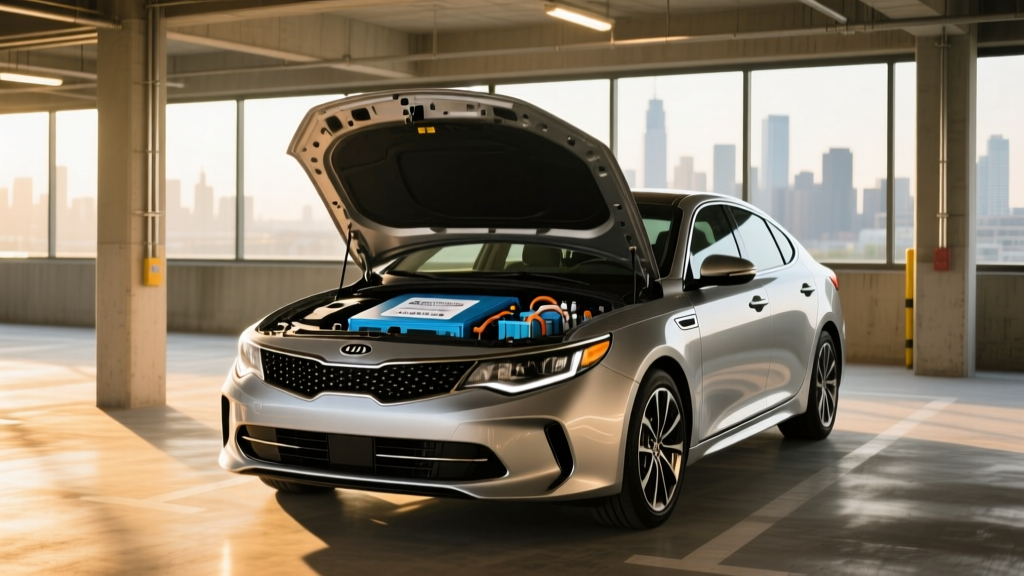
The 2017 Kia Optima PHEV (also sold as the Optima Plug-In Hybrid) uses a 9.8 kWh lithium-ion polymer battery pack supplied by LG Chem. This pack powers a 50 kW (67 hp) electric motor paired with a 2.0L gasoline engine for a combined system output of 202 hp. The EPA rated it at 27 miles of all-electric range when new, with a combined MPGe of 103.
| Specification | Value |
|---|---|
| Battery capacity (total) | 9.8 kWh |
| Battery chemistry | NMC (Nickel Manganese Cobalt) lithium-ion polymer |
| EPA electric-only range (new) | 27 miles |
| EPA combined MPGe | 103 MPGe |
| Electric motor output | 50 kW (67 hp) |
| Combined system output | 202 hp |
| Onboard charger (Level 2) | 3.3 kW |
| Level 2 charge time (0-100%) | ~3 hours |
| Battery warranty (original) | 10 years / 100,000 miles |
Source: fueleconomy.gov — 2017 Kia Optima PHEV
NMC Chemistry Explained: What Powers the Optima PHEV
The Optima PHEV's battery uses NMC (Nickel Manganese Cobalt) chemistry, which was the dominant lithium-ion formulation for plug-in vehicles in the mid-2010s and remains widely used in 2026 for vehicles prioritizing energy density. Understanding this chemistry helps you contextualize degradation behavior and compare it to alternatives.
LFP vs NMC/NCA: How Battery Chemistries Compare
| Attribute | NMC (Nickel Manganese Cobalt) | LFP (Lithium Iron Phosphate) | NCA (Nickel Cobalt Aluminum) |
|---|---|---|---|
| Energy density | High (150–220 Wh/kg cell-level) | Lower (120–160 Wh/kg) | Very high (200–260 Wh/kg) |
| Cycle life | 1,000–2,000 cycles to 80% SoH | 3,000–5,000+ cycles to 80% SoH | 1,000–1,500 cycles to 80% SoH |
| Cold-weather performance | Moderate — capacity drops 15–30% below freezing | Poor — greater resistance in cold; some packs include heating | Moderate to good |
| Cost per kWh | Mid-range (~$100–130/kWh in 2026) | Lower (~$75–100/kWh in 2026) | Higher (~$120–150/kWh) |
| Thermal stability | Good with active thermal management | Excellent — inherently more stable | Requires robust thermal management |
| Common applications | Most BEVs, nearly all PHEVs (2015–2026) | Tesla Model 3/Y RWD, BYD, Ford Lariat, Rivian Standard | Tesla Long Range/Performance, Panasonic cells |
| SoC flexibility | Best kept 20–80% for longevity | Can be charged to 100% regularly; benefits from periodic full calibration | Best kept 20–80% for longevity |
The 2017 Optima PHEV's NMC pack was chosen for its energy density — Kia needed to fit meaningful electric range into a midsize sedan without excessive weight. The trade-off is a shorter cycle life compared to LFP and greater sensitivity to high state-of-charge (SoC) storage. However, because PHEV batteries cycle through a relatively narrow SoC window (typically 15%–95%), the real-world degradation is gentler than the raw cycle-life number suggests.
Why This Matters for the Optima PHEV in 2026
Unlike a full BEV with a 75–100 kWh pack that might only need 500–800 full cycles over 200,000 miles, the Optima's small 9.8 kWh pack cycles more frequently per mile driven in electric mode. A driver who commutes 30 miles daily on electric power and charges nightly could accumulate 2,500+ partial cycles over 9 years. This is why PHEV battery warranties tend to be generous — manufacturers anticipate heavier cycling.
How Long Does the 2017 Kia Optima PHEV Battery Last?
This is the question every owner and prospective buyer asks. The short answer: most PHEV batteries outlast 10 years and 100,000–150,000 miles before degradation becomes functionally limiting, though capacity loss is gradual and continuous from day one.
Degradation Data: What the Numbers Show
Lithium-ion batteries lose capacity through two mechanisms: calendar aging (time-dependent chemical changes regardless of use) and cycle aging (wear from charge/discharge cycles). For the Optima PHEV's NMC pack, real-world data from owner reports and fleet studies suggest the following trajectory:
- Year 1–2 (0–25,000 mi): ~3–5% capacity loss — initial formation loss stabilizes
- Year 3–5 (25,000–60,000 mi): ~6–10% total loss — linear, slow degradation phase
- Year 6–8 (60,000–100,000 mi): ~10–16% total loss — gradual acceleration possible with frequent DC fast charging or hot-climate use
- Year 9–10+ (100,000–150,000 mi): ~15–22% total loss — pack may deliver 20–23 miles EV range vs. original 27
At 70% retained capacity (30% loss), Kia considers the battery below warranty threshold. Most Optima PHEV packs do not reach this point under normal use — but high-heat environments (Arizona, Texas) and aggressive fast-charging habits can accelerate the timeline.
A Geotab fleet study of over 6,300 electric and plug-in hybrid vehicles found an average annual degradation rate of approximately 1.8% per year across all chemistries and use patterns, with NMC packs in moderate climates showing slightly better retention than those in extreme heat.
When Is Replacement Actually Needed?
A battery doesn't "die" at a specific threshold — it simply holds less energy. You'll want to consider replacement when:
- Electric-only range drops below 12–15 miles and your commute depends on it
- The battery fails to hold charge overnight (indicating cell imbalance or module failure)
- The vehicle throws a high-voltage battery warning light or enters limp mode
- A diagnostic scan shows individual cell voltage deviation exceeding 0.3V (indicating a bad module)
For most 2017 Optima PHEV owners in 2026, the battery is still functional — just with reduced electric range. Total failure before 150,000 miles is uncommon unless there's a manufacturing defect (which the warranty covers) or physical damage.
2017 Kia Optima PHEV Battery Warranty: What's Covered in 2026
Kia provided one of the strongest PHEV battery warranties in the industry for the 2017 Optima. Here's what you need to know as a current owner or used-car buyer:
| Term | Detail |
|---|---|
| Coverage period | 10 years / 100,000 miles (whichever comes first) |
| Capacity retention threshold | 70% of original capacity (i.e., below ~6.86 kWh usable) |
| Transferability | Yes — transfers to second and subsequent owners at full terms |
| What's covered | Capacity loss below threshold, cell/module defects, BMS failures |
| What's NOT covered | Damage from accidents, flooding, unauthorized modifications, or use of non-approved chargers |
| Warranty status in 2026 | Original 10-year warranty expires in 2027 — most 2017 models are still within coverage |
This is a critical point for used-car shoppers: if you buy a 2017 Optima PHEV in 2026, the battery warranty is likely still active until the vehicle hits 10 years from its original in-service date or 100,000 miles. Always verify the in-service date on the original window sticker or through a Kia dealer using the VIN.
Under Kia's official coverage terms, if the battery falls below 70% capacity within the warranty period, Kia will repair or replace it at no cost. The replacement may be a new or remanufactured pack that meets the 70% threshold — not necessarily a brand-new battery.
How Much Does It Cost to Replace the 2017 Kia Optima PHEV Battery?
If your Optima PHEV's battery falls outside warranty coverage (or you've exceeded 100,000 miles), replacement costs are a legitimate concern. Here's the current landscape for 2026:
| Vehicle / Battery Size | Battery Cost (Part) | Labor | Total Estimated Cost |
| 2017 Kia Optima PHEV (9.8 kWh) | $3,500–$5,000 | $800–$1,500 | $4,300–$6,500 |
| Toyota Prius Prime (8.8 kWh) | $3,000–$4,500 | $700–$1,200 | $3,700–$5,700 |
| Chevrolet Volt (18.4 kWh, 2016–2019) | $5,500–$7,500 | $1,000–$1,800 | $6,500–$9,300 |
| Ford Escape PHEV (14.4 kWh) | $5,000–$7,000 | $900–$1,500 | $5,900–$8,500 |
| BEV — Tesla Model 3 (75 kWh) | $10,000–$14,000 | $1,500–$2,500 | $11,500–$16,500 |
| BEV — Chevrolet Bolt (65 kWh) | $9,000–$12,000 | $1,200–$2,000 | $10,200–$14,000 |
The Optima PHEV's relatively small 9.8 kWh pack keeps replacement costs at the lower end of the PHEV spectrum. For context, a full BEV with a 75+ kWh pack can cost two to three times as much to replace — but BEV batteries also degrade more slowly in absolute terms because they cycle through a larger buffer and typically see fewer full cycles per mile driven.
Important cost context: Most 2017 Optima PHEV batteries do not need replacement. The vehicle's resale value in 2026 ranges from roughly $9,000 to $15,000 depending on mileage and condition. A $5,000+ battery replacement would represent a significant percentage of the car's value — which is why verifying warranty status before purchase is essential.
Module-Level Repair: A Lower-Cost Alternative
Some independent EV repair shops offer module-level diagnostics and replacement. Instead of swapping the entire pack, a technician can identify and replace individual failed cell modules (the Optima PHEV pack contains multiple modules wired in series). This can reduce costs to $1,500–$3,000 if only one or two modules have degraded disproportionately. However, this requires specialized diagnostic equipment and should only be performed by shops experienced with high-voltage systems.
Factors That Affect Your Optima PHEV Battery's Lifespan
Not all 2017 Optima PHEV batteries age equally. The following factors have the most significant impact on long-term State of Health (SoH):
1. State of Charge (SoC) Habits
NMC batteries degrade fastest when held at extremes — either 100% or near 0% — for extended periods. The Optima PHEV's battery management system (BMS) includes a top buffer (you never truly reach 100% at the cell level) and a bottom buffer (the car switches to hybrid mode before the pack is truly empty). Even so:
- Avoid: Leaving the car plugged in at 100% for days without driving
- Better: Charge to 100% the night before you need electric range, then drive it down
- Best for longevity: If you have predictable short commutes, charge to ~80–90% (some aftermarket OBD2 tools allow setting a charge limit, though Kia does not offer this natively on the 2017 model)
2. Temperature Exposure
Heat is the primary enemy of NMC longevity. Battery cells stored or operated above 95°F (35°C) for sustained periods experience accelerated calendar aging. Optima PHEVs in Phoenix or Houston will degrade measurably faster than identical cars in Seattle or Minneapolis — though extreme cold also causes temporary range loss and increased internal resistance.
The 2017 Optima PHEV does not have active liquid thermal management for its battery — it relies on passive air cooling. This makes parking in shade or a garage more impactful than it would be for a liquid-cooled BEV like a Tesla or Hyundai Ioniq 5.
3. Charging Patterns
The Optima PHEV's 3.3 kW onboard charger means Level 2 charging is gentle on the battery — roughly a C-rate of 0.34, which is well within the safe zone for NMC longevity. Unlike BEVs that regularly use 150–350 kW DC fast chargers, the Optima PHEV does not support DC fast charging at all. This is actually a longevity advantage: the pack never experiences the thermal stress of high-rate charging.
4. Depth of Discharge
Every time you deplete the battery from full to near-empty and recharge, that's one full equivalent cycle. Shallow cycles (using 30% of the pack and recharging) cause less wear per kWh delivered than deep cycles. PHEV owners who plug in frequently and use smaller portions of the battery per trip tend to see slower degradation than those who fully deplete and recharge once daily.
- ✅ Park in a garage or shaded area during summer months — passive cooling benefits enormously from lower ambient temps
- ✅ Plug in regularly — lithium-ion batteries prefer regular, partial cycling over deep discharges
- ✅ Avoid storing the vehicle at 100% SoC for more than 24–48 hours
- ✅ If storing the car for 2+ weeks, leave it at approximately 50–60% SoC
- ✅ Use the car's built-in charge timer to finish charging just before departure rather than hours before
- ✅ Drive the car in EV mode regularly — batteries that sit unused degrade through calendar aging without the balancing benefit of cycling
- ❌ Do not let the battery sit at 0% (the car will enter hybrid mode before this, but avoid ignoring low-battery warnings for extended periods)
- ❌ Do not use aftermarket chargers not certified for J1772 / SAE J1772 compliance
How to Check Your Optima PHEV Battery Health (SoH)
Unlike modern BEVs from Tesla, Rivian, or Hyundai that display battery health metrics in the infotainment system, the 2017 Kia Optima PHEV does not have a built-in State of Health (SoH) readout accessible to the driver. Here are your options for monitoring battery condition:
Method 1: Dealer Diagnostic Scan
Any Kia dealership can perform a high-voltage battery diagnostic using the Kia Diagnostic System (KDS). This scan reads individual cell voltages, internal resistance, and calculated SoH percentage. Request this specifically — it's not part of a standard service visit. If the car is under warranty and SoH is below 70%, this scan documents your claim.
Method 2: OBD2 Scanner with EV Capability
Third-party OBD2 diagnostic tools like the OBDLink MX+ paired with apps such as EV BatMon or Torque Pro (with the appropriate Kia/Hyundai PID set) can read real-time battery data including:
- Current battery voltage and SoC percentage
- Individual cell group voltages (to detect imbalanced modules)
- Battery temperature sensor readings
- Cumulative charge/discharge energy (to estimate SoH by comparing energy-in vs. energy-out over a full cycle)
Method 3: Manual Range Tracking
The simplest method requires no tools: track your electric-only range over time. Fully charge the battery, reset the trip odometer, drive in EV mode until the car switches to hybrid, and record the miles. Compare this to the original 27-mile EPA figure:
- 24–27 miles: Excellent SoH (~90%+)
- 20–23 miles: Normal degradation (~80–89% SoH)
- 16–19 miles: Moderate degradation (~70–79% SoH) — approaching warranty threshold
- Below 16 miles: Significant degradation — schedule a dealer diagnostic
Perform this test in moderate temperatures (60–75°F) on a flat route for the most consistent comparison.
Looking Ahead: Solid-State and Silicon-Anode Batteries
If you're wondering whether future battery technology might offer a drop-in upgrade for the Optima PHEV, the honest answer is: not practically, and not soon.
Solid-state batteries — which replace the liquid electrolyte with a solid ceramic or polymer conductor — promise higher energy density, faster charging, and improved safety. Toyota, Samsung SDI, and QuantumScape have all demonstrated prototype cells, but as of 2026, solid-state packs remain in pre-production pilot phases. Realistic mass-market availability is projected for 2028–2032, initially in premium BEVs. They will not be retrofit-compatible with existing PHEV platforms.
Silicon-anode batteries (used in limited form in the 2025 Porsche Taycan and GM Ultium-based vehicles) offer 10–20% more energy density by replacing graphite anodes with silicon-dominant composites. These are entering production now but are designed for new vehicle architectures, not legacy retrofits.
For 2017 Optima PHEV owners, the practical path forward is maintaining the existing NMC pack through the care practices outlined above — or, if degradation eventually makes the electric range insufficient, evaluating whether a remanufactured pack (at $3,500–$5,000) or a vehicle upgrade makes more economic sense given the car's age and value.
Frequently Asked Questions
How long do EV and PHEV batteries typically last?
Most modern EV and PHEV batteries last 10–15 years and 150,000–200,000+ miles before degrading to 70% capacity. PHEV batteries like the Optima's 9.8 kWh pack experience more charge cycles per mile but benefit from smaller depth-of-discharge windows and gentler charging rates. Complete failure before 100,000 miles is rare and typically covered by warranty.
How much does an EV battery cost to replace?
PHEV battery replacement costs range from $3,700 to $9,300 depending on pack size, with the 2017 Optima PHEV at the lower end ($4,300–$6,500 including labor). Full BEV replacements are significantly more expensive: $10,000–$16,500 for packs in the 65–80 kWh range. Most owners never need a replacement because the battery outlasts the vehicle's economic life.
What does the battery warranty cover?
Kia's PHEV battery warranty covers capacity loss below 70% of original capacity and manufacturing defects for 10 years or 100,000 miles. It transfers to subsequent owners. It does not cover physical damage from accidents, flooding, or unauthorized modifications. For 2017 models, warranty coverage extends into 2027 in most cases.
How do I check and maximize my battery's health?
Check health through a Kia dealer diagnostic scan, an OBD2 EV-capable scanner, or manual electric-range tracking. Maximize longevity by avoiding prolonged storage at 100% SoC, parking in shade or a garage during hot weather, plugging in regularly for partial cycling, and using the car's charge timer to minimize time spent at full charge.
LFP vs NMC — which battery chemistry is better?
Neither is universally better; they serve different priorities. NMC offers higher energy density (more range per pound), making it ideal for PHEVs with limited battery space and for BEVs maximizing range. LFP offers longer cycle life (3,000–5,000 cycles vs. 1,000–2,000), better thermal safety, and lower cost, but is heavier and less energy-dense. For a 2017 PHEV, NMC was the correct engineering choice. For a 2026 standard-range BEV used as a daily commuter, LFP is often the smarter buy.
Can I upgrade the 2017 Optima PHEV to a larger or newer battery?
No. The battery pack is integrated into the vehicle's structure, BMS, and powertrain calibration. There is no compatible larger or newer-chemistry pack that can be installed. Third-party "range extender" modifications are not available and would void any remaining warranty.
Does the 2017 Optima PHEV support DC fast charging?
No. The 2017 Optima PHEV charges only via Level 1 (120V, ~1.4 kW) or Level 2 (240V, 3.3 kW) using a J1772 connector. A full charge from empty takes approximately 3 hours on Level 2. While this limits charging convenience on road trips, the gentle charge rate is beneficial for long-term battery health.