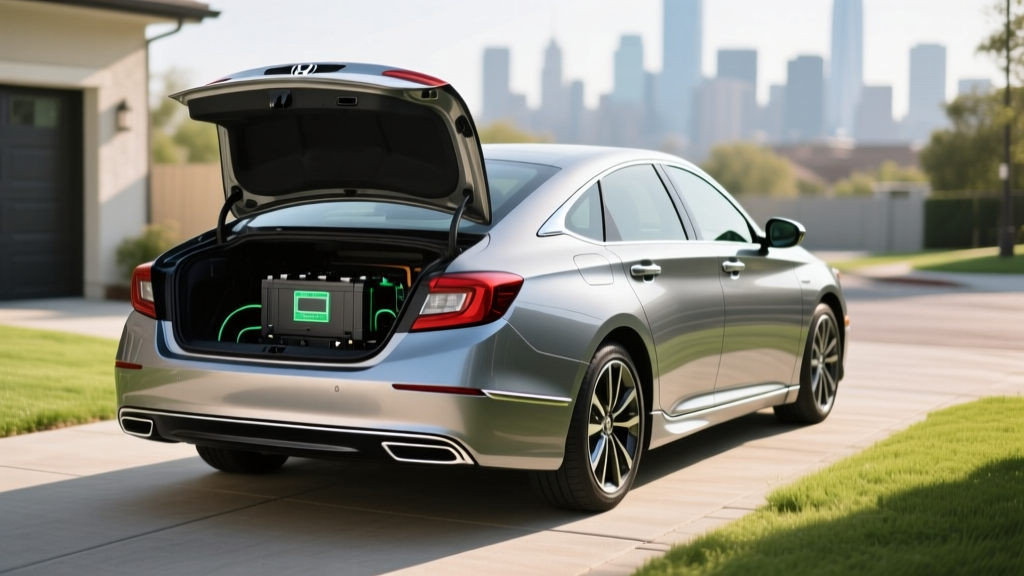
The 2017 Honda Accord Hybrid uses a 1.3 kWh lithium-ion traction battery to supplement its 2.0-liter Atkinson-cycle engine. Nearly a decade after production, owners are confronting a familiar question: how much life remains in the high-voltage pack, and what does replacement cost in 2026? This guide breaks down real-world degradation data, current replacement pricing, Honda's warranty terms, and how modern chemistries like LFP and NMC compare to the cells in your Accord.
2017 Honda Accord Hybrid Battery: Specifications at a Glance
The ninth-generation Accord Hybrid (2014–2017) uses a relatively small traction battery by today's standards. It is not a plug-in hybrid — you cannot charge it from a wall outlet. The battery recharges exclusively through regenerative braking and the gasoline engine.
| Specification | 2017 Honda Accord Hybrid |
|---|---|
| Battery Chemistry | Lithium-Ion (NMC-type) |
| Usable Battery Capacity | ~1.3 kWh |
| Combined System Output | 212 hp |
| EPA Combined Fuel Economy | 48 MPG (49 city / 47 hwy) |
| Electric-Only Driving | Very short low-speed bursts only |
| Plug-In Charging | No (self-charging HEV) |
| Battery Warranty (Original) | 8 years / 100,000 miles (10 yr / 150,000 mi in CARB states) |
How Long Does the 2017 Accord Hybrid Battery Last?
Honda's hybrid battery packs are engineered for longevity, but they do degrade. The 2017 Accord Hybrid's lithium-ion pack typically retains 70–80% of its original capacity after 100,000 miles, depending on climate, driving habits, and charging patterns (which, for a conventional hybrid, means how often the battery cycles between low and high state of charge).
Here is what real-world data and owner reports indicate:
| Mileage / Age | Typical Capacity Retained | Noticeable Symptoms |
|---|---|---|
| 50,000 mi / ~4 years | 88–93% | None — performance feels like new |
| 100,000 mi / ~8 years | 75–85% | Slight MPG decrease (1–3 MPG); slightly less electric assist on hills |
| 150,000 mi / ~12 years | 65–78% | More noticeable MPG loss (3–6 MPG); engine runs more frequently; reduced regen effectiveness |
| 200,000+ mi | 55–70% | Significant MPG penalty; possible IMA warning light; replacement likely needed |
A degraded hybrid battery doesn't leave you stranded — the gasoline engine continues to operate independently. However, you lose the fuel-economy advantage that made the hybrid worth buying. A 2017 Accord Hybrid with a severely degraded pack may drop from 48 MPG combined to the low-to-mid 30s, approaching the efficiency of a non-hybrid four-cylinder Accord.
What Does Honda's Hybrid Battery Warranty Cover?
Honda provided an 8-year/100,000-mile warranty on the hybrid battery for the 2017 Accord Hybrid in most states. In California Air Resources Board (CARB) states — including California, New York, Massachusetts, and several others — that warranty extends to 10 years / 150,000 miles.
| Coverage Detail | Standard States | CARB States |
|---|---|---|
| Duration | 8 years | 10 years |
| Mileage Limit | 100,000 miles | 150,000 miles |
| Capacity Retention Threshold | Failure or significant capacity loss (typically below ~60-70%) | Same |
| Covered Components | Hybrid battery pack, battery control module, related wiring | Same |
| Transferable to Second Owner? | Yes | Yes |
For a 2017 model, the standard 8-year warranty expired in 2025. If you purchased the car new in a CARB state, you may still have coverage through 2027 or until 150,000 miles — whichever comes first. Check your warranty booklet or contact a Honda dealer with your VIN to confirm your status. Honda's official owner resources page provides warranty lookup tools.
How Much Does a 2017 Accord Hybrid Battery Replacement Cost?
If your battery has degraded past the warranty threshold, replacement is the main option. Costs have come down as the hybrid parts aftermarket has matured, but this is still a significant expense.
| Replacement Option | Estimated Cost (2026) | Notes |
|---|---|---|
| New OEM Battery (Honda Dealer) | $3,000 – $4,200 | Full new pack installed by certified technician; includes labor |
| Remanufactured / Refurbished Pack | $1,800 – $2,800 | Rebuilt with tested cells; quality varies by supplier; 1–3 year warranty typical |
| Used Salvage Pack | $800 – $1,500 | Pulled from a wrecked or parted-out Accord; remaining life unknown; high risk |
| Individual Cell Module Replacement | $500 – $1,200 | Only viable if one or two modules are bad; requires specialized diagnostics |
Most owners opt for either a new OEM pack or a reputable remanufactured unit. The job typically takes 2–4 hours at a shop experienced with Honda hybrids. Independent hybrid specialists often undercut dealer pricing by 20–30%.
Is replacement worth it? If your 2017 Accord Hybrid has under 150,000 miles and is otherwise in good shape, a battery replacement at $2,500–$3,500 can extend the car's useful life by another 5–8 years. The fuel savings versus buying a new vehicle usually justify the investment. However, if the car has other major issues (transmission, suspension, body rust), the math shifts toward replacement.
LFP vs. NMC: Understanding Hybrid and EV Battery Chemistry
The 2017 Accord Hybrid uses an NMC-type (nickel manganese cobalt) lithium-ion battery. This was the dominant chemistry for hybrids and EVs in the mid-2010s due to its strong energy density. Today, the battery landscape has diversified, and understanding the trade-offs matters whether you're maintaining your Accord or considering an upgrade to a modern EV or PHEV.
| Attribute | NMC / NCA (Nickel-based) | LFP (Lithium Iron Phosphate) |
|---|---|---|
| Energy Density | High (200–260 Wh/kg) — more range in less space | Moderate (150–180 Wh/kg) — heavier for same capacity |
| Cycle Life | 1,000–2,000 full cycles to 80% capacity | 3,000–5,000+ full cycles to 80% capacity |
| Cold-Weather Performance | Better low-temp discharge; less range loss in winter | More range loss in cold; may need preconditioning for fast charging |
| Thermal Stability / Safety | Good, but more prone to thermal runaway if damaged | Excellent — far more resistant to thermal runaway |
| Cost | Higher (cobalt and nickel are expensive) | Lower (iron and phosphate are abundant and cheap) |
| Typical Use in 2026 | Long-range EVs, performance models, cold-climate vehicles | Standard-range EVs, fleet vehicles, home storage, budget models |
| Example Vehicles | Tesla Model 3 Long Range, Hyundai Ioniq 5, Ford F-150 Lightning Extended | Tesla Model 3 RWD, BYD models, Rivian Standard pack |
For the 2017 Accord Hybrid, NMC was the right call — Honda needed maximum energy density in a compact pack that would fit under the rear seat and trunk area. The trade-off is a shorter cycle life compared to LFP, which is one reason degradation becomes more noticeable past 100,000 miles.
If you're considering stepping up to a modern plug-in hybrid or full EV, many 2025–2026 models now offer LFP batteries as the standard-range option (Tesla Model 3 RWD, for instance). LFP's superior cycle life means less degradation anxiety over a decade of ownership, though you'll sacrifice some range per kilogram.
Factors That Accelerate Hybrid Battery Degradation
Your 2017 Accord Hybrid's battery management system (BMS) already does a lot to protect the pack — it prevents the battery from charging to a true 100% or discharging to a true 0%, using a buffer zone to extend life. But several owner-controllable factors still influence longevity:
- Extreme heat exposure: Parking in direct sun in hot climates (Arizona, Texas, Florida) accelerates chemical degradation. Garage parking or a sunshade helps significantly. Battery temperature above 95°F (35°C) for sustained periods is the single biggest longevity killer.
- Frequent deep cycling: While the BMS limits true depth of discharge, aggressive driving that constantly drains and recharges the pack (mountain commuting, heavy stop-and-go) wears cells faster than steady highway cruising.
- Long-term storage at extreme SoC: If the car sits unused for weeks, try to leave it with roughly 40–60% battery charge. The Accord Hybrid's BMS manages this to some degree, but prolonged storage in extreme heat with a near-empty or near-full pack accelerates calendar aging.
- Neglecting cooling system maintenance: The hybrid battery has its own cooling fan and air duct. A clogged cabin air filter or blocked rear-seat vent can restrict airflow to the battery, raising operating temperatures. Replace the cabin filter per Honda's schedule (typically every 15,000–30,000 miles).
- Ignoring warning lights: If the IMA (Integrated Motor Assist) light or check engine light illuminates with hybrid-system codes, address it promptly. Running with a failing module can cascade damage to the rest of the pack.
How to Check Your Accord Hybrid's Battery Health
Unlike modern EVs that display a State of Health (SoH) percentage in the infotainment screen or app, the 2017 Accord Hybrid does not offer a built-in battery health readout. Here's how to assess your pack's condition:
OBD-II Scanner Method: Plug an OBD-II diagnostic tool (such as a BlueDriver, Torque Pro with an ELM327 adapter, or a Honda-specific scan tool) into the port under the dashboard. Look for hybrid battery voltage readings and individual module voltages. A healthy pack shows module voltages within 0.1–0.2V of each other. A variance exceeding 0.3V suggests a weak or failing module.
Fuel Economy Tracking: Monitor your actual MPG over several tanks using fueleconomy.gov's "My MPG" tracker or a fuel log app. If your real-world combined MPG has dropped from the EPA-rated 48 to below 40 consistently (excluding winter months, when a 2–4 MPG drop is normal), degradation is likely significant.
Dealer Diagnostic: A Honda dealership can run a full hybrid system health check using Honda's HDS (Honda Diagnostic System). This provides module-level voltage data, internal resistance readings, and a capacity estimate. Expect to pay $100–$150 for this diagnostic if out of warranty.
Driving Behavior Observations: If you notice the gasoline engine kicking on more frequently at low speeds, the electric assist feeling weaker during acceleration, or regenerative braking capturing less energy on deceleration, these are practical indicators of reduced battery capacity.
Should You Replace, Upgrade, or Move On?
Facing a $2,500–$4,000 battery replacement on a 2017 Accord Hybrid that may be worth $12,000–$16,000 (depending on mileage and condition) requires a cost-benefit analysis.
Replace the battery if:
- The car has under 130,000 miles and is mechanically sound otherwise
- You plan to keep the vehicle 3+ more years
- You value the 48 MPG fuel economy and want to restore it
- The rest of the car (transmission, suspension, body) is in good shape
Consider moving to a modern EV or PHEV if:
- The car has over 150,000 miles and other maintenance items are piling up
- You want a larger battery with plug-in capability (the 2026 Honda Accord Hybrid still uses a self-charging system but with improved efficiency)
- You're eligible for the federal §30D tax credit on a new EV or PHEV (up to $7,500, subject to MSRP caps, buyer income limits, and battery sourcing requirements — consult a tax professional)
- You want modern safety tech (Honda Sensing on the 2017 is basic compared to 2026 systems)
Looking Ahead: Solid-State and Next-Generation Batteries
While the 2017 Accord Hybrid uses conventional lithium-ion cells, the battery industry is advancing rapidly. Here is what's on the horizon — with realistic timelines:
Solid-state batteries replace the liquid electrolyte with a solid material, promising higher energy density (potentially 400+ Wh/kg), faster charging, and improved safety. Toyota, Samsung SDI, and QuantumScape are leading development. Toyota has announced solid-state battery production targeted for 2027–2028, initially in limited-run vehicles. Mass-market availability is not expected before 2030.
Silicon-anode batteries replace the graphite anode with silicon, which can store roughly 10x more lithium ions per gram. Companies like Sila Nanotechnologies and Group14 are already supplying silicon-anode materials for select 2025–2026 EV models, offering 10–20% energy density gains. Expect broader adoption by 2028.
Sodium-ion batteries use abundant sodium instead of lithium, offering lower cost and good cycle life at the expense of energy density. CATL and BYD have begun production for budget EVs in China; US-market availability is anticipated around 2027–2028 for entry-level models.
None of these technologies are available as retrofits for the 2017 Accord Hybrid. However, if you're planning your next vehicle purchase, these advances mean that 2028–2030 models will likely offer significantly better battery longevity and faster charging than what's available today.
Frequently Asked Questions
Can I drive my 2017 Accord Hybrid if the hybrid battery fails completely?
Technically, the gasoline engine can still operate, but the car will likely enter a "limp mode" with severely reduced power and poor fuel economy. Honda's two-motor hybrid system relies on the battery for normal operation — the electric motor is the primary drive motor in most conditions. Driving with a failed hybrid battery is not recommended and may cause additional damage.
Is the hybrid battery the same as the 12V battery?
No. The 2017 Accord Hybrid has two batteries: a standard 12-volt auxiliary battery (under the hood) that powers lights, electronics, and the computer, and the high-voltage traction battery (in the rear) that powers the electric motor and stores regenerative braking energy. The 12V battery costs $150–$250 to replace and is a routine maintenance item. The high-voltage traction battery is the expensive component discussed in this guide.
Will a replacement battery restore my original 48 MPG?
Yes, a new or high-quality remanufactured battery should restore fuel economy to within 1–2 MPG of the original EPA rating, assuming the rest of the hybrid system (inverter, electric motor, engine) is functioning properly and tires are properly inflated.
Are aftermarket hybrid batteries reliable?
Quality varies widely. Reputable remanufacturers like GreenTech Automotive and Dorman offer packs with 1–3 year warranties that perform well. Avoid no-name eBay packs with no warranty. Ask for cell-matching data (all modules tested to within 0.1V of each other) before purchasing.
How does the 2017 Accord Hybrid battery compare to newer Honda hybrids?
The 2026 Honda Accord Hybrid uses a more advanced two-motor system with a slightly larger battery (~1.3 kWh still, as it remains a conventional HEV) and improved power electronics. EPA-rated fuel economy is similar (48–51 MPG depending on trim). The newer system has a more sophisticated BMS and better thermal management, which should translate to slower long-term degradation.