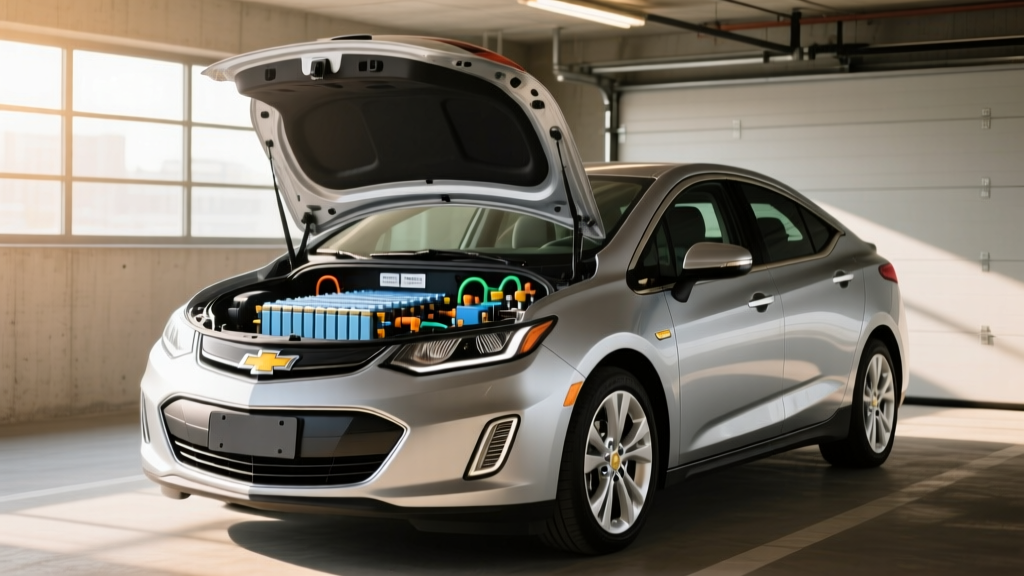
The 2017 Chevy Volt Battery at a Glance
The 2017 Chevrolet Volt uses an 18.4 kWh lithium-ion traction battery built with NMC (nickel-manganese-cobalt) chemistry, manufactured by LG Chem. That pack powers an EPA-rated 53 miles of electric-only range before the 1.5L range-extending gasoline engine kicks in, giving the Volt a combined 420 miles of total range. By 2026, these vehicles are approaching nine years on the road, and owners — both current and prospective used buyers — are rightly asking how much capacity remains, what replacement costs, and whether the warranty still applies.
This guide breaks down everything we know about the 2017 Volt's high-voltage battery from real-world degradation data to replacement economics, while also explaining how its NMC chemistry compares to the LFP packs now common in newer EVs. Whether you own a Volt today or are evaluating one on the used market, these are the numbers that matter.
| Usable capacity | 18.4 kWh (nominal) |
| Chemistry | NMC (LG Chem) |
| EPA electric range (new) | 53 miles |
| Total range (with gas) | 420 miles |
| Battery warranty (original) | 8 years / 100,000 miles (10 years / 150,000 miles in CARB states) |
| Thermal management | Active liquid cooling and heating |
NMC vs. LFP: Understanding Volt Battery Chemistry
The 2017 Volt's LG Chem NMC cells were industry-standard for plug-in hybrids and early BEVs of that era. NMC chemistry offers a strong balance of energy density and power delivery, which is why GM selected it for a vehicle where packaging 53 miles of range into a compact sedan required every kWh to count. But NMC is not the only option — today's EV market increasingly uses LFP (lithium iron phosphate) packs, particularly from manufacturers like Tesla (Model 3 Standard Range), BYD, and Ford (Mustang Mach-E Standard Range).
Understanding the trade-offs matters if you're comparing a used Volt to a newer EV or PHEV.
| Attribute | NMC (2017 Volt) | LFP (Modern BEVs) |
|---|---|---|
| Energy density | Higher (~160-220 Wh/kg cell-level) | Lower (~140-170 Wh/kg) |
| Cycle life | ~1,000-2,000 full cycles | ~3,000-5,000+ full cycles |
| Cold-weather performance | Better low-temp discharge | Reduced range in cold (10-20% more loss) |
| 100% SoC tolerance | Accelerated degradation above 80% | Tolerates 100% SoC well; recommended weekly |
| Cost (cell-level) | Higher (cobalt, nickel) | Lower (iron, phosphate) |
| Thermal stability | Good with active management | Excellent; lower runaway risk |
Which is better? For a PHEV like the Volt with a relatively small pack that cycles frequently, NMC was the right call — its higher energy density fit more range into limited space. For a modern long-range BEV where the pack is 75-100 kWh and weight matters less than longevity, LFP is increasingly preferred. Neither is universally superior; the application determines the winner.
How Long Does the 2017 Chevy Volt Battery Last?
The short answer: most Volt batteries outlast the vehicle itself. The longer answer requires looking at actual degradation data.
According to fleet data and owner reports compiled by sources including fueleconomy.gov and long-term owner tracking, the second-generation Volt (2016-2019) exhibits an average capacity loss of approximately 1-2% per year under normal use. A 2017 Volt that started with 53 EPA-rated electric miles might show 46-50 miles of range at nine years old, depending on climate, charging habits, and mileage.
- Year 1-2: ~1-3% capacity loss (initial settling)
- Year 3-5: ~0.5-1.5% annual loss (linear degradation phase)
- Year 6-9: ~1-2% annual loss; total estimated loss: 10-18%
- Expected electric range at year 9: ~43-48 miles (from original 53)
- Typical failure threshold: Rare before 150,000+ miles or 12+ years
GM's active liquid thermal management system deserves significant credit here. Unlike early Nissan Leafs with passive air cooling — which saw 20-30%+ degradation in hot climates — the Volt's liquid-cooled pack maintains cells within an optimal temperature window, dramatically slowing chemical aging. This is one of the biggest factors separating PHEVs and BEVs with active thermal management from those without.
A critical nuance: the Volt never uses its full 18.4 kWh. GM programmed a substantial buffer — the pack operates between roughly 20% and 85% true state of charge even when the dash shows "full" or "empty." This buffer strategy is a primary reason Volt packs degrade more slowly than the raw chemistry might suggest.
Battery Warranty: What GM Covers and When It Expires
The 2017 Volt's battery warranty is one of the most generous GM has offered, and understanding its terms is essential for used buyers in 2026.
| Parameter | Federal (Standard) | CARB States* |
|---|---|---|
| Duration | 8 years / 100,000 miles | 10 years / 150,000 miles |
| Capacity retention threshold | ~60-70% of original capacity (varies by diagnostic) | Same threshold applies |
| Transferable to second owner? | Yes, automatically | Yes, automatically |
| 2017 Volt status in 2026 | Expired (8 years elapsed in 2025) | May still apply through 2027 if under 150k miles |
*CARB states include California, Colorado, Connecticut, Maine, Maryland, Massachusetts, New Jersey, New York, Oregon, Rhode Island, Vermont, Virginia, and Washington — states that adopted California's stricter emissions and warranty standards.
This is a critical distinction for 2026 buyers: if you own or are buying a 2017 Volt registered in a CARB state with under 150,000 miles, the battery warranty may still be active until the vehicle's 10th anniversary. In non-CARB states, the warranty expired in 2025 when the car turned eight. Always verify warranty status through a GM dealer using the VIN.
2017 Volt Battery Replacement Cost: What to Budget
If your Volt's battery does degrade below usable thresholds or suffers a cell failure, here's what replacement looks like in 2026.
| Option | Estimated Cost | Notes |
|---|---|---|
| New OEM pack (GM dealer) | $6,500 - $8,500 (parts + labor) | Full pack replacement; labor-intensive due to pack location under rear seat and center console |
| Refurbished/remanufactured pack | $3,500 - $5,500 | Third-party rebuilt packs with new or tested cells; warranty varies (1-3 years typical) |
| Individual module replacement | $800 - $2,500 | If only 1-2 of the Volt's 8 modules are faulty; requires specialist diagnostic and cell balancing |
| Used/salvage pack | $1,500 - $3,000 | From a wrecked Volt; unknown SoH; highest risk option |
Context matters here: the Volt's 18.4 kWh pack is far smaller and less expensive to replace than a full BEV pack. A 2026 Chevy Equinox EV with a ~85 kWh NMC pack, for example, could cost $14,000-$20,000+ for a full replacement. The Volt's PHEV architecture keeps this risk manageable.
When is replacement typically needed? For most Volts, it isn't — at least not for the traction battery. According to data tracked by Volt owners and EV communities, complete pack failures in the Gen 2 Volt are rare. Most vehicles are retired, totaled, or traded before the battery reaches end-of-life. The more common scenario is gradual range loss that owners simply adapt to, especially since the gas engine seamlessly takes over.
Factors That Accelerate (or Preserve) Volt Battery Health
NMC chemistry is sensitive to specific stressors. Here's what actually moves the needle on your Volt's battery longevity:
- Avoid sustained 100% SoC: The Volt's built-in buffer helps, but if you don't need the full 53 miles daily, set the charge target to "Reduced" in the vehicle settings (charges to ~80%).
- Minimize DC fast charging: The Volt supports only Level 2 AC charging (no DC fast-charge capability), so this is inherently not a concern — a design advantage for longevity.
- Use preconditioning: In cold weather, use the Volt's scheduled departure feature or plug-in preconditioning to warm the battery on grid power before driving, reducing cold-stress on cells.
- Store at moderate SoC: If the Volt will sit unused for weeks, leave it plugged in with the charge target set to ~50-60%. The battery management system will maintain optimal SoC.
- Avoid extreme heat soaking: Park in shade or a garage in hot climates. The liquid thermal system handles heat well while driving, but a parked car in 110°F+ ambient temps still stresses cells over time.
- Drive it regularly: Lithium-ion cells prefer regular cycling to long dormancy. Even a short weekly drive keeps the chemistry healthy.
One Volt-specific advantage: because the battery is relatively small and the gas engine provides backup, Volt owners rarely face the "range anxiety charging to 100% every time" pattern that accelerates degradation in pure BEVs. The car's powertrain design naturally encourages moderate SoC usage.
How to Check Your Volt's Battery State of Health
The 2017 Volt does not display a State of Health (SoH) percentage on its dashboard, unlike some modern EVs. Here are the practical methods owners use:
1. Range tracking method: The simplest approach. Fully charge the Volt and note the displayed estimated range. When new, a full charge showed approximately 53 miles of EV range. If your Volt now shows 45 miles after a full charge and your driving conditions haven't changed, that's roughly 85% SoH. Track this quarterly to spot acceleration in degradation.
2. OBD-II scan tool: Devices like the ScanGauge or dedicated EV diagnostic tools (such as the OVMS — Open Vehicle Monitoring System) can read the Volt's battery management system data, including actual kWh available, cell voltage spread, and estimated SoH. This provides a more precise picture than range estimation alone.
3. GM dealer diagnostic: A Chevrolet dealer can run a Battery Energy Capacity Test (BECT) using GM's GDS2 diagnostic system. This test measures actual usable capacity versus original spec and is the most authoritative SoH reading available. Expect to pay $100-$150 for this service if not covered under warranty.
4. Cell voltage delta check: Advanced owners using OBD-II data can monitor the voltage spread between the highest and lowest cell groups. A delta under 100 mV at rest is healthy; above 200 mV suggests cell imbalance that may warrant module-level service.
Looking Ahead: Solid-State and Silicon Anode Batteries
For Volt owners wondering whether next-generation battery tech will eventually offer an upgrade path, here's the realistic landscape as of 2026:
Solid-state batteries — which replace the liquid electrolyte with a solid material for improved energy density, faster charging, and reduced fire risk — remain in limited production. Toyota has announced solid-state packs for select 2027-2028 models, and companies like QuantumScape are supplying prototype cells to Volkswagen. However, these packs will debut in premium BEVs at high cost and will not be retrofit-compatible with existing vehicles like the Volt. Expect solid-state to reach mainstream affordability around 2030-2032.
Silicon anode technology — which replaces graphite anodes with silicon to boost energy density by 20-40% — is closer to market. Sila Nanotechnologies is supplying silicon-dominant anode materials to Mercedes-Benz for the upcoming G-Class EV, and Group14 Technologies is working with Porsche. These advances improve new vehicles but, again, are not retrofit options for current Volt owners.
The practical takeaway: your Volt's NMC pack is the battery it will always have, and that's fine. The chemistry is proven, the degradation curve is gentle, and the PHEV powertrain means even a degraded pack still delivers usable electric miles with gasoline backup.
Frequently Asked Questions
How long do EV batteries last in years and miles?
Modern EV and PHEV batteries with active thermal management — like the 2017 Volt's liquid-cooled NMC pack — typically retain 70-85% of original capacity after 10-15 years or 150,000-200,000 miles. Complete failure requiring replacement is uncommon before 12+ years. Data from NREL studies on fleet batteries supports these figures across multiple chemistries and manufacturers.
How much does it cost to replace a 2017 Chevy Volt battery?
A full OEM replacement through a GM dealer runs approximately $6,500-$8,500 including labor. Refurbished packs from third-party suppliers cost $3,500-$5,500. Individual module replacement — if only specific cell groups are degraded — can be as low as $800-$2,500. For comparison, the Volt's small 18.4 kWh pack is significantly cheaper to replace than a full BEV battery.
Is the 2017 Volt battery warranty still active in 2026?
In non-CARB states, the 8-year/100,000-mile warranty expired in 2025. In CARB states (California, New York, and others adopting California emissions standards), the 10-year/150,000-mile warranty may still be active through 2027 if the vehicle has not exceeded 150,000 miles. Verify through any GM dealer with the VIN.
How do I maximize my Volt battery's lifespan?
Use the "Reduced" charge setting for daily driving (limits to ~80% SoC), precondition the battery in cold weather using grid power, avoid leaving the car at full charge for extended periods, park in shade during extreme heat, and drive it regularly rather than letting it sit dormant for weeks. The Volt's built-in buffer and liquid thermal management already do significant protective work.
LFP vs. NMC — which battery chemistry is better for me?
NMC offers higher energy density and better cold-weather performance, making it ideal for smaller packs where space is at a premium (like PHEVs). LFP offers longer cycle life, lower cost, better thermal stability, and tolerance for regular 100% charging — advantages that shine in larger BEV packs. Neither is universally superior; the right choice depends on the vehicle's design priorities and your usage pattern.
Can I upgrade my 2017 Volt to a larger or newer battery?
No. The Volt's battery pack is engineered specifically for its powertrain, physical packaging, and software calibration. There is no factory or aftermarket upgrade path to a larger capacity pack or different chemistry. The 18.4 kWh NMC pack is the only compatible option.