Why a 2016 Nissan Altima Battery Search Leads to EV Battery Questions
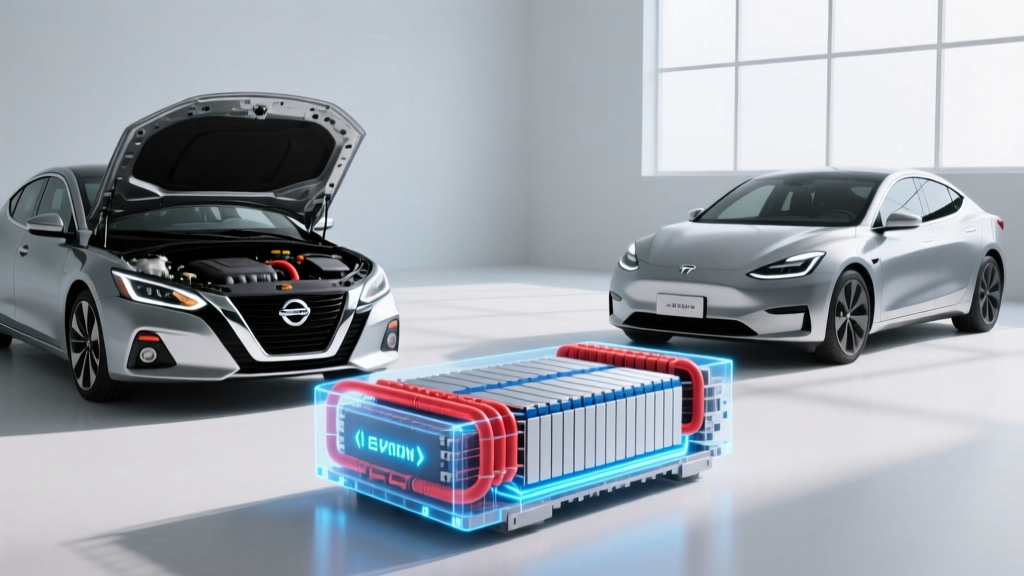
If you've searched for a 2016 Nissan Altima battery, you might be dealing with a dead 12-volt starter battery — the small lead-acid unit under the hood that powers your lights, radio, and engine cranking. That's a straightforward $150–$250 replacement at any auto parts store.
But many Altima owners making the jump to an electric vehicle quickly realize that "battery" means something entirely different in the EV world. The high-voltage traction battery in a modern EV is a 60–100+ kWh energy storage system costing thousands of dollars, engineered to last 15+ years, and governed by chemistry, thermal management, and charging habits that most gas-car owners never had to think about.
This guide bridges that gap. We'll cover everything an EV-curious driver (or current EV owner) needs to understand about modern traction batteries — chemistry, degradation, replacement costs, warranties, and care — with context that helps you make informed decisions whether you're replacing a 12V in your Altima or evaluating a 2026 EV purchase.
LFP vs. NMC: The Two Battery Chemistries Powering Today's EVs
Modern EV batteries use lithium-ion cells, but not all lithium-ion is the same. The two dominant chemistries in 2026 are LFP (lithium iron phosphate) and NMC/NCA (nickel manganese cobalt / nickel cobalt aluminum). Understanding the difference is critical because it affects your range, charging habits, longevity, and even the price you pay.
| Attribute | LFP (Lithium Iron Phosphate) | NMC/NCA (Nickel-Based) |
|---|---|---|
| Energy Density | Lower (~160 Wh/kg cell-level) | Higher (~250–300 Wh/kg cell-level) |
| Typical Range per Pack Size | Shorter for same weight/volume | Longer for same weight/volume |
| Cycle Life | 3,000–5,000+ cycles | 1,000–2,000 cycles |
| Charging to 100% Daily | Recommended (no degradation penalty) | Not recommended (80% daily limit advised) |
| Cold-Weather Performance | Weaker — more range loss below freezing | Better — less cold-weather range penalty |
| Cost per kWh | Lower ($100–$115/kWh at pack level, 2026) | Higher ($125–$145/kWh at pack level, 2026) |
| Cobalt Content | Zero cobalt (ethical sourcing advantage) | Contains cobalt (supply chain concerns) |
| Common in (2026 models) | Tesla Model 3/Y RWD, BYD, Ford Mustang Mach-E Select (LFP option) | Tesla Long Range, Hyundai Ioniq 5/6, Kia EV6, Rivian, most premium EVs |
Which Chemistry Is Better for You?
Choose LFP if: You mostly drive in moderate climates, can charge at home daily to 100%, want maximum cycle life, and prioritize lower cost over peak range. LFP is ideal for commuters who don't need 350+ miles of range.
Choose NMC/NCA if: You need maximum range per charge, regularly drive in cold climates, or take frequent road trips where energy density matters. NMC demands more careful charging habits (avoiding sustained 100% SoC) but delivers the range figures most buyers chase.
Neither chemistry is universally "better." The right choice depends on your driving pattern, climate, and charging access.
How Long Do EV Batteries Actually Last? Degradation Data
The single biggest fear among EV shoppers is battery degradation — the gradual loss of capacity over time. Here's what the real-world data shows in 2026:
- Year 1: ~2–3% loss (initial settling)
- Years 2–5: ~0.5–1% per year
- Years 6–10: ~0.3–0.5% per year
- At 100,000 miles: Most packs retain 88–93% of original capacity
- At 200,000 miles: Most packs retain 80–88% of original capacity
Source: Geotab fleet data analysis, aggregated from 10,000+ EVs across multiple model years.
For context, a 2026 Tesla Model Y Long Range with an EPA-estimated 320 miles of range would likely still deliver ~275–290 miles at 100,000 miles and ~255–280 miles at 200,000 miles. That's meaningful but not catastrophic.
LFP batteries degrade even more slowly. Tesla's LFP Model 3 RWD packs have shown minimal degradation — often under 5% at 100,000 miles — thanks to the chemistry's inherent stability and the ability to regularly charge to 100% (which keeps cell balancing active).
Early-generation EVs degraded faster. The 2011–2017 Nissan Leaf, which used passive air cooling and NMC chemistry, saw significantly higher degradation — some owners reported 20–30% capacity loss by 60,000–80,000 miles, especially in hot climates. Modern liquid-cooled thermal management systems have largely solved this problem. If you're cross-shopping a used Leaf against a modern EV, this is a critical distinction.
What Does the EV Battery Warranty Actually Cover?
Federal law mandates that EV batteries carry a minimum warranty of 8 years / 100,000 miles (10 years / 150,000 miles in California and states that follow CARB standards). But the details vary significantly by manufacturer:
| Manufacturer | Warranty Term | Capacity Threshold | Notes |
|---|---|---|---|
| Tesla (all models) | 8 yr / 120,000 mi (Model 3/Y RWD); 8 yr / 150,000 mi (Long Range/Performance) | 70% retention | Covers defects + degradation below threshold |
| Hyundai / Kia | 10 yr / 100,000 mi | 70% retention | Among the longest terms in the industry |
| Ford (Mustang Mach-E, F-150 Lightning) | 8 yr / 100,000 mi | 70% retention | Covers battery components + degradation |
| General Motors (Ultium platform) | 8 yr / 100,000 mi | 70% retention (60% for commercial) | Transferable to second owner |
| BMW | 8 yr / 100,000 mi | 70% retention | Extends to 10 yr in some markets |
What "70% retention" means: If your 82 kWh (usable) battery drops below 57.4 kWh of usable capacity within the warranty period, the manufacturer must repair or replace it at no cost. In practice, very few modern liquid-cooled EV batteries fall below this threshold within the warranty window. According to Recurrent Auto's analysis of 15,000+ EVs, fewer than 1.5% of batteries have been replaced under warranty for degradation-related issues.
EV Battery Replacement Costs: What You'll Actually Pay
This is where the fear-mongering usually starts. Let's ground it in data:
| Vehicle / Pack Size | Battery Capacity | Replacement Cost (Parts + Labor) | When Is It Typically Needed? |
|---|---|---|---|
| Tesla Model 3 RWD (LFP) | ~60 kWh | $12,000–$16,000 | Rarely — LFP cycle life exceeds most vehicle lifespans |
| Tesla Model Y Long Range (NMC) | ~75 kWh | $14,000–$18,000 | 200,000+ miles if at all |
| Hyundai Ioniq 5 (NMC) | 77.4 kWh | $15,000–$20,000 | 150,000–200,000+ miles |
| Ford F-150 Lightning Extended Range | 131 kWh | $22,000–$30,000 | 200,000+ miles if at all |
| Chevrolet Bolt EV/EUV (NMC) | 65 kWh | $14,000–$16,000 | 150,000+ miles |
The reality check: Pack-level battery costs have fallen from over $1,000/kWh in 2010 to approximately $115–$140/kWh in 2026, according to BloombergNEF. And the vast majority of EV batteries never need replacement. Modern liquid-cooled packs routinely outlast 200,000 miles with 80%+ capacity remaining. For most owners, the car will be retired or totaled in an accident before the battery needs replacing.
If a replacement is needed outside warranty, third-party refurbishers and module-level repairs (replacing individual cell modules rather than the entire pack) are increasingly available for $5,000–$10,000, depending on the vehicle.
Factors That Accelerate (or Preserve) Battery Life
Your habits directly impact how quickly your battery degrades. Here's what matters most, ranked by impact:
- Avoid sustained high SoC (NMC/NCA only): Set your daily charge limit to 80%. Charge to 100% only for road trips. LFP owners can (and should) charge to 100% regularly.
- Minimize DC fast charging frequency: Occasional fast charging is fine. Daily reliance on 150+ kW DCFC accelerates degradation by ~1–2% over the pack's life compared to Level 2 home charging. Use Level 2 (7–11.5 kW) as your primary charging method.
- Avoid extreme heat exposure: Parking in direct sun in 100°F+ climates for extended periods stresses the battery. Use a garage or shaded spot when possible. Liquid-cooled packs handle this far better than older air-cooled designs (like the early Leaf).
- Don't let SoC sit at 0% or 100% for days: If storing the car, leave it at ~50% SoC. Leaving an NMC pack at 100% for a week in hot weather causes measurable degradation.
- Use preconditioning: Most modern EVs let you precondition the battery before fast charging or departure. This warms or cools the cells to optimal temperature, reducing stress during charging and improving efficiency.
- Drive moderately in extreme cold: Cold batteries have higher internal resistance. Aggressive acceleration on a cold, un-preconditioned battery causes more stress than gentle driving.
The biggest myth: "Fast charging will destroy your battery." In reality, modern battery management systems (BMS) actively throttle charge rates when cells are too hot or too cold, protecting the pack. The degradation difference between exclusive DCFC use and exclusive Level 2 use is typically 2–5% over 150,000 miles — meaningful but not catastrophic.
How to Check Your EV's Battery Health (State of Health)
State of Health (SoH) is the percentage of your battery's original capacity that remains usable. Here's how to monitor it:
Manufacturer Tools
- Tesla: No built-in SoH display in the app, but you can estimate SoH by comparing your actual range at 100% charge to the original EPA rating. Third-party apps like Tessie or TeslaFi provide more granular data.
- Hyundai/Kia: The infotainment system includes an EV battery health screen showing SoH percentage.
- Ford: The FordPass app provides battery health status.
- GM (Ultium): OnStar diagnostics include battery health reporting.
OBD-II Scanners and Third-Party Tools
Devices like the OBDLink SX paired with apps such as LeafSpy (for Nissan Leaf) or ABRP (A Better Route Planner) can read battery health data directly from the vehicle's CAN bus. This is especially useful for used-EV buyers who want independent verification before purchase.
Dealer Diagnostics
Any authorized dealer can run a full battery health report. If you're buying a used EV, request this report as part of pre-purchase inspection. A healthy pack should show 90%+ SoH under 50,000 miles and 85%+ under 100,000 miles.
Emerging Battery Technology: What's Coming and When
Several next-generation battery technologies are in development. Here's a realistic timeline — none of these are available in production vehicles as of early 2026:
Solid-State Batteries: Replace the liquid electrolyte with a solid material, promising higher energy density (~400+ Wh/kg), faster charging, and improved safety. Toyota has announced plans for limited solid-state EV production around 2027–2028, with broader availability not expected until 2030+. Samsung SDI and QuantumScape are also in advanced testing. Expect initial solid-state EVs to carry premium pricing.
Silicon Anode Batteries: Replacing graphite anodes with silicon can boost energy density by 20–40%. Companies like Sila Nanotechnologies and Group14 are supplying silicon anode materials to battery manufacturers. Expect gradual integration into NMC cells starting in 2027–2028 model-year vehicles, likely debuting in premium segments.
Sodium-Ion Batteries: Using abundant sodium instead of lithium, these cells are cheaper and perform well in cold weather, but have lower energy density. CATL and BYD are producing sodium-ion cells for budget EVs in China. US-market availability is uncertain and likely 2028+ at the earliest, initially in fleet/commercial applications.
Semi-Solid-State: A bridge technology using a gel-like electrolyte. NIO's 150 kWh semi-solid-state pack is available in China (2024+). US availability remains unannounced. This offers ~30% more energy density than current NMC but at significantly higher cost.
Frequently Asked Questions
How long do EV batteries last in years and miles?
Most modern liquid-cooled EV batteries last 15–20 years and 200,000+ miles before dropping below 80% capacity. Data from Geotab and Recurrent Auto confirms that average annual degradation is under 1.5% per year for most vehicles. The car's body, suspension, and electronics are more likely to reach end-of-life before the battery does.
How much does an EV battery cost to replace?
Full pack replacement costs range from $12,000 to $30,000 depending on battery size and vehicle model. However, the vast majority of EV batteries never need replacement during normal ownership. Module-level repairs (replacing individual cell groups) cost $5,000–$10,000 and are an increasingly common alternative to full-pack swaps.
What does the battery warranty cover?
Federal law requires a minimum 8-year/100,000-mile battery warranty (10/150,000 in CARB states). Warranties cover manufacturing defects and capacity loss below a specified threshold — typically 70% of original capacity. If your battery drops below that threshold within the warranty period, the manufacturer must repair or replace it at no cost.
How do I check and maximize my EV battery health?
Check SoH through your vehicle's built-in diagnostics, manufacturer app, or an OBD-II scanner with EV-compatible software. Maximize lifespan by charging to 80% daily (NMC), minimizing exclusive DCFC reliance, avoiding extreme SoC storage, using preconditioning, and parking in shade in hot climates.
LFP vs. NMC — which is better and why?
Neither is universally better. LFP offers longer cycle life (3,000–5,000 cycles), lower cost, and the ability to charge to 100% daily — ideal for commuters in moderate climates. NMC delivers higher energy density (more range per kWh of battery weight) and better cold-weather performance — better for long-distance drivers and cold-climate owners. Your driving pattern determines the right choice.
Is a 2016 Nissan Altima battery the same as an EV battery?
No. The 2016 Nissan Altima uses a conventional 12V lead-acid battery (Group 35, approximately $150–$250 to replace) that starts the engine and powers accessories. An EV traction battery is a high-voltage lithium-ion pack (60–131 kWh) that propels the vehicle and costs $12,000–$30,000 to replace. The only connection is the word "battery."