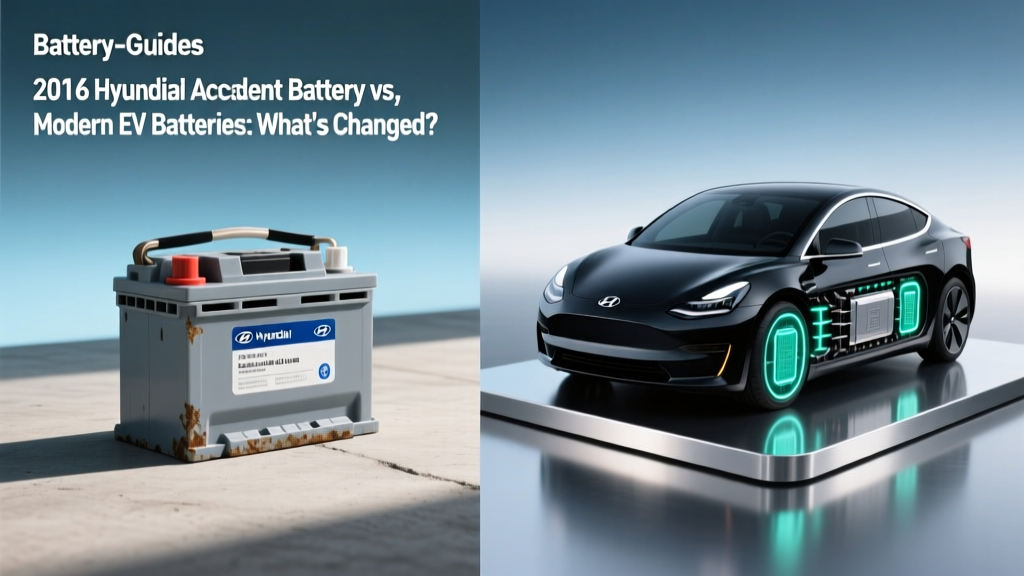
If you've searched for a 2016 Hyundai Accent battery, you're likely dealing with a 12-volt lead-acid replacement for a conventional gasoline subcompact — a $150–$250 Group 47 AGM or flooded-cell battery that cranks a 1.6L four-cylinder engine. But that search also opens a much larger conversation in 2026: how do the simple lead-acid batteries in gas cars compare to the sophisticated high-voltage lithium-ion traction batteries powering today's electric vehicles?
The answer reveals why EV battery technology has become one of the most important — and most misunderstood — topics for car buyers. This guide breaks down everything you need to know about modern EV batteries: chemistry, degradation, warranties, replacement costs, and how to maximize longevity.
From Lead-Acid to Lithium-Ion: A Battery Evolution
The 2016 Hyundai Accent uses a conventional 12V battery rated at roughly 45–60 amp-hours. It powers the starter motor, lights, and electronics. Typical lifespan: 3–5 years. Replacement cost: under $250.
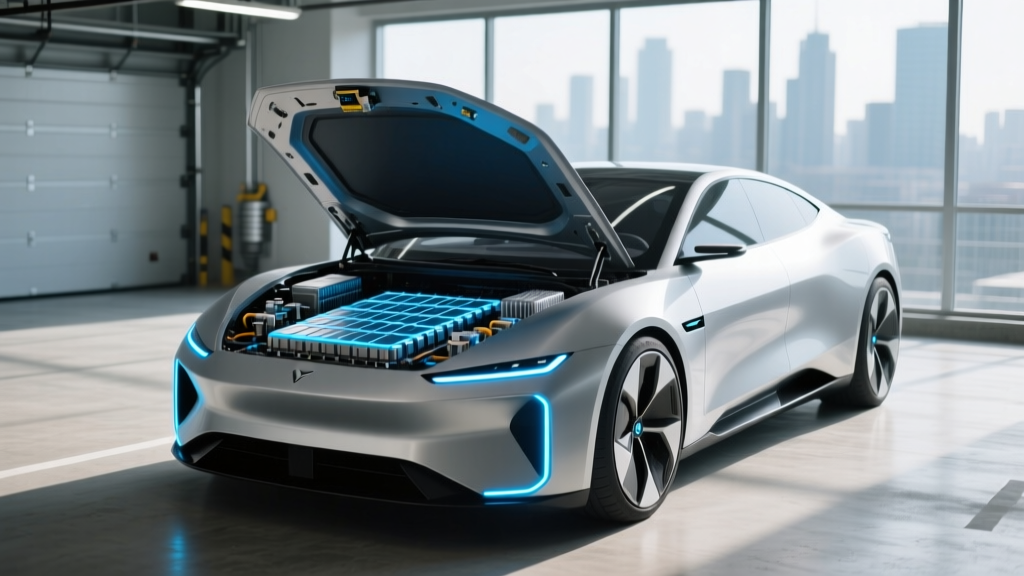
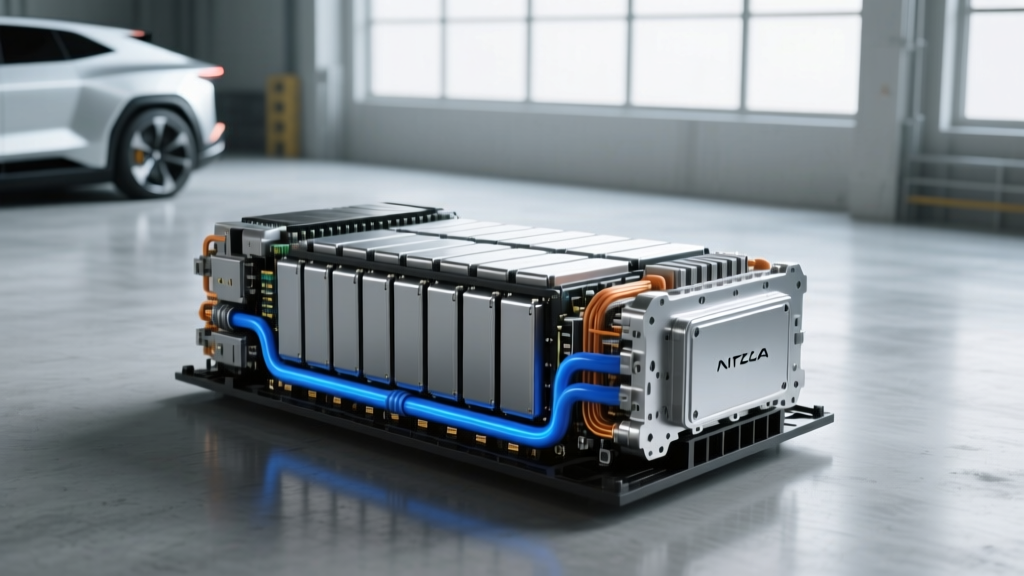
Modern EV traction batteries operate in an entirely different universe. A 2026 Hyundai Ioniq 5, for example, carries a 77.4 kWh usable lithium-ion pack operating at 400V (or 800V on certain trims). It stores roughly 1,300 times more energy than that Accent's 12V battery and is engineered to last the lifetime of the vehicle — typically 150,000–200,000+ miles before reaching end-of-automotive-life (defined as 70–80% of original capacity).
Even Hyundai's own EV lineup illustrates this leap. The Ioniq 5's battery warranty covers 10 years/100,000 miles with a capacity retention threshold, compared to the 2016 Accent's 3-year/36,000-mile basic warranty that covered its humble lead-acid cell.
LFP vs NMC: Understanding EV Battery Chemistry
Not all EV batteries use the same chemistry. The two dominant types in 2026 are LFP (lithium iron phosphate) and NMC/NCA (nickel manganese cobalt / nickel cobalt aluminum). Each has distinct trade-offs that affect range, longevity, and cost.
| Attribute | LFP (Lithium Iron Phosphate) | NMC/NCA (Nickel-Based) |
|---|---|---|
| Energy Density | Lower (~160 Wh/kg cell-level) | Higher (~250–300 Wh/kg cell-level) |
| Typical Range per Pack Size | Slightly less range for same kWh | More range for same physical pack |
| Cycle Life | 3,000–5,000+ cycles | 1,000–2,000 cycles |
| Cold-Weather Performance | More range loss in freezing temps (~30–40%) | Better cold retention (~20–30% loss) |
| Charging to 100% Regularly | Recommended — no degradation penalty | Best kept 20–80% for longevity |
| Cost | Lower (no cobalt or nickel) | Higher (commodity-sensitive metals) |
| Thermal Stability | Excellent — very low thermal runaway risk | Good — requires more active thermal management |
| Common In (2026) | Tesla Model 3/Y RWD, Ford Mustang Mach-E Select, BYD models | Long-range AWD trims, Hyundai Ioniq 5/6, Rivian, Lucid |
Which is better? It depends on your use case. LFP wins for daily commuters who charge at home and want maximum cycle life. NMC wins for road-trippers who prioritize range per charge and cold-weather drivability. Neither is universally superior — automakers choose based on the vehicle's mission profile.
How Long Do EV Batteries Actually Last?
This is the question every prospective EV buyer asks, and the data is reassuring. Based on fleet data, manufacturer reports, and independent testing through 2025–2026:
- Average degradation at 100,000 miles: 5–10% capacity loss (most packs retain 90–95% State of Health)
- Average degradation at 150,000 miles: 10–15% capacity loss
- Average degradation at 200,000 miles: 15–20% capacity loss
- Tesla fleet data (2024 report): Model S/X batteries showed ~12% average degradation at 150,000 miles
- Geotab fleet study (50,000+ EVs): Average annual degradation of ~1.8% per year across all models, with LFP packs showing slower decline
- Worst-case outliers: Early Nissan Leaf (passive air cooling) saw 20–30% loss by 80,000 miles; modern liquid-cooled packs have largely solved this
Sources: Geotab EV Battery Degradation Study, Tesla Impact Reports
The key takeaway: most modern liquid-cooled EV batteries will outlast the vehicle's economic life. A 2026 EV with a 300-mile EPA range losing 15% capacity over 200,000 miles still delivers 255 miles — more than adequate for daily use.
What Does the EV Battery Warranty Actually Cover?
Federal law mandates a minimum EV battery warranty of 8 years/100,000 miles (10 years/150,000 miles in CARB states including California, New York, Massachusetts, and others). Most manufacturers exceed this baseline.
| Manufacturer | Warranty Period | Capacity Retention Threshold | Notes |
|---|---|---|---|
| Hyundai / Kia | 10 yr / 100,000 mi | 70% of original capacity | Among the most generous; covers Ioniq 5, Ioniq 6, EV6, EV9 |
| Tesla (Model 3/Y LFP) | 8 yr / 120,000 mi | 70% minimum retention | Longer mileage for LFP RWD trims |
| Tesla (Model S/X, LR/AWD) | 8 yr / 150,000 mi | 70% minimum retention | Higher mileage threshold for premium packs |
| Ford (Mach-E, F-150 Lightning) | 8 yr / 100,000 mi | 70% minimum retention | Standard across BEV lineup |
| GM (Ultium-platform) | 8 yr / 100,000 mi | 70% minimum retention (some models 60%+) | Varies by model; check specific warranty booklet |
| Rivian | 8 yr / 175,000 mi | 70% minimum retention | Highest mileage threshold in the industry |
| Volkswagen (ID.4) | 8 yr / 100,000 mi | 70% minimum retention | Standard CARB and federal coverage |
Critical detail: The warranty threshold matters. A 70% retention guarantee means the manufacturer will replace or repair the battery if it falls below 70% of original capacity within the warranty period. Normal degradation (say, from 100% to 88% over five years) is not a warranty claim — it's expected wear.
For current IRS §30D federal tax credit eligibility, battery sourcing and critical mineral requirements also apply. Check the IRS clean vehicle credit page for 2026 rules, as these change based on supply-chain compliance.
EV Battery Replacement Costs: What to Expect
Battery replacement is the specter that haunts EV skeptics — but context matters enormously. Most EV batteries never need replacement during original ownership. When they do, it's typically after 150,000+ miles, and costs have been declining steadily.
| Vehicle / Pack Size | Battery Capacity | Estimated Replacement Cost | Cost per kWh |
|---|---|---|---|
| Compact EV (e.g., Chevy Bolt EV) | ~65 kWh | $9,000–$13,000 | ~$140–$200/kWh |
| Mid-size crossover (e.g., Tesla Model Y, Ioniq 5) | ~75–80 kWh | $11,000–$16,000 | ~$140–$200/kWh |
| Large SUV/truck (e.g., F-150 Lightning, Rivian R1S) | ~100–135 kWh | $15,000–$25,000 | ~$140–$190/kWh |
| Luxury sedan (e.g., Lucid Air, Mercedes EQS) | ~100–118 kWh | $18,000–$30,000+ | ~$180–$260/kWh |
Compare this to the 2016 Hyundai Accent's $200 lead-acid battery. Yes, EV battery replacement is dramatically more expensive — but the Accent's engine could require a $4,000–$7,000 replacement if it failed, and its transmission another $3,000–$5,000. The EV eliminates those failure points entirely.
Also worth noting: the used EV battery market is growing. Refurbished and remanufactured packs are increasingly available at 40–60% of new-pack cost, and module-level repair (replacing only degraded cells rather than the entire pack) is becoming more common at specialized EV service centers.
Factors That Affect EV Battery Longevity
While modern battery management systems (BMS) do an excellent job protecting the pack, your habits still influence long-term State of Health (SoH). Here's what the data shows:
- Minimize DC fast charging when possible: Frequent use of 150+ kW DC fast charging accelerates degradation by roughly 0.5–1% additional per year vs. primarily Level 2 charging. Road trips are fine; daily fast-charging is what matters.
- Avoid extreme State of Charge storage: Storing an NMC battery at 100% SoC for weeks in hot weather accelerates calendar aging. Store at 40–60% if the car will sit for 2+ weeks. (LFP batteries are more tolerant of 100% storage.)
- Use scheduled charging: Set your car to finish charging to 80% right before departure rather than sitting at full charge overnight. Most EVs offer this feature in-app.
- Precondition in cold weather: Using the car's battery preconditioning feature before fast charging in winter reduces stress on the cells and improves charge speed. The battery heater brings cells to optimal temperature (~25–35°C).
- Don't baby it excessively: Modern BMS systems maintain top and bottom buffers (typically 5–10% of total capacity is hidden). Charging to 100% occasionally for a road trip won't meaningfully harm the pack.
- Park in shade/garage when possible: Sustained high ambient temperatures (95°F+) are more damaging than cold. Battery degradation correlates more strongly with heat exposure than with cycle count.
How to Check Your EV Battery's State of Health
Unlike the 2016 Hyundai Accent's 12V battery — which you test with a simple multimeter or load tester at an auto parts store — EV battery health monitoring requires software-based diagnostics.
In-car methods:
- Tesla: Navigate to Service → Battery Health in the car's menu (available on 2022+ software). Displays SoH percentage.
- Hyundai/Kia: The infotainment system's EV menu shows estimated battery condition. Dealer diagnostic tools provide granular cell-level data.
- Ford: The FordPass app displays battery health metrics on Mach-E and Lightning models.
- General Motors: The myChevrolet/myCadillac apps show battery health indicators on Ultium-platform vehicles.
Third-party tools:
- OBD-II dongles + apps: Tools like OBDLink SX paired with apps such as EV Battery Health or LeafSpy (for Nissan Leaf) can read detailed SoH data, individual cell voltages, and degradation curves.
- Dealer diagnostics: A service center can pull a full battery health report showing capacity retention, cell balancing status, and thermal management history. Request this during routine service visits.
- Charging data analysis: Comparing your actual kWh consumed during a 10–80% charge session against the pack's rated usable capacity gives a rough SoH estimate. If your 77.4 kWh pack only accepts 68 kWh during a controlled charge, that's roughly 88% SoH.
Looking Ahead: Solid-State and Next-Gen Batteries
The next frontier in EV battery technology includes solid-state batteries (replacing liquid electrolyte with a solid conductor) and silicon-anode cells (boosting energy density by 20–40%). Here's where these technologies realistically stand as of 2026:
- Solid-state: Toyota has announced limited production in select 2027–2028 models, claiming 750+ km (466 mi) range and 10-minute fast charging. Samsung SDI and QuantumScape are supplying prototypes to BMW and Volkswagen, respectively. However, mass-market solid-state vehicles are not expected before 2029–2030 at the earliest. Manufacturing yield and cost remain significant barriers.
- Silicon-anode: Already in limited use — Tesla's 4680 cells incorporate silicon-carbon anode material. Companies like Sila Nanotechnologies and Group14 are scaling production. Expect incremental energy density gains (5–10% per generation) rather than a sudden breakthrough.
- Sodium-ion: CATL and BYD have begun deploying sodium-ion batteries in Chinese-market budget EVs. Lower energy density but cheaper and cobalt-free. US availability is not yet confirmed for mainstream models.
These technologies are promising but should not delay a 2026 EV purchase. Current lithium-ion batteries already deliver 200,000+ mile lifespans with manageable degradation — the engineering is mature and proven.
Frequently Asked Questions
How long do EV batteries last in years and miles?
Most modern liquid-cooled EV batteries are designed to last 15–20 years or 150,000–200,000+ miles before degrading to 70–80% of original capacity. Fleet data from Geotab and manufacturer reports confirm average annual degradation of roughly 1.8% per year. Many early Tesla Model S vehicles from 2012–2014 are still running on original packs at 200,000+ miles with 75–85% retention.
How much does an EV battery cost to replace in 2026?
Replacement costs range from approximately $9,000 for a compact EV pack (65 kWh) to $25,000+ for large truck/SUV packs (130+ kWh). The per-kWh cost has fallen to roughly $140–$200 at the pack level. However, most EV batteries never require replacement during typical ownership. Module-level repair and refurbished packs offer lower-cost alternatives when service is needed.
What does the EV battery warranty cover?
Federal minimum is 8 years/100,000 miles (10 years/150,000 miles in CARB states). Coverage guarantees the battery will retain at least 70% of original capacity (some manufacturers use slightly different thresholds). The warranty covers defects and abnormal degradation — not normal wear or damage from accidents, flooding, or unauthorized modifications. Hyundai and Kia offer 10 years/100,000 miles; Rivian covers 8 years/175,000 miles.
LFP vs NMC — which battery chemistry should I choose?
Choose LFP if you primarily charge at home, want maximum cycle life (3,000–5,000 cycles), live in a mild climate, and don't need the absolute longest single-charge range. Choose NMC/NCA if you need maximum range per charge, frequently drive in cold weather, or take regular road trips where energy density matters. Both chemistries are proven and well-supported in 2026.
Does fast charging damage my EV battery?
Occasional DC fast charging (road trips, a few times per month) has minimal impact on battery health. The concern is frequent daily fast charging at 150+ kW, which can add roughly 0.5–1% additional annual degradation compared to primarily Level 2 home charging. Modern battery management systems actively limit charge rates when cells are too cold or too warm to protect longevity.
For authoritative data on EV battery performance and efficiency ratings, see the U.S. Department of Energy's fueleconomy.gov database and IRS guidelines on clean vehicle credits.