Why a 2015 GMC Acadia Battery Search Leads Straight to EV Battery Questions
If you're searching for a 2015 GMC Acadia battery, you're likely dealing with a dead 12-volt starter battery — a $150–$250 fix at any auto parts store. The Acadia is a conventional gasoline V6 SUV with no high-voltage traction pack. But that routine replacement often sparks a bigger question among shoppers now considering an electric vehicle: How long do EV batteries actually last, and what happens when they need replacing?
The short answer is reassuring. Modern EV traction batteries are engineered to outlast the vehicles they power. The long answer involves chemistry, charge habits, thermal management, and warranty fine print that every EV buyer should understand before signing a purchase agreement.
This guide breaks down exactly how long EV batteries last in 2026, what degradation looks like with real data, what warranties actually cover, and what a replacement would cost if you ever need one. We'll also compare the humble 12V battery in your Acadia to the 60–100+ kWh traction packs powering today's EVs.
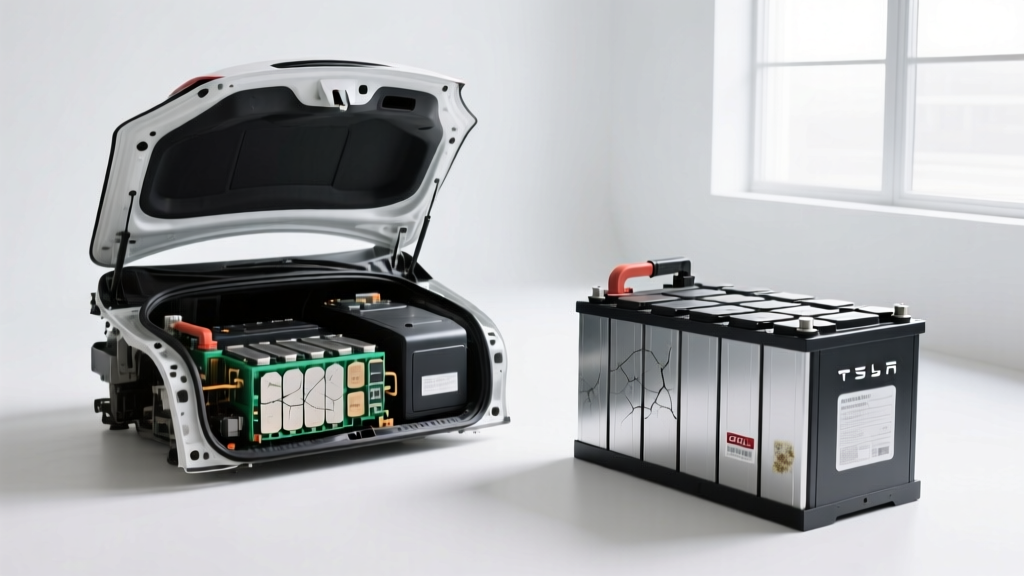
12V Auxiliary vs. High-Voltage Traction Battery: Know the Difference
The battery in a 2015 GMC Acadia is a standard 12V lead-acid (or AGM) unit. It cranks the starter motor, powers accessories when the engine is off, and typically lasts 3–5 years before replacement. Cost: roughly $150–$250 installed.
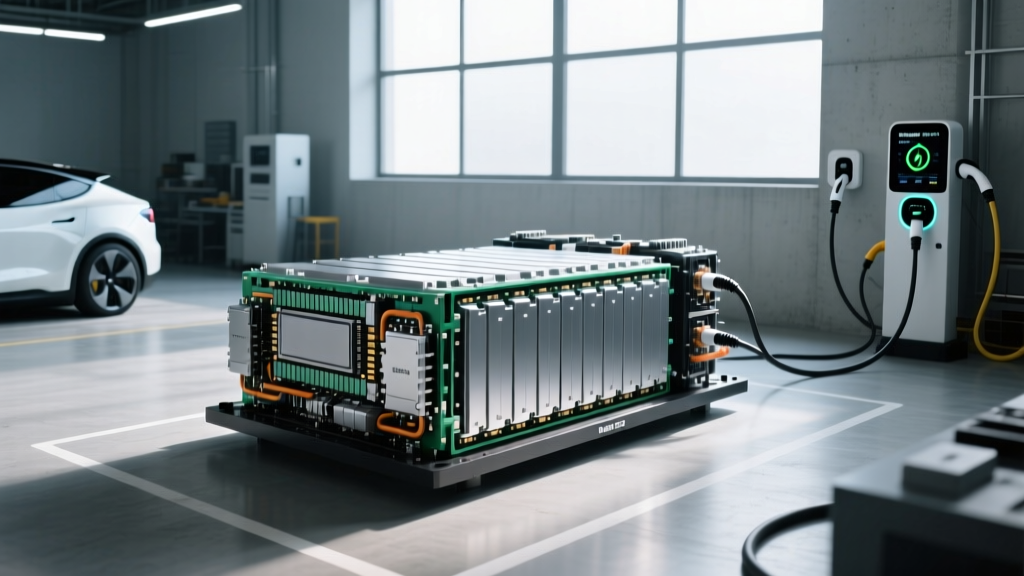
An EV traction battery is an entirely different system. It's a high-voltage lithium-ion pack (typically 400V or 800V architecture) storing 50–130+ kWh of energy that powers the electric drive motors. This pack is liquid-cooled, actively managed by a battery management system (BMS), and designed for a 150,000–200,000+ mile service life.
Critically, EVs also carry a 12V auxiliary battery (or in Tesla's case, a 16V lithium-ion unit) to power lights, infotainment, door locks, and the computers that close the high-voltage contactors. When an EV owner says "my battery died," they sometimes mean the 12V auxiliary — a $200–$400 replacement, not a $10,000+ traction pack swap. Understanding this distinction prevents unnecessary panic.
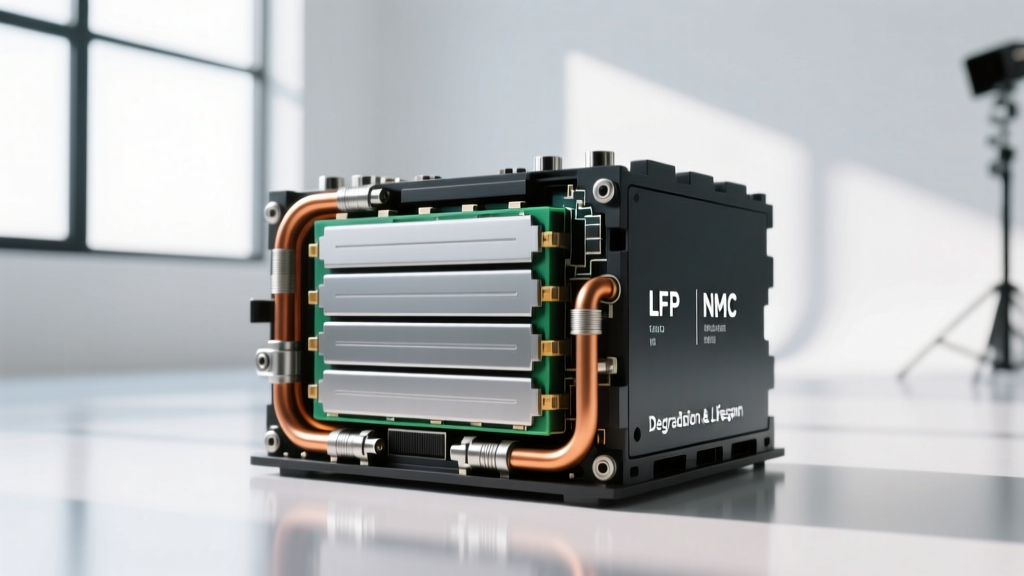
LFP vs. NMC: Which EV Battery Chemistry Is Right for You?
Two lithium-ion chemistries dominate the 2026 EV market, and the choice between them affects range, longevity, cold-weather performance, and price.
| Attribute | LFP (Lithium Iron Phosphate) | NMC / NCA (Nickel Manganese Cobalt / Nickel Cobalt Aluminum) |
|---|---|---|
| Energy density | ~160–180 Wh/kg (lower) | ~230–300 Wh/kg (higher) |
| Typical cycle life | 3,000–5,000+ cycles | 1,500–2,500 cycles |
| Cold-weather performance | Moderate; more range loss below freezing | Better low-temp discharge efficiency |
| Cost per kWh | Lower (~$80–$100/kWh at cell level) | Higher (~$110–$140/kWh at cell level) |
| Optimal daily SoC | Can charge to 100% daily without harm | Best kept at 80% for daily use; 100% for trips only |
| Thermal stability / safety | Excellent; higher runaway threshold | Good; requires more robust BMS monitoring |
| Common in (2026 models) | Tesla Model 3/Y RWD, Ford Mustang Mach-E Select, Rivian Standard | Hyundai Ioniq 5/6 Long Range, Tesla Long Range/Performance, BMW iX, GM Ultium-based models |
The practical takeaway: If you prioritize maximum range per charge and don't mind managing state-of-charge habits, NMC/NCA packs deliver more miles from a smaller, lighter pack. If you want a battery you can charge to 100% every night without worrying about degradation — and you don't need 350+ miles of range — LFP is the more carefree choice. LFP's longer cycle life means it's likely to retain more capacity over 10+ years of daily charging.
How Long Do EV Batteries Actually Last? Real Degradation Data
EV battery degradation is not a cliff — it's a gradual, mostly front-loaded curve. Most packs lose 5–10% of their original capacity in the first 2–3 years, then the rate slows considerably.
- Tesla fleet data (2025 Impact Report): Model 3/Y batteries retain approximately 85% of original capacity after 200,000 miles. Many packs still operate above 80% at 300,000+ miles.
- Geotab fleet study (2024, 10,000+ EVs): Average annual degradation across all brands was 1.8% per year — meaning a typical EV retains ~82% capacity after 10 years.
- Nissan Leaf (passive-cooled, older design): Earlier 24/30 kWh Leafs showed 10–20% loss within 5 years, largely due to lack of active thermal management. Modern liquid-cooled packs have largely solved this.
- Hyundai/Kia E-GMP platform: Owner reports and EPA data show Ioniq 5 and EV6 packs holding 90%+ capacity through the first 50,000 miles with normal use.
For context, most drivers keep a vehicle 6–8 years and put on 80,000–120,000 miles. At a 1.8% annual degradation rate, that means roughly 85–88% capacity remaining when the average owner trades in. The battery is rarely the reason an EV is retired.
EV Battery Warranty Terms: What's Actually Covered
Federal law mandates that EV batteries carry a minimum warranty of 8 years / 100,000 miles (10 years / 150,000 miles in California Air Resources Board states). Most manufacturers meet or exceed this baseline. Here's how the major brands stack up in 2026:
| Manufacturer | Warranty Period | Mileage Cap | Capacity Retention Threshold |
|---|---|---|---|
| Tesla (Model 3/Y LFP) | 8 years | 120,000 miles | 70% |
| Tesla (Model 3/Y LR, S, X) | 8 years | 120,000–150,000 miles | 70% |
| Hyundai / Kia (E-GMP) | 10 years | 100,000 miles | 70% |
| GM (Ultium-based: Equinox EV, Blazer EV, Silverado EV) | 8 years | 100,000 miles | 70% (60% for commercial use) |
| Ford (Mach-E, F-150 Lightning) | 8 years | 100,000 miles | 70% |
| Rivian (R1T, R1S) | 8 years | 175,000 miles | 70% |
| BMW (i4, iX, i7) | 8 years | 100,000 miles | 70% |
Key warranty nuances: The threshold matters. A 70% retention guarantee means the manufacturer will repair or replace modules if your pack drops below 70% of original capacity within the warranty window. Normal gradual degradation above that threshold is not covered. Also, some warranties void if the vehicle is used for rideshare, commercial fleet, or frequent DC fast charging beyond stated limits — always read the specific terms.
EV Battery Replacement Cost: What It Actually Takes
Out-of-warranty traction battery replacement remains the single biggest fear among prospective EV buyers. Here's what the numbers look like in 2026:
| Vehicle / Platform | Battery Size (kWh) | Full Pack Replacement (Parts + Labor) | Module-Level Repair (if available) |
|---|---|---|---|
| Tesla Model 3 / Model Y | 60–82 kWh | $12,000–$16,000 | $3,000–$5,000 per module section |
| Hyundai Ioniq 5 / Kia EV6 | 58–77.4 kWh | $10,000–$15,000 | Module replacement available |
| Ford Mustang Mach-E | 70–91 kWh | $14,000–$20,000 | Module replacement available |
| Ford F-150 Lightning (Extended Range) | 131 kWh | $22,000–$30,000 | Module-level service emerging |
| Chevrolet Equinox EV | 85 kWh (est.) | $12,000–$16,000 | Ultium modular architecture |
| Rivian R1T / R1S (Max Pack) | 149 kWh | $25,000–$35,000 | Modular pack design |
| BMW iX xDrive50 | 111.5 kWh | $20,000–$28,000 | Module service at certified centers |
Two critical points provide context. First, most EV owners never need a full battery replacement. The pack typically outlasts the vehicle's economic life — by the time a 12-year-old EV needs a $15,000 battery, the car's resale value is $5,000–$8,000, and the owner has already saved $10,000–$15,000 in fuel and maintenance over a gasoline equivalent. Second, module-level repair is increasingly available. Rather than replacing the entire pack, technicians can swap individual degraded or failed modules for a fraction of the cost — a trend accelerating as platforms like GM's Ultium and Hyundai's E-GMP were designed with modular serviceability in mind.
Compare this to the 2015 GMC Acadia's 12V battery: $150–$250 every 3–5 years. Over 10 years, that's $300–$800 in 12V batteries alone — plus the Acadia's $8,000–$15,000 in gasoline costs over the same period. The EV's traction battery, even factoring in a worst-case replacement, often nets out favorably in total cost of ownership.
Factors That Accelerate (or Preserve) Battery Health
Lithium-ion batteries degrade through calendar aging and cycle aging. Your habits influence the cycle-aging side significantly. Here's what the data shows:
- Avoid sustained 100% SoC: For NMC/NCA packs, set your daily charge limit to 80%. Charge to 100% only when departing on a road trip. LFP packs are the exception — manufacturers recommend periodic 100% charges for BMS calibration.
- Minimize DC fast charging when possible: Frequent 150+ kW DC sessions accelerate degradation slightly. Reserve DCFC for road trips; rely on Level 2 home charging for daily use. Data from Geotab shows vehicles that fast-charge more than 3x per week degrade ~0.5% faster annually than those that primarily Level 2 charge.
- Avoid extreme SoC storage: Don't leave your EV sitting at 100% or below 10% for weeks. If storing for vacation, set the charge limit to 50–60%.
- Use preconditioning: Most EVs let you precondition the battery (warm it to optimal temperature) before fast charging or departure. This reduces internal resistance and stress on cells. Use your vehicle's scheduled departure feature.
- Park in shade or a garage in extreme heat: Sustained high ambient temperatures (above 95°F / 35°C) accelerate calendar aging. Active thermal management mitigates this, but passive heat soak while parked still matters.
- Don't baby it too much: Modern BMS systems are sophisticated. The buffer (typically 5–10% of gross capacity hidden from the user) protects against deep discharge and overcharge. Drive normally and let the car manage the chemistry.
How to Check Your EV's Battery State of Health (SoH)
State of Health (SoH) is the percentage of your battery's current maximum capacity relative to its original factory capacity. A new EV has 100% SoH; a pack at 85% SoH holds 85% of its original kWh.
Methods to check SoH in 2026:
- In-vehicle displays: Tesla, Hyundai/Kia, BMW, and Rivian now offer SoH or battery health indicators in the settings menu or service screen. Tesla's is accessible via the Service menu; Hyundai's appears in the EV-specific settings cluster.
- OBD-II diagnostic tools: Devices like the OBDLink SX paired with apps such as EV Battery Health or ABRP (A Better Route Planner) can read the BMS-reported SoH directly. Cost: $30–$60 for the adapter, free or low-cost apps.
- Dealer diagnostic check: Any authorized service center can pull a full battery health report showing SoH, cell voltage variance, and module balance. Some brands (Hyundai, Tesla) offer this free during routine service visits.
- Third-party services: Companies like Recurrent Auto provide battery health reports based on telematics data — often free if you opt into their research fleet. These reports are increasingly accepted by used-EV buyers and insurers as a reliability indicator.
If you're buying a used EV, always request a SoH reading before purchase. A 2020 Model 3 with 60,000 miles and 92% SoH is a far better bet than one at 82% SoH, even if the price is similar. SoH is the single most important data point in a used EV evaluation — more predictive than odometer reading alone.
What's Next: Solid-State, Silicon Anodes, and Realistic Timelines
The battery landscape is evolving, but it's important to separate laboratory announcements from showroom reality.
Solid-state batteries replace the liquid electrolyte with a solid ceramic, polymer, or sulfide layer, promising higher energy density (potentially 400+ Wh/kg), faster charging, and improved safety. Toyota has announced solid-state-equipped vehicles for 2027–2028, initially in limited-production models. Samsung SDI and QuantumScape are targeting 2027–2029 production ramps. These are not yet available in any production vehicle as of 2026. Expect solid-state to debut in premium, low-volume applications before reaching mainstream pricing — likely not before 2030 for vehicles under $50,000.
Silicon anode technology is closer to market. Companies like Sila Nanotechnologies and Group14 are supplying silicon-dominant anode materials to manufacturers including Mercedes-Benz (for the upcoming G-Class electric) and others. Silicon anodes can boost energy density 20–40% over current graphite anodes. Expect to see silicon-anode cells in production vehicles starting in 2026–2027, with gradual adoption through 2030.
Sodium-ion batteries are emerging as a low-cost alternative for entry-level EVs. CATL has begun production, and brands like BYD are integrating sodium-ion packs in budget models for the Chinese market. Energy density is lower (~120–150 Wh/kg), but cost is significantly below LFP. US-market availability remains uncertain beyond 2028.
None of these technologies should delay an EV purchase today. Current lithium-ion packs (both LFP and NMC) are mature, well-understood, and backed by warranties that cover the period most owners keep their vehicles.
Frequently Asked Questions
How long do EV batteries last in years and miles?
Based on fleet data from Tesla, Geotab, and manufacturer reports, modern liquid-cooled EV batteries retain 80–85% of their original capacity after 200,000 miles or 10–15 years. Many packs continue functioning well beyond that point, albeit with reduced range. The battery is rarely the component that ends an EV's service life.
How much does an EV battery cost to replace?
Full pack replacement ranges from $10,000 to $35,000 depending on battery size and vehicle, with most mainstream models (Model 3, Ioniq 5, Mach-E) falling in the $12,000–$20,000 range. However, most owners never need a replacement, and module-level repairs (when available) cost $3,000–$5,000. By comparison, a gasoline vehicle's transmission replacement can cost $4,000–$8,000, and engine rebuilds $5,000–$10,000+ — costs EV owners never face.
What does the EV battery warranty actually cover?
Federal law requires a minimum of 8 years / 100,000 miles (10/150,000 in CARB states). The warranty covers capacity loss below a stated threshold — typically 70% of original capacity. If your pack drops below that level within the warranty period, the manufacturer repairs or replaces it at no cost. Normal gradual degradation above 70% is considered expected wear and is not covered.
How do I check and maximize my EV's battery health?
Check SoH via your vehicle's settings menu, an OBD-II adapter with an EV health app, or a dealer diagnostic visit. To maximize longevity: charge NMC/NCA packs to 80% daily (100% for LFP), minimize frequent DC fast charging, precondition the battery before fast charges and in cold weather, and avoid leaving the vehicle at extreme SoC levels for extended periods.
LFP vs NMC — which battery chemistry is better?
Neither is universally better. LFP offers longer cycle life (3,000–5,000 cycles vs. 1,500–2,500), lower cost, the ability to charge to 100% daily, and superior thermal safety — but with lower energy density and somewhat reduced cold-weather performance. NMC/NCA provides higher energy density (more range from a smaller pack) and better cold-weather discharge, but requires more careful SoC management for maximum longevity. For daily commuters who charge at home, LFP is increasingly the pragmatic choice. For road-trippers who need maximum range, NMC/NCA remains preferable.
Does a 2015 GMC Acadia have an EV battery?
No. The 2015 GMC Acadia is a conventional gasoline-powered SUV with a 3.6L V6 engine and a standard 12V lead-acid battery (Group 48, typically an H6/48 size). It has no high-voltage traction battery. If you're replacing the Acadia's 12V battery, expect to pay $150–$250 for an AGM unit at retailers like AutoZone, Advance Auto Parts, or Costco. If the Acadia search is leading you toward your first EV purchase, the battery longevity and cost data above should provide confidence that modern EV packs are a solved engineering problem — not the liability they're sometimes portrayed as.