The 2015 Fiat 500e Battery at a Glance: What You're Working With
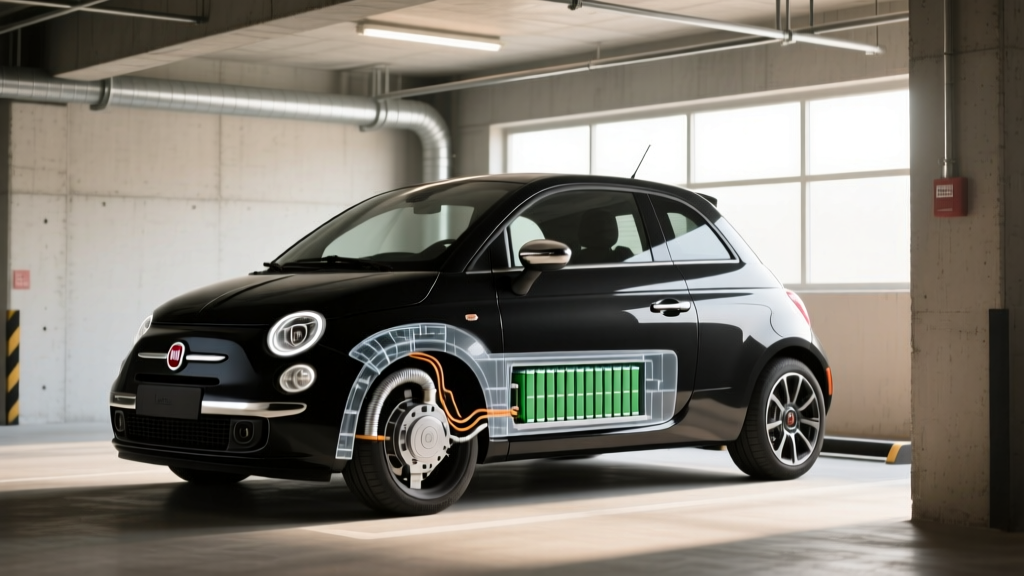
If you're shopping for a used 2015 Fiat 500e battery electric vehicle — or already own one and want to understand what's happening inside that compact hatchback — you need to know exactly what's under the floor. The 2015 Fiat 500e uses a 24 kWh lithium-ion traction battery (approximately 19.2 kWh usable) paired with an 83 kW (111 hp) electric motor driving the front wheels. The EPA rated it at 87 miles of range when new, with a combined efficiency of 112 MPGe.
That battery pack uses NMC (nickel-manganese-cobalt) chemistry — the dominant cell type of that era. It's air-cooled via a passive thermal management system, which is a critical detail for longevity. Unlike liquid-cooled packs in a Tesla Model 3 or Chevrolet Bolt, the 500e's battery relies on airflow to manage temperature. This design choice has real implications for how the pack ages, especially in hot climates like Arizona or Southern California where many 500e models were originally sold under California's ZEV mandate.
- Gross capacity: 24 kWh
- Usable capacity: ~19.2 kWh (80% buffer strategy)
- Chemistry: NMC (Nickel-Manganese-Cobalt)
- Thermal management: Passive air-cooling
- EPA range (new): 87 miles
- Onboard charger: 6.6 kW (Level 2)
- DC fast charging: Not supported (Level 2 max only)
The lack of DC fast charging is actually a longevity advantage. The 500e can only charge at Level 2 speeds — a full charge from empty takes roughly 4 hours on a 240V, 30A circuit. Because you can't hammer this pack with 50+ kW of DC current, one of the biggest degradation accelerators is eliminated by design. For a second-hand buyer in 2026, this matters.
How Long Do EV Batteries Last? Real Degradation Data for the 500e and Beyond
The question every used-EV buyer asks: how much capacity has the battery lost? For the 2015 Fiat 500e, we now have over a decade of real-world data to draw from. Industry-wide, modern EV batteries lose approximately 1.5% to 2.5% of capacity per year under normal use, but the 500e's passive cooling system and small pack size shift those numbers.
Based on owner-reported data from Fiat 500e forums, Recurrent Auto's battery health database, and independent OBD-II diagnostics, here's what degradation looks like for a 2015 500e in 2026:
| Scenario | Estimated SoH (State of Health) | Effective Range |
|---|---|---|
| Mild climate, garage-kept, Level 2 only | 82–87% | 71–76 miles |
| Hot climate (AZ/CA), outdoor parking | 72–80% | 63–69 miles |
| High mileage (100K+), frequent 100% SoC | 68–75% | 59–65 miles |
For broader context, Recurrent Auto's 2025 battery study analyzing over 15,000 EVs found that the median battery retains roughly 90% of original capacity at 100,000 miles across all chemistries and cooling systems. The 500e's air-cooled pack and smaller buffer zone put it slightly below that median — but not catastrophically so. Most 2015 500e packs in 2026 still deliver 65–75 real-world miles, which is adequate for city commuting but tight for anything beyond.
It's worth noting that the 500e's generous 20% buffer (the gap between 24 kWh gross and 19.2 kWh usable) was engineered to mask early degradation. As cells lose capacity, the car can gradually unlock buffer reserves, so the driver-perceived range loss is less dramatic than the raw cell degradation. This is a common strategy — Tesla and GM use similar buffer management — but the 500e's relatively large buffer for its pack size gives it a longevity tail.
NMC vs LFP: Understanding Battery Chemistry Trade-Offs
The 2015 Fiat 500e uses NMC cells, but if you're cross-shopping newer EVs or evaluating a battery replacement, understanding the chemistry landscape is essential. In 2026, two chemistries dominate the EV market: NMC/NCA (nickel-manganese-cobalt / nickel-cobalt-aluminum) and LFP (lithium iron phosphate). Here's how they compare on the metrics that matter to owners:
| Attribute | NMC / NCA | LFP |
|---|---|---|
| Energy density (Wh/kg) | 250–300 (higher range per kg) | 160–200 (heavier for same kWh) |
| Cycle life (to 80% SoH) | 1,000–2,000 cycles | 3,000–5,000+ cycles |
| Cold-weather performance | Better low-temp discharge | Reduced performance below 32°F |
| Thermal stability / safety | Good (requires active cooling) | Excellent (more resistant to thermal runaway) |
| Cost per kWh (2026) | $110–$140 | $80–$100 |
| 100% SoC tolerance | Degrades faster at 100% (80% daily recommended) | Tolerates 100% SoC well (periodic full charge recommended for BMS calibration) |
| Cobalt/nickel dependency | Yes (supply-chain and cost risk) | No (iron and phosphate — abundant, cheaper) |
Which is better? It depends on the use case. NMC wins on energy density — it's why long-range vehicles like the Tesla Model 3 Long Range and Hyundai Ioniq 5 use it. You get more miles in a lighter, smaller pack. LFP wins on longevity, safety, and cost. The Tesla Model 3 RWD, standard-range BYD models, and many commercial EVs now use LFP. For a small city car like the 500e, LFP would have been ideal if the cost and energy-density trade-offs had been favorable in 2015 — but they weren't at that time.
If you're having a 500e battery rebuilt by an independent EV shop in 2026, some now offer LFP cell swaps. This can extend cycle life dramatically, though the reduced energy density may slightly reduce range unless the shop can pack more cells into the same physical space.
What Does the 2015 Fiat 500e Battery Warranty Cover?
Fiat Chrysler (now Stellantis) provided a battery warranty for the 500e that was competitive for its time. Understanding these terms helps you evaluate whether a used 500e might still have warranty coverage remaining and what that coverage actually means in practice.
| Term | 2015 Fiat 500e | Industry Typical (2026 Models) |
|---|---|---|
| Duration | 8 years / 100,000 miles | 8 years / 100,000 miles |
| Capacity retention threshold | Below 70% of original capacity | 60–70% (varies by manufacturer) |
| CARB states extension | 10 years / 150,000 miles (CA and adopting states) | 10 years / 150,000 miles (CARB states) |
| What triggers a claim | Measured SoH drops below threshold, confirmed by dealer diagnostic | Same — dealer or certified tech diagnostic confirmation |
| Remedy | Repair, module replacement, or full pack replacement at Stellantis discretion | Repair or replacement to meet threshold |
For a 2015 model, the standard 8-year/100,000-mile warranty expired in 2023 at the latest. However, if the car was originally titled in a CARB-adopting state (California, Colorado, Connecticut, Maine, Maryland, Massachusetts, New Jersey, New York, Oregon, Rhode Island, Vermont, Washington, and others), the extended 10-year/150,000-mile warranty may still provide coverage through 2025. Check your specific vehicle's in-service date and mileage against these thresholds.
The 70% threshold is important context. For the 500e, 70% of 19.2 kWh usable capacity means the pack would need to drop below roughly 13.4 kWh usable — translating to about 60 miles of range — before a warranty claim would be honored. That's a significant loss, and it's why most warranty claims involve packs with cell failures or severe imbalance, not gradual degradation.
How Much Does It Cost to Replace a 2015 Fiat 500e Battery?
This is the question that generates the most anxiety, and it deserves an honest, data-backed answer. EV battery replacement costs vary dramatically by vehicle, pack size, and whether you go OEM, refurbished, or aftermarket.
| Vehicle / Pack Size | OEM New (Dealer) | Refurbished / Aftermarket | Cell-Level Rebuild |
|---|---|---|---|
| 2015 Fiat 500e (24 kWh) | $12,000–$16,000 | $8,000–$11,000 | $5,000–$7,500 |
| Nissan Leaf (40 kWh) | $14,000–$18,000 | $9,000–$12,000 | $6,000–$8,500 |
| Chevrolet Bolt EV (65 kWh) | $14,000–$17,000 | $10,000–$13,000 | $7,000–$9,500 |
| Tesla Model 3 (75 kWh) | $13,000–$18,000 | $9,000–$13,000 | $7,000–$10,000 |
| Tesla Model S / X (100 kWh) | $18,000–$25,000 | $13,000–$18,000 | $10,000–$14,000 |
For the 2015 Fiat 500e specifically, the replacement economics require clear-eyed analysis. A clean-title 2015 500e in 2026 typically sells for $6,000 to $10,000 depending on mileage and condition. An OEM dealer battery replacement at $12,000–$16,000 often exceeds the car's value, which is why most owners pursue refurbished packs or cell-level rebuilds from independent EV shops.
When is replacement actually needed? The vast majority of EV batteries outlast their vehicles. According to data compiled by the U.S. Department of Energy via FuelEconomy.gov, fewer than 5% of EV batteries are replaced due to degradation within the first 10 years. Replacement is typically triggered by: catastrophic cell failure (often from physical damage or manufacturing defect), severe capacity loss below 60-65% making the car impractical, or module imbalance that the BMS cannot correct. Gradual degradation to 80% SoH — the level that concerns most owners — is rarely a replacement event. It simply means less range.
Factors That Accelerate (or Preserve) Battery Life
Battery degradation isn't random — it follows predictable electrochemical patterns. For the 2015 Fiat 500e, several factors are particularly relevant given its air-cooled design and NMC chemistry.
- Avoid sustained 100% SoC: NMC cells degrade fastest at full charge. Charge to 80-90% daily; reserve 100% for when you need maximum range. (Unlike LFP, NMC does not benefit from regular full charges.)
- Minimize deep discharges: Try not to regularly drain below 15-20%. Shallow cycles (40-80% SoC) are the gentlest on NMC chemistry.
- Park in shade or a garage in hot climates: The 500e's passive air cooling cannot actively shed heat when parked. Ambient temperatures above 95°F with a high SoC battery accelerate calendar degradation. This is the single biggest controllable factor for 500e owners in the Southwest.
- Precondition in cold weather: Below 40°F, NMC cells have increased internal resistance. If your 500e is plugged in, use scheduled departure or preconditioning to warm the pack before driving — this reduces strain and recovers range.
- Don't worry about Level 2 charging speed: The 500e's 6.6 kW onboard charger is gentle on the pack. There is no fast-charging degradation concern because the car cannot DC fast charge.
- Drive it regularly: Lithium-ion cells prefer regular use to long-term storage. If storing for more than two weeks, leave SoC at 50-60% and keep the car plugged in so the 12V system doesn't drain the traction battery through the DC-DC converter.
The 500e's biggest vulnerability is heat. NMC cells held at high SoC in hot ambient temperatures experience accelerated calendar aging — degradation that occurs even when the car isn't being driven. A 2015 500e parked outdoors in Phoenix at 100% charge through summer months will degrade measurably faster than one garaged in Portland at 70% SoC. This isn't speculation; it's well-documented electrochemistry confirmed by studies from the National Renewable Energy Laboratory (NREL).
On the positive side, the 500e's inability to DC fast charge and its modest 6.6 kW Level 2 charging rate mean the pack never experiences the thermal stress that high-rate charging imposes on larger, fast-charging-capable EVs. Every charge session is relatively gentle.
How to Check Battery Health (State of Health) on a 500e
Unlike Tesla or Hyundai, the 2015 Fiat 500e does not display a battery health percentage on its dashboard or infotainment screen. Checking State of Health (SoH) requires one of the following approaches:
OBD-II Diagnostic Tools
The most reliable method for a 500e owner is to use an OBD-II Bluetooth adapter (such as an OBDLink SX or MX+) paired with a compatible app. Leaf Spy (despite the name) and EV Battery Health apps can read the BMS-reported SoH on many Fiat 500e models. You're looking for two numbers: the reported SoH percentage and the measured available kWh. Compare the available kWh to the original 19.2 kWh usable figure to cross-check the BMS reading.
Dealer Diagnostic Check
A Stellantis dealer can run a battery diagnostic that reads the BMS health report. This is the method used for warranty claims. Expect to pay $100–$150 for this service if the car is out of warranty. Request a printout of the SoH percentage and individual cell voltage readings — large voltage spreads between cells (more than 0.1V at rest) indicate imbalance that may require module-level service.
Range-Based Estimation
As a rough field test: fully charge the 500e to 100%, reset the trip meter, and drive a known route at moderate speeds (under 55 mph, minimal HVAC use). Compare the miles driven plus remaining range estimate to the original 87-mile EPA figure. If you achieve 70 miles total on a full charge, your SoH is approximately 80%. This method is imprecise — temperature, terrain, and driving style all affect results — but it provides a reasonable estimate without tools.
Looking Ahead: Solid-State and Silicon-Anode Batteries
If you're wondering whether future battery technology might offer a drop-in upgrade for the 500e or inform your next EV purchase, here's where emerging tech stands as of 2026:
Solid-state batteries — which replace the liquid electrolyte with a solid material for improved energy density and safety — remain in limited production. Toyota has announced solid-state packs for select 2027-2028 models, and QuantumScape is supplying prototype cells to Volkswagen. However, these are earmarked for new vehicle platforms, not retrofits. Realistic availability in mainstream, affordable EVs is 2029-2031. A solid-state retrofit for a 500e is not technically or economically feasible and will not become so.
Silicon-anode batteries — which boost energy density by incorporating silicon into the graphite anode — are closer to market. Companies like Sila Nanotechnologies and Group14 are supplying silicon-anode materials to battery manufacturers, with early production vehicles expected in 2027-2028. These cells offer 20-40% more energy density than current NMC, which could mean longer range in the same physical space. Again, this benefits new-vehicle buyers, not retrofit scenarios.
Sodium-ion batteries are entering mass production in China through CATL and BYD, targeting budget EVs and energy storage. While cheaper and free of lithium and cobalt, they have lower energy density than even LFP. They're unlikely to appear in the U.S. market before 2028-2029 and are not candidates for 500e applications.
The practical takeaway: if your 500e's battery needs attention in 2026, plan for current-technology solutions (refurbished NMC pack or cell rebuild). Future chemistries will benefit your next EV purchase, not this one.
Frequently Asked Questions
How long do EV batteries last in years and miles?
Most modern EV batteries last 15-20 years and 150,000-200,000+ miles before dropping below 70% capacity. The 2015 Fiat 500e, with its air-cooled NMC pack, is on the lower end — expect 12-15 years of usable service with 75-85% SoH remaining if well maintained. Complete battery failure before 100,000 miles is rare and usually covered by warranty.
How much does an EV battery cost to replace?
Replacement costs range from $5,000 for a cell-level rebuild on a small pack (like the 500e) to $25,000 for an OEM replacement on a large pack (Tesla Model S). For the 2015 Fiat 500e specifically, expect $8,000-$11,000 for a refurbished pack or $5,000-$7,500 for a cell rebuild. However, most EV batteries never need replacement — they outlast the vehicle's economic life.
What does the battery warranty cover?
The 2015 Fiat 500e's battery warranty covers capacity loss below 70% of original capacity for 8 years/100,000 miles (10 years/150,000 miles in CARB states). It covers defects, premature degradation, and cell failures. It does not cover damage from accidents, flooding, or unauthorized modifications. The standard warranty has expired for all 2015 models; the CARB extension may still apply through 2025 for qualifying vehicles.
How do I check and maximize battery health?
Check SoH using an OBD-II adapter with a compatible EV diagnostic app, or have a dealer run a battery diagnostic. Maximize health by keeping SoC between 20-80% for daily use, avoiding parking in extreme heat at high SoC, preconditioning in cold weather, and driving the car regularly rather than letting it sit for extended periods.
LFP vs NMC — which is better and why?
Neither is universally better. NMC offers higher energy density (more range in a lighter pack) and better cold-weather performance — ideal for long-range and performance vehicles. LFP offers longer cycle life (3,000-5,000+ cycles vs 1,000-2,000), better thermal safety, lower cost, and tolerance for 100% SoC — ideal for standard-range, city, and commercial vehicles. The 2015 Fiat 500e uses NMC because LFP's energy density in 2015 was too low for even the 500e's modest 87-mile target.
Should I buy a used 2015 Fiat 500e in 2026?
If you need an affordable city commuter with a sub-$10,000 price tag, access to Level 2 home charging, and realistic daily driving needs under 50 miles, a 500e with 75%+ SoH is a compelling option. Get a battery health check before purchasing, budget for potential battery service down the road, and understand that the 87-mile EPA range (likely 65-75 miles in real-world use with degradation) limits this car to urban and suburban duty. It's not a road-trip vehicle, and the lack of DC fast charging means highway travel requires significant planning.