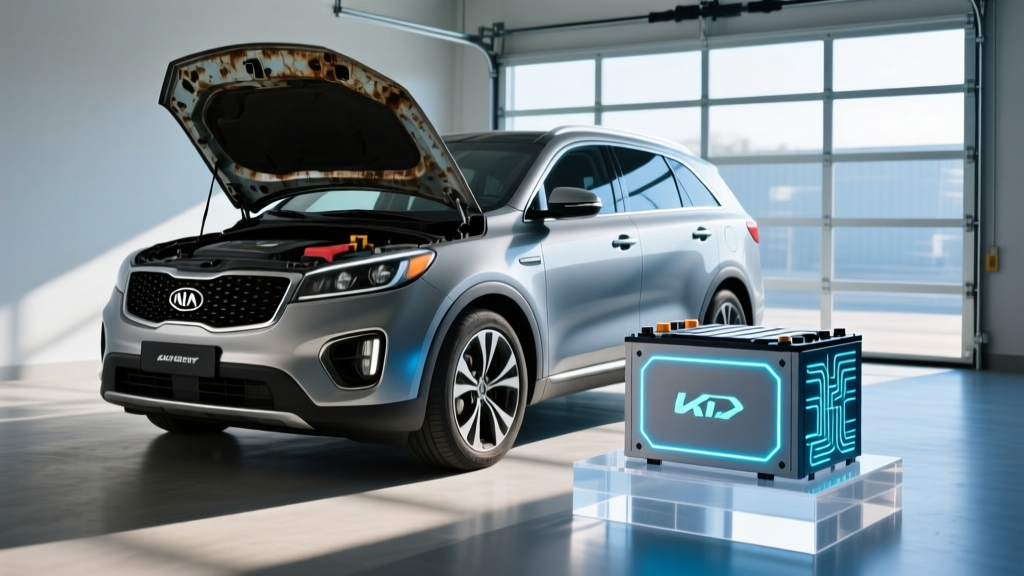
If you're searching for a 2014 Kia Sorento battery, you're likely dealing with one of two scenarios: the original 12V starter battery has died (a $150–$250 fix), or you're weighing whether to keep an aging crossover versus stepping into a modern electric or plug-in hybrid vehicle. The Sorento's 12V Group 24F or 121R battery is a straightforward lead-acid replacement — but understanding how it compares to the high-voltage traction batteries in today's EVs reveals just how far battery technology has come.
This guide breaks down the 2014 Kia Sorento's battery basics, then pivots to a deep-dive on modern EV battery chemistry, degradation data, replacement costs, and warranty coverage. Whether you're maintaining an older vehicle or researching your next electrified purchase, these are the numbers that matter.
2014 Kia Sorento Battery: What You're Actually Replacing
The 2014 Kia Sorento — whether equipped with the 2.4L four-cylinder or 3.3L V6 — uses a conventional 12V lead-acid starter battery. This is not a high-voltage traction battery like those in electric vehicles. Its sole job is to crank the engine and power accessories when the engine is off.
| Specification | 2014 Kia Sorento (2.4L) | 2014 Kia Sorento (3.3L V6) |
|---|---|---|
| Battery Group Size | 121R / H5 | 24F / H6 |
| Cold Cranking Amps (CCA) | 550–600 CCA | 650–700 CCA |
| Voltage | 12V | 12V |
| Chemistry | Flooded Lead-Acid | Flooded Lead-Acid |
| Typical Lifespan | 3–5 years | 3–5 years |
| Replacement Cost (2026) | $140–$220 | $160–$260 |
Lead-acid batteries degrade primarily due to sulfation (crystal buildup on plates), heat exposure, and deep discharge cycles. In hot climates like Arizona or Texas, expect closer to 3 years; cooler northern states often see 4–5 years. This is a wear item, like brake pads — not a catastrophic failure point.
Key distinction: The 2014 Sorento is not a hybrid or EV. It has no high-voltage traction battery. If you're cross-shopping this vehicle against something like a Kia EV6 or Hyundai Ioniq 5, you're comparing fundamentally different powertrain architectures. That comparison is where things get interesting.
EV Battery Chemistry: LFP vs NMC Explained
Modern electric vehicles use one of two dominant lithium-ion chemistries: LFP (Lithium Iron Phosphate) or NMC/NCA (Nickel Manganese Cobalt / Nickel Cobalt Aluminum). Each has distinct trade-offs that affect range, longevity, cold-weather performance, and price.
| Attribute | LFP (LiFePO4) | NMC / NCA |
|---|---|---|
| Energy Density | Lower (~160 Wh/kg cell-level) | Higher (~250–300 Wh/kg cell-level) |
| Cycle Life | 3,000–5,000+ cycles | 1,000–2,000 cycles |
| Cold Performance | More range loss below 32°F | Better cold-weather retention |
| Cost | ~15–20% cheaper per kWh | Higher (cobalt/nickel pricing) |
| Charging to 100% | Recommended regularly for SoC calibration | 80% daily limit recommended |
| Thermal Stability | Excellent (less thermal runaway risk) | Good (requires robust BMS) |
| Common In 2026 | Tesla Model 3/Y RWD, BYD, base Ford Mustang Mach-E, Rivian Standard | Long-range AWD models, Hyundai Ioniq 5/6, BMW iX, Lucid |
Which is better? It depends on your use case. LFP wins on longevity and cost — ideal for daily commuters who charge at home and don't need maximum range. NMC wins on energy density and cold performance — better for long road trips, cold climates, and buyers prioritizing maximum EPA range per charge.
For the 2014 Sorento owner considering an EV upgrade: if you drive under 40 miles daily and have home charging, an LFP-equipped vehicle like the Tesla Model 3 RWD offers 3,000+ charge cycles — enough to outlast the car itself.
EV Battery Degradation: Real Data, Not Guesswork
The single most persistent myth in EV ownership is that batteries "wear out like phone batteries" and need expensive replacement within a few years. The data tells a different story.
Typical EV Battery Degradation Curve (NMC Chemistry)
- Year 1: ~2–3% capacity loss (initial formation loss)
- Years 2–4: ~1–2% per year (linear slow degradation)
- Years 5–8: ~1% per year
- Year 8 average: ~88–92% State of Health (SoH) remaining
- Year 10 average: ~83–88% SoH remaining
- 200,000 miles (typical): ~85–90% SoH
Sources: Recurrent Auto battery data (2025 fleet study), Geotab fleet degradation analysis.
LFP batteries degrade even more slowly. Tesla's 2025 Impact Report noted that Model 3 RWD (LFP) vehicles retained an average of 92% capacity at 100,000 miles. Some fleet vehicles with LFP packs have surpassed 200,000 miles with less than 10% degradation.
Compare this to the 2014 Sorento's lead-acid battery, which typically loses 30–50% of its cranking capacity within 3–5 years and must be replaced. The EV traction battery is engineered for the life of the vehicle — and the data confirms it.
What Does the EV Battery Warranty Actually Cover?
Federal law mandates that EV batteries carry a minimum warranty of 8 years / 100,000 miles (10 years / 150,000 miles in CARB states like California, New York, and others). But the details matter — specifically the capacity retention threshold.
| Manufacturer | Warranty Term | Capacity Threshold | What Triggers a Claim |
|---|---|---|---|
| Tesla (Model 3/Y LFP) | 8 yr / 100,000 mi | 70% | SoH drops below 70% within term |
| Tesla (Model 3/Y LR NMC) | 8 yr / 120,000 mi | 70% | SoH drops below 70% within term |
| Hyundai / Kia | 10 yr / 100,000 mi | 70% | SoH drops below 70% within term |
| Ford (Mach-E, F-150 Lightning) | 8 yr / 100,000 mi | 70% | SoH drops below 70% within term |
| GM (Ultium platform) | 8 yr / 100,000 mi | 70% | SoH drops below 70% within term |
| Rivian | 8 yr / 120,000 mi | 70% | SoH drops below 70% within term |
| BMW | 8 yr / 100,000 mi | 70% | SoH drops below 70% within term |
What this means practically: If your EV battery drops to 69% of original capacity within the warranty period, the manufacturer must repair or replace it at no cost. Given the degradation data above, hitting 70% within 8 years is extremely rare under normal use — most batteries retain 85%+ at that mark.
This warranty covers the high-voltage traction battery, not the 12V auxiliary battery (which, like the 2014 Sorento's starter battery, is a wear item with a 2–4 year typical warranty).
EV Battery Replacement Cost: The Real Numbers
When an EV battery does need replacement — typically beyond the warranty period, at 150,000+ miles — the cost depends on pack size and chemistry. Prices have fallen significantly: in 2026, pack-level replacement costs average $110–$150 per kWh for the battery module alone, plus labor.
| Vehicle (Example) | Battery Size | Chemistry | Out-of-Warranty Replacement (2026 est.) |
|---|---|---|---|
| Tesla Model 3 RWD | 60 kWh | LFP | $7,500–$10,000 |
| Hyundai Ioniq 5 (Std Range) | 63 kWh | NMC | $9,000–$12,000 |
| Ford Mustang Mach-E (ER) | 91 kWh | NMC | $13,000–$17,000 |
| Ford F-150 Lightning (ER) | 131 kWh | NMC | $18,000–$24,000 |
| Chevrolet Equinox EV | 85 kWh | NMC (Ultium) | $11,000–$15,000 |
| BMW iX xDrive50 | 111.5 kWh | NMC | $16,000–$22,000 |
Context that matters: According to Recurrent Auto's 2025 fleet data, fewer than 1.5% of EVs have required a full battery replacement. Most EV batteries outlive the vehicles they're installed in. For comparison, a 2014 Kia Sorento's engine or transmission replacement at 150,000 miles typically runs $4,000–$7,000 — and those failures are far more common than EV battery failures.
Factors That Accelerate (or Slow) Battery Degradation
Not all miles are equal when it comes to battery wear. Here's what actually moves the needle on State of Health:
- DC Fast Charging Frequency: Occasional DCFC (1–2x/week) has minimal impact. Daily 150+ kW fast charging can add ~2–4% extra degradation over 5 years vs. Level 2 home charging. Preconditioning the battery before fast charging reduces stress.
- State of Charge Habits (NMC): Keeping NMC batteries between 20–80% for daily use extends cycle life. Charging to 100% occasionally for road trips is fine — just don't let it sit at 100% for days.
- State of Charge Habits (LFP): LFP batteries should be charged to 100% at least once a week for accurate SoC calibration. They tolerate full charges better than NMC.
- Extreme Heat: Sustained ambient temps above 95°F accelerate degradation. Vehicles with active liquid thermal management (Tesla, Hyundai E-GMP, GM Ultium) handle heat far better than passively cooled packs.
- Extreme Cold: Cold doesn't permanently damage batteries, but it temporarily reduces range (20–30% loss at 20°F) and slows charging. Preconditioning is critical in winter.
- Depth of Discharge: Shallow cycles (e.g., charging from 40–70%) are gentler than deep cycles (10–95%). But modern BMS systems manage this automatically — don't stress over it.
How to Check and Monitor Your EV Battery Health
Unlike the 2014 Sorento's 12V battery — where you're essentially waiting for a slow-crank morning — EV batteries offer real-time health monitoring.
Built-in methods:
- Tesla: Service menu displays battery health percentage. Third-party apps like Tessie or Stats pull detailed SoH data via the Tesla API.
- Hyundai/Kia: The infotainment system's EV diagnostics page shows battery condition. OBD-II scanners like the OBDeleven or BimmerCode (for BMW) can pull SoH data from the BMS.
- GM Ultium: The myChevrolet/myCadillac app displays battery health metrics.
- OBD-II Tools: Devices like the OBDLink SX paired with apps such as EVbat or LeafSpy (Nissan) can read cell-level voltage data and calculate SoH.
What to look for: A healthy battery shows cell voltage variance under 20–30 mV at rest. If one module consistently reads 50+ mV below others, it may indicate a weak cell group worth flagging under warranty.
Emerging Battery Tech: Solid-State and Silicon Anodes
Two technologies are poised to reshape EV batteries — but neither is ready for mass production in 2026.
Solid-State Batteries: These replace the liquid electrolyte with a solid ceramic or polymer layer, promising 40–50% higher energy density, faster charging (potentially 10–80% in under 10 minutes), and improved safety. Toyota has announced limited production for 2027–2028, initially in low-volume luxury models. Samsung SDI and QuantumScape are targeting 2028–2029 for broader availability. Expect premium pricing initially — this will not be a budget technology until the early 2030s.
Silicon Anode Batteries: Companies like Sila Nanotechnologies and Group14 are replacing graphite anodes with silicon-dominant composites, boosting energy density by 20–40%. These are closer to market — appearing in limited applications (Mercedes G-Wagen EV, select consumer electronics) in 2025–2026, with broader EV adoption expected by 2027–2028.
Realistic timeline: If you're buying an EV in 2026, today's LFP and NMC chemistries are mature, well-understood, and backed by substantial degradation data. Waiting for solid-state means waiting 3–5 years for limited availability at premium prices.
Frequently Asked Questions
How long do EV batteries last in years and miles?
Based on fleet data from Recurrent Auto and Geotab, modern EV batteries (both LFP and NMC) typically retain 85–90% capacity at 150,000–200,000 miles and 8–10 years. Most outlast the vehicles they're installed in. Full replacements before 150,000 miles are rare — under 1.5% of the fleet.
How much does an EV battery cost to replace?
Out-of-warranty replacement costs range from $7,500 (smaller LFP packs like the Tesla Model 3 RWD's 60 kWh) to $24,000 (large NMC packs like the F-150 Lightning's 131 kWh). Most replacements are covered under the 8-year/100,000-mile federal warranty mandate. Prices continue to decline as cell costs drop.
What does the EV battery warranty cover?
Federal law requires a minimum 8-year/100,000-mile warranty (10/150,000 in CARB states) covering capacity loss below 70%. This applies to the high-voltage traction battery only — not the 12V auxiliary battery. If your battery's State of Health drops below 70% within the warranty term, the manufacturer repairs or replaces it at no cost.
How do I check and maximize my EV battery health?
Use your vehicle's built-in diagnostics, OEM apps, or OBD-II tools to monitor State of Health. To maximize longevity: use Level 2 home charging for daily use, limit DC fast charging to road trips, keep NMC batteries between 20–80% daily (charge LFP to 100% weekly), precondition before fast charging, and avoid leaving the vehicle at 100% SoC for extended periods in hot weather.
LFP vs NMC — which battery chemistry is better?
LFP offers longer cycle life (3,000–5,000 cycles vs 1,000–2,000), lower cost, better thermal stability, and tolerance for 100% charging — but sacrifices energy density and cold-weather range. NMC delivers more range per kWh, better cold performance, and faster DC charging in cold weather — at higher cost and with more careful SoC management needed. For daily commuters with home charging, LFP is the practical choice. For road-trippers and cold-climate drivers, NMC remains advantageous.
Is the 2014 Kia Sorento battery the same as an EV battery?
No. The 2014 Sorento uses a 12V lead-acid starter battery ($140–$260 replacement, 3–5 year lifespan) to crank a gasoline engine. EVs use a high-voltage lithium-ion traction battery (60–131 kWh, $7,500–$24,000 replacement, 150,000+ mile lifespan) to power the electric motor. The 2014 Sorento is not a hybrid or EV and has no high-voltage battery. EVs also have a separate 12V auxiliary battery for electronics — similar in function to the Sorento's battery but much smaller.
Whether you're replacing a $200 lead-acid battery in a 2014 Sorento or evaluating a $45,000 EV with an 85 kWh NMC pack, the principle is the same: understand what you're buying, what it costs to maintain, and what the data actually says about longevity. For modern EVs, that data is overwhelmingly reassuring.