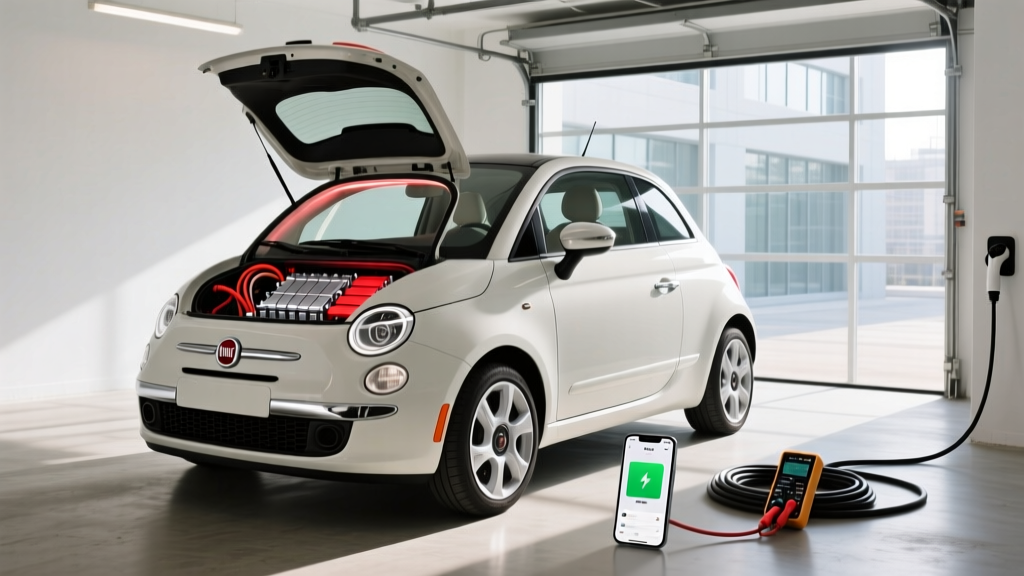
The 2014 Fiat 500e was one of the first mass-market city EVs sold in the United States, built primarily to satisfy California's zero-emission vehicle mandate. With its 24 kWh lithium-ion traction battery and EPA-rated 87 miles of range, it was never a road-trip car — but for urban commuting, it was punchy, cheap to run, and surprisingly fun. Now, over a decade later, the question that dominates owner forums and used-EV listings is simple: how is the 2014 Fiat 500e battery holding up?
This guide examines the 500e's original battery chemistry, documented degradation patterns, what a replacement actually costs in 2026, and how early-generation EV battery lessons apply to modern packs. Whether you own a 500e, are considering a used one, or want to understand how first-generation EV batteries age, the data below separates fact from forum rumor.
2014 Fiat 500e Battery: Original Specifications
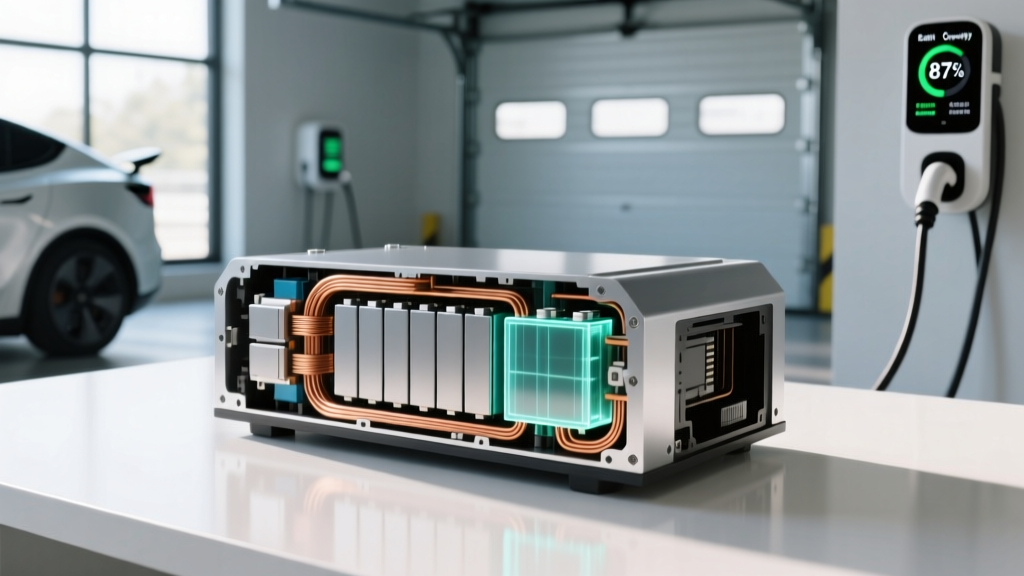
The 2014 Fiat 500e shipped with a 24 kWh lithium-ion battery pack (approximately 21.6 kWh usable) manufactured by Samsung SDI. The pack uses NMC (Nickel Manganese Cobalt) cell chemistry, which was the dominant EV chemistry of that era before LFP gained mainstream adoption in the 2020s. The pack is liquid-cooled, a significant advantage over the passive-air-cooled packs in competing vehicles like the 2014 Nissan Leaf.
| Specification | Value |
|---|---|
| Battery chemistry | NMC (Nickel Manganese Cobalt) |
| Total capacity | 24 kWh |
| Usable capacity | ~21.6 kWh |
| Cell manufacturer | Samsung SDI |
| Thermal management | Liquid-cooled / heated |
| EPA range (new) | 87 miles |
| EPA efficiency | 108 MPGe combined |
| Motor output | 83 kW (111 hp) |
| 0-60 mph | ~9.1 seconds |
| DC fast charging | Not supported (Level 2 only) |
| Level 2 charge rate | 6.6 kW (J1772) |
| Level 2 full charge time | ~4 hours (0-100%) |
| Original battery warranty | 8 years / 100,000 miles |
The absence of DC fast charging is the 500e's most significant limitation by modern standards. The 6.6 kW onboard charger means a full Level 2 charge takes roughly four hours. On the plus side, the lack of DC fast charging has arguably protected these packs — high-power fast charging is one of the primary accelerants of lithium-ion degradation, and 500e batteries have never been exposed to it.
Battery Chemistry: NMC vs. LFP and Why It Matters
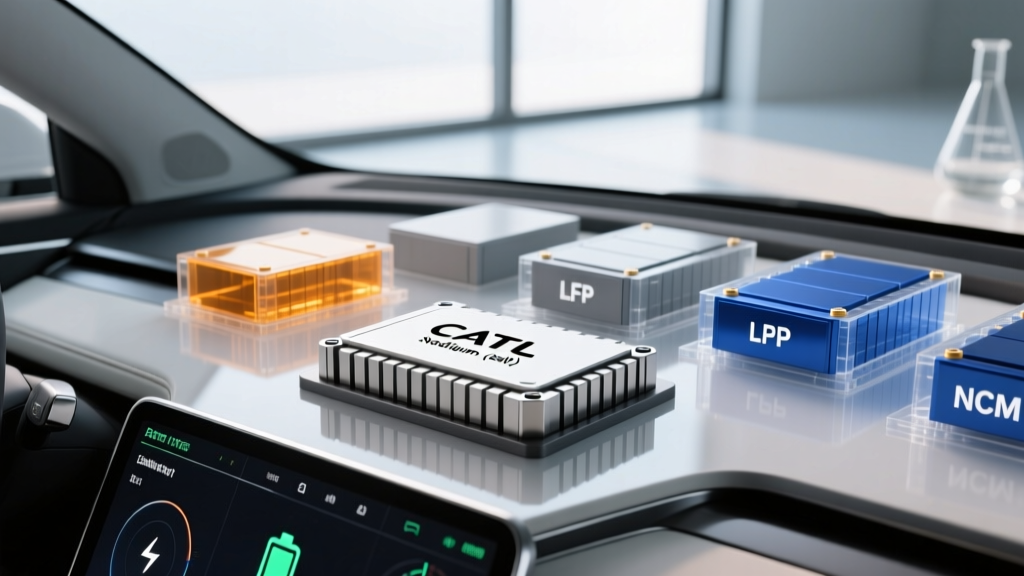
Understanding the 500e's NMC chemistry is essential context for evaluating its longevity — and for comparing it against the LFP packs now common in vehicles like the Tesla Model 3 Standard Range and BYD models. Here is how the two dominant chemistries compare:
| Attribute | NMC (2014 Fiat 500e) | LFP (Modern Standard Range EVs) |
|---|---|---|
| Energy density | Higher (~150–220 Wh/kg) | Lower (~90–160 Wh/kg) |
| Cycle life | ~1,000–2,000 full cycles | ~3,000–5,000+ full cycles |
| Cold-weather performance | Better low-temp discharge | Reduced performance below freezing |
| Cost per kWh | Higher (cobalt/nickel) | Lower (iron/phosphate) |
| Thermal stability | Good (requires management) | Excellent (inherently stable) |
| Optimal daily SoC | ~80% for longevity | 100% acceptable (recommended weekly) |
| Calendar aging sensitivity | Moderate–high at high SoC | Lower |
The 500e's NMC pack benefits from higher energy density — important in a small car where packaging space is limited — but it is more sensitive to sustained high states of charge and calendar aging than modern LFP cells. This is why 500e owners who stored the car at 100% SoC for extended periods tend to see more degradation than those who kept charge levels between 20% and 80%.
Modern NMC formulations (NMC 811, NMC 9½½) used in 2024–2026 vehicles have improved cycle life significantly over the 2014-era cells, but the fundamental trade-offs remain. LFP's superior cycle life is why manufacturers like Tesla, Ford, and Hyundai now use it in base-trim models where ultimate energy density is less critical.
Real-World Degradation: What 2014 Fiat 500e Owners Report
The 2014 Fiat 500e is now 12 years old, making it one of the best real-world case studies for early-generation EV battery aging. Based on owner reports across Fiat 500e forums, Recurrent Auto data, and used-EV listing analyses, the following degradation patterns have emerged:
| Vehicle Age / Mileage | Average Capacity Retained | Estimated Real-World Range |
|---|---|---|
| Year 1–3 / 0–30K mi (historical) | 95–100% | 80–87 mi |
| Year 5–7 / 40K–70K mi | 85–92% | 70–80 mi |
| Year 8–10 / 60K–90K mi | 78–88% | 65–75 mi |
| Year 11–12 / 70K–100K+ mi (2025–2026) | 70–85% | 55–72 mi |
Several factors explain the wide range in current degradation numbers:
- Climate: 500e vehicles in hot climates (Arizona, inland California) show measurably higher degradation than those in temperate coastal areas. Battery chemistry degrades faster at sustained high temperatures, and while the 500e's liquid cooling helps, it cannot fully offset prolonged 100°F+ ambient heat.
- Charging habits: Owners who relied exclusively on Level 2 charging at moderate SoC levels (20–80%) report the best longevity. Since the 500e has no DC fast charging, it avoided the high-C-rate stress that accelerates degradation in other early EVs.
- Storage patterns: Cars stored at high SoC for weeks at a time (vacation periods, seasonal use) show elevated calendar aging. NMC cells degrade faster when held above 80% SoC, especially in warm conditions.
- Mileage: Most 2014 500e vehicles have relatively low mileage (50K–90K miles is typical) because the limited range kept them as secondary or commuter cars. Lower cycle counts have helped preserve capacity.
According to data aggregated by Recurrent Auto, the average EV battery from the 2013–2015 model years retains approximately 80–85% of original capacity at the 8-year mark. The 500e's liquid-cooled pack has generally tracked with or slightly better than this average, particularly for cars in moderate climates.
What Does the Battery Warranty Cover?
When the 2014 Fiat 500e was new, it came with an 8-year / 100,000-mile battery warranty (10 years / 150,000 miles in California and other CARB states). This warranty guaranteed that the high-voltage traction battery would retain at least 70% of its original capacity during the coverage period.
| Coverage Detail | Standard States | CARB States (CA, NY, MA, etc.) |
|---|---|---|
| Duration | 8 years | 10 years |
| Mileage limit | 100,000 miles | 150,000 miles |
| Capacity threshold | 70% of original | 70% of original |
| Covered defects | Capacity loss below threshold, cell/module failure | Same |
| Exclusions | Damage from accidents, improper charging, modifications | Same |
| Transferable to second owner? | Yes | Yes |
Important for 2026: For most 2014 Fiat 500e vehicles, the standard 8-year warranty has expired. However, if the car was originally sold and registered in a CARB state (California, Connecticut, Maine, Maryland, Massachusetts, New Jersey, New York, Oregon, Rhode Island, Vermont), the 10-year/150,000-mile warranty may still be active through mid-to-late 2024 or into 2025 depending on the original in-service date. Check your warranty booklet and original purchase date. Fiat (now under Stellantis) honored these claims through authorized dealers, though the process often required a dealer diagnostic scan confirming capacity below 70%.
For comparison, current federal law (per EPA guidance) requires a minimum of 8 years / 80,000 miles for EV battery warranties, though most 2025–2026 models from Tesla, Hyundai, and BMW offer 8 years / 100,000 miles with a 70% retention threshold.
2014 Fiat 500e Battery Replacement Cost
If your 500e's battery has degraded below usable levels — or if it has suffered a fault outside warranty coverage — replacement is the costly reality. Here is what 500e owners face in 2026:
| Cost Component | Estimated Range |
|---|---|
| Remanufactured/replacement battery pack | $5,500 – $9,000 |
| Labor (removal and installation, 4–6 hours) | $1,200 – $2,500 |
| Diagnostic and programming | $300 – $600 |
| Taxes, shop supplies, disposal | $200 – $500 |
| Total estimated cost | $7,200 – $12,600 |
Several context points are critical here:
- OEM new packs are largely unavailable. Stellantis does not actively stock new 24 kWh packs for the 500e. Most replacements use remanufactured packs from third-party EV battery specialists or salvaged packs from wrecked 500e vehicles with verified low mileage.
- The car's value matters. A clean 2014 Fiat 500e in good condition sells for approximately $6,000–$10,000 in the used market in 2026. A full battery replacement can approach or exceed the car's value, making it an economic decision that requires careful consideration.
- Module-level repair is sometimes possible. Some independent EV shops can diagnose and replace individual failed modules within the pack rather than replacing the entire assembly, potentially reducing costs to $2,500–$5,000. This depends on the specific failure mode and parts availability.
- Most 500e batteries do not need replacement. Based on current data, the majority of 2014 500e packs still function above 70% capacity. Complete pack failure (sudden, catastrophic) is rare — gradual degradation is the norm, and a pack at 75% capacity still provides ~60 miles of usable range for city driving.
For broader context, replacement costs across the EV industry scale with pack size. A 24 kWh pack like the 500e's is at the low end; modern 75–100 kWh packs in vehicles like the Ford F-150 Lightning or Tesla Model S can cost $15,000–$25,000+ to replace out of warranty.
Factors That Affect EV Battery Longevity
The 500e's aging pattern illustrates broader principles of lithium-ion battery health. Whether you own a 2014 500e or a 2026 EV with a modern pack, these factors determine how quickly capacity declines:
- Avoid sustained 100% SoC: For NMC packs, charge to 80% for daily use; reserve 100% for trips where you need full range. LFP packs tolerate 100% better but still benefit from occasional partial-discharge cycles.
- Minimize DC fast charging: Repeated high-power DC charging (150 kW+) accelerates degradation. The 500e sidesteps this entirely with Level 2-only charging, which is gentler on cells.
- Manage extreme temperatures: Avoid leaving the car at high SoC in extreme heat. Precondition the battery (if equipped) before charging in cold weather. The 500e's liquid thermal management provides meaningful protection here.
- Drive it regularly: Lithium-ion batteries prefer regular use over prolonged storage. If storing for more than two weeks, leave SoC around 50%.
- Avoid deep discharges: Consistently running the battery to near 0% stresses cells. Try to recharge before dropping below 15–20%.
- Keep software updated: Battery management system (BMS) updates can improve charge algorithms and thermal management — applicable mainly to newer EVs, but relevant if Stellantis issued any 500e service bulletins.
How to Check Battery Health (State of Health) on a 500e
Unlike modern EVs with built-in battery health displays (Tesla's Energy app, Hyundai's Bluelink diagnostics), the 2014 Fiat 500e does not have a user-accessible State of Health (SoH) readout on its dashboard. Owners rely on the following methods:
Method 1: Dealer OBD-II Diagnostic Scan
A Fiat/Stellantis dealer can connect the vehicle to their diagnostic system and read the BMS-reported SoH percentage. This is the most authoritative method and was required for any warranty claim. Expect to pay $100–$150 for this service out of warranty.
Method 2: Third-Party OBD-II Scanner
Devices like the OBDLink SX or MX+, paired with apps such as LeafSpy (originally designed for the Nissan Leaf but compatible with some other EVs) or AlfaOBD (which supports Fiat protocols), can read battery parameters including estimated SoH, cell voltage spread, and battery temperature. Results vary in accuracy but provide a useful trend line over time.
Method 3: Manual Range Tracking
The simplest approach: track your real-world range over a full charge cycle. Charge to 100%, reset the trip meter, drive normally until the battery is nearly depleted, and record miles driven. Compare this to the original 87-mile EPA figure. A consistent 70-mile real-world range at 100% charge suggests roughly 80% SoH. This method is imprecise (temperature, driving style, and terrain all affect results) but requires no special equipment.
Method 4: Independent EV Battery Assessment Services
Companies like Recurrent offer battery health reports that use connected-car data or OBD readings to provide a certified SoH estimate — useful if you are buying or selling a used 500e and want documented proof of battery condition.
Lessons from the 500e: What Early EV Batteries Teach Us
The 2014 Fiat 500e's battery trajectory offers several data-backed takeaways for anyone evaluating EV longevity:
1. Liquid cooling matters. The 500e's liquid-cooled pack has aged noticeably better than the passively cooled 2013–2015 Nissan Leaf packs, which suffered well-documented rapid degradation in hot climates. Modern EVs universally use active thermal management for this reason.
2. Moderate charging speeds extend life. The 500e's 6.6 kW Level 2-only charging, while a convenience limitation, has been a longevity advantage. No DC fast charging means no high-C-rate stress on the cells. Modern EVs that fast-charge frequently at 250+ kW will likely show different degradation curves.
3. NMC packs age predictably when treated well. The 500e demonstrates that an NMC pack with proper thermal management and moderate SoC habits can retain 75–85% capacity after 10–12 years and 70K–100K miles. This aligns with broader industry data and should reassure owners of modern NMC-equipped vehicles.
4. Calendar aging is real and unavoidable. Even a low-mileage 500e that was garage-kept and carefully charged will show degradation from calendar aging alone — the chemical processes that reduce capacity over time regardless of use. This is why a 2014 model with only 30,000 miles may still show 15–20% capacity loss.
Looking Ahead: Solid-State and Next-Generation Battery Tech
While the 2014 500e represents first-generation EV battery technology, the industry is advancing rapidly. Here is where emerging technologies stand as of 2026:
- Solid-state batteries: Toyota, Samsung SDI, and QuantumScape have demonstrated prototype solid-state cells with higher energy density and faster charging. Toyota has announced limited production in select 2027–2028 models. However, mass-market availability at affordable price points remains estimated for 2030+. These are not yet available for purchase or retrofit.
- Silicon-dominant anodes: Companies like Sila Nanotechnologies and Group14 are supplying silicon-anode materials to manufacturers including Mercedes-Benz and Panasonic. Silicon anodes increase energy density by 20–40% compared to graphite, and vehicles using this technology are entering limited production in 2025–2026. This is a near-term improvement, not a distant promise.
- Sodium-ion batteries: CATL and BYD have begun producing sodium-ion packs for lower-cost, shorter-range applications. These offer lower energy density than LFP but eliminate lithium, cobalt, and nickel entirely. Expected in budget EVs by 2027–2028, primarily in Asian and European markets initially.
None of these technologies are available as retrofits for existing vehicles like the 500e. They are forward-looking developments relevant to new-vehicle buyers evaluating how battery technology will evolve over their next ownership cycle.
Frequently Asked Questions
How long do EV batteries last in years and miles?
Based on data from Recurrent Auto and manufacturer warranty structures, most modern EV batteries are designed to last 15–20 years or 150,000–200,000+ miles before degrading to 70% of original capacity. The 2014 Fiat 500e's NMC pack, now 12 years old, shows that even early-generation batteries with liquid cooling can retain 70–85% capacity at the decade mark when properly maintained. Catastrophic failure is rare; gradual degradation is the norm.
How much does an EV battery cost to replace?
Replacement costs vary widely by pack size and vehicle. For the 2014 Fiat 500e's 24 kWh pack, expect $7,200–$12,600 total (parts and labor) using a remanufactured unit. For modern EVs with larger packs: a 60 kWh pack (Chevrolet Bolt) runs $10,000–$15,000; a 75–100 kWh pack (Tesla Model Y/S, Ford F-150 Lightning) can cost $15,000–$25,000+. Most EVs never need a full battery replacement during their useful life.
What does the EV battery warranty cover?
Federal law requires a minimum of 8 years / 80,000 miles of EV battery coverage. Most manufacturers offer 8 years / 100,000 miles (10 years / 150,000 in CARB states). Coverage typically guarantees the battery will retain at least 70% of original capacity and covers defects, premature degradation, and module failures. Warranties exclude damage from accidents, aftermarket modifications, and improper charging equipment. Always check the specific terms for your vehicle's model year and state of registration.
How do I check and maximize my EV battery health?
To check SoH: use a dealer diagnostic scan, a compatible OBD-II scanner with EV software, or manual range tracking over a full charge cycle. To maximize health: keep daily SoC between 20–80% (NMC) or charge to 100% weekly (LFP), minimize DC fast charging, avoid prolonged storage at high SoC in hot weather, drive regularly, and avoid repeated deep discharges below 10%.
LFP vs. NMC — which battery chemistry is better?
Neither is universally better; they serve different priorities. NMC offers higher energy density (more range in a smaller, lighter pack) and better cold-weather performance, making it ideal for long-range and performance vehicles. LFP provides superior cycle life (3,000–5,000+ cycles), lower cost, better thermal stability, and tolerance for daily 100% charging, making it ideal for standard-range and fleet vehicles. For most daily commuters, LFP's longevity advantages outweigh NMC's energy density edge. The 2014 Fiat 500e uses NMC, which was the only viable chemistry for its size and range targets at the time.
Is it worth replacing the battery in a 2014 Fiat 500e?
This depends on the car's overall condition and your use case. With used 500e values between $6,000–$10,000 and replacement costs of $7,200–$12,600, a new battery can approach the car's total value. If the car is otherwise excellent and serves your commuting needs (60–70 mile daily round trip), a remanufactured battery at the lower end of the cost range may be justified. If you need more range or modern features, applying that budget toward a used 2020+ EV with a larger pack and DC fast charging may be the better financial decision.