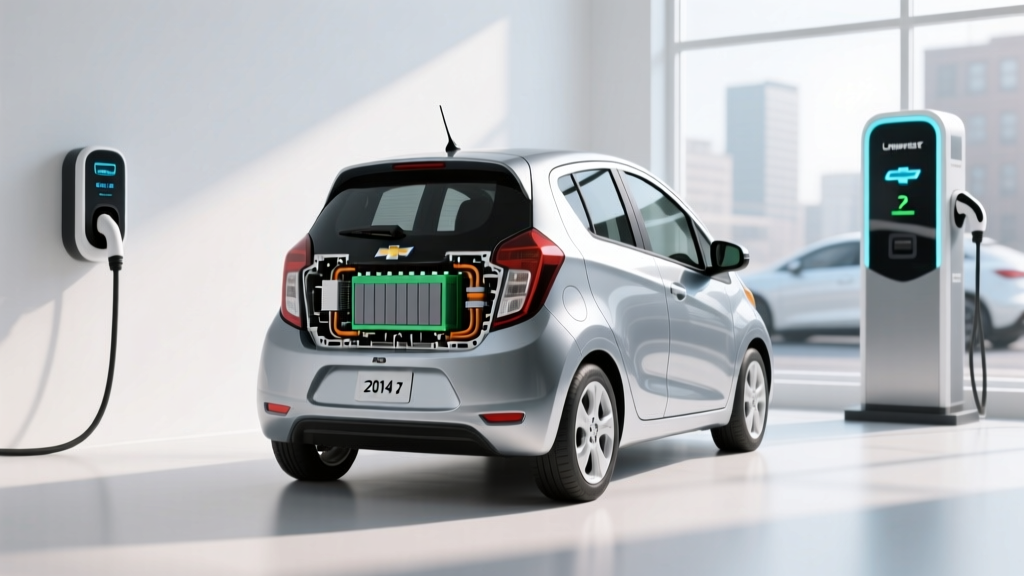
The 2014 Chevrolet Spark EV was one of the first mainstream, affordable battery-electric vehicles sold in the United States. Built primarily to help General Motors meet California's zero-emission vehicle mandates, it packed surprising punch for its size: 134 horsepower, 400 lb-ft of torque, and an EPA-rated 82 miles of range from a 21.3 kWh (usable) lithium-ion battery. But with these early-generation EVs now crossing the decade mark, owners and prospective used-EV buyers are asking the same question: how much life is left in the 2014 Chevy Spark EV battery, and what happens when it needs replacing?
This guide breaks down everything we know about the Spark EV's high-voltage traction battery — its chemistry, real-world degradation patterns, warranty coverage, replacement economics, and the habits that help maximize its remaining lifespan. We'll also place the Spark's battery in the broader context of modern EV battery technology so you can evaluate it against newer alternatives.
The 2014 Spark EV Battery: Specs and Chemistry
The 2014 Spark EV uses a nickel-manganese-cobalt (NMC) lithium-ion battery pack supplied by A123 Systems. The pack is rated at 21.3 kWh of usable capacity and weighs approximately 560 pounds. It is liquid-cooled and heated via a dedicated thermal management system — a feature that gave the Spark EV a longevity advantage over passively cooled competitors of the same era, such as the early Nissan Leaf.
Here's a quick spec snapshot:
| Attribute | Value |
|---|---|
| Chemistry | NMC (Nickel-Manganese-Cobalt) |
| Total pack capacity | ~21.3 kWh (usable) |
| EPA range (new) | 82 miles |
| Combined efficiency | 119 MPGe (28 kWh/100 mi) |
| DC fast charge (SAE Combo/CCS) | Up to 50 kW; 0–80% in ~20 min |
| Level 2 AC charge | 3.3 kW; ~7 hours 0–100% |
| Thermal management | Active liquid cooling and heating |
| Warranty (original) | 8 years / 100,000 miles |
Sources: EPA Fuel Economy, Chevrolet Spark EV Owner's Manual.
LFP vs NMC: Understanding Your Battery Chemistry
The Spark EV's NMC chemistry was the dominant EV battery type throughout the 2010s. Today, the market has shifted toward two main chemistries: NMC (and its variant NCA) and LFP (lithium iron phosphate). Understanding the trade-offs matters whether you're maintaining an older NMC pack like the Spark's or evaluating a new EV purchase.
| Factor | LFP (Lithium Iron Phosphate) | NMC / NCA |
|---|---|---|
| Energy density | Lower (~160 Wh/kg cell-level) | Higher (~250–300 Wh/kg cell-level) |
| Typical cycle life | 3,000–6,000+ cycles | 1,000–2,500 cycles |
| Cold-weather performance | Weaker; slower charging below freezing | Better low-temp discharge and charge acceptance |
| Cost per kWh | Lower (no cobalt or nickel) | Higher (commodity-dependent) |
| State-of-charge recommendation | Can be held at 100% daily | Best kept 20–80% for daily use |
| Used in (examples) | Tesla Model 3/Y RWD, Ford Mustang Mach-E Select (2025+), BYD | Chevy Spark EV, Hyundai Ioniq 5, most long-range EVs |
Which is better? There is no single winner. LFP is the better choice for drivers who want maximum cycle life, lower cost, and the simplicity of charging to 100% every day — ideal for commuters with predictable routes. NMC remains superior when you need maximum range in a compact package, better cold-climate performance, or faster DC charging in low temperatures. The Spark EV's NMC pack was the right choice for its era, prioritizing energy density in a small vehicle footprint.
Real-World Degradation: What the Data Shows
Battery degradation is the gradual, irreversible loss of usable capacity over time and charge cycles. For the 2014 Chevy Spark EV, the data tells a reasonably encouraging story — especially compared to passively cooled EVs of the same vintage.
Based on aggregated owner reports from Spark EV forums, Recurrent Auto's fleet data, and Recurrent's battery degradation studies, here is what typical NMC-pack degradation looks like for early-2010s liquid-cooled EVs:
| Age / Mileage | Average Capacity Retained | Approx. Spark EV Range Remaining |
|---|---|---|
| Year 1 / 12k mi | ~95–97% | ~78–80 mi |
| Year 3 / 36k mi | ~90–93% | ~74–76 mi |
| Year 5 / 60k mi | ~86–90% | ~71–74 mi |
| Year 8 / 100k mi | ~80–85% | ~66–70 mi |
| Year 10+ / 120k+ mi | ~75–82% | ~62–67 mi |
The Spark EV's liquid thermal management is the key variable here. By contrast, the 2011–2015 Nissan Leaf (passively cooled, NMC) commonly showed 70–75% retention by year 8 in hot climates. The Spark EV's active cooling keeps cell temperatures in a healthier range during DC fast charging and summer driving, slowing the chemical aging process.
Still, a 2014 Spark EV in 2026 is at least 12 years old. Calendar aging — degradation that occurs regardless of mileage — accounts for a meaningful share of capacity loss. Expect a well-maintained example to retain roughly 75–82% of its original capacity, translating to a real-world range of approximately 62–67 miles under moderate conditions. Highway driving at 70 mph or cold-weather operation below 32°F can cut that figure by an additional 15–25%.
Battery Warranty: What GM Covered — and What Remains
Chevrolet warranted the 2014 Spark EV's high-voltage battery for 8 years or 100,000 miles (whichever came first), with a capacity-retention threshold of approximately 60–70% of original capacity (GM's specific threshold varied by model year documentation; the industry standard for that era was 60–70%). In California Air Resources Board (CARB) states, the warranty extended to 10 years / 150,000 miles under PZEV/evaporative-emissions provisions.
| Coverage | Standard | CARB States (CA, NY, etc.) |
|---|---|---|
| Duration | 8 years | 10 years |
| Mileage | 100,000 miles | 150,000 miles |
| Capacity threshold | ~60–70% retention | ~60–70% retention |
| Covered defects | Capacity below threshold, cell/module failure | Same |
As of 2026, most 2014 Spark EVs have aged out of their standard 8-year federal warranty. If you registered the car in a CARB state and are under 150,000 miles, you may still have residual coverage through 2024 model-year registration — but this window has largely closed. Any battery failure today will likely be an out-of-pocket expense.
Replacement Cost: What to Budget
Replacing the high-voltage battery in a 2014 Chevy Spark EV is not cheap, but the car's small pack keeps costs below those of long-range modern EVs. Here's the realistic range:
| Source | Part Cost | Labor | Total Estimate |
|---|---|---|---|
| OEM new (GM dealer) | $6,000–$8,000 | $1,500–$2,500 | $7,500–$10,500 |
| Remanufactured / refurbished | $3,500–$5,500 | $1,500–$2,500 | $5,000–$8,000 |
| Used salvage pack | $1,500–$3,000 | $1,500–$2,500 | $3,000–$5,500 |
For context, a used 2014 Spark EV in 2026 trades for roughly $4,000–$7,000 depending on mileage and condition. A new OEM battery replacement can easily exceed the vehicle's value, which is why most owners facing a failed pack opt for a refurbished unit or simply retire the car.
When is replacement typically needed? For liquid-cooled NMC packs of this era, significant capacity loss (below 70%) usually appears between 120,000 and 180,000 miles or at the 12–15 year mark from calendar aging. Catastrophic failure (a dead module or BMS fault) is less common but can occur at any mileage.
Maximizing Battery Health: Practical Care Checklist
If you own or are considering a 2014 Spark EV, the following habits will help preserve whatever capacity remains in the pack. These apply to NMC chemistry specifically.
- Avoid sustained 100% SoC: Charge to 80% for daily use. Reserve 100% charges for the morning of a longer trip. NMC cells degrade faster when held at high voltage for extended periods.
- Don't let it sit at 0%: Storing the car with a near-empty battery accelerates degradation. If parking for weeks, aim for ~50% SoC.
- Limit DC fast charging: The Spark EV's 50 kW CCS capability is useful for road trips, but frequent daily DCFC sessions generate heat stress. Use Level 2 (240V) charging as your primary method.
- Precondition in cold weather: Use the Spark's cabin preheating feature while plugged in. This warms the battery pack via the thermal management system, improving charge acceptance and reducing stress.
- Park in shade or a garage: Prolonged exposure to ambient temperatures above 95°F accelerates calendar aging. The liquid cooling system helps, but it can't run when the car is off.
- Drive moderately: Aggressive acceleration generates high current draw and pack heat. The Spark EV's 400 lb-ft of torque is fun, but repeated full-throttle launches stress the cells.
How to Check Your Spark EV's Battery Health (SoH)
State of Health (SoH) is the percentage of original battery capacity that remains usable. Unlike State of Charge (SoC), which fluctuates with every drive, SoH declines slowly over the pack's lifetime. Here's how to assess it on a Spark EV:
1. Use the dashboard range estimate as a rough proxy. Charge the Spark to 100% on a warm day (above 65°F). The guess-o-meter (GOM) range display should read somewhere in the 60–82 mile range depending on pack health. A fully charged reading below 60 miles suggests SoH has dropped below ~75%.
2. OBD-II diagnostic apps. Plug an OBD-II Bluetooth adapter (such as an ELM327-compatible dongle) into the Spark EV's diagnostic port and use apps like Leaf Spy-equivalent tools or GM-specific diagnostic software (e.g., Torque Pro with appropriate PIDs). These can read the battery management system's reported SoH percentage directly, along with individual cell voltages and pack temperature.
3. Dealer or independent EV shop scan. A Chevrolet dealer can run a battery health report via GDS2 (GM's diagnostic tool), providing cell-by-cell voltage variance and a formal SoH reading. Some independent EV shops offer this service for $50–$100.
4. Third-party battery health reports. Services like Recurrent Auto offer free battery health reports that compare your pack's degradation to a fleet of similar vehicles. Connect your telematics data and receive a SoH estimate plus a range-confidence score.
Factors That Accelerate Battery Aging
Understanding what degrades an NMC battery helps you avoid the worst offenders. The primary aging mechanisms are:
Heat exposure: Sustained cell temperatures above 104°F (40°C) accelerate electrolyte decomposition and cathode wear. This is why hot-climate cars (Arizona, Texas, Southern California) tend to show faster degradation than Pacific Northwest or Northeast examples.
High state of charge: NMC cells held above 90% SoC for days or weeks experience elevated voltage stress on the cathode. This is a chemical reality, not a myth — and it's why daily charging to 80% is the single most impactful habit you can adopt.
Deep discharge cycles: Regularly running the battery below 10% SoC stresses the anode's graphite structure. Try to plug in before the pack drops below 15–20%.
Frequent DC fast charging: High-current charging (50 kW on the Spark, or 150–350 kW on modern EVs) generates internal heat. Occasional DCFC is fine — the thermal management system handles it — but making it your daily routine adds cumulative stress.
Calendar aging: Even a garage-kept, rarely driven Spark EV will lose capacity over time. This is unavoidable and is driven by slow chemical reactions within the cells. A 12-year-old pack will have lost some capacity regardless of mileage.
Emerging Battery Technology: What's Next (and When)
While the 2014 Spark EV's NMC pack represents early-2010s technology, the battery industry has advanced significantly. Here is a realistic look at what's on the horizon — none of which is available in production vehicles as of early 2026, but all of which may influence your next EV purchase:
Silicon-dominant anodes: Companies like Sila Nanotechnologies and Group14 are replacing graphite anodes with silicon-based materials, boosting energy density by 20–40%. Limited production deployments have begun in select 2025–2026 models (e.g., the Mercedes G-Class EV), but broad availability is expected by 2027–2028.
Solid-state batteries: These replace the liquid electrolyte with a solid conductor, promising higher energy density, faster charging, and improved safety. Toyota, Samsung SDI, and QuantumScape are leading development. Toyota has announced a target of 2027–2028 for limited production, but widespread, affordable solid-state EVs are realistically a 2030+ proposition. Don't delay an EV purchase waiting for solid-state.
Sodium-ion batteries: CATL and other Chinese manufacturers have begun producing sodium-ion packs for low-cost, short-range EVs. These trade energy density for dramatically lower material costs and better cold-weather performance. They may appear in US-market budget EVs by 2028–2029.
For a 2014 Spark EV owner, these technologies are relevant only insofar as they inform your next vehicle decision. The Spark's existing pack, properly cared for, should continue providing usable (if diminished) range for several more years.
Frequently Asked Questions
How long do EV batteries last in years and miles?
Modern liquid-cooled EV batteries (NMC or LFP) are designed to last 15–20 years or 150,000–200,000+ miles before dropping below 70% of original capacity. The 2014 Spark EV, with its liquid-cooled NMC pack, typically retains 75–82% capacity at the 12-year mark based on fleet data. Catastrophic failure before 100,000 miles is uncommon but possible.
How much does it cost to replace a 2014 Chevy Spark EV battery?
Expect to pay $5,000–$8,000 for a refurbished pack installed, or $7,500–$10,500 for a new OEM replacement. Given that a used 2014 Spark EV is worth approximately $4,000–$7,000, a full OEM replacement often exceeds the car's value. Most owners opt for refurbished units or retire the vehicle.
Is the 2014 Spark EV battery still under warranty?
The original 8-year / 100,000-mile warranty has expired for virtually all 2014 models as of 2022 (or 2024 in CARB states with 10-year coverage). Unless you are under 150,000 miles in a CARB state and can document a capacity issue that was reported before the warranty window closed, replacement costs are out of pocket.
Can I still daily-drive a 2014 Spark EV with a degraded battery?
Yes — if your commute is under 50 miles round trip and you have reliable Level 2 charging at home. A Spark EV with 75–80% SoH still delivers roughly 62–67 miles of range in moderate weather. It remains a practical city car; just don't rely on it for highway road trips without careful planning around its 50 kW CCS charging and diminished range.
Should I buy a used 2014 Spark EV in 2026?
Only if you can verify the battery's State of Health before purchase (via OBD-II scan or dealer report), your budget is tight, your commute is short, and you accept the risk of a $5,000+ battery replacement down the road. For a few thousand dollars more, a used 2017–2019 Chevy Bolt EV offers 238 miles of EPA range and a larger, more modern pack — often a better long-term value.
LFP vs NMC — which battery chemistry is better for longevity?
LFP offers significantly longer cycle life (3,000–6,000+ cycles vs 1,000–2,500 for NMC) and tolerates daily 100% charging without accelerated degradation. If longevity is your top priority, LFP wins. But NMC provides higher energy density (more range in a smaller pack) and better cold-weather charging performance, which is why it remains the choice for most long-range EVs.