Why Searching for a "Battery for a 2014 Chevy Equinox" Leads to Two Very Different Answers
If you've landed here searching for a battery for a 2014 Chevy Equinox, you're likely dealing with a dead 12-volt starting battery in your gasoline-powered crossover. The Equinox has never been offered as an electric or hybrid vehicle — it relies on a conventional Group 48 or Group 47 lead-acid or AGM 12V battery to crank its 2.4L or 3.6L engine. That's a straightforward auto-parts-store fix, typically $130–$250 installed.
But if your search brought you here because you're considering trading that aging Equinox for a modern EV, you're about to encounter a very different kind of battery conversation. Electric vehicles use high-voltage lithium-ion traction batteries — measured in kilowatt-hours (kWh) of energy capacity, not cold-cranking amps — and understanding how they work, degrade, and get warrantied is the single most important thing an EV buyer can learn.
This guide covers both: the quick answer for your 2014 Equinox's 12V battery, and a deep-dive into EV traction battery technology, chemistry trade-offs, degradation data, warranty terms, replacement costs, and care strategies — so you can make an informed decision about going electric.
The 2014 Chevy Equinox Battery: What You Actually Need
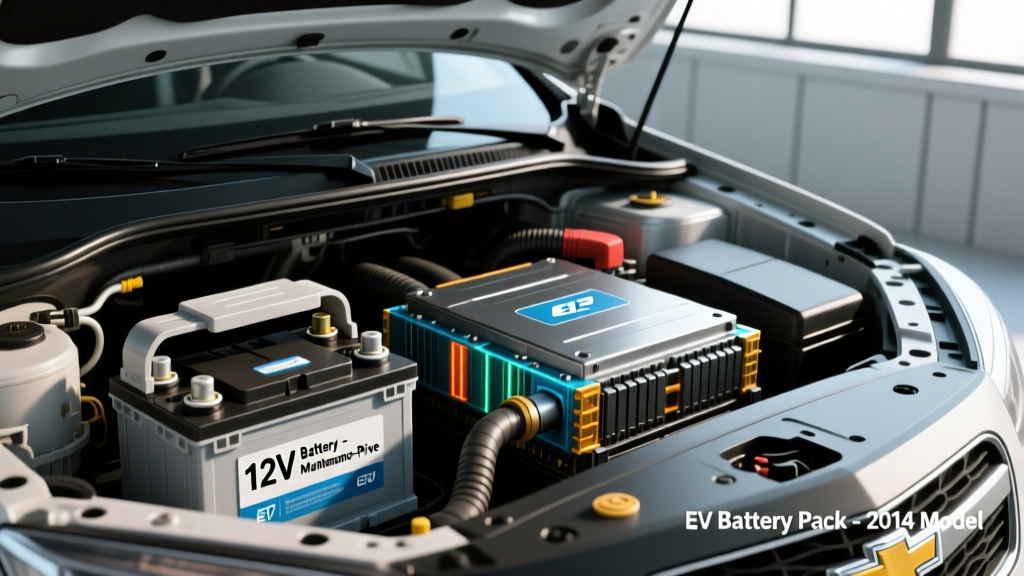
The 2014 Chevrolet Equinox uses a standard 12V automotive battery. This is not a traction battery; it powers the starter motor, lights, infotainment, and electronics. Here's what to know:
- Battery group size: Group 48 (H6) for most trims; some V6 models use Group 47 (H5)
- Chemistry: Flooded lead-acid (standard) or AGM (Absorbent Glass Mat — recommended for colder climates or vehicles with higher electrical loads)
- CCA (Cold Cranking Amps): 575–730 CCA depending on group and brand
- Typical cost: $120–$180 for flooded; $180–$250 for AGM
- Lifespan: 3–5 years depending on climate, driving habits, and parasitic draw
Brands like Interstate, Duralast, DieHard, and ACDelco are widely available at auto parts stores. Installation is simple — most retailers will test and install for free. This is routine maintenance unrelated to EV technology.
EV Traction Battery Chemistry: LFP vs NMC vs NCA
Modern electric vehicles use lithium-ion traction battery packs, but not all lithium-ion chemistry is the same. The two dominant chemistries in 2026 are LFP (Lithium Iron Phosphate) and NMC/NCA (Nickel Manganese Cobalt / Nickel Cobalt Aluminum). Your EV's chemistry determines its range, longevity, cold-weather behavior, and cost.
| Attribute | LFP (Lithium Iron Phosphate) | NMC / NCA |
|---|---|---|
| Energy density | Lower (~150–170 Wh/kg cell-level) | Higher (~230–300 Wh/kg cell-level) |
| Cycle life | 3,000–5,000+ cycles to 80% capacity | 1,000–2,500 cycles to 80% capacity |
| Cold-weather performance | More range loss in freezing temps; slower charging below 32°F without preconditioning | Better low-temp performance; still loses ~15–30% range in extreme cold |
| Cost | Lower — no cobalt or nickel; ~$80–100/kWh (2026 pack-level trend) | Higher — commodity-driven; ~$110–140/kWh |
| SoC charging habit | Can be charged to 100% daily without significant degradation | Best kept between 20–80% for daily use; 100% only for road trips |
| Common in | Tesla Model 3/Y RWD, Ford Mustang Mach-E Select (2025+), Rivian Standard, BYD models | Tesla Long Range/Performance, Hyundai Ioniq 5/6, BMW i4/iX, most long-range EVs |
| Verdict | Better for daily commuters, high-mileage drivers, budget-focused buyers | Better for maximum range, cold-climate drivers, performance models |
Which is better? Neither is universally superior. LFP wins on longevity and cost — if you plan to keep a car 10+ years or drive 20,000+ miles annually, LFP's cycle-life advantage is massive. NMC/NCA wins on energy density and cold-weather usability — if you need 300+ miles of EPA range or live in Minnesota, NMC is the pragmatic choice. In 2026, LFP adoption is growing rapidly in standard-range trims, while NMC remains the choice for long-range and performance variants.
How Long Do EV Batteries Actually Last? Degradation Data
The most common fear among prospective EV buyers is catastrophic battery failure. The data tells a reassuring story: most EV batteries outlast the vehicles they power.
- Tesla Model 3/Y (NMC): ~5–8% capacity loss at 100,000 miles; ~10–12% at 200,000 miles (Tesla Impact Report data)
- Tesla Model 3/Y (LFP): ~3–5% loss at 100,000 miles; projected 8–10% at 200,000+ miles based on cycle-life models
- Hyundai/Kia E-GMP platform (Ioniq 5, EV6): ~4–7% loss at 80,000 miles based on owner-reported fueleconomy.gov comparisons
- Chevrolet Bolt EV/EUV (NMC, 65 kWh): ~6–10% loss at 100,000 miles; some early 2017 models experienced higher degradation linked to full-charge storage in hot climates
- Nissan Leaf (passive air cooling): Higher degradation — 15–25% loss at 80,000–100,000 miles in hot climates; a cautionary example of why thermal management matters
To put this in perspective: if your EV starts with 300 miles of EPA range and loses 10% over 150,000 miles, you still have 270 miles — more than adequate for 95% of daily driving and road trips. The average American drives ~14,000 miles per year, meaning a 200,000-mile battery lifespan translates to roughly 14 years of use.
Degradation data sourced from manufacturer impact reports, fueleconomy.gov, and aggregated owner community data. Individual results vary based on climate, charging habits, and thermal management system quality.
What Does an EV Battery Warranty Cover?
Federal law in the United States mandates that EV battery warranties last a minimum of 8 years or 100,000 miles (whichever comes first). In California Air Resources Board (CARB) states — including California, Colorado, Maine, Massachusetts, New York, Oregon, Vermont, Virginia, and Washington — the requirement extends to 10 years or 150,000 miles.
| Manufacturer | Duration | Capacity Retention Threshold | Notes |
|---|---|---|---|
| Tesla | 8 yr / 120,000 mi (Model 3/Y Long Range) | 70% | Transferable to subsequent owners |
| Hyundai / Kia | 10 yr / 100,000 mi | 70% | Among the longest coverage periods |
| Ford | 8 yr / 100,000 mi | 70% | Applies to Mustang Mach-E, F-150 Lightning |
| BMW | 8 yr / 100,000 mi | 70% | Covers i4, iX, i7 series |
| Rivian | 8 yr / 175,000 mi (R1T/R1S) | 70% | Higher mileage threshold than most competitors |
| GM (Chevrolet/Cadillac) | 8 yr / 100,000 mi | 70% | Ultium platform vehicles |
The critical number is the capacity retention threshold — typically 70%. This means the manufacturer will repair or replace the battery if its usable capacity drops below 70% of its original kWh rating within the warranty period. In practice, very few EVs hit this threshold under normal use. A warranty claim is far more likely to involve a defective module or BMS (Battery Management System) issue than wholesale degradation.
How Much Does an EV Battery Cost to Replace?
Out-of-warranty battery replacement is the bogeyman of EV ownership. Here's what it actually costs in 2026 — and why most owners will never pay it:
| Vehicle | Battery Size | Estimated Full Replacement Cost | Module-Level Repair |
|---|---|---|---|
| Tesla Model 3 (LFP, ~60 kWh) | 60 kWh | $8,000–$12,000 | $1,500–$3,500 |
| Tesla Model Y Long Range (NMC, ~75 kWh) | 75 kWh | $12,000–$16,000 | $2,000–$4,500 |
| Hyundai Ioniq 5 (NMC, 77.4 kWh) | 77.4 kWh | $11,000–$15,000 | $2,000–$4,000 |
| Ford F-150 Lightning (Extended, 131 kWh) | 131 kWh | $18,000–$25,000 | $3,000–$6,000 |
| Chevrolet Equinox EV (NMC, ~85 kWh) | 85 kWh | $12,000–$16,000 | $2,000–$4,000 |
Context that matters: Pack-level replacement costs have dropped ~40% since 2020 as cell prices fell and modular repair techniques improved. Many "battery replacements" are actually module-level repairs — swapping individual defective cell modules rather than the entire pack. A qualified EV technician can often identify and replace a single faulty module for $1,500–$4,500, not the full pack cost.
Additionally, the used-EV battery market is growing. Refurbished packs from salvaged vehicles offer a 30–50% discount over new OEM packs. And critically: the vast majority of EV batteries never need replacement. Data from NHTSA warranty claim databases and manufacturer reports consistently show that battery failure rates are far lower than internal combustion engine or transmission failure rates over equivalent mileage.
Factors That Affect EV Battery Life (and How to Maximize It)
Battery degradation isn't random — it's driven by identifiable, controllable factors. Here's what the data shows:
- Avoid sustained 100% SoC (NMC/NCA only): Daily charging to 80% dramatically slows degradation. LFP owners can charge to 100% regularly — the chemistry tolerates it.
- Minimize DC fast charging frequency: Occasional road-trip fast charging is fine. Daily reliance on 150+ kW DCFC accelerates wear — aim for Level 2 home charging as your primary method.
- Precondition before fast charging: Most EVs automatically warm the battery when you navigate to a charger. This enables faster charging AND reduces stress on cells. Always use the car's built-in navigation to DCFC stations.
- Avoid extreme SoC in extreme heat: A battery at 100% SoC sitting in 110°F Phoenix heat degrades faster. If you must park in extreme heat, keep SoC around 50–60%.
- Don't baby it too much: Modern BMS systems are sophisticated. The biggest longevity gains come from the 20–80% daily habit (NMC) and avoiding daily DCFC. Everything else is marginal.
- Use scheduled charging: Set your EV to finish charging just before you leave — this minimizes time spent at high SoC.
The single most impactful habit: charge at home on Level 2 (7–11 kW) and set your daily limit to 80% for NMC/NCA, or 100% for LFP. This one change can extend battery life by years compared to frequent DC fast charging and sustained high SoC.
How to Check Your EV Battery's State of Health (SoH)
State of Health (SoH) is a percentage representing your battery's current usable capacity relative to its original capacity. A new EV has 100% SoH; a pack at 85% SoH holds 85% of its original kWh.
How to check SoH in 2026:
- In-car displays: Tesla, Hyundai/Kia, BMW, and Rivian offer battery health readouts in their service menus or companion apps. Tesla's service mode (accessible via the software screen) shows estimated degradation percentage.
- OBD-II + app tools: Devices like the OBDLink SX paired with apps such as LeafSpy (Nissan), TeslaFi, or ABRP (A Better Route Planner) can pull detailed cell-level data including individual module voltages, internal resistance, and estimated SoH.
- Dealer diagnostics: Any authorized service center can run a full battery health report. Request this during routine service visits — it's often free.
- Charging data analysis: Compare your current full-charge range estimate to the original EPA sticker. If your 300-mile EV now shows 265 miles at 100% SoC, your SoH is roughly 88%. Note: this is approximate — the car's range estimator also factors in driving style and temperature.
For used-EV buyers, always request a battery health report before purchase. A pre-purchase inspection at a dealer or EV-specialist shop should include SoH verification. Avoid vehicles with SoH below 85% unless the price reflects significant battery depreciation.
Emerging Battery Tech: Solid-State and Silicon Anodes
The battery landscape is evolving rapidly, but it's essential to separate lab breakthroughs from showroom reality:
Solid-state batteries: These replace the liquid electrolyte with a solid material, promising higher energy density (~400+ Wh/kg), faster charging, and improved safety (no flammable electrolyte). Toyota, Samsung SDI, and QuantumScape have announced production timelines for 2027–2030, but as of early 2026, no mass-produced consumer EV uses a full solid-state pack. Expect limited deployment in luxury vehicles first (likely 2028+), with mainstream adoption in the 2030s.
Silicon anode technology: Companies like Sila Nanotechnologies and Group14 are replacing graphite anodes with silicon-dominant materials, boosting energy density by 20–40%. The Mercedes G-Class EV (2025) was among the first to use silicon anode cells. Expect broader adoption in 2026–2028 model-year vehicles. This is incremental improvement, not revolution — but it meaningfully extends range without increasing pack size.
Sodium-ion batteries: CATL and BYD have begun deploying sodium-ion packs in Chinese-market vehicles. These offer lower energy density but dramatically lower cost and no lithium, cobalt, or nickel dependency. US-market availability is estimated for 2027–2028, likely in budget-focused models. Watch this space for potential disruption in the sub-$30,000 EV segment.
From a 2014 Equinox to an EV: The Transition Explained
If you're replacing the 12V battery in your 2014 Chevy Equinox and simultaneously considering an EV upgrade, the comparison is instructive. Your Equinox's 12V battery costs $150 and lasts 4 years. A modern EV's traction battery costs $12,000+ but lasts 15+ years and 200,000+ miles — and is warrantied for 8–10 years. The annualized cost of an EV battery, spread over its lifespan, is often less than what a gas car owner spends on oil changes, timing belts, and transmission fluid over the same period.
Consider the Chevrolet Equinox EV (introduced for 2024, continuing into 2026) as a direct upgrade path: it offers an EPA-estimated 315 miles of range (FWD, 85 kWh NMC Ultium battery), DC fast charging at up to 150 kW (10–80% in ~30 minutes), and a starting MSRP around $33,600 — potentially eligible for the federal §30D clean vehicle credit depending on your income, the vehicle's MSRP, and battery component/critical mineral sourcing requirements. Check current eligibility at irs.gov, as rules change annually.
Frequently Asked Questions
How long do EV batteries last in years and miles?
Based on 2026 fleet data, most EV batteries retain 85–92% of original capacity at 100,000 miles and 80–88% at 200,000 miles. In years, that's typically 10–15+ years of normal driving before capacity drops to 70% (the warranty threshold). LFP chemistry extends this further — projected 15–20+ years for daily-driven vehicles.
How much does an EV battery cost to replace?
Full pack replacement ranges from $8,000–$25,000 depending on battery size (kWh) and vehicle. Module-level repairs — fixing individual defective sections — cost $1,500–$6,000. Most owners never pay this: battery failure rates are low, and 8–10 year warranties cover premature degradation below 70% capacity.
What does the EV battery warranty cover?
EV battery warranties cover defects and capacity loss below a threshold (typically 70% of original capacity) for 8 years/100,000 miles (federal minimum) or 10 years/150,000 miles (CARB states). They do not cover damage from accidents, flooding, or unauthorized modifications. Warranties are generally transferable to second owners.
How do I check and maximize my EV battery health?
Check SoH through your vehicle's service menu, companion app, or OBD-II diagnostic tools. Maximize longevity by: charging to 80% daily (NMC/NCA) or 100% (LFP), using Level 2 home charging as your primary method, preconditioning before DC fast charging, and avoiding prolonged high SoC in extreme heat.
LFP vs NMC — which battery chemistry is better?
LFP is better for longevity (3,000–5,000 cycles vs 1,000–2,500), daily charging convenience (100% OK), and cost. NMC is better for maximum range per kWh, cold-weather performance, and performance-oriented driving. Choose LFP if you commute daily and plan long ownership. Choose NMC if you need 300+ mile range or live in a cold climate.
Is the battery in a 2014 Chevy Equinox the same as an EV battery?
No. The 2014 Chevy Equinox is a gasoline vehicle that uses a standard 12V lead-acid or AGM starting battery (Group 48, ~$150). EV traction batteries are high-voltage lithium-ion packs (40–131 kWh, $8,000–$25,000) that propel the vehicle. They share no components or technology.