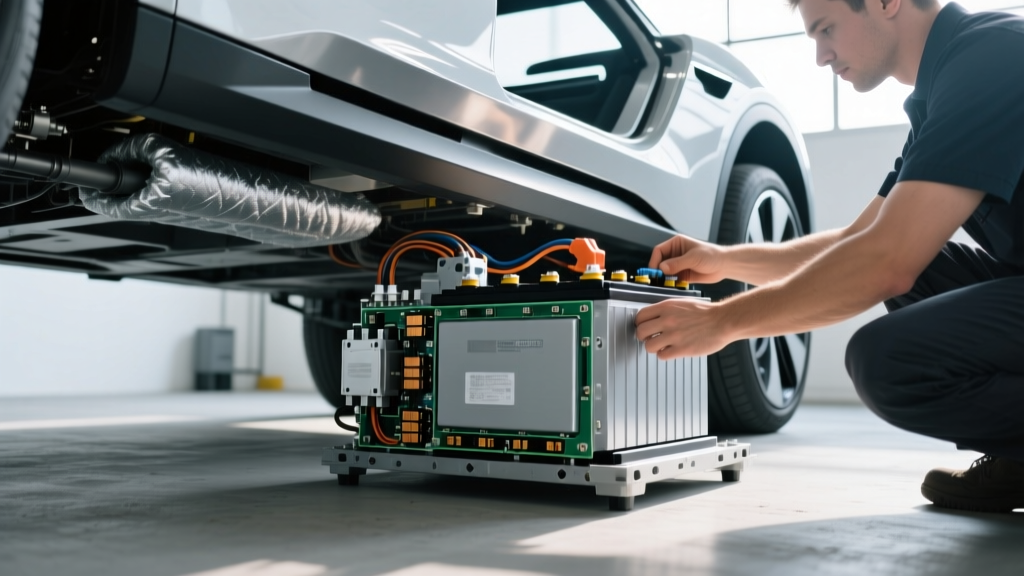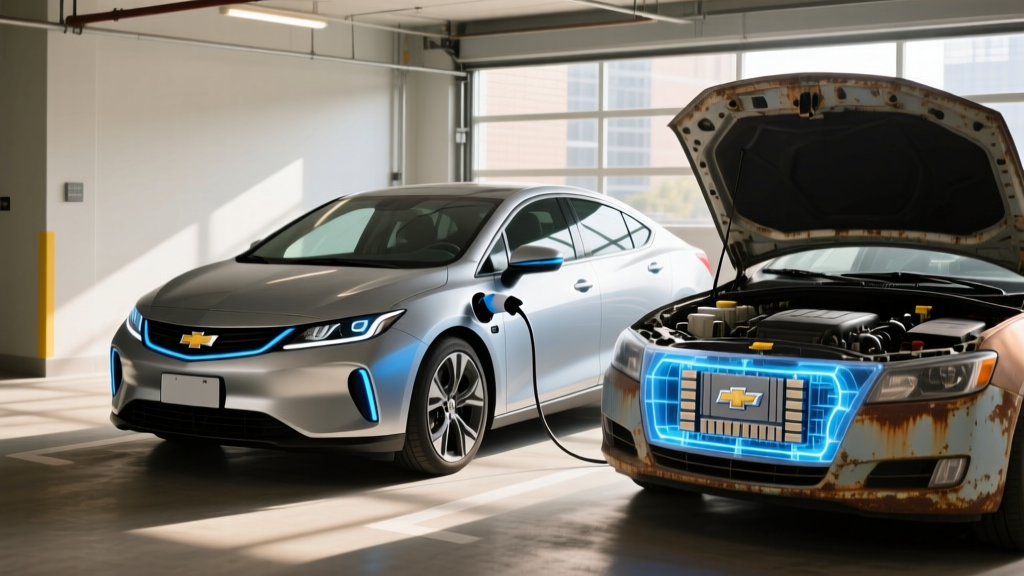
If you've ever replaced the battery in a 2014 Chevrolet Malibu, you know the drill: a $180–$260 12V lead-acid group 48 or 47 battery, a 10mm wrench, and about fifteen minutes in the driveway. It's one of the most routine maintenance items in automotive ownership. But when EV shoppers search for "2014 Chevrolet Malibu battery" information, they're often starting a broader question: how do EV batteries compare in lifespan, cost, and reliability to the batteries I already know?
This guide answers that question head-on. We'll break down high-voltage EV traction battery chemistry, real-world degradation data, warranty coverage, replacement economics, and daily care habits — using the humble Malibu battery as a baseline comparison throughout. Whether you're cross-shopping a used Bolt, a new Equinox EV, or a Tesla Model 3, the numbers below will ground your expectations in data, not marketing.
The Fundamental Difference: 12V Starter vs. High-Voltage Traction
Before comparing lifespans, let's eliminate the most common source of confusion. A 2014 Chevrolet Malibu uses a conventional 12V lead-acid (or AGM) battery rated at roughly 70 Ah and 700 CCA (cold cranking amps). Its sole job is cranking the starter motor and buffering the alternator's electrical output. It weighs about 40 lbs, stores less than 1 kWh of usable energy, and typically lasts 3–5 years before sulfation or plate degradation forces a swap.
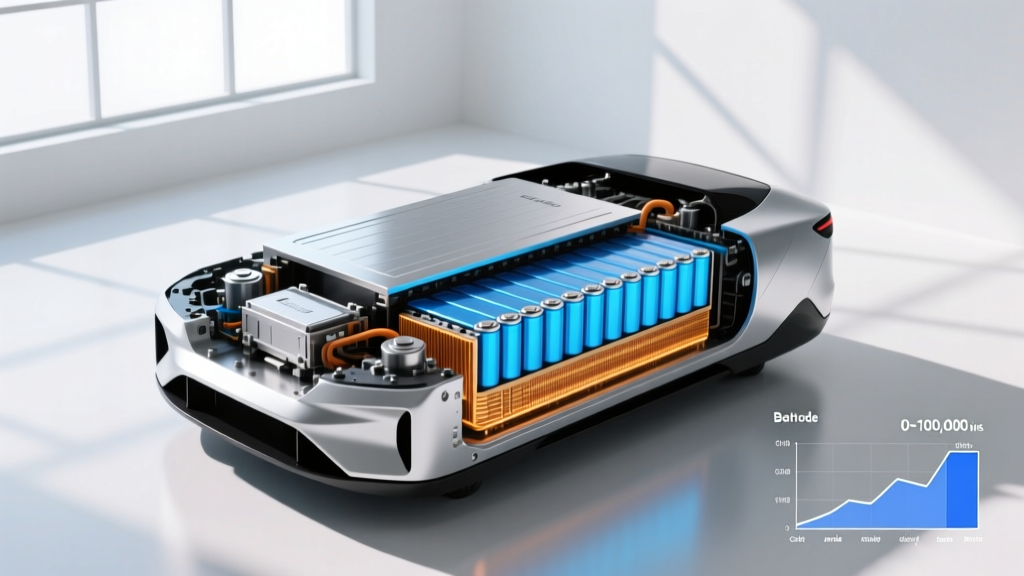
An EV traction battery is an entirely different class of component. A 2026 Chevrolet Equinox EV, for example, carries an Ultium-platform NMC (nickel manganese cobalt) pack with roughly 85 kWh of usable capacity — nearly 100 times the energy of that Malibu 12V. It weighs over 900 lbs, powers a 213–288 hp electric drivetrain, and is engineered for a 150,000+ mile service life. The two batteries share a name and little else.
Notably, most modern EVs also carry a small 12V lithium-iron-phosphate (LiFePO4) or lead-acid auxiliary battery to run lights, infotainment, and computers — but this is separate from the traction pack that actually propels the car. When we discuss "EV battery" below, we mean the high-voltage traction battery exclusively.
Battery Chemistry: LFP vs. NMC/NCA Trade-Offs
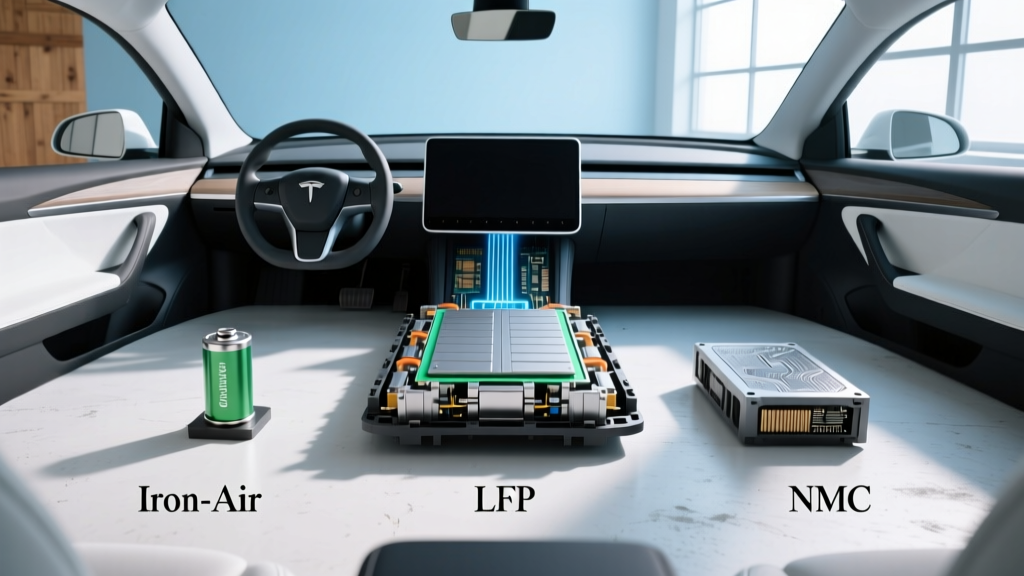
Not all EV batteries are built from the same chemistry. The two dominant types in 2026 passenger EVs are LFP (lithium iron phosphate) and NMC/NCA (nickel manganese cobalt / nickel cobalt aluminum). Each has measurable trade-offs that affect range, longevity, cold-weather behavior, and price.
| Attribute | LFP (LiFePO4) | NMC / NCA |
|---|---|---|
| Energy density (cell-level) | ~160–180 Wh/kg | ~230–300 Wh/kg |
| Typical cycle life (to 80% SoH) | 3,000–5,000+ cycles | 1,000–2,000 cycles |
| Cold-weather range retention (0°F) | ~55–65% of EPA | ~65–75% of EPA |
| Cost per kWh (2026 pack-level) | ~$80–$100 | ~$110–$140 |
| Recommended daily SoC | 100% OK; periodic full charge encouraged | 80% daily; 100% only for trips |
| Thermal runaway risk | Very low | Low, but higher than LFP |
| Common 2026 applications | Tesla Model 3/Y RWD, Ford Mustang Mach-E Select (LFP option), BYD, Rivian Standard | Chevy Equinox EV, Hyundai Ioniq 5/6, Tesla Long Range, BMW iX |
Which is better? There's no universal winner. LFP excels in longevity, safety, and cost — making it ideal for daily commuters who charge at home and don't need maximum range. NMC/NCA wins on energy density and cold-weather performance, which matters for road-trippers and buyers in northern climates. Tesla's own guidance (Tesla Model 3 Owner's Manual) explicitly recommends 100% daily charge for LFP variants and 80% for NMC Long Range models — a distinction that directly shapes ownership habits.
Real-World Degradation: What the Data Actually Shows
Battery degradation is the single largest source of EV purchase anxiety — and the area most distorted by anecdote. Let's anchor expectations in published fleet data.
Typical EV traction battery degradation curve (fleet averages):
- Year 1 / 15,000 mi: 1–3% capacity loss (initial SEI layer formation)
- Year 3 / 45,000 mi: 4–7% cumulative loss
- Year 5 / 75,000 mi: 6–10% cumulative loss
- Year 8 / 120,000 mi: 8–14% cumulative loss
- Year 10 / 150,000 mi: 10–18% cumulative loss (chemistry- and use-dependent)
Sources: Geotab fleet study of 6,300+ EVs, Recurrent Auto battery health reports, Tesla 2024 Impact Report.
Several patterns emerge from this data. First, degradation is non-linear — the steepest losses occur in the first 12–24 months as the solid electrolyte interphase (SEI) stabilizes on the anode, then the curve flattens considerably. Second, LFP packs consistently show slower long-term degradation than NMC in fleet data, often retaining 90%+ State of Health (SoH) past 100,000 miles. Third, thermally managed packs (liquid-cooled, as in virtually all 2026 EVs) dramatically outperform older passively-cooled designs like the 2011–2017 Nissan Leaf, which suffered accelerated calendar degradation in hot climates.
For comparison, a 2014 Chevrolet Malibu's 12V battery will typically deliver 3–5 years of service before failing outright — a far shorter functional lifespan, though at a fraction of the replacement cost.
Battery Warranties: What's Covered and for How Long
Federal law (EPA emissions warranty requirements) effectively mandates that EV manufacturers warrant the traction battery for at least 8 years / 100,000 miles in most states, and 10 years / 150,000 miles in California Air Resources Board (CARB) states including CA, NY, MA, NJ, CT, RI, VT, ME, OR, WA, CO, and others. Most manufacturers exceed the minimum.
| Vehicle | Battery Chemistry | Warranty Term | Capacity Retention Threshold |
|---|---|---|---|
| Chevrolet Equinox EV | NMC (Ultium) | 8 yr / 100,000 mi | ≥70% SoH |
| Tesla Model 3 RWD | LFP | 8 yr / 100,000 mi | ≥70% SoH |
| Tesla Model 3 Long Range | NMC/NCA | 8 yr / 120,000 mi | ≥70% SoH |
| Hyundai Ioniq 5 | NMC | 10 yr / 100,000 mi | ≥70% SoH |
| Ford Mustang Mach-E | NMC | 8 yr / 100,000 mi | ≥70% SoH |
| Rivian R1S / R1T | NMC | 8 yr / 175,000 mi | ≥70% SoH |
The critical detail is the retention threshold: nearly all manufacturers define a warranty claim as the pack falling below 70% of original usable capacity within the term. A 2026 Equinox EV with an EPA range of 319 miles would need to drop below roughly 223 miles of range (at equivalent conditions) to qualify. In practice, Recurrent Auto's data shows that fewer than 2% of EVs in their 15,000-vehicle study have required warranty battery replacements — the vast majority of packs outlive their warranty terms with meaningful capacity remaining.
Replacement Cost: When, Why, and How Much
Full traction battery replacements remain rare, but they do happen — typically due to manufacturing defects caught under warranty, collision damage, or (in older models) accelerated degradation from chronic DC fast-charging abuse or thermal mismanagement. Out-of-warranty replacement costs have dropped significantly as cell prices have fallen.
| Vehicle / Pack Size | Battery Capacity | Estimated Replacement Cost |
|---|---|---|
| Chevrolet Bolt EV (2017–2023) | 60–65 kWh | $9,000–$14,000 |
| Tesla Model 3 RWD (LFP) | ~57 kWh | $8,000–$12,000 |
| Tesla Model Y Long Range | ~75 kWh | $12,000–$16,000 |
| Hyundai Ioniq 5 | 77.4 kWh | $11,000–$15,000 |
| Ford F-150 Lightning (Extended) | ~131 kWh | $18,000–$25,000 |
| Chevrolet Silverado EV | ~200 kWh | $25,000–$35,000 |
For context: a 2014 Chevrolet Malibu 12V battery replacement runs $180–$260 installed. The EV traction battery is 40–100x more expensive — but it's also expected to last 3–5x the vehicle's typical ownership period. Most EV batteries are never replaced; the car is retired or sold before the pack reaches end-of-life. When replacements are needed under warranty, the owner's cost is $0.
A growing trend in 2026 is module-level repair: rather than swapping the entire pack, specialists at shops like Electrified Garage or dealer high-voltage techs can diagnose and replace individual failed modules for $2,000–$5,000, extending pack life at a fraction of full-replacement cost.
Factors That Accelerate (or Slow) Battery Aging
Battery degradation isn't random — it's driven by electrochemistry you can influence. The five factors below have the largest measured impact on long-term State of Health.
- State of Charge extremes: Storing an NMC pack at 100% SoC for days or weeks accelerates cathode oxidation and electrolyte breakdown. For daily driving, 80% is the NMC sweet spot. LFP tolerates 100% far better and actually benefits from periodic full charges for BMS (battery management system) cell-balancing calibration.
- DC fast-charging frequency: Occasional Supercharging or Electrify America sessions are fine. But fleet data from Geotab shows that vehicles DC fast-charging more than 3x per week degrade roughly 1.5–2x faster than those primarily Level 2 charging at home. The high C-rates (3C+) generate heat and lithium plating risk.
- Temperature extremes: Sustained exposure to ambient temperatures above 95°F accelerates calendar aging. Below 20°F, charging without preconditioning can cause lithium plating on the anode — permanent capacity loss. Modern thermal management systems (liquid cooling + heat pumps) mitigate this significantly, but parking in shade or a garage in Phoenix still matters.
- Depth of discharge: Regularly draining to 5% or below stresses cells more than shallow cycles. Aim to plug in before hitting 15–20% SoC when practical.
- Calendar aging: Even a parked EV battery degrades slowly over time — roughly 1–2% per year at moderate SoC and temperature. This is unavoidable, but storing at ~50% SoC in a cool environment minimizes it.
Monitoring Battery Health: How to Check SoH
Unlike a 2014 Malibu's 12V battery (which you test with a $40 load tester at an auto parts store), checking EV traction battery health requires software-level access. Here are the practical methods available to owners in 2026:
- In-vehicle displays: Tesla, Hyundai/Kia, BMW, and Rivian show estimated range at full charge, which — compared to original EPA figures — gives a rough SoH proxy. Tesla's service menu includes a battery health test accessible via the touchscreen.
- OBD-II dongles + apps: Devices like the OBDeleven (VW/Audi/Hyundai), Scan My Tesla app with an ELM327 adapter, or Leaf Spy (Nissan) can read nominal full pack (NFP) capacity in kWh directly from the BMS. Divide current NFP by original rated capacity to calculate SoH percentage.
- Third-party services: Recurrent offers free battery health reports that compare your pack against their fleet database. Some dealerships can print a formal SoH certificate — useful for resale.
- Manufacturer portals: GM's myChevrolet app and FordPass provide battery health summaries for Ultium and Mach-E platforms, respectively.
For used-EV buyers, always request a battery health report before purchase. A 2020 Model 3 showing 92% SoH at 45,000 miles is in excellent shape; one at 83% SoH may indicate chronic fast-charging or high-SoC storage and warrants deeper investigation.
Looking Ahead: Solid-State, Silicon Anode, and What's Real
Next-generation battery technologies generate enormous hype — and considerable confusion about availability. Here's the grounded 2026 outlook:
Silicon-dominant anodes (replacing graphite) are already shipping in limited production. GM's Ultium platform uses silicon-carbon composite anodes to boost energy density by ~10–15%. Group14 Technologies and Sila Nanotechnologies are scaling supply. This is current tech, not future.
Sodium-ion (Na-ion) batteries from CATL and BYD are entering Chinese-market EVs in 2025–2026, offering lower cost and excellent cold performance at the trade-off of ~30% lower energy density. US-market availability remains limited as of early 2026.
Solid-state batteries — replacing liquid electrolyte with a solid ceramic or sulfide conductor — promise step-change improvements in energy density (~400+ Wh/kg), charge speed, and safety. Toyota, Nissan, and Samsung SDI have announced pilot production for 2027–2029. However, manufacturing yield, cost, and scale remain unsolved challenges. No solid-state EV is currently available for purchase in the US market, and realistic volume production is likely 2029–2031 at earliest. Treat any "solid-state coming next year" claim with skepticism.
The practical takeaway: today's LFP and NMC chemistries, paired with modern thermal management, are mature, well-understood technologies. Waiting for solid-state is not a rational reason to delay an EV purchase in 2026.
Frequently Asked Questions
How long do EV batteries actually last?
Fleet data from Geotab and Recurrent Auto shows that the median EV traction battery retains 85–90% of original capacity at 100,000 miles (roughly 7–8 years of average US driving). Most packs will outlast 150,000 miles before dropping below the 70% SoH warranty threshold. They rarely "die" suddenly — they gradually lose range over a decade or more.
How much does an EV battery cost to replace out of warranty?
Between $8,000 and $35,000 depending on pack size, with most mid-size crossovers (75–85 kWh) in the $11,000–$16,000 range in 2026. However, the vast majority of EV batteries never require replacement during the vehicle's useful life. Module-level repair is also increasingly available for $2,000–$5,000.
What does the EV battery warranty cover?
Federally mandated minimum coverage is 8 years / 100,000 miles (10 yr / 150,000 mi in CARB states) against capacity loss below 70% of original. This covers defects and abnormal degradation but not collision damage, misuse, or unauthorized modifications. Warranty replacement is at no cost to the owner.
LFP vs. NMC — which should I choose?
Choose LFP if you charge primarily at home, want maximum cycle life, live in a moderate climate, and don't need the longest possible single-charge range. Choose NMC if you regularly road-trip, live in a cold climate, or need the highest energy density in a smaller/lighter pack. Both chemistries are reliable when properly managed.
How do I maximize my EV battery's lifespan?
For NMC: charge to 80% daily, use Level 2 home charging as your primary source, precondition before DC fast-charging, avoid sustained storage above 90% or below 10% SoC, and park in shade when possible in hot climates. For LFP: charge to 100% at least weekly for BMS calibration, and follow the same thermal and fast-charging guidelines.
Is an EV battery anything like the 12V battery in my 2014 Malibu?
Only in name. The Malibu's 12V lead-acid battery stores under 1 kWh, costs ~$200, and lasts 3–5 years. An EV traction battery stores 60–200 kWh, costs $8,000–$35,000, and is engineered for 150,000+ miles over 10–15 years. They share no chemistry, construction, or function.