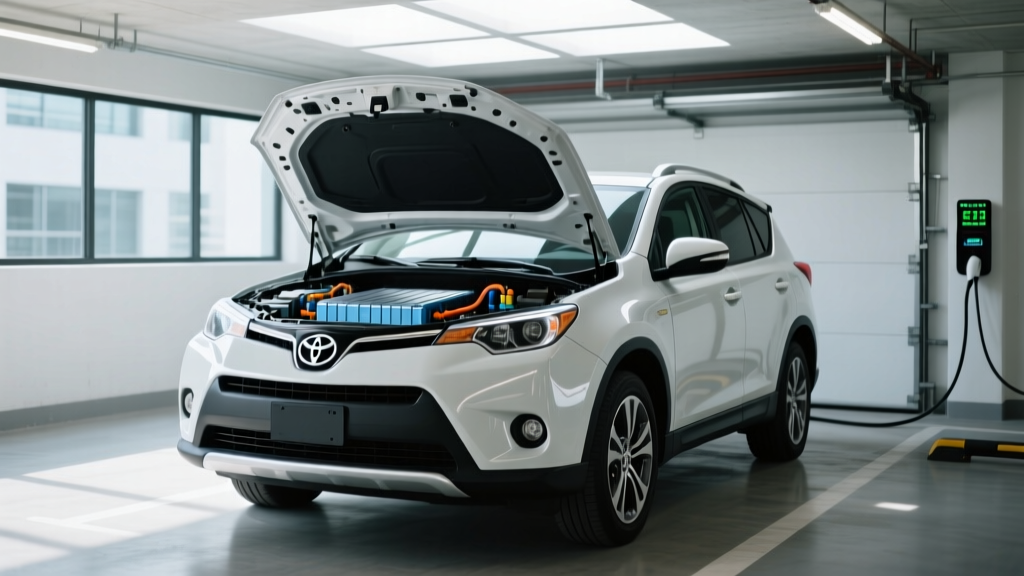
The 2013 Toyota RAV4 EV holds a unique place in electric vehicle history. Born from a collaboration between Toyota and Tesla, this all-electric compact SUV packed a 41.8 kWh lithium-ion battery supplied by Tesla — the same cell technology powering the early Model S. Over a decade later, many of these vehicles are still on the road, but owners and prospective used-EV buyers have pressing questions about battery health, replacement costs, and what degradation looks like on a pack that's now 12+ years old.
This guide breaks down everything you need to know about the 2013 Toyota RAV4 battery — from its NMC chemistry and real-world degradation trajectory to replacement pricing and how modern EV battery warranties compare. Whether you own one, are considering a used purchase, or want to understand how early EV packs have aged, the data below provides concrete answers.
2013 RAV4 EV Battery Specifications at a Glance
Before assessing longevity, it's essential to understand what Toyota and Tesla actually put under the floor of this vehicle. The 2013 RAV4 EV was only sold in California (a compliance car), and production ended in 2014 after roughly 2,900 units were built.
| Specification | Value |
|---|---|
| Battery Capacity (Total) | 41.8 kWh |
| Usable Capacity | ~35 kWh (buffer-protected) |
| Chemistry | NMC (Nickel Manganese Cobalt) |
| Cell Supplier | Tesla (18650 cylindrical cells) |
| EPA Range (Original) | 103 miles |
| Motor Output | 154 hp (115 kW) |
| 0–60 mph | ~8.6 seconds |
| DC Fast Charge (Max) | 50 kW (CHAdeMO) |
| Level 2 Charge Rate | 6.6 kW (240V) |
| Original MSRP | $49,500 (before incentives) |
| EPA Efficiency | 76 MPGe combined |
The 41.8 kWh pack was substantial for 2013 — larger than the Nissan Leaf's 24 kWh pack that same year. Tesla's thermal management system (liquid cooling and heating) gave the RAV4 EV an advantage over passively cooled competitors in managing degradation from extreme temperatures.
NMC vs LFP Chemistry: What's in the RAV4 EV and Why It Matters
The 2013 RAV4 EV uses NMC (Nickel Manganese Cobalt) lithium-ion cells — the dominant chemistry of that era and still widely used in 2026 for long-range EVs. Modern buyers will also encounter LFP (Lithium Iron Phosphate) batteries, which Tesla, Ford, and others now use in standard-range models. Understanding the trade-offs is critical when evaluating any used or new EV.
| Attribute | NMC (RAV4 EV) | LFP (e.g., Tesla Model 3 RWD, 2026) |
|---|---|---|
| Energy Density | Higher (~200–250 Wh/kg cell-level) | Lower (~160–180 Wh/kg cell-level) |
| Cycle Life | ~1,000–2,000 cycles to 80% SoH | ~3,000–5,000+ cycles to 80% SoH |
| Cold-Weather Performance | Better low-temp power delivery | Reduced range and slower charging in cold |
| Thermal Stability | Good (requires active management) | Excellent (inherently more stable) |
| Cost per kWh | Higher (cobalt/nickel commodity exposure) | Lower (~20–30% cheaper per kWh) |
| Recommended Charging Habit | 20–80% daily; avoid 100% sits | OK to charge to 100% regularly |
| Typical Application | Long-range, performance EVs | Standard-range, fleet, high-mileage use |
Which is better? It depends on the use case. NMC wins on energy density (more range in a smaller, lighter pack) and cold-weather capability — which is why the 2013 RAV4 EV achieved 103 miles from a relatively compact pack. LFP wins on longevity and cost, making it the pragmatic choice for daily commuters and high-mileage drivers in 2026. For the RAV4 EV owner, the NMC pack's primary vulnerability is calendar aging and sensitivity to prolonged high-state-of-charge storage.
How Long Do EV Batteries Last? Real-World Degradation Data
This is the question every EV owner and prospective buyer asks. The short answer: most modern EV batteries outlast the vehicle itself, but early-generation packs like the RAV4 EV's show measurable degradation over 10+ years.
Based on owner reports aggregated by EV communities and data from fueleconomy.gov, here's what the degradation curve typically looks like for NMC packs of this era:
Typical NMC Degradation Trajectory (41.8 kWh pack, RAV4 EV class):
- Year 1–2 (0–30,000 mi): ~3–5% capacity loss (initial break-in degradation)
- Year 3–5 (30,000–75,000 mi): Additional ~3–5% loss (total ~6–10% from new)
- Year 6–8 (75,000–120,000 mi): ~2–4% additional loss (total ~10–14% from new)
- Year 10–13 (120,000–180,000 mi): Calendar aging accelerates; total ~15–25% loss typical
For a 2013 RAV4 EV in 2026, this means an original 103-mile EPA range has likely compressed to approximately 78–90 miles depending on charging habits, climate exposure, and mileage. Vehicles in hot climates (Arizona, inland California) that were frequently DC fast-charged or stored at 100% SoC tend to cluster toward the higher degradation end. Garage-kept, temperate-climate examples charged primarily on Level 2 at moderate states of charge have fared better.
For context, modern EVs with improved thermal management and cell chemistry (2020+) are projected to lose only 10–15% capacity over 15 years / 200,000 miles based on data from Recurrent Auto and other fleet-monitoring services. The RAV4 EV's Tesla-sourced pack was ahead of its time in thermal management but still subject to the calendar-aging realities of early-2010s NMC cells.
What Does the Battery Warranty Cover?
When new, Toyota provided the following warranty coverage for the 2013 RAV4 EV's high-voltage battery:
| Coverage | Term |
|---|---|
| EV Battery Warranty | 8 years / 100,000 miles (whichever comes first) |
| Capacity Retention Threshold | Below ~70% of original capacity (varies by state interpretation) |
| CARB-State Extended Coverage | 10 years / 150,000 miles in California and CARB-adopting states |
| What's Covered | Defects, excessive degradation below threshold, cell/module failure |
| What's Not Covered | Damage from accidents, flooding, unauthorized modifications, neglect |
In 2026, all original warranty coverage has expired for every 2013 RAV4 EV. The 8-year/100,000-mile federal warranty ended no later than 2021 (or upon reaching 100k miles), and even the extended California CARB warranty maxed at 2023 / 150,000 miles. Any battery replacement or repair is now an out-of-pocket expense.
For comparison, 2026 new-EV battery warranties from major manufacturers follow the federal minimum of 8 years / 100,000 miles, with most guaranteeing 70% capacity retention. Hyundai/Kia offers 10 years / 100,000 miles. Tesla provides 8 years / 100,000–150,000 miles depending on the model. These warranties remain relevant for current new-EV buyers but don't apply to the 2013 RAV4 EV at this stage of its life.
2013 RAV4 EV Battery Replacement Cost: What to Expect in 2026
With warranty coverage expired, replacement cost is the defining economic question for aging EV ownership. Here's the current landscape for the 2013 RAV4 EV battery:
| Option | Estimated Cost | Notes |
|---|---|---|
| OEM New (Toyota Dealer) | $12,000 – $16,000+ | Limited availability; Toyota may not stock new packs for this model in 2026 |
| Remanufactured / Refurbished Pack | $8,000 – $12,000 | Most common route; third-party EV shops rebuild with tested modules |
| Used Salvage Pack | $4,000 – $7,500 | From wrecked/low-mile RAV4 EVs; health varies, no warranty typical |
| Module-Level Repair | $1,500 – $4,000 | Replace only failed modules (if damage is localized); requires specialist |
| Labor (Any Option) | $1,000 – $2,500 | 3–6 hours at EV-certified shop; high-voltage safety protocols required |
When is replacement typically needed? Most EV batteries don't "die" suddenly — they gradually lose range until the vehicle becomes impractical for the owner's needs. For the 2013 RAV4 EV, owners typically pursue replacement or major service when usable range drops below 60–70 miles (roughly 65–70% State of Health), making daily commutes unreliable. Based on degradation data, this threshold is commonly reached between 130,000–180,000 miles or 12–16 years of age, though individual results vary widely.
The economic reality: a $10,000 battery investment on a vehicle with a 2026 resale value of roughly $8,000–$14,000 (depending on condition and battery health) is a difficult proposition. Many owners opt for module-level repair to extend the vehicle's life by 2–4 more years rather than a full pack replacement. Per NHTSA safety guidance, any high-voltage battery work should only be performed by certified technicians.
Factors That Accelerate (or Preserve) EV Battery Life
Not all 2013 RAV4 EVs have aged equally. Battery longevity is driven by a combination of usage patterns, environmental exposure, and charging habits. Here's what the data shows:
Factors That Accelerate Degradation:
- Frequent DC fast charging: Regular use of 50 kW CHAdeMO charging generates heat that stresses NMC cells. Occasional DCFC is fine; daily reliance accelerates capacity loss by an estimated 1–3% per year versus Level 2-only charging.
- Prolonged high SoC storage: Leaving the vehicle plugged in at 100% for days or weeks — especially in heat — is the single most damaging habit for NMC chemistry.
- Extreme heat exposure: Sustained ambient temperatures above 95°F (35°C), particularly without garage parking, accelerate calendar aging. The RAV4 EV's active thermal management helps but doesn't eliminate this risk.
- Deep discharge cycles: Routinely driving the battery below 10% SoC stresses cell chemistry.
- High mileage in short time: 100,000+ miles in 5 years means more charge cycles, which consumes cycle life faster.
Habits That Maximize Longevity:
- Level 2 home charging as primary method: Slower charging generates less heat; a 6.6 kW Level 2 station is ideal for daily use.
- 20–80% SoC window for daily driving: Reserve 100% charges for road trips. The RAV4 EV's built-in charge-limit settings support this.
- Garage parking in extreme climates: Reducing thermal exposure is the most impactful passive protection.
- Preconditioning while plugged in: Warming or cooling the cabin (and battery) while connected to shore power reduces the pack's thermal load during driving.
- Driving it regularly: Lithium-ion cells degrade faster when sitting idle for months at any SoC. Moderate, regular use is healthier than long-term storage.
How to Check Battery Health (State of Health) on a RAV4 EV
Unlike modern EVs with detailed in-app battery health dashboards, the 2013 RAV4 EV doesn't provide a direct State of Health (SoH) percentage on the instrument cluster. Here are the methods owners and prospective buyers use to assess pack condition:
Method 1: Range Observation
The simplest indicator. Charge to 100% and note the estimated range display. Compare it to the original 103-mile EPA figure. A fully charged display showing 85 miles suggests roughly 82% SoH (accounting for the vehicle's range estimation algorithm, which can vary with driving style and temperature). Repeat this test in moderate weather (65–75°F) for the most consistent baseline.
Method 2: OBD-II Diagnostic Scan
Using an OBD-II adapter compatible with Toyota's EV protocols (such as a ScanGauge or app-based tools like LeafSpy-equivalent for Toyota), owners can read battery voltage, individual module balance, and estimated remaining capacity. This requires some technical knowledge but provides far more granularity than the dashboard display.
Method 3: Professional Battery Health Report
EV-specialist shops can perform a controlled discharge test and provide a certified SoH report. This is the gold standard for used-EV purchases and typically costs $100–$250. Services like Recurrent Auto also offer remote battery health monitoring for compatible vehicles.
Method 4: Charging Data Analysis
If you track energy consumption (kWh added during a full charge from near-empty to 100%), you can estimate usable capacity. For example, if a 10%→100% charge adds only 28 kWh from your Level 2 station (accounting for ~10% charging losses), the usable pack capacity is approximately 25 kWh — suggesting roughly 71% of the original ~35 kWh usable capacity remains.
Looking Ahead: Solid-State and Next-Gen Battery Tech
For 2013 RAV4 EV owners wondering whether to invest in a replacement pack or wait for future technology, it's worth understanding what's on the horizon — and what isn't yet available.
Solid-state batteries — which replace the liquid electrolyte with a solid material for improved energy density and safety — remain in the pilot-production phase as of 2026. Toyota has announced prototype demonstrations and targets limited commercial production in the 2027–2029 timeframe, but these will debut in new vehicles, not as retrofit packs for 2013 models. Toyota's published battery roadmap indicates solid-state is aimed at next-generation model platforms.
Silicon-anode batteries, which increase energy density by replacing graphite anodes with silicon-dominant materials, are entering limited production in 2026 (notably through suppliers like Sila Nanotechnologies and Group14). These are expected to appear in select 2027–2028 model-year EVs, offering 10–20% more range from the same physical pack size.
Sodium-ion batteries are emerging as a low-cost alternative for smaller EVs and stationary storage, with CATL and other manufacturers beginning volume production. These won't apply to RAV4 EV retrofits but signal a broader diversification of battery chemistry options.
The practical takeaway: none of these technologies will produce a drop-in replacement pack for a 2013 RAV4 EV. If the vehicle's battery needs service, the available options remain OEM-new (if stock exists), remanufactured, or used salvage packs using the original Tesla-supplied NMC cell format.
Should You Buy a Used 2013 RAV4 EV in 2026?
Consider it if:
- The battery SoH is verified above 80% (range at full charge above ~85 miles in moderate weather)
- You need a short-range commuter (under 50 miles round trip) with home Level 2 charging
- The price is below $10,000 and you're comfortable budgeting for a potential $5,000–$10,000 battery service within 3–5 years
- You value the Tesla-sourced powertrain and Toyota build quality at a bargain entry point
Look elsewhere if:
- You need reliable range above 80 miles without range planning
- You lack home charging access and would rely on public DCFC (CHAdeMO infrastructure is declining as NACS becomes the 2026 standard)
- You live in an extreme-heat climate and can't garage the vehicle
- A battery replacement would exceed the vehicle's value and you need long-term transportation certainty
The 2013 RAV4 EV remains a fascinating artifact of early EV collaboration — a vehicle that offered 103 miles of range and liquid-cooled battery management years before most competitors. But in 2026, its battery is the defining factor in whether it's a smart used-EV bargain or a looming financial liability. Get the SoH verified before purchase, understand the replacement cost landscape, and make your decision on data — not nostalgia.
Frequently Asked Questions
How long do EV batteries last in years and miles?
Most modern EV batteries (2020+) are engineered to retain 70–80% of original capacity after 15 years or 200,000 miles. Early-generation packs like the 2013 RAV4 EV's NMC pack typically show 15–25% degradation by year 12–13, depending on usage and climate. Complete failure before 150,000 miles is uncommon; gradual range loss is the norm.
How much does it cost to replace a 2013 RAV4 EV battery?
In 2026, expect $8,000–$12,000 for a remanufactured pack (the most common option), $4,000–$7,500 for a used salvage pack, or $1,500–$4,000 for a targeted module repair. OEM-new packs from Toyota may cost $12,000–$16,000+ if available. Labor adds $1,000–$2,500.
Is the 2013 RAV4 EV battery still under warranty?
No. Toyota's original 8-year/100,000-mile battery warranty (10 years/150,000 miles in CARB states) has expired for all 2013 RAV4 EVs as of 2023 at the latest. All battery service is now an owner expense.
Can I upgrade the 2013 RAV4 EV battery to a larger or newer pack?
There is no factory-approved upgrade path. The vehicle's battery management system, cooling system, and physical battery tray are designed for the original 41.8 kWh Tesla-supplied pack. Aftermarket upgrades would require extensive custom engineering and are not practical or widely available.
Is the 2013 RAV4 EV battery the same as a Tesla battery?
Yes, at the cell level. Toyota contracted Tesla to supply the battery pack and powertrain. The RAV4 EV uses Tesla's 18650-format NMC cylindrical cells — the same cell format used in the Tesla Roadster and early Model S. However, the pack configuration, BMS software, and integration are specific to the RAV4 EV platform.
Does the 12V battery affect the RAV4 EV's range or high-voltage battery?
No. The 12V auxiliary battery powers accessories, lights, and the vehicle's computers — it is entirely separate from the 41.8 kWh high-voltage traction battery. A failing 12V battery can prevent the vehicle from starting (a common issue in older EVs) but does not affect driving range or traction battery health. Replace the 12V battery independently as needed (~$150–$250 for an AGM replacement).
LFP vs NMC — which battery chemistry is better for a used EV buyer?
For a used-EV buyer, LFP chemistry is generally preferable if available: it degrades more slowly, tolerates 100% daily charging, and offers 3,000+ cycle life. However, LFP wasn't used in mainstream EVs until the 2020s, so most used EVs from 2013–2019 (including the RAV4 EV) have NMC packs. NMC offers better cold-weather performance and energy density but requires more careful charging habits to maximize longevity.