If you've landed here searching for a battery for 2013 Toyota RAV4, you're likely dealing with a dead 12-volt starter battery — a Group 35 or 24F lead-acell unit that costs roughly $150–$250 at any auto parts store. That's a straightforward swap. But if your interest in batteries extends to the electric vehicle you're considering next, or the RAV4 Prime plug-in hybrid you already own, the conversation shifts dramatically. Modern electrified vehicles rely on high-voltage lithium-ion traction packs that are fundamentally different in chemistry, cost, and lifespan.
This guide bridges both worlds. We'll clarify what battery the 2013 RAV4 actually uses, then deliver a deep technical breakdown of EV and PHEV traction battery technology — chemistry, degradation, warranties, replacement economics, and care practices — so you can make an informed decision whether you're maintaining a gas RAV4 or shopping for your first BEV.
The 2013 Toyota RAV4 Battery: What You Actually Need
The 2013 Toyota RAV4 (fourth generation, gasoline-only) uses a conventional 12V lead-acid auxiliary battery, typically a Group 24F or Group 35 size with around 550–650 cold cranking amps (CCA). This battery powers the starter motor, lights, infotainment, and ECU — nothing more. It has no connection to electric propulsion because the 2013 RAV4 is not electrified.
However, there's an important footnote: the 2013 RAV4 EV — a battery-electric version sold only in California and in limited numbers — used a 41.8 kWh lithium-ion traction pack co-developed with Tesla. If you own this rare variant and need traction battery service, you're looking at a specialized high-voltage system, not an AutoZone swap. Parts availability is limited; expect to work with a Toyota dealer or independent EV specialist.
EV Battery Chemistry: LFP vs NMC vs NCA
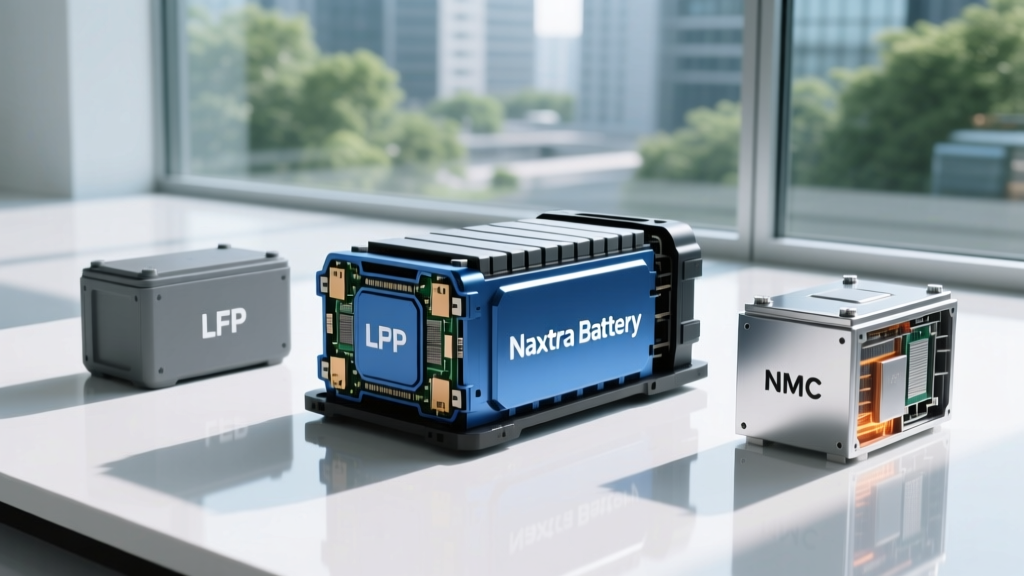
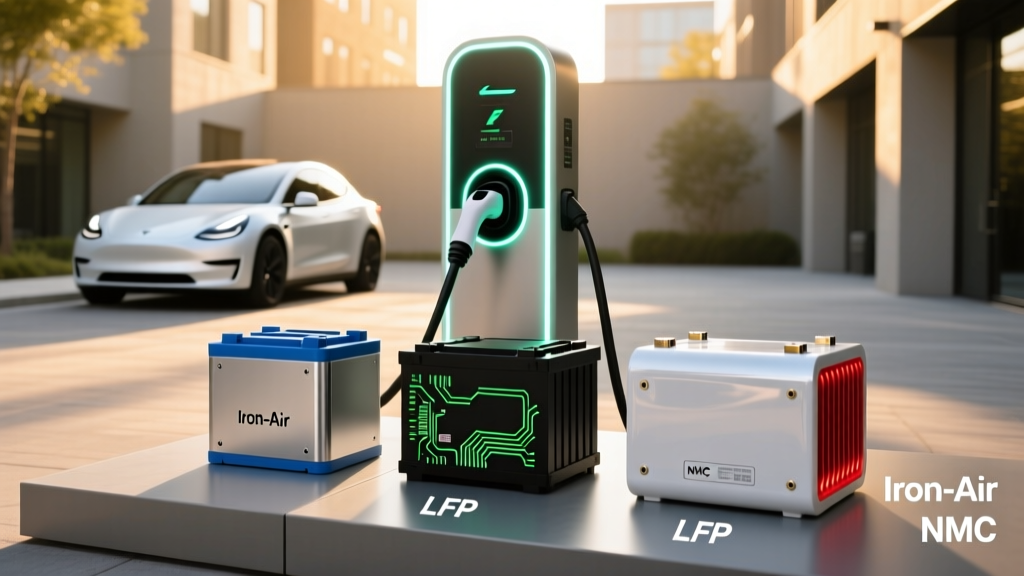
Modern EV traction batteries use one of three dominant lithium-ion cathode chemistries. The choice affects your range, longevity, cold-weather usability, and even how you should charge at home.
| Attribute | LFP (Lithium Iron Phosphate) | NMC (Nickel Manganese Cobalt) | NCA (Nickel Cobalt Aluminum) |
|---|---|---|---|
| Energy Density | Lower (~160 Wh/kg cell-level) | Higher (~220–260 Wh/kg) | Highest (~260–300 Wh/kg) |
| Cycle Life | 3,000–5,000+ cycles to 80% SoH | 1,000–2,000 cycles to 80% SoH | 1,000–1,500 cycles to 80% SoH |
| Cold Performance | Weaker — more range loss below 32°F | Better cold-weather retention | Good with active thermal mgmt |
| Cost | Lower — no cobalt or nickel | Moderate — commodity-linked | Moderate-high |
| SoC Recommendation | Can charge to 100% regularly | Best at 80% daily; 100% for trips | Best at 80% daily; 100% for trips |
| Common In (2026) | Tesla Model 3/Y RWD, Ford Mustang Mach-E Select, many Chinese-market EVs | Hyundai Ioniq 5/6, VW ID.4, BMW iX, most long-range trims | Tesla Long Range/Performance, Rivian, Lucid |
Which is better? There's no single winner. LFP excels in longevity and cost but sacrifices energy density and cold-weather range. NMC/NCA delivers more miles per kWh and handles cold better but degrades faster if routinely charged to 100%. For high-mileage drivers in warm climates who can charge daily to 100%, LFP is the durability play. For buyers prioritizing maximum range and cold-weather capability, NMC or NCA remains the stronger choice.
How Long Do EV Batteries Last? Degradation Data
The fear that EV batteries need replacement every few years is not supported by fleet data. Most modern packs outlast the vehicle's useful economic life.
- Tesla fleet data (2025 Impact Report): Model 3/Y packs retain approximately 85% capacity at 150,000 miles. NMC/NCA packs show roughly 12–15% loss at that mileage.
- Geotab fleet study (6,300+ EVs): Average annual degradation of 1.8% across all chemistries — meaning ~82% State of Health (SoH) at 10 years under typical use.
- Recurrent fleet data: LFP-equipped vehicles show slower long-term degradation curves, with many retaining 90%+ SoH after 100,000 miles.
- Early Nissan Leaf (2011–2015, passive air cooling): Notable outlier — 24 kWh packs in hot climates lost 20–30% capacity within 5 years. Modern liquid-cooled packs have largely solved this.
Translation: if you buy a 2026 EV with an EPA-rated 300-mile range, expect roughly 255–270 miles of usable range at 150,000 miles. That's noticeable but not debilitating. Catastrophic failure (sudden brick) is exceedingly rare; degradation is a slow, linear taper.
Battery Warranty Terms: What Manufacturers Guarantee
Federal law mandates a minimum of 8 years / 100,000 miles on EV and PHEV battery warranties (10 years / 150,000 miles in CARB states including California, New York, Massachusetts, and others). Most manufacturers exceed this floor.
| Manufacturer | Coverage | Capacity Retention Threshold |
|---|---|---|
| Tesla | 8 yr / 120,000 mi (Model 3/Y); 8 yr / 150,000 mi (S/X) | 70% minimum SoH |
| Hyundai / Kia | 10 yr / 100,000 mi | 70% minimum SoH |
| Ford | 8 yr / 100,000 mi | 70% minimum SoH |
| GM (Chevrolet, Cadillac) | 8 yr / 100,000 mi | 60–70% depending on model |
| BMW | 8 yr / 100,000 mi | 70% minimum SoH |
| Toyota (bZ4X / RAV4 Prime) | 8 yr / 100,000 mi (hybrid battery: 10 yr / 150,000 mi) | 70% minimum SoH |
The warranty triggers when your pack falls below the stated threshold — typically 70% of original capacity — within the coverage window. A warranty claim results in module-level repair, partial replacement, or full pack replacement at the manufacturer's discretion. See fueleconomy.gov for EV/PHEV classification details relevant to warranty and credit eligibility.
EV Battery Replacement Cost: When and How Much
Out-of-warranty battery replacement is the number-one anxiety for prospective EV buyers. Here's what the data shows:
| Vehicle / Pack Size | Approximate Replacement Cost | Notes |
|---|---|---|
| Chevrolet Bolt EV (65 kWh) | $14,000–$16,000 | GM reduced costs post-recall; module repair often cheaper |
| Tesla Model 3 (75 kWh NMC) | $13,000–$16,000 | Refurbished packs available at lower cost |
| Tesla Model Y LFP (~60 kWh) | $10,000–$13,000 | LFP chemistry = lower cell cost |
| Ford F-150 Lightning (131 kWh Ext. Range) | $22,000–$28,000 | Largest consumer pack; highest cost |
| Hyundai Ioniq 5 (77.4 kWh) | $14,000–$18,000 | Module-level repair often $3,000–$6,000 |
| Toyota RAV4 Prime PHEV (18.1 kWh) | $6,000–$9,000 | Smaller pack; hybrid battery warranty 10yr/150k mi |
When is replacement actually needed? Rarely before 200,000+ miles on modern liquid-cooled packs. Most EVs are scrapped or sold for other reasons (collision, body rust, owner upgrade) before the traction battery reaches end-of-life. Module-level repair — replacing individual cell groups rather than the entire pack — is increasingly common and costs $2,000–$7,000 depending on the fault.
Factors That Accelerate (or Slow) Battery Degradation
Battery wear isn't random. Five variables dominate the degradation curve:
- State of Charge (SoC) habits: Routinely storing an NMC/NCA battery at 100% SoC accelerates electrolyte decomposition. LFP chemistry tolerates 100% storage far better. For NMC/NCA, set your daily charge limit to 80% and reserve 100% for road trips.
- DC fast-charging frequency: Occasional DCFC use (road trips) has negligible impact. Daily reliance on 150+ kW DC fast charging without proper thermal preconditioning can add 1–3% extra annual degradation. Tesla's own data shows minimal impact when preconditioning is active.
- Temperature extremes: Sustained exposure to ambient temperatures above 95°F without active cooling accelerates calendar aging. Similarly, charging below freezing without battery preconditioning causes lithium plating — permanent capacity loss. Modern liquid-cooled packs (virtually all 2020+ EVs) mitigate this substantially.
- Depth of Discharge: Shallow cycles (e.g., 30%–70% SoC) are gentler than deep cycles (5%–100%). You don't need to obsess over this, but avoiding regular sub-10% states helps.
- Calendar aging: Even a parked EV battery degrades. Storing at ~50% SoC in moderate temperatures minimizes this. A battery sitting at 100% SoC in a 100°F garage degrades measurably faster.
- ☑ Set daily charge limit to 80% (NMC/NCA) or 100% (LFP)
- ☑ Enable battery preconditioning before DC fast charging
- ☑ Avoid leaving the car at 100% SoC for more than a few hours
- ☑ In extreme heat, park in shade or a garage when possible
- ☑ In sub-freezing weather, plug in and let the car precondition before driving
- ☑ Use Level 2 home charging as your primary routine — it's gentler than daily DCFC
- ☑ If storing for 2+ weeks, set SoC to ~50%
How to Check Your Battery's State of Health (SoH)
State of Health (SoH) represents the remaining capacity of your battery relative to its original spec. A new pack is 100% SoH; a pack with 12% degradation sits at 88% SoH. Here's how to check it:
OEM Apps and In-Car Displays: Tesla provides a battery health readout in the service menu (software 2024.20+). Hyundai/Kia's Bluelink and FordPass display estimated range vs. original, from which SoH can be derived. BMW's iDrive shows a direct SoH percentage.
OBD-II Tools: Third-party apps like Leaf Spy (Nissan Leaf), Scan My Tesla, or Car Scanner ELM OBD2 can read pack voltage, cell balance, and estimated SoH directly from the BMS (Battery Management System). These typically require a Bluetooth OBD-II dongle ($30–$60).
Third-Party Reports: Services like Recurrent offer battery health reports based on telematics data, useful for used-EV buyers who want independent verification before purchase.
Manual calculation: Fully charge to 100%, note the displayed range, and compare it to the original EPA rating. A 300-mile EPA vehicle showing 265 miles at 100% SoH is at roughly 88% health. Note: this method is approximate because displayed range also factors in recent driving efficiency.
What's Next: Solid-State and Silicon-Anode Batteries
Two emerging technologies promise step-change improvements, but neither is available in production consumer EVs as of 2026:
Solid-state batteries replace the liquid electrolyte with a solid material, potentially doubling energy density, enabling 10-minute fast charges, and eliminating thermal runaway risk. Toyota has announced a 2027–2028 production timeline for a limited solid-state deployment. Samsung SDI targets 2027. QuantumScape continues pilot production with Volkswagen. Realistic mass-market availability remains 2029–2032.
Silicon-anode batteries replace graphite anodes with silicon-dominant materials, boosting energy density by 20–40%. Companies like Sila Nanotechnologies (partnered with Mercedes-Benz and Panasonic) and Group14 (partnered with Porsche) are in early production stages. Expect limited availability in premium models starting 2026–2027, with broader adoption by 2028–2030.
Both technologies are genuinely promising but remain forward-looking. Buying decisions today should be based on current lithium-ion chemistry performance, not speculative future tech. For authoritative battery safety data, see NHTSA's EV battery safety resources.
Frequently Asked Questions
How long do EV batteries last in years and miles?
Modern liquid-cooled EV batteries typically retain 80–90% of original capacity at 150,000–200,000 miles (10–15 years of average use). Fleet data from Geotab shows ~1.8% average annual degradation. Most packs will outlast the vehicle's economic life. Early air-cooled packs (pre-2017 Nissan Leaf) are the main exception.
How much does an EV battery cost to replace?
Full pack replacement ranges from ~$10,000 (smaller LFP packs) to $28,000 (large packs like the F-150 Lightning Extended Range). However, most replacements are module-level repairs at $2,000–$7,000. Catastrophic full-pack failure outside warranty is rare on post-2018 vehicles.
What does the EV battery warranty actually cover?
Federal minimum is 8 years / 100,000 miles (10 yr / 150,000 mi in CARB states). Coverage triggers when capacity drops below a stated threshold — typically 70% SoH. The warranty covers defects and excessive degradation, not damage from collisions, flooding, or unauthorized modifications. Check your owner's manual for exact terms.
How do I check and maximize my battery's health?
Check SoH via your OEM app, an OBD-II scanner with EV-specific software, or a third-party report from Recurrent. Maximize longevity by: setting daily charge to 80% (NMC/NCA), enabling preconditioning, avoiding prolonged 100% storage, minimizing DCFC-only routines, and parking in moderate temperatures when possible.
LFP vs NMC — which battery chemistry should I choose?
Choose LFP if you prioritize longevity, lower cost, and plan to charge to 100% daily (e.g., high-mileage commuters, warm-climate drivers). Choose NMC/NCA if you need maximum range per charge, better cold-weather performance, or are buying a long-range AWD model. Neither is universally superior — the right choice depends on your climate, driving pattern, and charging access.
I need a battery for my 2013 Toyota RAV4 — is this an EV battery?
No. The 2013 gasoline RAV4 uses a standard 12V lead-acid battery (Group 24F or 35), available at any auto parts retailer for $150–$250. The rare 2013 RAV4 EV used a 41.8 kWh Tesla-sourced lithium-ion traction pack — an entirely different system requiring dealer or specialist service. If you're transitioning from a gas RAV4 to a modern EV or PHEV like the RAV4 Prime, the traction battery technology described in this guide is what you'll be living with.