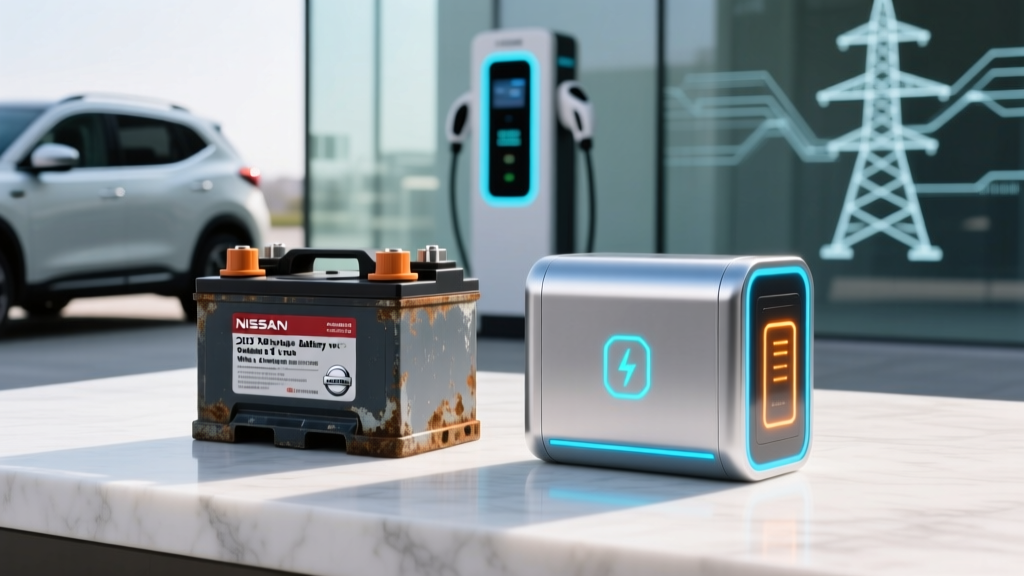
If you've ever searched for a 2013 Nissan Rogue battery, you were likely dealing with a 12-volt lead-acid starter battery that cost around $150–$250 to swap at an auto parts store. That search query represents a completely different automotive era — one where the Rogue was a conventional gasoline compact SUV with no high-voltage traction pack, no liquid-cooled thermal management, and no 8-year federal battery warranty.
Fast-forward to 2026, and Nissan now sells the Ariya with an 87 kWh (usable) NMC lithium-ion battery delivering up to 304 miles of EPA-estimated range. The contrast between a 2013 Rogue's simple electrical system and a modern EV's traction battery is staggering — and it raises critical questions for today's EV shoppers and owners about longevity, degradation, replacement cost, and chemistry choices.
This guide bridges that gap. We'll examine what modern EV battery technology actually delivers, how it degrades over time, what warranties protect you, and how current chemistries like LFP and NMC compare — giving you the data to make an informed purchase or ownership decision.
What the 2013 Nissan Rogue Battery Was (and Wasn't)
The 2013 Nissan Rogue used a conventional 12V lead-acid battery — typically a Group 35 or Group 24F — to start its 2.5-liter four-cylinder engine and power accessories. It had no electric drivetrain, no regenerative braking, and no high-voltage system. When that battery died after 3–5 years, you replaced it for roughly $130–$200 at any auto parts retailer.
This matters because many buyers still conflate 12V auxiliary batteries with high-voltage traction batteries in modern EVs. Today's electric vehicles carry both: a small 12V battery (or in some newer models, a 12V lithium-iron-phosphate unit) that powers electronics and a massive high-voltage pack — typically 50 to 100+ kWh — that actually propels the vehicle. The 2013 Rogue had only the former.
For the rest of this guide, when we say "EV battery," we mean the high-voltage traction battery. The 12V auxiliary battery in a modern EV is a separate, inexpensive component that occasionally needs replacement, much like in the 2013 Rogue.
EV Battery Chemistry: LFP vs. NMC/NCA Trade-Offs
Modern EV traction batteries predominantly use one of two lithium-ion chemistries, each with distinct engineering trade-offs that affect range, longevity, cost, and cold-weather performance.
| Attribute | LFP (Lithium Iron Phosphate) | NMC/NCA (Nickel Manganese Cobalt / Nickel Cobalt Aluminum) |
|---|---|---|
| Energy Density | ~160–180 Wh/kg (lower) | ~220–300 Wh/kg (higher) |
| Cycle Life | 3,000–6,000+ cycles | 1,000–2,500 cycles |
| Cold-Weather Performance | Greater range loss below 32°F; slower charging | Better low-temp performance; preconditioning helps |
| Cost per kWh (2026) | ~$80–$100/kWh at pack level | ~$110–$140/kWh at pack level |
| Optimal Daily Charge Limit | 100% SoC is fine — recommended weekly | 80% SoC for daily; 100% for trips only |
| Cobalt Content | None | Contains cobalt (supply-chain and ethical concerns) |
| Notable 2026 Applications | Tesla Model 3/Y RWD, Ford Mustang Mach-E Select (LFP option), BYD models | Hyundai Ioniq 5/6, Kia EV6/EV9, Tesla Long Range/Performance, Nissan Ariya, Rivian |
The bottom line: LFP wins on longevity and cost but sacrifices energy density and cold-weather efficiency. NMC/NCA delivers more range per kilogram and charges faster in cold climates but degrades sooner and costs more. Neither is universally "better" — the right choice depends on your driving patterns, climate, and how long you plan to keep the vehicle.
How Long Do EV Batteries Actually Last? Degradation Data
Based on fleet data aggregated from sources like Geotab's EV Battery Health study and manufacturer reports, modern EV batteries lose capacity gradually — not catastrophically. Here's what the data shows:
Typical Degradation Curve (2024–2026 Era EVs)
- Year 1: ~2–3% capacity loss (initial formation loss)
- Years 2–5: ~0.5–1.0% loss per year (steady-state)
- Years 6–10: ~0.3–0.7% loss per year (plateau)
- Expected SoH at 100,000 miles: ~88–93% remaining capacity
- Expected SoH at 200,000 miles: ~80–88% remaining capacity
For context, an EV with 300 miles of EPA-estimated range that retains 88% capacity at 100,000 miles would still deliver approximately 264 miles — a noticeable but manageable reduction. Most owners report that this level of degradation is barely perceptible in daily driving because they rarely use the full battery capacity.
Older-generation packs tell a more cautionary story. The 2011–2017 Nissan Leaf, which used passively air-cooled NMC batteries, saw accelerated degradation in hot climates — some units losing 20–30% capacity within 5 years. Modern liquid-cooled thermal management systems, now standard on virtually every major EV sold in the US, have largely solved this problem.
What Does the EV Battery Warranty Cover?
Federal law in the United States mandates that EV batteries carry a minimum warranty of 8 years or 100,000 miles (whichever comes first). In California Air Resources Board (CARB) states, the requirement extends to 10 years or 150,000 miles. Here's how major manufacturers structure their coverage as of 2026:
| Manufacturer | Warranty Term | Capacity Retention Threshold | Notes |
|---|---|---|---|
| Tesla (Model 3/Y RWD, LFP) | 8 yr / 100,000 mi | 70% | LFP pack; covers defects and excess degradation |
| Tesla (Long Range/Performance) | 8 yr / 120,000 mi | 70% | NMC/NCA pack |
| Hyundai / Kia | 10 yr / 100,000 mi | 70% | Among the longest coverage in the industry |
| Ford (Mach-E, F-150 Lightning) | 8 yr / 100,000 mi | 70% | Transferable to subsequent owners |
| Nissan (Ariya) | 8 yr / 100,000 mi | 70% (9 capacity bars of 12) | Improved thermal management vs. original Leaf |
| GM (Ultium-based: Equinox EV, Blazer EV, Silverado EV) | 8 yr / 100,000 mi | 70% | Ultium platform; modular pack design |
| Rivian (R1T/R1S) | 8 yr / 175,000 mi | 70% | Higher mileage threshold reflecting truck use case |
Key detail: These warranties cover capacity loss below the stated threshold (typically 70% State of Health) and manufacturing defects. They do not cover damage from accidents, flooding, or unauthorized modifications. If your battery drops below 70% SoH within the warranty period, the manufacturer must repair or replace it at no cost.
EV Battery Replacement Cost: What You'll Actually Pay
This is where the 2013 Nissan Rogue battery comparison becomes stark. While that lead-acid unit cost under $200, replacing a modern EV traction battery is a significant expense — though one that most owners will never face during their ownership.
| Vehicle / Pack Size | Battery Capacity | Estimated Replacement Cost (Parts + Labor) |
|---|---|---|
| Tesla Model 3 RWD (LFP) | ~60 kWh | $8,000–$12,000 |
| Hyundai Ioniq 5 | 77.4 kWh | $12,000–$16,000 |
| Ford F-150 Lightning (Extended Range) | ~131 kWh | $20,000–$28,000 |
| Nissan Ariya | 87 kWh (usable) | $13,000–$18,000 |
| Chevrolet Equinox EV | ~85 kWh | $12,000–$16,000 |
When is replacement typically needed? In practice, very rarely during normal ownership. Data from Consumer Reports and warranty claim analyses suggest fewer than 5% of EVs require traction battery replacement within the first 10 years. When replacements do occur, they're often covered under warranty. Out-of-pocket replacements typically happen on vehicles 12–15+ years old or those with accident/fire/water damage.
Pack-level battery costs have fallen from over $1,000/kWh in 2010 to approximately $100–$140/kWh in 2026, according to BloombergNEF. Module-level repairs (replacing only degraded segments rather than the entire pack) are increasingly available and can reduce costs to $3,000–$8,000 depending on the vehicle architecture.
Factors That Accelerate (or Preserve) Battery Life
Not all miles are equal when it comes to battery wear. Based on fleet telemetry and laboratory testing, these factors have the most significant impact on long-term State of Health:
Battery Care Checklist — Maximize Your EV's Battery Life
- Avoid habitual DC fast charging: Occasional road-trip use is fine, but daily reliance on 150+ kW DCFC accelerates degradation. Level 2 home charging (7–11 kW) is gentler on cells.
- Manage State of Charge: For NMC/NCA packs, keep daily SoC between 20–80%. LFP packs tolerate 100% better — Tesla recommends charging LFP vehicles to 100% at least once weekly for calibration.
- Avoid extreme heat exposure: Parking in shade or a garage in hot climates reduces calendar degradation. Liquid-cooled packs handle this better, but sustained ambient temps above 95°F still stress cells.
- Precondition before fast charging: Most modern EVs automatically precondition the battery when you navigate to a charger. This brings the pack to optimal temperature (~77–95°F), enabling faster charging and reducing lithium plating risk.
- Don't store at 100% or 0%: If leaving your EV unused for weeks, set the charge limit to ~50% SoC. Long-term storage at extreme SoC levels accelerates calendar aging.
- Limit cold-weather fast charging without preconditioning: Charging a cold battery (below 32°F) at high power can cause lithium plating, a permanent degradation mechanism.
How to Check Your EV's Battery Health (SoH)
State of Health (SoH) represents the current maximum capacity of your battery as a percentage of its original capacity. Here's how to monitor it:
Manufacturer apps: Most automakers provide SoH estimates through their companion apps. Tesla's app shows estimated range at 100% charge, from which you can calculate approximate SoH. Hyundai/Kia's Bluelink and FordPass provide similar metrics. Nissan's Ariya displays capacity bars (out of 12) on the instrument cluster — a carryover from the Leaf's system.
OBD-II diagnostic tools: Third-party tools like the OBD Eleven or apps like TorqOBD can read detailed battery management system (BMS) data, including individual cell voltages, pack voltage, and estimated SoH. This is the most granular method available to consumers.
Dealer diagnostic checks: During service visits, dealerships can run a full battery health report. If you're considering a used EV purchase, requesting a dealer battery health check is worthwhile — it provides an official capacity assessment that can verify or challenge the seller's claims.
Real-world range tracking: The simplest method: charge to 100% periodically (on LFP) or note your displayed range at a consistent SoC, then compare to the EPA-rated range when new. A vehicle originally rated at 300 miles that now shows 270 miles at 100% has approximately 90% SoH.
Emerging Battery Technology: What's Next (and When)
Several next-generation battery technologies are in development, but it's critical to separate announced timelines from production reality:
Solid-state batteries promise higher energy density (potentially 400+ Wh/kg), faster charging, and improved safety by replacing the liquid electrolyte with a solid material. Toyota, Nissan, and Samsung SDI have all announced prototype programs. Toyota targets limited commercial production around 2027–2028, initially in low-volume applications. Realistic mass-market availability: 2029–2032 at the earliest.
Silicon-dominant anodes (replacing graphite) can increase energy density by 20–40%. Companies like Sila Nanotechnologies and Group14 Technologies are supplying early-production silicon anode materials. The Mercedes-Benz G-Class 580e uses a silicon-anode battery from Sila. Expect broader adoption in premium EVs by 2027–2028, with cost reduction enabling mainstream use by approximately 2030.
Sodium-ion batteries eliminate lithium entirely, using abundant sodium instead. CATL has begun mass production in China for lower-range city EVs. Energy density remains lower than LFP (~120–150 Wh/kg), making sodium-ion best suited for budget urban vehicles. US-market availability is uncertain but likely post-2028.
None of these technologies are currently available in volume for US-market EVs as of 2026. Buyers should make decisions based on today's proven LFP and NMC technology, not promised future breakthroughs.
From the 2013 Rogue to the 2026 Ariya: What Nissan's Evolution Teaches Us
The distance between searching for a "2013 Nissan Rogue battery" and evaluating the 2026 Nissan Ariya's 87 kWh NMC pack encapsulates the entire EV revolution. That Rogue's 12V battery was a $150 consumable with a 4-year lifespan. The Ariya's traction battery is a $15,000+ engineered system designed to last 15–20 years, backed by an 8-year/100,000-mile warranty, and managed by sophisticated thermal controls that the Leaf's air-cooled pack lacked.
If you're shopping for an EV today, the data is reassuring: modern batteries degrade slowly, warranties are robust, and replacement costs — while high — are rarely incurred during normal ownership. Choose LFP if you prioritize longevity and plan to own your vehicle 10+ years. Choose NMC/NCA if you need maximum range and better cold-weather performance. Either way, follow the care checklist above, and your battery will very likely outlast your ownership of the vehicle.
Frequently Asked Questions
How long do EV batteries last in years and miles?
Modern liquid-cooled EV batteries (2020 and newer) typically retain 80–90% of their original capacity at 150,000–200,000 miles. In calendar years, most are designed for 15–20 years of service before falling below the 70% SoH warranty threshold. The oldest modern EVs (2018–2020 models) are now confirming these projections with real-world data.
How much does an EV battery cost to replace?
Full pack replacement ranges from approximately $8,000 for a 60 kWh pack (Tesla Model 3 RWD) to $28,000 for a 131 kWh pack (F-150 Lightning Extended Range), including labor. Module-level repairs can reduce this to $3,000–$8,000. However, fewer than 5% of EVs require battery replacement within 10 years, and most replacements during that period are covered under warranty.
What does the battery warranty actually cover?
Federal law mandates 8 years/100,000 miles minimum coverage (10 years/150,000 miles in CARB states). Warranties cover capacity loss below a threshold — typically 70% State of Health — and manufacturing defects. They do not cover accident damage, flood damage, or unauthorized modifications. Coverage is transferable to subsequent owners on most brands.
How do I check and maximize my EV battery health?
Check SoH through your manufacturer's app, an OBD-II diagnostic tool, or a dealer service visit. Maximize longevity by favoring Level 2 home charging over DC fast charging, keeping NMC/NCA packs between 20–80% SoC for daily use (LFP packs tolerate 100%), avoiding prolonged storage at extreme charge levels, and preconditioning before fast charging in cold weather.
LFP vs. NMC — which battery chemistry is better for me?
Choose LFP if you want maximum cycle life (3,000–6,000+ cycles), lower cost, cobalt-free sourcing, and plan to own your EV for 10+ years. Accept slightly lower range and reduced cold-weather performance. Choose NMC/NCA if you need the longest possible EPA range, better cold-weather efficiency, and faster cold-weather DC charging. Accept a shorter cycle life (1,000–2,500 cycles) and higher cost per kWh.