Search for a 2013 Nissan Pathfinder battery and you'll mostly find 12-volt lead-acid replacements costing $150–$250 — the small auxiliary battery that starts the engine and powers accessories. But that search query highlights a broader question EV shoppers and owners keep asking: how long do batteries really last, what do they cost to replace, and how does an electric vehicle's high-voltage traction battery compare to the simple lead-acid cell in a conventional SUV?
This guide answers those questions with hard data — chemistry trade-offs, degradation curves, warranty terms, replacement costs, and daily habits that extend or shorten battery life. We'll also use the 2013 Pathfinder as a baseline comparison, because understanding what "battery replacement" means for a gas vehicle makes the EV conversation far more concrete.
Two Very Different Batteries: 12V Auxiliary vs. High-Voltage Traction
Before diving into chemistry and degradation, it's critical to separate the two batteries in most electrified vehicles:
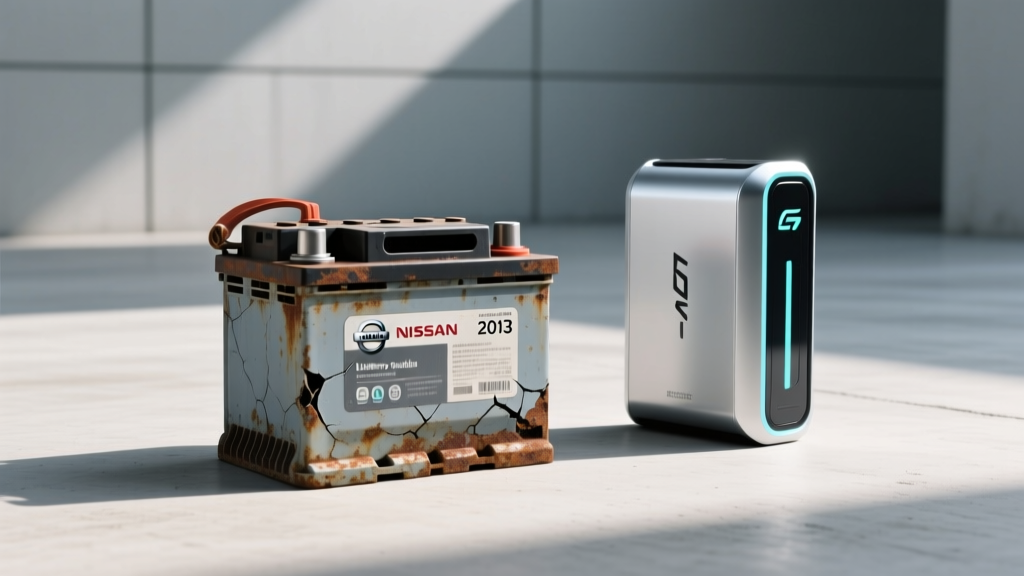
- 12V auxiliary battery: A lead-acid or lithium 12-volt cell that powers lights, infotainment, door locks, and control computers. In the 2013 Nissan Pathfinder, this is a Group 35 or Group 24F battery, typically rated around 550–650 cold cranking amps (CCA). Replacement cost: $140–$260 at an auto parts store. Lifespan: 3–5 years. Every EV, hybrid, and gas car has one.
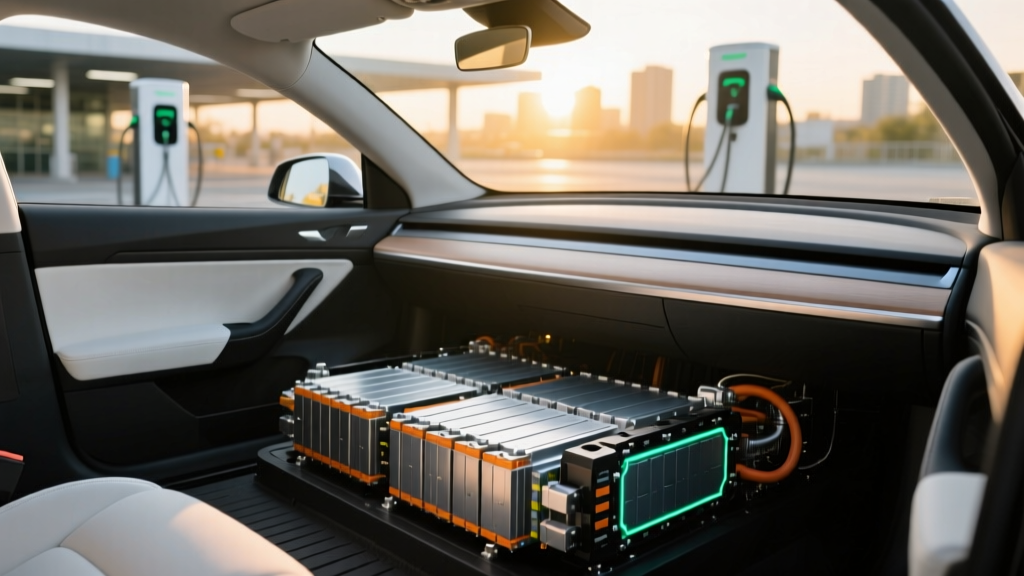
- High-voltage traction battery: The large lithium-ion pack (measured in kilowatt-hours, or kWh) that actually propels an electric vehicle. This is the battery we're focusing on in this guide — the one that stores energy, degrades over time, and carries a federal warranty.
When someone searches for a 2013 Nissan Pathfinder battery, they're looking for the 12V unit. When an EV owner worries about "battery replacement," they're talking about the traction pack. The cost, lifespan, and technology are entirely different.
EV Battery Chemistry in 2026: LFP vs. NMC vs. NCA
Modern EV traction batteries use one of two dominant lithium-ion chemistries, each with distinct trade-offs. Here's how they compare across the metrics that matter for real ownership:
| Attribute | LFP (Lithium Iron Phosphate) | NMC / NCA (Nickel Manganese Cobalt / Nickel Cobalt Aluminum) |
|---|---|---|
| Energy density | Lower (~160–180 Wh/kg cell-level) | Higher (~220–300 Wh/kg cell-level) |
| Cycle life | 3,000–5,000+ full cycles | 1,000–2,000 full cycles |
| Cold-weather performance | Weaker — greater range loss below 32°F | Better low-temp conductivity |
| Cost per kWh | Lower — no cobalt or nickel | Higher — commodity-sensitive metals |
| Thermal stability | Excellent — very low thermal runaway risk | Good — requires more active thermal management |
| Charging to 100% | Recommended periodically for BMS calibration | 80% daily recommended; 100% for trips only |
| Common in (2026) | Tesla Model 3/Y Standard Range, Ford Mustang Mach-E Select, Rivian Standard, BYD models | Hyundai Ioniq 5/6 Long Range, BMW i4/iX, Lucid Air, most long-range trims |
The practical takeaway: LFP is the better choice if you prioritize longevity, lower cost, and plan to keep the vehicle 8–10+ years. NMC/NCA wins if you need maximum range per charge and live in a cold climate where every mile of range matters. Neither chemistry is universally "better" — it depends on your driving pattern, climate, and ownership timeline.
How Long Do EV Batteries Actually Last? Degradation Data
The most persistent EV myth is that batteries "die" like phone batteries after a few years. Real-world fleet data tells a different story. EV batteries don't fail catastrophically — they gradually lose capacity, reducing range over time.
Typical lithium-ion EV battery degradation curve (aggregated fleet data):
- Year 1 / 15,000 miles: ~2–4% capacity loss (initial formation loss)
- Year 3 / 45,000 miles: ~6–8% total loss
- Year 5 / 75,000 miles: ~8–12% total loss
- Year 8 / 120,000 miles: ~10–15% total loss
- Year 10 / 150,000 miles: ~12–20% total loss (chemistry and usage dependent)
Sources: Recurrent Auto fleet data (2025 report), Geotab longitudinal EV battery study, manufacturer warranty thresholds.
A few critical nuances:
- LFP batteries degrade more slowly and linearly. Tesla's Standard Range fleet data shows LFP packs retaining roughly 92–95% capacity at 100,000 miles.
- NMC batteries tend to lose more in the first year (formation degradation) then flatten out. Hyundai/Kia's E-GMP platform packs have shown strong retention, with many Ioniq 5 owners reporting 90%+ State of Health at 60,000 miles.
- Early Nissan Leaf (2011–2017) packs with passive air cooling degraded significantly faster — some losing 20–30% in 5 years in hot climates. This is the historical experience that still colors public perception, but modern liquid-cooled packs have largely solved this.
- For comparison: A 2013 Nissan Pathfinder's original lead-acid battery likely needed replacement by year 3 or 4, and its engine and transmission face far more expensive failure modes past 150,000 miles. The EV traction battery is arguably the most durable component in the vehicle.
What Does the Battery Warranty Actually Cover?
Federal law mandates that EV battery warranties cover at least 8 years / 100,000 miles (10 years / 150,000 miles in California Air Resources Board states). But the details matter — specifically the capacity retention threshold that triggers a warranty claim.
| Manufacturer (2026 models) | Warranty Period | Capacity Threshold | Notes |
|---|---|---|---|
| Tesla (Model 3/Y LFP) | 8 yr / 120,000 mi | 70% retention | Long Range (NMC): 8 yr / 120,000 mi, 70% |
| Hyundai / Kia (E-GMP) | 10 yr / 100,000 mi | 70% retention | Among the longest coverage periods |
| Ford (Mach-E, F-150 Lightning) | 8 yr / 100,000 mi | 70% retention | Covers battery and electric drive components |
| GM (Ultium platform) | 8 yr / 100,000 mi | 70% retention | Some commercial: 8 yr / 100,000 mi |
| Rivian | 8 yr / 175,000 mi | 70% retention | Highest mileage threshold in the segment |
| BMW | 8 yr / 100,000 mi | 70% retention | Module-level replacement where possible |
What triggers a claim: If your battery's State of Health (SoH) drops below the threshold (typically 70%) within the warranty window, the manufacturer must repair or replace it — often swapping individual modules rather than the entire pack. This is not a hypothetical benefit; owners of early Chevy Bolts received full pack replacements under warranty when cells were found to have manufacturing defects.
What's NOT covered: Damage from accidents, flooding, or improper modifications. Gradual capacity loss above the threshold is considered normal wear, not a defect. See fueleconomy.gov for the EPA's overview of EV battery technology and warranty requirements.
EV Battery Replacement Cost: What Owners Actually Pay
Out-of-warranty traction battery replacement is the single biggest fear for prospective EV buyers. Here are real-world cost ranges based on 2025–2026 service data and manufacturer parts pricing:
| Vehicle / Pack Size | Battery Capacity | Estimated Replacement Cost (Parts + Labor) | Typical Replacement Timeline |
|---|---|---|---|
| Tesla Model 3 Standard Range (LFP) | ~60 kWh | $12,000–$16,000 | Rarely needed before 200,000+ mi |
| Hyundai Ioniq 5 Long Range | 77.4 kWh | $14,000–$20,000 | Module-level repair: $2,000–$5,000 per module |
| Ford F-150 Lightning Extended Range | ~131 kWh | $20,000–$30,000 | Largest packs carry the highest cost |
| Chevy Bolt EV | 65 kWh | $14,000–$16,000 | Post-recall packs showing strong longevity |
| Nissan Leaf (40 kWh pack) | 40 kWh | $6,500–$9,000 | Older design; third-party swap options available |
Context that matters: The vast majority of EV batteries never need full replacement during typical ownership. Data from Recurrent Auto shows that fewer than 5% of EV batteries have been replaced outside of recalls, and most packs outlast the vehicle's economic life. A 2013 Nissan Pathfinder, by comparison, faces $3,000–$6,000 in transmission service or replacement past 120,000 miles — a failure mode that's far more common than EV battery failure.
When replacements are needed, manufacturers increasingly perform module-level repairs rather than full-pack swaps. An NMC pack with 12 modules might need only one or two replaced, bringing costs down to $2,000–$5,000 instead of the full-pack figure.
Factors That Accelerate (or Slow) Battery Degradation
Battery longevity isn't random — it's driven by measurable habits and environmental conditions. Here's what the data shows:
What hurts battery health
- Frequent DC fast charging above 150 kW: Occasional fast charging is fine, but daily reliance on high-power DC charging (especially without preconditioning) accelerates degradation by roughly 1–2% per year compared to Level 2 home charging.
- Sustained high State of Charge: Leaving an NMC battery at 100% for days or weeks stresses the cathode. LFP is more tolerant of 100% SoC, which is why Tesla recommends periodic full charges for LFP packs.
- Extreme heat exposure: Ambient temperatures above 95°F combined with high SoC accelerate chemical degradation. This is why liquid-cooled packs (standard in 2026 on nearly all EVs) dramatically outperform the passively cooled early Nissan Leaf.
- Deep discharges to 0%: Letting the battery sit at or near empty for extended periods can cause copper dissolution in the anode, permanently reducing capacity.
What preserves battery health
- Level 2 home charging at 7–11 kW: Slower charging generates less heat and stress on cells.
- 20–80% SoC range for daily use (NMC): This "middle window" minimizes cathode and anode stress.
- Preconditioning before fast charging: Warming the battery to optimal temperature (typically 77–95°F) before a DC fast charge reduces lithium plating risk.
- Moderate climates or garage parking: Avoiding sustained extreme temperatures extends cycle life significantly.
EV Battery Care Checklist
- ☐ Set daily charge limit to 80% (NMC) or follow manufacturer guidance (LFP)
- ☐ Use Level 2 home charging for daily needs; reserve DC fast charging for road trips
- ☐ Enable battery preconditioning when navigating to a fast charger
- ☐ Avoid leaving the vehicle at 100% SoC for more than 24 hours
- ☐ Don't let the battery sit below 10% SoC for extended periods
- ☐ Park in shade or a garage during extreme heat; use a block heater or garage in extreme cold
- ☐ Check tire pressure monthly — underinflated tires increase energy consumption and heat generation
How to Check and Monitor Battery Health (State of Health)
State of Health (SoH) is the percentage of original capacity your battery retains. A new EV has 100% SoH; a pack that held 77.4 kWh when new but now holds 69 kWh is at ~89% SoH. Here's how to check it:
In-vehicle methods
- Tesla: The Service menu (accessible via the touchscreen) shows battery health percentage. Third-party apps like TeslaFi or Tessie log SoH over time from the vehicle's API.
- Hyundai/Kia: The infotainment system's EV diagnostics page shows battery condition. Dealership OBD-II scans provide exact SoH figures.
- Ford: The FordPass app and in-vehicle diagnostics provide battery health indicators; dealerships can pull detailed SoH data.
- Universal: Any dealership service department can read SoH via the OBD-II port using manufacturer-specific diagnostic tools. Request this during routine service visits.
Third-party tools
- OBD-II dongles + apps: Devices like the OBDLink SX paired with apps such as LeafSpy (Nissan), ABRP (generic), or Car Scanner can read battery SoH, cell voltage variance, and pack temperature.
- Recurrent Auto: A free service that connects to your EV's telematics and provides personalized battery health reports benchmarked against similar vehicles in the fleet.
When buying used: Always request a battery health report from the seller or have a dealership perform an SoH scan. A 3-year-old EV at 94% SoH is in excellent shape; one at 82% SoH warrants investigation into charging habits and warranty status.
Looking Ahead: Solid-State and Silicon Anode Batteries
Next-generation battery technologies are frequently hyped, so here's a realistic, data-grounded timeline:
- Silicon anode batteries: Companies like Sila Nanotechnologies and Group14 are shipping silicon-dominant anode materials to manufacturers now. Expect first production EVs with silicon anodes (offering ~15–20% energy density improvement) in 2027–2028 models. These are incremental, not revolutionary — they improve existing lithium-ion cells rather than replacing them.
- Solid-state batteries: Toyota has announced a 2027–2028 production timeline for solid-state EVs with ~750 km (466 mi) range and 10-minute fast charging. Samsung SDI targets 2027 production. QuantumScape is shipping prototype cells to automotive partners. Realistically, solid-state EVs will appear in limited, premium models starting around 2028–2029, with broad availability not expected until the early 2030s. Cost remains the primary barrier.
- Sodium-ion batteries: CATL and BYD are producing sodium-ion cells for lower-cost, shorter-range EVs (primarily in China). These offer lower energy density but dramatically lower material costs and better cold-weather performance. Possible in US-market budget EVs by 2028–2029.
The practical implication: If you're buying an EV in 2026, current lithium-ion technology (LFP or NMC) is mature, well-warrantied, and proven to last 150,000+ miles with modest degradation. Waiting for solid-state means waiting 3–5+ years for limited availability at premium prices. Today's batteries are not a compromise — they're a known quantity with strong data backing their longevity.
The 2013 Pathfinder Comparison: What Gas Car Owners Actually Spend on "Batteries"
To bring this full circle: a 2013 Nissan Pathfinder owner will replace the 12V battery roughly every 4 years ($180 each time), spend $200–$400 on alternator-related issues over the vehicle's life, and face a transmission service ($250–$400) or rebuild ($3,000–$5,000) past 120,000 miles. The internal combustion engine itself carries risks of head gasket, timing chain, and oil consumption issues that have no analog in an electric powertrain.
An EV owner replaces the 12V auxiliary battery on a similar schedule (~$150–$300 for a lithium 12V replacement in most 2026 EVs). The traction battery, the component people worry about most, is warrantied for 8–10 years and fleet data shows it lasting well beyond that with 10–20% degradation. The electric motor has far fewer moving parts than a gas engine and rarely requires service.
The honest math: EV battery replacement is a low-probability, high-cost event that most owners will never face. Gas powertrain repairs are a high-probability, moderate-to-high-cost event that most owners will face. Both are real costs — but the risk profile is different than public perception suggests.
How long do EV batteries last in years and miles?
Modern liquid-cooled EV batteries (2020+) typically last 150,000–200,000+ miles with 10–20% capacity loss. In years, that translates to 12–15 years of average driving (12,000–15,000 miles/year). LFP chemistry packs are showing even longer cycle life, with some fleet data suggesting 200,000+ miles at 85%+ SoH.
How much does an EV battery cost to replace?
Full pack replacement ranges from $6,500 (smaller packs like the Nissan Leaf) to $30,000 (large packs like the F-150 Lightning Extended Range). Most common mid-size EVs fall in the $12,000–$20,000 range. However, module-level repairs cost $2,000–$5,000, and fewer than 5% of EV batteries have required replacement outside of recalls.
What does the EV battery warranty cover?
Federal law requires at least 8 years / 100,000 miles of battery coverage (10 years / 150,000 miles in CARB states). The warranty guarantees the battery will retain at least 70% of its original capacity. If SoH drops below that threshold within the warranty period, the manufacturer repairs or replaces the battery at no cost to the owner.
How do I check my EV battery's State of Health?
Most EVs show battery health in the infotainment diagnostics menu or via the manufacturer's mobile app. Dealerships can read exact SoH via OBD-II. Third-party services like Recurrent Auto provide ongoing health monitoring. For used EV purchases, always request a battery health report before buying.
LFP vs NMC — which battery chemistry is better?
LFP offers longer cycle life (3,000–5,000 cycles vs 1,000–2,000), lower cost, better thermal stability, and tolerance for 100% charging. NMC offers higher energy density (more range per pound), better cold-weather performance, and faster charging in some implementations. Choose LFP for longevity and value; choose NMC for maximum range and cold-climate driving. Neither is objectively superior — they serve different priorities.
Is it safe to fast-charge my EV regularly?
Occasional DC fast charging is fine and won't meaningfully impact battery life. Daily fast charging, especially at 150+ kW without preconditioning, can add 1–2% extra annual degradation compared to Level 2 charging. For daily use, a home Level 2 charger at 7–11 kW is the optimal approach. Reserve fast charging for road trips.
Will solid-state batteries make current EVs obsolete?
Not in the near term. Solid-state batteries are expected in limited premium models starting around 2028–2029, with broad availability in the early 2030s. Current lithium-ion batteries are mature, well-warrantied, and proven to last the life of the vehicle. The transition will be gradual, and today's EVs will remain practical and supported for many years.