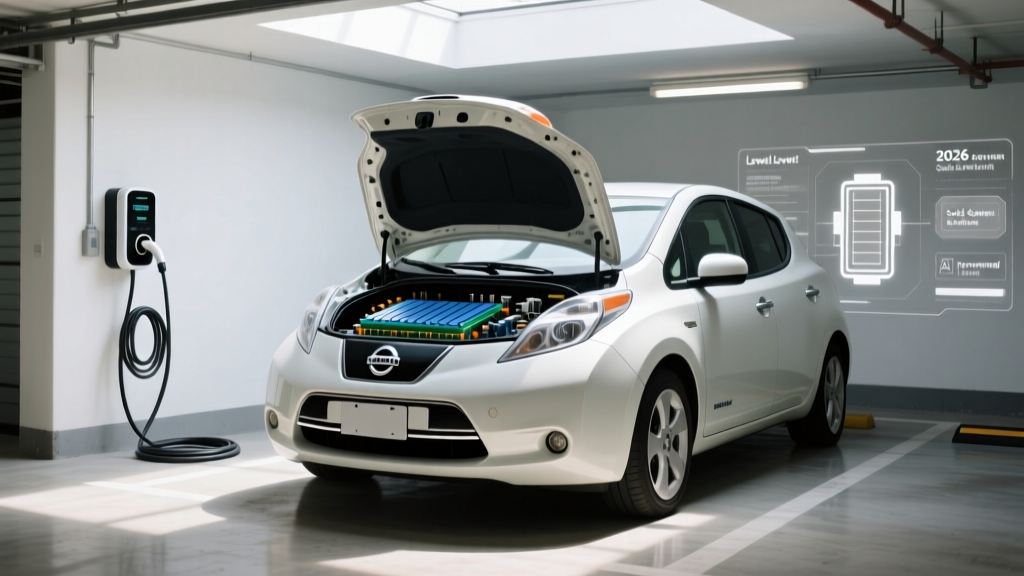
The 2013 Nissan Leaf was one of the first mass-market EVs, and by 2026, most original 24 kWh lithium-manganese-oxide (LMO) packs have lost significant capacity. If you own a 2013 Leaf and are noticing range drop-off, a battery replacement is likely your best path to restoring usability. This guide covers exact costs, available battery options, degradation data, and how to evaluate whether replacement makes financial sense for a vehicle now over a decade old.
Why 2013 Leaf Owners Are Replacing Batteries Now
The 2013 Nissan Leaf shipped with a 24 kWh (usable ~21.3 kWh) LMO battery pack rated for 75 miles of EPA range when new. Unlike modern NMC or LFP chemistries, Nissan's early LMO cells had no active thermal management — they relied on passive air cooling. This design choice, combined with over a decade of charge cycles, heat exposure, and DC fast charging, has pushed many original packs to 60–70% State of Health (SoH) by 2026.
At 65% SoH, a 2013 Leaf delivers roughly 45–50 miles of real-world range — a far cry from its original 75. For owners who depend on the car for daily commuting, a battery swap is the difference between keeping a perfectly functional vehicle and scrapping it.
Battery Chemistry 101: What Was in the 2013 Leaf vs. Modern Packs
Understanding battery chemistry is essential when evaluating replacement options. The 2013 Leaf used LMO (lithium manganese oxide), which differs substantially from today's dominant chemistries. Here's how the three main EV battery types compare:
| Attribute | LMO (2013 Leaf) | NMC/NCA (Modern EVs) | LFP (Tesla Model 3 RWD, etc.) |
|---|---|---|---|
| Energy Density | Low (~100 Wh/kg) | High (~250 Wh/kg) | Medium (~160 Wh/kg) |
| Cycle Life | ~500–800 cycles | ~1,000–2,000 cycles | ~3,000–5,000 cycles |
| Thermal Stability | Moderate | Good (with active cooling) | Excellent |
| Cold Performance | Poor (no thermal mgmt) | Good (heat pump equipped) | Moderate |
| Cost per kWh | N/A (legacy) | ~$110–130/kWh (pack-level) | ~$80–100/kWh (pack-level) |
| Degradation (10 yr) | 25–40% loss typical | 10–15% loss typical | 8–12% loss typical |
LFP vs NMC — which is better and why? It depends on the use case. LFP (lithium iron phosphate) wins on longevity, safety, and cost — ideal for standard-range vehicles charged daily to 100%. NMC (nickel manganese cobalt) and NCA (nickel cobalt aluminum) win on energy density — critical for long-range vehicles where packing maximum kWh into limited space matters. For a 2013 Leaf replacement, you're limited to Nissan-compatible packs, which remain LMO or upgraded NMC modules from later-model Leafs.
2013 Nissan Leaf Battery Replacement Cost in 2026
Replacement costs vary significantly depending on whether you choose a refurbished original pack, a newer 30 kWh pack from a 2016–2017 Leaf, or a 40 kWh pack from a 2018+ Leaf (which requires adapter hardware and software pairing). Here's what owners are paying in 2026:
| Option | Battery Cost | Labor | Total Range | Expected Range |
|---|---|---|---|---|
| Refurbished 24 kWh (OEM LMO) | $3,500–$5,000 | $1,000–$1,500 | $4,500–$6,500 | 65–75 mi (restored) |
| Used 30 kWh (2016–17 Leaf) | $4,500–$6,500 | $1,200–$1,800 | $5,700–$8,300 | 85–107 mi |
| Used 40 kWh (2018+ Leaf, w/ adapter) | $5,500–$7,500 | $1,500–$2,500 | $7,000–$10,000 | 120–150 mi |
| Nissan dealer new 24 kWh | $6,500–$8,500 | $1,500–$2,000 | $8,000–$10,500 | 75 mi (like new) |
Is it worth it? A 2013 Leaf in good condition (no rust, clean interior, solid suspension) has a private-party market value of roughly $4,000–$7,000 in 2026. Spending $6,000+ on a 40 kWh upgrade only makes sense if you plan to keep the car for several more years and need the range. For many owners, the refurbished 24 kWh option at $4,500–$6,500 is the sweet spot — it restores original usability without exceeding the car's value.
How Long Do EV Batteries Last? Degradation Data
EV battery longevity depends on chemistry, thermal management, and usage patterns. Based on fleet data and owner reports compiled by sources including Recurrent Auto and the U.S. Department of Energy, here's what real-world degradation looks like:
- 2013–2015 Nissan Leaf (24 kWh, LMO, passive cooling): 25–40% capacity loss over 10–12 years; average SoH ~65% by year 12 in hot climates
- 2018+ Nissan Leaf (40/62 kWh, NMC, passive cooling): 10–18% loss over 5–7 years; better cell chemistry offsets lack of active cooling
- Tesla Model 3/Y (NMC/NCA, active liquid cooling): ~10% loss at 150,000 miles per Tesla's 2023 Impact Report; fleet data shows <15% at 200,000 miles
- Chevrolet Bolt EV (60 kWh, NMC, active cooling): ~8–12% loss over 6 years; recall-replacement packs performing well
- LFP-equipped vehicles (Tesla Model 3 RWD, BYD): ~5–10% loss over 5+ years; early data highly promising for 15+ year lifespan
The general consensus: modern liquid-cooled EV batteries (NMC/NCA and LFP) are lasting 200,000+ miles with 80%+ capacity retention. The 2013 Leaf is an outlier because of its passively-cooled LMO chemistry — a design Nissan abandoned in subsequent generations.
What Does the Nissan Leaf Battery Warranty Cover?
For the 2013 model year, Nissan provided two battery warranties. By 2026, both have expired for all 2013 Leaf vehicles, but understanding the original terms helps contextualize Nissan's expectations:
| Coverage Type | Duration | Threshold | Status in 2026 |
|---|---|---|---|
| Lithium-Ion Battery Capacity Coverage | 5 years / 60,000 miles | Below 9 of 12 capacity bars (~70% SoH) | Expired |
| EV System Coverage (defects) | 8 years / 100,000 miles | Component failure / manufacturing defect | Expired |
For context, current federal regulations (per EPA guidance) and California Air Resources Board (CARB) rules require EV battery warranties of at least 10 years / 150,000 miles in states following CARB standards. Most 2026 EV models carry 8-year/100,000-mile warranties with a 70% capacity retention threshold — meaning the manufacturer must replace or repair the battery if it degrades below 70% of original capacity within that window.
How to Check Your 2013 Leaf's Battery Health (SoH)
Before committing to a replacement, verify your current battery's State of Health using these methods:
- Dashboard Capacity Bars: The 2013 Leaf displays 12 capacity bars on the instrument cluster. A new battery shows all 12 bars. Count the bars visible — 9 bars ≈ 70% SoH; 8 bars ≈ 62% SoH; 7 bars ≈ 55% SoH. This is a rough estimate, not a precise measurement.
- LeafSpy Pro (OBD-II App): The gold standard for Leaf owners. Plug a compatible OBD-II Bluetooth adapter (~$25) into the port under the dash, pair with the LeafSpy Pro app (~$20), and read exact SoH percentage, individual cell voltages, battery temperature, and cycle count. This is what most independent EV shops use.
- Nissan Dealer Diagnostic: A dealer can run a full battery health report via Nissan Consult-III software. Expect a $100–$150 diagnostic fee. Request a printout showing SoH %, cell voltage spread, and any fault codes.
Key metric to watch: Cell voltage spread. If any individual cell group reads more than 200 mV different from the pack average under load, the pack has weak modules that will accelerate degradation. LeafSpy makes this easy to spot.
Factors That Accelerate (or Slow) Battery Degradation
Not all 2013 Leafs degraded equally. Owners in Phoenix saw far worse capacity loss than those in Seattle. Here's what drives the divergence:
- ☐ Avoid frequent DC fast charging: CHAdeMO sessions generate significant heat in a passively-cooled pack. Owners who DC fast-charged daily saw 2–3x faster degradation than Level 2-only chargers.
- ☐ Minimize high SoC storage: Parking at 100% charge for days (especially in heat) stresses LMO cells. Target 80% for daily use; charge to 100% only before longer trips.
- ☐ Avoid extreme heat exposure: Battery temperature above 104°F (40°C) accelerates chemical degradation. Garage parking in hot climates measurably extends pack life.
- ☐ Don't store at very low SoC: Letting the pack sit below 10% for extended periods risks cell imbalance and copper dissolution in the anode.
- ☐ Use Level 2 (240V) for daily charging: A 3.3 kW or 6.6 kW Level 2 charge generates far less heat than a 50 kW CHAdeMO session. This is the single most impactful habit for passive-cooled packs.
- ☐ Precondition while plugged in: Using the Leaf's timer-based climate preconditioning while connected to shore power avoids drawing from the battery and reduces thermal stress.
Emerging Battery Tech: What's on the Horizon
While not relevant to a 2013 Leaf replacement today, the broader EV battery landscape is shifting rapidly:
- Solid-state batteries: Toyota, Nissan, and Samsung SDI have announced solid-state prototypes promising 2x energy density and faster charging. Nissan has targeted 2028–2029 for pilot production, but mass-market availability remains unconfirmed. These will not be retrofittable to a 2013 Leaf.
- Silicon anode cells: Companies like Sila Nanotechnologies and Group14 are commercializing silicon-dominant anodes that boost energy density 20–40% over graphite. Appearing in select 2025–2026 models (e.g., Mercedes G-Class 580e), this tech will trickle into mainstream packs by 2028–2030.
- Sodium-ion batteries: CATL and BYD are producing sodium-ion cells for budget EVs in China. Lower energy density but dramatically lower cost and no lithium/cobalt dependency. Possible in US-market budget EVs by 2027–2028.
These technologies are forward-looking and will benefit new EV buyers — not legacy Leaf owners seeking replacements. For the 2013 Leaf, the practical options remain OEM-compatible LMO or NMC packs from the existing Nissan ecosystem.
Frequently Asked Questions
How long do EV batteries last in years and miles?
Modern liquid-cooled EV batteries (NMC, NCA, LFP) typically last 15–20 years or 200,000+ miles before dropping below 80% capacity. Passively-cooled packs like the 2013 Leaf's LMO battery degrade faster — typically reaching 65–75% SoH at 10–12 years. The vehicle itself often reaches end-of-life before a well-managed modern battery does.
How much does an EV battery cost to replace?
Replacement costs range from $4,500 to $20,000+ depending on the vehicle and pack size. For the 2013 Nissan Leaf specifically, expect $4,500–$6,500 for a refurbished 24 kWh pack or $7,000–$10,000 for a 40 kWh upgrade. Larger modern packs (e.g., 82 kWh Tesla Model 3, 77 kWh Hyundai Ioniq 5) run $12,000–$18,000 at dealer pricing. Independent shops and refurbished packs can cut costs 30–50%.
What does a typical EV battery warranty cover?
Current industry standard (2026 model year) is 8 years / 100,000 miles with a 70% capacity retention guarantee. If the battery falls below 70% of original capacity within that window, the manufacturer must repair or replace it at no cost. In CARB states (California and adopting states), the requirement extends to 10 years / 150,000 miles. The 2013 Leaf's original 5-year/60,000-mile capacity warranty and 8-year/100,000-mile defect warranty have both expired.
How do I maximize my EV battery's health and lifespan?
The highest-impact practices are: (1) charge primarily on Level 2, not DC fast chargers; (2) keep daily State of Charge between 20–80% (except LFP, which tolerates 100% daily); (3) avoid parking at full charge in extreme heat; (4) use preconditioning while plugged in; and (5) monitor SoH periodically with a tool like LeafSpy (Nissan) or the vehicle's built-in battery health screen (Tesla, Hyundai, BMW).
LFP vs NMC — which battery chemistry is better?
Neither is universally "better." LFP excels in cycle life (3,000–5,000 cycles vs 1,000–2,000 for NMC), thermal safety, and cost — making it ideal for standard-range daily drivers. NMC excels in energy density (~250 Wh/kg vs ~160 Wh/kg for LFP), enabling 300+ mile ranges in compact packages. If you prioritize longevity and don't need maximum range, LFP is the stronger choice. If you need 300+ miles per charge, NMC remains necessary. For 2026, most automakers use LFP for base trims and NMC for long-range trims.
Can I upgrade my 2013 Leaf to a larger battery?
Yes, with caveats. Independent EV shops can install a 30 kWh pack (from a 2016–2017 Leaf) or a 40 kWh pack (from a 2018+ Leaf) into a 2013 chassis. The 40 kWh swap requires adapter brackets, a compatible BMS (battery management system), and software pairing — adding $1,500–$2,500 to labor costs. The result is 120–150 miles of range, transforming the car's usability. However, this investment may exceed the vehicle's residual value, so weigh it against your ownership timeline.
Sources: fueleconomy.gov (2013 Leaf EPA data), Recurrent Auto battery degradation research, Nissan Owner's Manuals.