If you own or are considering buying a used first-generation Nissan Leaf, the high-voltage traction battery is the single most important component to evaluate. The 2013 Nissan Leaf battery — a 24 kWh lithium-ion pack using lithium manganese oxide (LMO) chemistry — was one of the first mass-market EV battery systems deployed at scale. More than a decade later, real-world data from thousands of Leaf owners gives us a remarkably clear picture of how these batteries age, what replacement costs, and how to maximize remaining life.
This guide uses the 2013 Leaf as a detailed case study, then broadens into general EV battery technology — chemistry types, degradation science, warranty structures, and care strategies — so you can make an informed decision whether you're shopping for a used Leaf or evaluating any EV battery's long-term prospects.
The 2013 Nissan Leaf Battery: Specs and Design
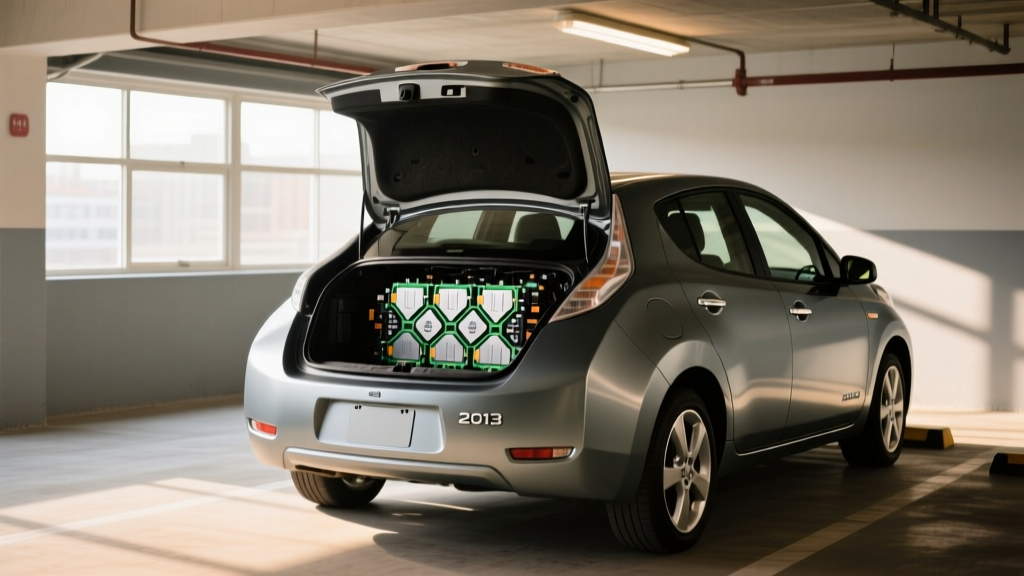
The 2013 Leaf shipped with a 24 kWh lithium-ion battery pack composed of 192 laminated cells arranged in 48 modules. Key specifications:
- Usable capacity: ~21.6 kWh (Nissan reserves a buffer at top and bottom to protect longevity)
- Chemistry: Lithium Manganese Oxide (LMO) — chosen for thermal stability and cost, but with lower energy density than modern NMC cells
- EPA range (new): 75 miles (fueleconomy.gov)
- Thermal management: Passive air cooling — no active liquid thermal management system
- Charging: 3.3 kW Level 2 (J1772); optional 6.6 kW onboard charger; 50 kW CHAdeMO DC fast charge on higher trims
The passive air-cooling design is the defining characteristic of the Leaf's battery system — and its biggest vulnerability. Unlike the liquid-cooled packs in Tesla, Chevrolet Bolt, and most modern EVs, the Leaf relies on ambient airflow to shed heat. This makes it particularly susceptible to degradation in hot climates and during repeated DC fast charging.
Real-World Degradation: What 2013 Leaf Owners Actually See
Over a decade of fleet and owner data paints a consistent picture of 2013 Nissan Leaf battery degradation:
Typical Degradation Curve (24 kWh Pack):
- Year 1–2: 5–8% capacity loss (initial formation loss)
- Year 3–5: Additional 5–10% loss (roughly 85–90% State of Health)
- Year 6–8: Gradual decline to 75–85% SoH
- Year 10–12: 65–80% SoH depending heavily on climate and usage
A 2013 Leaf at 70% SoH retains roughly 15 kWh usable — yielding approximately 45–55 miles of real-world range, down from the original 65–75 miles.
Climate matters enormously. Leafs in Phoenix or Houston commonly show 30–40% degradation by year 10, while those in Seattle or Portland often retain 75–80% capacity over the same period. Heat is the primary accelerator of lithium-ion cell degradation, and the Leaf's passive cooling provides minimal protection.
Frequent DC fast charging compounds the problem. Studies and owner logs consistently show that Leafs charged primarily via CHAdeMO DC fast charging (50 kW) degrade 5–15% faster than those charged predominantly on Level 2. The high current generates internal cell heat that the passive cooling system cannot dissipate quickly enough.
EV Battery Chemistry: LMO, NMC, NCA, and LFP Compared
The 2013 Leaf's LMO chemistry is relatively uncommon in modern EVs. Today's market has consolidated around two primary chemistries, with a third used in premium applications:
| Attribute | LMO (2013 Leaf) | NMC/NCA (Most EVs) | LFP (Tesla Model 3 RWD, base EVs) |
|---|---|---|---|
| Energy Density | Low (~100–120 Wh/kg) | High (~200–300 Wh/kg) | Low-Moderate (~140–180 Wh/kg) |
| Cycle Life | ~500–1,000 cycles | ~1,000–2,000 cycles | ~2,000–5,000+ cycles |
| Thermal Stability | Good | Moderate (needs active cooling) | Excellent |
| Cold Performance | Moderate | Good | Reduced (more range loss in cold) |
| Cost per kWh | Low | Moderate-High | Low |
| 100% SoC Charging | Tolerated | Accelerates degradation | Tolerated (recommended weekly) |
| Used In (2025–2026) | Rare / legacy | Hyundai, VW, BMW, Rivian, Ford | Tesla, BYD, Rivian base models |
LFP vs NMC — which is better? There is no universal winner. NMC offers superior energy density, meaning more range in a smaller, lighter pack — critical for long-range vehicles. LFP offers dramatically longer cycle life, better safety margins, and tolerance for daily 100% charging, making it ideal for standard-range daily drivers. For a 2026 buyer, LFP is the pragmatic choice for a commuter car, while NMC remains necessary if you need 300+ miles of range.
Battery Warranty Terms: What's Covered and for How Long
Federal law mandates that EV batteries carry a minimum warranty of 8 years/100,000 miles (10 years/150,000 miles in CARB states). However, the specific capacity retention threshold varies by manufacturer:
| Manufacturer | Warranty Period | Capacity Retention Threshold |
|---|---|---|
| Nissan Leaf (2013) | 8 years / 100,000 miles | Below 9 of 12 capacity bars (~70%) |
| Tesla (Model 3/Y) | 8 years / 100,000–120,000 miles | Below 70% retention |
| Hyundai/Kia | 10 years / 100,000 miles | Below 70% retention |
| Chevrolet (Bolt EV/EUV) | 8 years / 100,000 miles | Below 60% retention |
| Ford (Mach-E, F-150 Lightning) | 8 years / 100,000 miles | Below 70% retention |
For the 2013 Leaf specifically, the original 8-year/100,000-mile battery warranty has now expired for virtually all vehicles. Nissan used a 12-bar capacity display on the dashboard; warranty replacement was triggered when the battery dropped below 9 bars (approximately 70% capacity). If you're buying a used 2013 Leaf today, any battery replacement will be an out-of-pocket expense unless an extended warranty was purchased.
2013 Nissan Leaf Battery Replacement Cost
Battery replacement is the most expensive single repair an EV owner may face, though it's worth emphasizing that most EV batteries outlast their vehicles. For the 2013 Leaf, the market has matured enough to provide several options:
| Option | Cost Range | Notes |
|---|---|---|
| Nissan Dealer (new OEM pack) | $6,000–$8,500+ | Includes parts and labor; 24 kWh or upgraded 30/40 kWh pack if available |
| Refurbished/remanufactured pack | $3,500–$5,500 | Rebuilt with tested cells; quality varies by supplier |
| Used pack from salvage | $2,000–$4,000 | Capacity uncertain; verify SoH before purchase |
| Cell-level module replacement | $1,500–$3,000 | Replace only degraded modules; requires specialist shop |
Several aftermarket companies, including ReJoule and various independent EV shops, now offer Leaf battery diagnostics and module-level repairs. If only a few of the 48 modules are weak, targeted replacement can restore significant capacity at a fraction of a full pack swap.
Is replacement worth it? A 2013 Leaf in good condition with a fresh battery remains a capable 60–75-mile commuter car. With total vehicle values ranging from $4,000–$8,000 depending on condition, a $5,000 battery replacement may or may not be economically justified. Consider the vehicle's overall condition, your commute needs, and whether a newer used EV might offer better value.
How to Check and Monitor Battery Health
The 2013 Leaf provides a basic but useful onboard health indicator, and third-party tools offer much deeper insight:
Battery Health Monitoring Methods:
- Dashboard Capacity Bars: The far-right instrument cluster display shows 12 bars when new. Count the remaining bars — 10 bars ≈ 83% SoH; 8 bars ≈ 67% SoH.
- Leaf Spy Pro (OBD-II app): Connects via a Bluetooth OBD-II dongle ($20–$30) to read actual battery capacity in Ah, State of Health percentage, cell voltage spread, and temperature. This is the gold standard for Leaf battery diagnostics.
- Nissan Dealer Diagnostic: A dealership can run a formal battery health report, though this typically costs $100–$150 for the service visit.
- Range Tracking: Monitor your GOM (Guess-O-Meter) range readings over time at consistent SoC levels. A steady decline signals ongoing degradation.
What to look for when buying a used 2013 Leaf: Always check capacity bars before purchase. A 2013 Leaf showing 10+ bars has aged well. Below 9 bars, factor in replacement cost. Use Leaf Spy if the seller permits — it reveals cell imbalance (voltage spread >200mV between cells is a red flag) and actual Ah capacity versus the original 66.25 Ah rating.
Maximizing Battery Life: Care Strategies That Work
Whether you're nursing a 2013 Leaf or protecting a brand-new EV, these practices are grounded in lithium-ion electrochemistry:
1. Minimize DC fast charging. High-current charging generates heat and stresses cells. Use Level 2 (240V, 3.3–7.2 kW) as your primary charging method. Reserve DC fast charging for road trips.
2. Avoid extreme State of Charge. For NMC and LMO batteries, the 20–80% SoC window minimizes stress. Storing at 100% for extended periods accelerates calendar degradation. (LFP batteries are an exception — manufacturers recommend periodic 100% charges for cell balancing.)
3. Manage heat exposure. Park in shade or garages during hot weather. The 2013 Leaf's passive cooling is especially vulnerable to heat soak — a Leaf parked in a 100°F+ parking lot for hours experiences accelerated degradation even while idle.
4. Precondition in cold weather. If your EV offers battery preconditioning (most modern EVs do; the 2013 Leaf does not), use it before fast charging. Cold lithium-ion cells accept charge slowly and are damaged by high-current charging below freezing.
5. Drive moderately. Aggressive acceleration and sustained high speeds generate more battery heat than gentle driving. The Leaf's modest 80 kW motor limits this risk compared to high-performance EVs.
Looking Ahead: Solid-State and Next-Generation Batteries
The battery technology landscape is shifting, though timelines for next-generation chemistries remain long:
Solid-state batteries replace the liquid electrolyte with a solid material, promising higher energy density (~400+ Wh/kg at the cell level), faster charging, and improved safety. Toyota, Nissan, Samsung SDI, and QuantumScape are all pursuing solid-state development. Nissan has announced plans for a solid-state pilot production line by 2028, with commercial availability targeted for approximately 2028–2030. Toyota has demonstrated prototypes but has not committed to a specific production vehicle date.
Silicon-anode batteries (from companies like Sila Nanotechnologies and Group14) replace graphite anodes with silicon, increasing energy density by 20–40%. These are beginning to appear in limited production applications and are expected to scale into mainstream EVs by 2027–2029.
Sodium-ion batteries offer a low-cost alternative using abundant materials, with CATL and BYD already deploying them in Chinese-market EVs. Energy density is lower (~120–160 Wh/kg), making them suitable for city cars and budget models. US availability remains uncertain.
None of these technologies are available in production EVs sold in the US as of 2026. For buyers today, the choice remains between proven NMC and LFP chemistries — both of which have demonstrated the ability to deliver 150,000–300,000+ miles of service with proper care.
How Long Do EV Batteries Last? The Big Picture
The 2013 Nissan Leaf represents something of a worst-case scenario for EV battery longevity — a passively cooled, lower-energy-density pack in an early-generation EV. Even so, many 2013 Leafs are still on their original batteries at 100,000+ miles with 65–75% capacity remaining.
Modern EVs with liquid-cooled NMC or LFP packs are performing substantially better. Tesla's fleet data shows median degradation of approximately 12% at 200,000 miles for Model S/X vehicles. Hyundai/Kia's 800V architecture models (Ioniq 5, EV6) with advanced thermal management are tracking similarly. LFP-equipped vehicles like the Tesla Model 3 RWD are demonstrating minimal degradation even after 100,000+ miles, owing to LFP's inherently longer cycle life.
The realistic expectation for a 2025–2026 EV battery: 15–20 years or 200,000–300,000 miles before capacity drops below 70%, assuming normal use and moderate climate exposure. The 2013 Leaf's track record taught the industry critical lessons about thermal management — lessons that directly benefit today's buyers.
Frequently Asked Questions
How long does a 2013 Nissan Leaf battery last?
Most 2013 Leaf batteries last 10–15 years before dropping below 70% capacity, depending heavily on climate and charging habits. Hot-climate vehicles with frequent DC fast charging may reach this threshold at 8–10 years; mild-climate vehicles with Level 2 charging often exceed 12 years with usable capacity.
How much does it cost to replace a 2013 Nissan Leaf battery?
A full battery replacement ranges from approximately $3,500 (refurbished pack) to $8,500+ (new OEM pack at a Nissan dealer). Module-level repairs can cost $1,500–$3,000 if only specific cell groups are degraded.
Is the 2013 Leaf battery still under warranty?
No. The original 8-year/100,000-mile battery warranty expired no later than 2021 for all 2013 model-year vehicles. Any battery repair or replacement is now an owner expense.
Can I upgrade a 2013 Leaf to a larger battery?
Yes, with caveats. Nissan offered a 30 kWh pack upgrade in some markets, and aftermarket specialists have installed 40 kWh and even 62 kWh packs from later Leaf models. These upgrades require compatible hardware and software and typically cost $5,000–$9,000 installed.
What causes the most battery degradation in the Leaf?
Heat is the primary factor — the passive cooling system cannot protect cells from high ambient temperatures or heat generated during DC fast charging. The combination of hot climate plus frequent fast charging produces the worst degradation outcomes.
LFP vs NMC — which battery chemistry should I choose?
Choose LFP if you want maximum longevity, lower cost, and can accept somewhat less range for a given pack size. Choose NMC if you need maximum range in a given vehicle platform. For most daily commuters, LFP's cycle-life advantage (2,000–5,000+ cycles vs. 1,000–2,000 for NMC) makes it the more durable choice.
How do I check my Leaf's battery health without going to a dealer?
Purchase an OBD-II Bluetooth dongle and install the Leaf Spy Pro app ($20 for hardware, ~$10 for the app). This gives you real-time State of Health percentage, cell voltage readings, battery temperature, and Ah capacity — far more detailed than the dashboard bar display.