If you've searched for a 2013 Malibu battery, you're likely dealing with one of two things: a dead 12-volt starter battery on Chevrolet's midsize sedan, or you're cross-shopping an older gas car against a modern electric vehicle and wondering how maintenance stacks up. The gap between a $200 lead-acid battery swap and a $10,000+ EV traction battery replacement is enormous — but so is the difference in what those batteries actually do and how long they last.
This guide breaks down exactly how modern EV high-voltage traction batteries work, what they cost, and how they compare to the simple 12V battery in a 2013 Chevrolet Malibu. We'll cover chemistry trade-offs, real degradation data, warranty coverage, and the habits that extend (or shorten) battery life.
2013 Malibu Battery vs. EV Traction Battery: Two Completely Different Systems
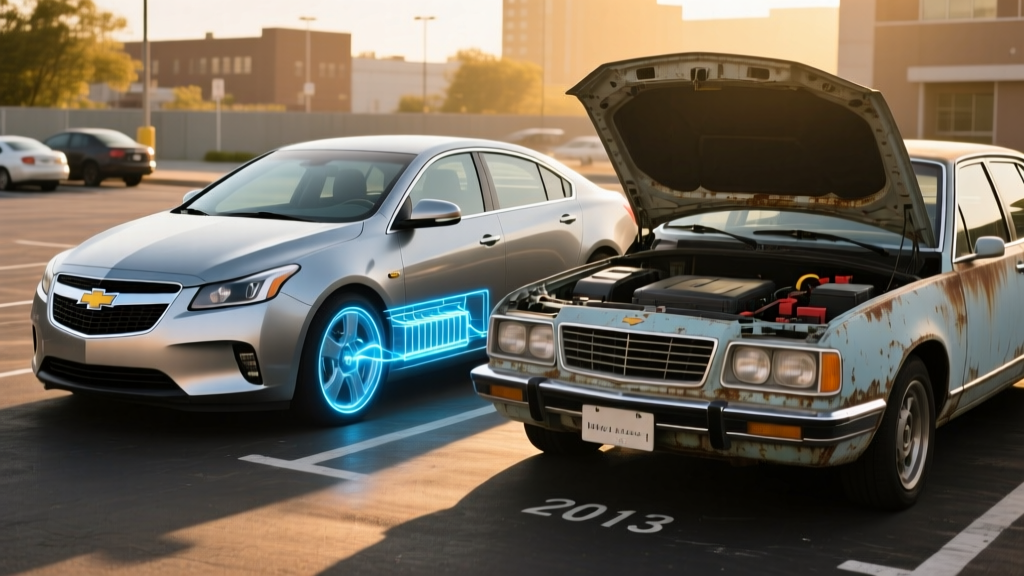
The 2013 Chevrolet Malibu uses a conventional 12-volt lead-acid (or AGM) battery. Its sole job is to crank the internal-combustion engine and run low-voltage accessories when the alternator isn't spinning. It stores roughly 0.5–0.7 kWh of usable energy, weighs about 35–45 pounds, and costs between $150 and $280 at an auto parts store. Typical lifespan: 3–5 years before sulfation or plate degradation kills it.
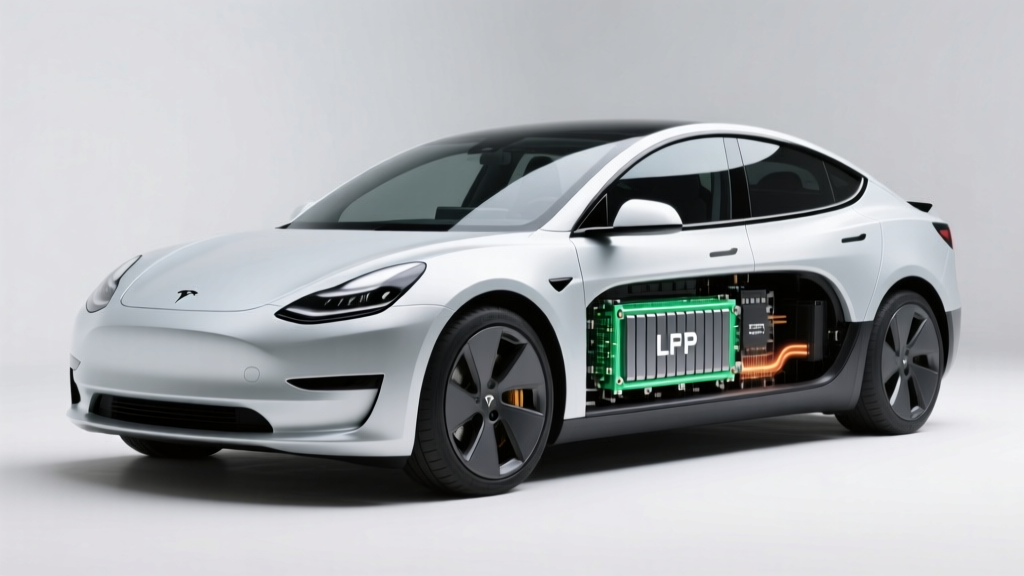
An EV traction battery, by contrast, is the vehicle's primary energy source — the equivalent of both the gas tank and the engine's fuel delivery system. A 2026 Tesla Model Y Long Range carries an ~75 kWh usable NMC (nickel manganese cobalt) pack weighing roughly 1,000 pounds. A base-model BYD Dolphin or Tesla Model 3 RWD might use a 60 kWh LFP (lithium iron phosphate) pack. These batteries are engineered for 1,500–3,000+ full charge cycles and are expected to outlast the vehicle itself in most cases.
| Attribute | 2013 Malibu 12V Battery | Typical 2026 EV Traction Battery |
|---|---|---|
| Voltage | 12V | 350–800V |
| Usable Energy | ~0.5–0.7 kWh | 50–100+ kWh |
| Chemistry | Lead-Acid / AGM | LFP or NMC/NCA |
| Weight | 35–45 lbs | 700–1,200 lbs |
| Typical Lifespan | 3–5 years | 15–20+ years / 150,000–300,000 mi |
| Replacement Cost | $150–$280 | $5,000–$20,000+ |
| Warranty | 1–3 years (pro-rated) | 8 yr / 100,000 mi (federal minimum) |
Key distinction: EVs also carry a separate 12V auxiliary battery (or increasingly, a DC-DC converter that eliminates it, as Tesla did starting in 2022). That 12V system powers lights, infotainment, and ECU logic — just like in the Malibu. When people talk about "EV battery replacement," they mean the high-voltage traction pack, not the small 12V unit.
Battery Chemistry Explained: LFP vs. NMC/NCA Trade-Offs
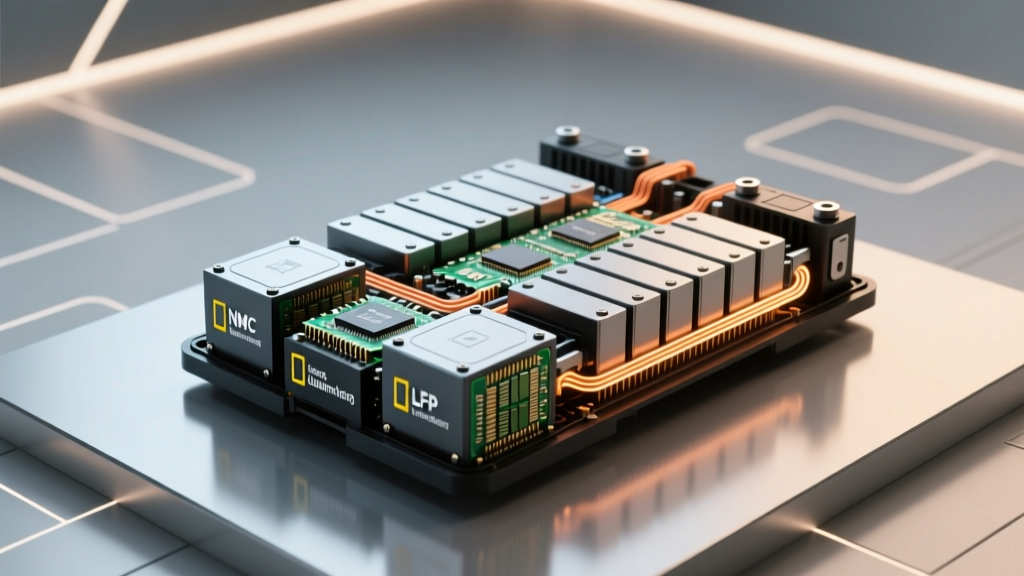
Not all lithium-ion EV batteries are the same. The two dominant chemistries in 2026 are LFP (lithium iron phosphate) and NMC/NCA (nickel manganese cobalt / nickel cobalt aluminum). Your choice of vehicle often dictates which chemistry you get, and each has distinct strengths.
| Factor | LFP (Lithium Iron Phosphate) | NMC / NCA (Nickel-Based) |
|---|---|---|
| Energy Density | Lower (~160 Wh/kg cell-level) | Higher (~250–300 Wh/kg cell-level) |
| Cycle Life | 3,000–5,000+ cycles | 1,000–2,000 cycles |
| Cold-Weather Performance | Weaker — more range loss below 32°F | Better low-temp discharge & charge acceptance |
| Cost | Lower — no cobalt or nickel | Higher — commodity-sensitive materials |
| Thermal Stability | Excellent — very resistant to thermal runaway | Good but requires more active thermal management |
| State of Charge Estimation | Harder — flat voltage curve makes SoC guessing less precise | Easier — sloping voltage curve |
| Typical Vehicles (2026) | Tesla Model 3 RWD, Model Y RWD, BYD models, Ford Mustang Mach-E Select | Tesla LR/Performance, Hyundai Ioniq 5/6 LR, Rivian, Lucid, BMW iX |
| Recommended Daily Charge Limit | 100% (manufacturers encourage it) | 80% for daily; 100% only before trips |
Which is better? It depends on your use case. If you commute short distances, charge at home nightly, live in a mild climate, and want the longest possible cycle life, LFP is the pragmatic pick — it's cheaper and more durable. If you need maximum range per charge, regularly drive in cold weather, or want the fastest DC fast-charging speeds, NMC delivers. Neither is universally superior; they're engineering trade-offs.
How Long Do EV Batteries Actually Last? Real Degradation Data
The fear that EV batteries die at 100,000 miles is a relic of early-2010s Nissan Leaf ownership (which used passive air cooling and NMC cells that degraded quickly in hot climates). Modern liquid-cooled packs tell a very different story.
Typical degradation curves based on fleet data (2020–2026 model years):
- Year 1 / 15,000 mi: ~2–4% capacity loss (initial formation loss)
- Year 3 / 45,000 mi: ~5–8% total loss
- Year 5 / 75,000 mi: ~7–10% total loss
- Year 8 / 100,000–120,000 mi: ~10–15% total loss
- Year 12+ / 150,000+ mi: ~15–20% total loss (varies heavily by climate and charging habits)
Sources: Geotab fleet battery health study, Recurrent Auto battery data reports, and manufacturer warranty filings.
To translate: a 2026 Hyundai Ioniq 5 Long Range with an EPA-estimated 305 miles of range would realistically show ~270–280 miles at 75,000 miles and ~255–270 miles at 120,000 miles — still highly functional. Most EV batteries will retain 70–80% capacity at 200,000 miles, which is why full replacements are rare before the vehicle is retired for other reasons.
For comparison, your 2013 Malibu's 12V battery will likely be on its third or fourth replacement by the time an EV pack shows 15% degradation. The total cost of those four lead-acid batteries (~$800–$1,100) still doesn't approach an EV pack swap — but the EV pack is doing exponentially more work over a far longer period.
What Does the EV Battery Warranty Actually Cover?
U.S. federal law (EPA emissions-related warranty provisions and CARB-aligned rules) mandates that EV batteries carry a minimum warranty of 8 years / 100,000 miles. In CARB states (California and states that follow California's standards), that extends to 10 years / 150,000 miles. Most manufacturers meet or exceed these thresholds.
| Manufacturer (2026 Models) | Battery Warranty | Capacity Retention Threshold |
|---|---|---|
| Tesla (Model 3/Y RWD — LFP) | 8 yr / 120,000 mi | 70% |
| Tesla (Model 3/Y LR/Perf — NMC) | 8 yr / 120,000 mi | 70% |
| Hyundai / Kia (Ioniq 5/6, EV6) | 10 yr / 100,000 mi | 70% |
| Ford (Mach-E, F-150 Lightning) | 8 yr / 100,000 mi | 70% |
| GM (Ultium-based: Equinox EV, Blazer EV, Silverado EV) | 8 yr / 100,000 mi | 70% (some trims 60% for commercial) |
| Rivian (R1T / R1S) | 8 yr / 175,000 mi | 70% |
| BMW (iX, i4) | 8 yr / 100,000 mi | 70% |
What triggers a warranty claim? If your battery's State of Health (SoH) drops below the stated threshold (typically 70% of original capacity) within the warranty period, the manufacturer must repair or replace it — usually by swapping in a refurbished pack with capacity above the threshold. The warranty covers defects and abnormal degradation; it does not cover physical damage from accidents, flooding, or unauthorized modifications.
Important: the 2013 Malibu's 12V battery warranty is typically 2–3 years pro-rated — meaning you get partial credit if it fails in year 2. EV traction battery warranties are far more robust because the component is far more critical and expensive.
EV Battery Replacement Cost: What It Actually Takes
Most EV batteries never need replacement during normal ownership. But if one does — due to a manufacturing defect that falls outside warranty, physical damage, or extreme degradation on a high-mileage vehicle — here's what you're looking at in 2026:
| Vehicle / Pack Size | Battery Capacity | Replacement Cost (Parts + Labor) |
|---|---|---|
| Tesla Model 3 RWD (LFP) | ~60 kWh | $8,000–$12,000 |
| Tesla Model Y Long Range (NMC) | ~75 kWh | $12,000–$16,000 |
| Hyundai Ioniq 5 Long Range | ~77.4 kWh | $10,000–$15,000 |
| Ford F-150 Lightning Extended Range | ~131 kWh | $18,000–$28,000 |
| Chevrolet Bolt EV (older, 2017–2023) | ~65 kWh | $6,000–$9,000 (refurbished packs available) |
| Lucid Air Grand Touring | ~112 kWh | $20,000–$30,000+ |
Context that prevents fear-mongering: a Recurrent Auto analysis of over 15,000 EVs found that fewer than 1.5% of EV batteries have been replaced outside of recall campaigns. The vast majority of EVs are scrapped or sold with their original pack still functional. Battery replacement is a real cost to be aware of, but statistically it's a low-probability event — much like an engine rebuild on a well-maintained gas car.
Also worth noting: out-of-warranty replacement costs are declining roughly 8–12% per year as cell prices fall and the refurbished-pack market matures. By 2030, today's $15,000 replacement may cost closer to $8,000–$10,000.
Factors That Accelerate (or Preserve) Battery Life
EV battery degradation is not purely a function of time or mileage — it's driven by how the battery is used. The same 75 kWh pack can lose 8% or 18% over five years depending on these variables:
- DC fast-charging frequency: Occasional fast charging is fine. Daily 150–250 kW DC sessions accelerate degradation by ~1–3% over 100,000 miles compared to Level 2 home charging. Use DC fast charging for road trips; rely on Level 2 for daily needs.
- State of Charge (SoC) habits: For NMC batteries, storing at 100% SoC for extended periods stresses the cathode. Daily charging to 80% and avoiding prolonged periods below 10% SoH-preserves longevity. LFP batteries are the exception — manufacturers like Tesla and BYD recommend charging to 100% at least weekly to recalibrate the battery management system.
- Extreme temperatures: Sustained exposure to ambient temperatures above 95°F accelerates calendar aging. Below 20°F, lithium plating risk increases during charging if the battery isn't preconditioned. Garage parking in summer and preconditioning in winter both help.
- Preconditioning before fast charging: Most modern EVs automatically warm or cool the pack when a DC fast charger is set as your navigation destination. This optimizes the charge curve and reduces stress. Skipping preconditioning (by pulling into a charger without navigation routing) results in slower charging and more cell stress.
- Depth of discharge: Shallow cycles (charging from 30% to 70%) are easier on the battery than full 0–100% swings. You don't need to obsess over this, but avoiding regular 0% states helps.
- Calendar aging: Even a parked EV degrades slowly. Storing at ~50% SoC in moderate temperatures minimizes this. A car sitting at 100% in a hot driveway for weeks will lose capacity faster than one stored at 50% in a garage.
How to Check and Monitor Your EV Battery's State of Health
Unlike the 2013 Malibu — where you'd test the 12V battery with a multimeter or load tester at an auto parts store — EV battery health monitoring is software-driven.
Built-in methods:
- Tesla: Navigate to Service → Battery Health in the vehicle menu (added in 2024+ software updates). This shows a degradation percentage and SoH estimate.
- Hyundai/Kia: The EV-specific menu in the cluster or infotainment shows battery condition. Third-party OBD-II dongles (like OBDLink MX+ paired with apps such as Car Scanner or EVNotify) can read detailed cell-level data.
- GM (Ultium): The myChevrolet/myCadillac app displays a battery health indicator; dealerships can pull full SoH reports via GDS2 diagnostic tools.
- Universal OBD-II apps: Tools like Car Scanner ELM OBD2, EVNotify, or LeafSpy (Nissan-specific) read the battery management system directly and display SoH, cell voltage variance, and degradation curves.
When to check: Pull a SoH reading every 6–12 months, or before purchasing a used EV. A 3-year-old EV showing 94% SoH is normal; one showing 85% warrants investigation. If you're approaching the warranty threshold (e.g., 70% at 90,000 miles), document readings to support a potential claim.
For the 2013 Malibu owner cross-shopping: any auto parts store will test your 12V battery for free. There's no equivalent "free EV battery health check" at AutoZone — but a pre-purchase inspection at an EV-certified dealer or a $50–$100 OBD-II diagnostic session will give you the data you need.
What's Next: Solid-State and Silicon-Anode Batteries
Two emerging technologies are frequently mentioned as the next leap in EV batteries. It's important to understand their realistic timelines:
Solid-state batteries replace the liquid electrolyte with a solid material (ceramic, sulfide, or polymer), promising higher energy density (~400–500 Wh/kg at cell level), faster charging, and improved safety. Toyota, Samsung SDI, and QuantumScape are leading development. Toyota has announced a solid-state EV for 2027–2028, but this is a limited-production target — mass-market availability at competitive pricing is not expected before 2030–2032. QuantumScape's cells are in validation with Volkswagen's PowerCo but remain pre-commercial.
Silicon-anode batteries (using silicon-dominant anodes instead of graphite) offer 20–40% energy density improvements with existing manufacturing processes. Companies like Sila Nanotechnologies and Group14 are supplying early production cells. The 2026 Mercedes-Benz G-Class electric (announced) uses a silicon-anode pack from Sila. This technology is closer to mainstream adoption — expect broader availability in premium vehicles by 2027–2028 and mass-market vehicles by 2029–2030.
Neither technology is available in a vehicle you can buy today at a mainstream price point. Current LFP and NMC chemistries remain the practical choice for 2026 buyers, and their continued cost reductions mean today's EVs are already compelling without waiting.
Frequently Asked Questions
How long do EV batteries last in years and miles?
Most modern liquid-cooled EV batteries (2020 and newer) retain 70–85% of their original capacity at 150,000–200,000 miles, which translates to 12–20 years of typical use. They rarely fail catastrophically — they gradually lose range. At 200,000 miles, a 300-mile EV might offer 240–260 miles of range, which is still practical for most drivers.
How much does an EV battery cost to replace?
Between $5,000 and $30,000 depending on pack size and vehicle. A Chevy Bolt refurbished pack runs ~$6,000–$9,000; a Tesla Model Y LR pack runs $12,000–$16,000; a Ford F-150 Lightning extended-range pack can exceed $25,000. However, fewer than 1.5% of EV batteries are ever replaced outside of recalls, making this a low-probability expense.
What does the EV battery warranty cover?
Federally mandated minimum: 8 years / 100,000 miles with a capacity retention threshold (usually 70%). If your battery degrades below that threshold within the warranty period, the manufacturer repairs or replaces it at no cost. In CARB states, coverage extends to 10 years / 150,000 miles. Physical damage, accidents, and unauthorized modifications are excluded.
How do I check my EV battery's health?
Use the vehicle's built-in battery health screen (Tesla, Hyundai, GM), or connect an OBD-II dongle with an app like Car Scanner or EVNotify to read State of Health (SoH) directly from the battery management system. Check every 6–12 months, and always before buying a used EV.
LFP vs. NMC — which battery chemistry is better?
LFP wins on cost, cycle life, and thermal safety — ideal for daily commuters who charge at home and live in mild climates. NMC wins on energy density, cold-weather performance, and fast-charging speed — better for long-range drivers and cold regions. Neither is universally better; the right choice depends on your driving patterns and climate.
Can I still drive an EV if the battery degrades to 70%?
Absolutely. A 300-mile EV at 70% SoH still delivers ~210 miles of range — more than enough for most daily driving and many road trips. The 70% warranty threshold isn't a "dead battery" line; it's the point at which the manufacturer guarantees intervention. Many EVs continue functioning well below 70% capacity.
Is the 2013 Malibu's 12V battery the same as an EV's battery?
No. The Malibu's 12V battery is a lead-acid unit that starts the engine and runs accessories. An EV's traction battery is a high-voltage lithium-ion pack (350–800V) that propels the vehicle. EVs also have a separate 12V battery (or DC-DC converter) for accessories, but when people discuss "EV battery replacement," they mean the much larger and more expensive traction pack.