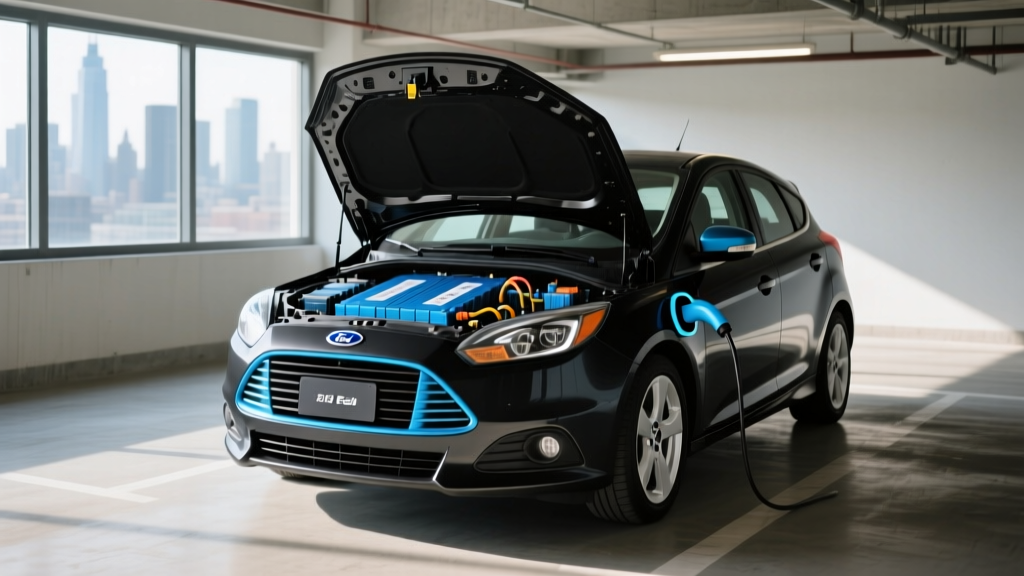
The 2013 Ford Focus Electric was one of the earliest mainstream battery-electric vehicles sold in the United States, arriving with a 23 kWh liquid-cooled lithium-ion traction battery and an EPA-rated 76 miles of range. More than a decade later, many of these cars are still on the road — but their original high-voltage packs have aged, and owners are confronting questions about degradation, replacement cost, and whether it makes sense to keep driving an early-generation EV. If you own a Focus Electric or are considering buying one used, understanding the battery for 2013 Ford Focus Electric — its chemistry, its aging profile, and what modern alternatives look like — is essential.
This guide covers the Focus Electric's original battery in detail, then zooms out to explain modern EV battery chemistry (LFP vs. NMC/NCA), degradation data, warranty structures, replacement economics, and care strategies that apply whether you're nursing a 2013 pack along or shopping for a 2026 model.
The 2013 Ford Focus Electric Battery: Original Specs and What's Changed
The 2013 Focus Electric shipped with a 23 kWh (usable capacity approximately 19.5 kWh) lithium-ion battery pack built by LG Chem. The cells use an NMC (nickel-manganese-cobalt) chemistry, which was the dominant choice for EV traction batteries in that era. The pack is liquid-cooled — a significant advantage over the passive-air-cooled Nissan Leaf battery of the same vintage, which suffered notoriously from heat-related degradation in warm climates.
| Attribute | Specification |
|---|---|
| Battery chemistry | NMC (nickel-manganese-cobalt) |
| Total capacity | 23 kWh |
| Usable capacity | ~19.5 kWh |
| Thermal management | Active liquid cooling/heating |
| EPA range (original) | 76 miles |
| Onboard charger | 6.6 kW (Level 2) |
| DC fast charging | Not available |
| 0-60 mph | ~9.2 seconds |
| Motor output | 143 hp (107 kW) |
| Original MSRP | $39,200 (before incentives) |
By 2026 standards, 76 miles of EPA range is extremely limited. Most new EVs offer 250-350 miles. But the Focus Electric's liquid-cooled pack has aged more gracefully than many of its contemporaries. Owners reporting on forums and EV databases frequently show packs retaining 75-85% of original capacity at 100,000+ miles — not ideal, but far from catastrophic.
LFP vs. NMC/NCA: Understanding Modern Battery Chemistry Trade-Offs
If you're evaluating whether to replace a degraded Focus Electric battery or upgrade to a newer EV, you'll encounter two dominant chemistries: LFP (lithium iron phosphate) and NMC/NCA (nickel-manganese-cobalt / nickel-cobalt-aluminum). Each has distinct strengths, and the right choice depends on your driving pattern, climate, and budget.
| Factor | LFP (Lithium Iron Phosphate) | NMC / NCA |
|---|---|---|
| Energy density | Lower (~160-180 Wh/kg cell-level) — heavier pack for same range | Higher (~220-300 Wh/kg) — lighter, more compact |
| Cycle life | Excellent: 3,000-5,000+ cycles to 80% SoH | Good: 1,000-2,000 cycles to 80% SoH |
| Cold-weather performance | Weaker — reduced range and slower charging below 32°F | Better low-temp discharge and charge acceptance |
| Cost | Lower — no cobalt or nickel; ~$100-120/kWh at pack level (2025-2026) | Higher — commodity-sensitive; ~$130-160/kWh |
| Thermal stability | Superior — very low risk of thermal runaway | Good but requires robust BMS and cooling |
| Charging to 100% | Can be charged to 100% regularly without accelerated degradation | Best kept at 80-90% daily; 100% only for trips |
| Common applications (2026) | Tesla Model 3 RWD, Model Y RWD, BYD, Rivian Standard, Ford Mustang Mach-E Select | Long-range/AWD trims, Hyundai Ioniq 5/6, Kia EV6/9, GM Ultium vehicles |
Which is better? For a daily commuter who charges at home and drives under 200 miles per day, LFP is increasingly the smarter choice: lower cost, longer cycle life, and the simplicity of charging to 100% without guilt. For drivers who need maximum range, tow frequently, or live in very cold climates, NMC/NCA still holds the edge in energy density and cold-weather usability. The 2013 Focus Electric's NMC pack was appropriate for its era, but if Ford had offered that car with a modern 60 kWh LFP pack, it would likely still be running with minimal degradation today.
How Long Do EV Batteries Last? Degradation Data by the Numbers
The most common question from EV shoppers and early-adopter owners alike: how long will the battery actually last? The answer depends on chemistry, thermal management, charging habits, and climate — but we now have enough real-world data to provide concrete benchmarks.
Typical Degradation Curves (NMC packs with active thermal management):
- Year 1-2 / 15,000-30,000 miles: 2-5% capacity loss (initial "break-in" degradation)
- Year 3-5 / 45,000-75,000 miles: Additional 3-5% loss; total ~5-10% degraded
- Year 6-8 / 90,000-120,000 miles: Gradual linear decline; total ~10-15% degraded
- Year 10+ / 150,000+ miles: Total ~15-25% degraded depending on usage patterns
2013 Focus Electric specific observations: Owner-reported data on platforms like PlugShare and SpeakEV suggests average capacity retention of approximately 75-82% at the 10-year / 100,000-mile mark. The liquid cooling system has protected these packs from the severe degradation seen in air-cooled competitors, but a 23 kWh pack losing 20% drops usable capacity to roughly 15.5 kWh — translating to about 55-60 miles of real-world range. That's a significant reduction from an already modest starting point.
Data from Geotab's large-scale fleet study of over 6,000 EVs shows that the average EV battery loses about 2.3% of capacity per year across all chemistries and cooling types. Vehicles with active liquid cooling — like the Focus Electric, Tesla Model S/3, and Chevrolet Bolt — consistently outperform passively cooled vehicles in long-term retention.
Battery Warranty Terms: What's Covered and for How Long
Federal law mandates that EV battery warranties cover a minimum of 8 years / 100,000 miles (10 years / 150,000 miles in CARB states like California). Here's how the Focus Electric's original warranty compared to current benchmarks:
| Vehicle | Warranty Period | Capacity Threshold | Notes |
|---|---|---|---|
| 2013 Ford Focus Electric | 8 years / 100,000 miles | Not explicitly defined in original docs (case-by-case) | Now expired for all 2013 models |
| 2026 Tesla Model 3 (LFP) | 8 years / 120,000 miles | 70% retention minimum | LFP pack; covers defects and excessive degradation |
| 2026 Hyundai Ioniq 5 | 10 years / 100,000 miles | 70% retention minimum | Among the longest coverage periods |
| 2026 Chevrolet Equinox EV | 8 years / 100,000 miles | 60% retention minimum | GM Ultium platform |
| 2026 Ford Mustang Mach-E | 8 years / 100,000 miles | 70% retention minimum | Ford's current EV standard |
Key detail for Focus Electric owners: The original 8-year/100,000-mile battery warranty expired no later than 2021 for all 2013 models. Any battery replacement or repair is now an out-of-pocket expense unless covered by an extended warranty purchased separately. The warranty's capacity threshold was somewhat ambiguous in Ford's original documentation — unlike today's clearly defined 70% retention floors — which made claims more dependent on dealer discretion.
EV Battery Replacement Costs: What to Expect in 2026
Battery replacement is the single biggest ownership fear for EV buyers. The reality is more nuanced than the headlines suggest: most EV batteries outlast the vehicles they power, and replacement costs have dropped significantly even as pack sizes have grown.
| Vehicle / Pack Size | Battery Cost (Parts) | Labor & Ancillary | Total Installed Range |
|---|---|---|---|
| 2013 Ford Focus Electric (23 kWh) | $4,500 - $8,000 (refurbished/used) | $1,500 - $3,000 | $6,000 - $11,000 |
| Nissan Leaf (40 kWh, 2018+) | $6,500 - $9,000 | $1,500 - $2,500 | $8,000 - $11,500 |
| Chevrolet Bolt EV (65 kWh) | $9,000 - $14,000 | $2,000 - $3,500 | $11,000 - $17,500 |
| Tesla Model 3 (75 kWh, NMC) | $12,000 - $16,000 | $2,000 - $4,000 | $14,000 - $20,000 |
| Ford F-150 Lightning (131 kWh Extended) | $18,000 - $25,000 | $3,000 - $5,000 | $21,000 - $30,000 |
For the 2013 Focus Electric specifically, sourcing a replacement battery is challenging. Ford does not sell new 23 kWh packs for this discontinued model. Owners typically rely on:
- Salvage yards and EV recyclers: Used packs from wrecked Focus Electrics, typically $3,500-$6,000 depending on tested capacity.
- Aftermarket refurbishers: Companies that rebuild packs with new cells, typically $7,000-$10,000 installed.
- Cell-level repair: Some specialist shops can identify and replace individual degraded modules within the pack, reducing cost to $2,000-$5,000 if only a few modules have failed.
The economic reality: A 2013 Focus Electric in decent condition has a resale value of roughly $5,000-$9,000 in 2026. A full battery replacement at $6,000-$11,000 may approach or exceed the vehicle's value, making it a difficult financial decision. Many owners opt for cell-level repair if only specific modules are weak, or they choose to trade into a modern EV with 250+ miles of range and a fresh warranty.
Factors That Accelerate or Slow Battery Degradation
Not all EV batteries age equally. The same pack chemistry can degrade 10% or 25% over 8 years depending on how it's treated. Here are the factors that matter most, ranked by impact:
High-impact factors:
- Extreme heat exposure: Sustained ambient temperatures above 95°F, especially combined with high state of charge, accelerate chemical breakdown. The Focus Electric's liquid cooling mitigates this significantly versus air-cooled rivals, but parking in shade or a garage still helps.
- Chronic 100% state of charge: Storing an NMC battery at 100% for extended periods (days or weeks) stresses the cathode. For the Focus Electric's NMC pack, daily charging to 80-90% is ideal; 100% only when you need the full range for a trip.
- Frequent DC fast charging at high power: The Focus Electric lacks DC fast charging, which ironically may have helped its longevity — all charging occurs at a gentle 6.6 kW Level 2 or 1.4 kW Level 1. For modern EVs with 150-350 kW DC capability, limiting DC fast charges to road trips (not daily use) reduces degradation.
Moderate-impact factors:
- Deep discharge cycles: Regularly driving the battery to 0% or near 0% before recharging. Aim to plug in before dropping below 15-20%.
- Cold-weather charging without preconditioning: Charging a freezing-cold battery at high power can cause lithium plating. Modern EVs precondition the battery before charging; the Focus Electric has limited preconditioning capability via its scheduled charging feature.
- High-mileage accumulation: Simply put, more miles = more charge cycles = more degradation. But the curve is logarithmic — most loss happens early, then plateaus.
Low-impact factors (often overstated):
- Regenerative braking intensity: Minimal direct effect on battery health; regen currents are well within safe C-rate limits.
- Occasional 100% charges: Charging to 100% before a road trip and using the range within a few hours causes negligible harm.
How to Check and Monitor Battery Health (State of Health)
State of Health (SoH) is the percentage of original battery capacity remaining. A new battery is 100% SoH; a battery that can now hold only 18 kWh of its original 23 kWh is at approximately 78% SoH. Here's how to check it:
For the 2013 Ford Focus Electric:
- OBD-II scanner with EV-capable software: Tools like LeafSpy (despite the name, compatible with many EVs) or Forscan can read the Focus Electric's battery management system data, including estimated SoH, cell voltage spreads, and pack temperature. A basic OBD-II dongle costs $20-$40; Forscan software is free or low-cost.
- Manual range tracking: Charge to 100%, note the displayed range estimate, and compare to the original 76-mile EPA figure. If your fully charged range now reads 58 miles, you're at roughly 76% SoH. This is imprecise (temperature and driving style affect the estimate) but directionally useful.
- Dealer diagnostic: A Ford dealer can run a battery health report, though support for the discontinued Focus Electric varies by location. Expect to pay $100-$150 for the diagnostic if out of warranty.
For modern EVs (2020+ models):
- In-app SoH display: Some manufacturers (Hyundai, Kia, BMW) show battery SoH directly in the vehicle's infotainment or companion app.
- Third-party reports: Services like Recurrent and Battery Health Reports from certified dealers provide detailed degradation analysis.
- OBD-II tools: Apps like LeafSpy Pro, ABRP (A Better Route Planner) with OBD integration, and manufacturer-specific tools provide real-time cell-level data.
Should You Replace the Battery or Upgrade to a Modern EV?
This is the practical decision every aging-EV owner faces. Here's a framework for the Focus Electric specifically:
Replace the battery if:
- The rest of the car is in excellent condition (body, interior, suspension, brakes) and you value its driving dynamics.
- You can source a tested used pack for under $6,000 and have access to an EV-qualified shop for installation.
- Your daily driving needs remain under 50 miles round-trip, and 55-60 miles of restored range (from a partially degraded replacement) is sufficient.
- You're emotionally attached or the car has sentimental value.
Upgrade to a modern EV if:
- You need more than 60 miles of reliable daily range, especially in winter (expect 20-30% range loss in freezing temperatures).
- You want DC fast charging for road trips — the Focus Electric's lack of DCFC is a permanent limitation regardless of battery condition.
- You want a current warranty. A 2026 EV like the Chevrolet Equinox EV ($33,000 base, 315 miles EPA) or Hyundai Kona Electric ($32,975, 261 miles EPA) comes with a fresh 8-10 year battery warranty.
- You can take advantage of the federal §30D tax credit (up to $7,500, subject to MSRP caps, buyer income limits, and battery sourcing requirements — consult a tax professional for eligibility).
- The total replacement cost would exceed the car's market value, making it economically irrational to invest further.
Emerging Battery Technology: What's on the Horizon
Battery technology is advancing rapidly, but it's important to separate what's available now from what's still in development:
Silicon-dominant anodes (available now, limited deployment): Companies like Sila Nanotechnologies and Group14 are supplying silicon-carbon anode materials that boost energy density by 10-20% over traditional graphite anodes. These are appearing in limited applications — the 2025-2026 Mercedes G-Class electric uses a Sila-supplied anode — but haven't reached mass-market scale. Expect broader adoption by 2027-2028.
Semi-solid-state batteries (limited production): NIO in China has deployed a 150 kWh semi-solid-state pack in its ET7 sedan, achieving over 600 miles of range (WLTP). This is a real, drivable product but only available in the Chinese market and at a premium price point. U.S. availability is uncertain.
True solid-state batteries (announced, not yet available): Toyota has announced plans for solid-state battery EVs around 2027-2028, promising 750+ km range and 10-minute fast charging. QuantumScape is working with Volkswagen on solid-state cells. Samsung SDI targets 2027 production. These are promising but remain pre-commercial. Realistic mass-market availability is 2029-2032 based on current timelines.
Sodium-ion batteries (early deployment): CATL and BYD are producing sodium-ion cells for lower-cost, shorter-range EVs in China. Energy density is lower than LFP (~120-150 Wh/kg), but raw materials are abundant and cheap. Potential fit for urban runabouts and fleet vehicles; U.S. market entry likely post-2027.
None of these technologies change the calculus for a 2013 Focus Electric owner today. But if you're planning your next EV purchase in the 2027-2030 window, the battery landscape will look meaningfully different — with higher energy density, faster charging, and potentially lower costs.
Frequently Asked Questions
How long do EV batteries last in years and miles?
Most modern EV batteries with active thermal management last 150,000-200,000+ miles before degrading below 70% capacity — typically 12-15 years of average use. The 2013 Focus Electric's liquid-cooled NMC pack has demonstrated 75-82% capacity retention at the 10-year mark in owner-reported data. Early-generation air-cooled batteries (like the 2011-2015 Nissan Leaf) degraded faster, sometimes reaching 70% SoH in 5-7 years in hot climates.
How much does it cost to replace the battery in a 2013 Ford Focus Electric?
Expect $6,000-$11,000 for a complete replacement using a refurbished or used pack, including labor. New OEM packs are no longer produced. Cell-level module repair, if only specific sections have failed, can cost $2,000-$5,000. Given the car's $5,000-$9,000 resale value, a full replacement is often economically questionable.
What did the original Focus Electric battery warranty cover?
Ford's original warranty covered 8 years / 100,000 miles against defects and excessive capacity loss. The exact capacity retention threshold was not as clearly defined as modern warranties (which typically guarantee 70% SoH). This warranty has expired for all 2013 models as of 2021 at the latest.
How do I check the battery health on my Focus Electric?
The most reliable method is using an OBD-II adapter with Forscan or a similar EV-compatible diagnostic tool to read SoH directly from the battery management system. You can also approximate SoH by charging to 100% and comparing the displayed range to the original 76-mile EPA figure. Ford dealers can run a diagnostic report, but support for this discontinued model varies.
Is LFP better than NMC for longevity?
Yes, for cycle life and calendar life, LFP is superior — it typically endures 3,000-5,000+ charge cycles versus 1,000-2,000 for NMC before reaching 80% SoH. LFP can also be charged to 100% daily without accelerated degradation. However, NMC offers higher energy density (more range in a lighter, smaller pack) and better cold-weather performance. For a daily commuter with home charging, LFP is the longevity winner. For maximum range and cold-climate driving, NMC remains the better fit.
Does fast charging damage EV batteries?
Occasional DC fast charging has minimal impact on battery health. However, exclusive reliance on high-power DC fast charging (150+ kW) for every charge session can accelerate degradation by 1-3% over the battery's lifetime compared to primarily Level 2 charging. The Focus Electric's lack of DC fast charging means its pack has only ever seen gentle 6.6 kW Level 2 or 1.4 kW Level 1 charging — which has likely contributed to its relatively strong longevity. For modern EVs, the best practice is Level 2 for daily charging and DC fast charging for road trips.
Can I upgrade my 2013 Focus Electric to a larger battery?
No practical upgrade path exists. The battery enclosure, BMS software, wiring harness, and cooling system are specific to the 23 kWh LG Chem pack. Swapping in a larger modern pack would require extensive custom engineering that far exceeds the car's value. This is a permanent limitation of early-generation EVs.
Sources: EPA fuel economy data via fueleconomy.gov; IRS clean vehicle credit rules via irs.gov; Geotab EV battery degradation study; owner-reported data from PlugShare and SpeakEV forums.