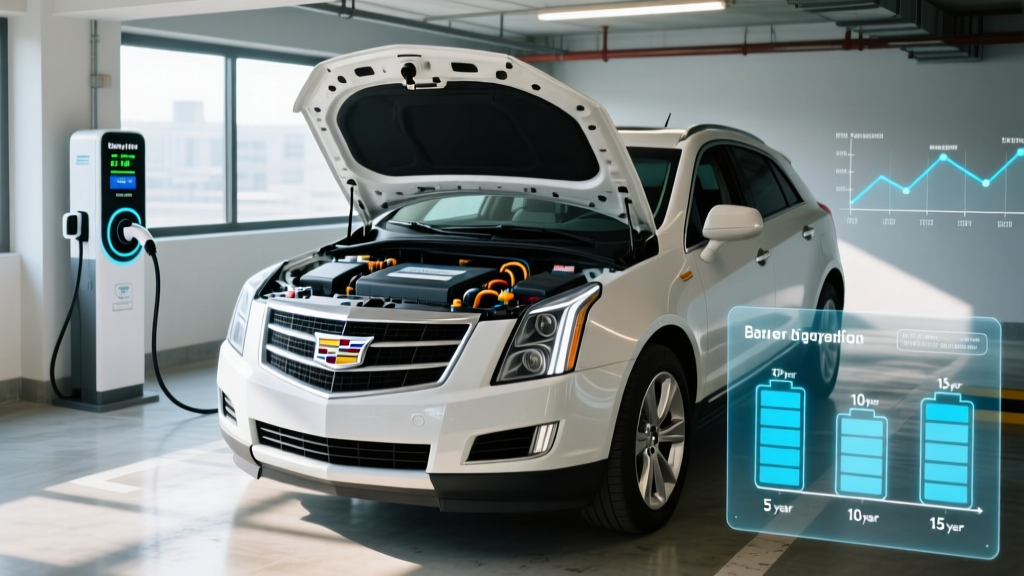
If you own a 2013 Cadillac SRX and the original 12-volt battery is showing its age, you're likely shopping for a Group 48 AGM replacement. That's a straightforward maintenance item — typically $180–$260 for the part, plus 15 minutes of labor. But the keyword "battery for 2013 Cadillac SRX" also pulls in a surprisingly common search from EV-curious drivers wondering how the high-voltage traction batteries in modern electric vehicles compare in longevity, cost, and care. This guide addresses both: the practical 12V replacement for your SRX, and a deep-dive into the high-voltage lithium-ion packs powering today's EVs.
The 2013 Cadillac SRX: 12V Battery Basics
The 2013 SRX uses a conventional 12-volt lead-acid (AGM recommended) starting battery, not a high-voltage traction pack. The SRX was never offered as a hybrid or EV — it's a 3.6L V6 gasoline crossover. Here's what you need:
- Group size: 48 (H6)
- Type: AGM (Absorbed Glass Mat) strongly recommended over flooded lead-acid due to the SRX's electronics load
- CCA (Cold Cranking Amps): 730–800
- Typical cost: $180–$260 (parts only, retailers like AutoZone, Advance Auto, Costco)
- Lifespan: 3–5 years depending on climate and parasitic draw
This is an entirely different animal from the 60–120+ kWh lithium-ion traction batteries in modern EVs, which we'll cover in depth below.
EV Battery Chemistry: LFP vs NMC vs NCA
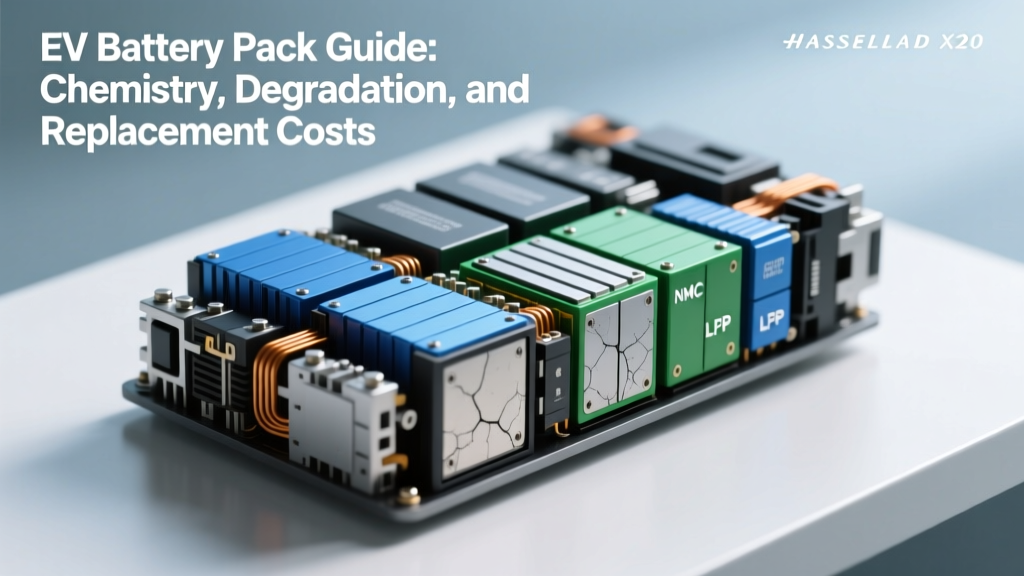
Modern EV traction batteries use one of three dominant lithium-ion chemistries. The choice affects range, longevity, cold-weather performance, and price. Here's how they stack up in 2026:
| Attribute | LFP (Lithium Iron Phosphate) | NMC (Nickel Manganese Cobalt) | NCA (Nickel Cobalt Aluminum) |
|---|---|---|---|
| Energy density | Lower (~160 Wh/kg cell-level) | Higher (~220–260 Wh/kg) | Highest (~260–290 Wh/kg) |
| Cycle life | 3,000–5,000+ cycles | 1,000–2,000 cycles | 1,000–1,500 cycles |
| Cold-weather performance | Weaker below 32°F; needs preconditioning | Better low-temp discharge | Good low-temp discharge |
| Cost per kWh (2026) | ~$80–$95 | ~$110–$130 | ~$115–$135 |
| Recommended daily SoC | 100% OK (no degradation penalty) | 80% for daily; 100% for trips only | 80% for daily; 100% for trips only |
| Common 2026 applications | Tesla Model 3/Y RWD, Ford Mustang Mach-E Select, BYD models | Hyundai Ioniq 5/6 Long Range, VW ID.4 Pro, BMW iX | Tesla Model S/X, Rivian R1T/R1S (some packs) |
| Thermal stability | Excellent (less prone to thermal runaway) | Good with active thermal management | Good with active thermal management |
The trade-off in plain terms: LFP batteries are heavier and offer slightly less range per kWh, but they last significantly longer, cost less, and can be charged to 100% daily without accelerated degradation. NMC/NCA packs deliver more range in a lighter package but benefit from staying between 20–80% SoC for daily use. If you're a high-mileage commuter who charges nightly at home, LFP is increasingly the pragmatic choice. If you need maximum range for road trips and live in a cold climate, NMC's better cold performance and energy density still win.
How Long Do EV Batteries Actually Last?
The fear of a $20,000 battery replacement at 100,000 miles is the single biggest barrier to EV adoption — and it's largely a myth based on early-generation packs. Real-world degradation data from 2025–2026 tells a different story.
Typical degradation curves (fleet and owner-reported data):
- Year 1 / 15,000 mi: 2–4% capacity loss (initial "break-in" drop, then plateau)
- Year 3 / 45,000 mi: 5–8% total loss
- Year 5 / 75,000 mi: 8–12% total loss
- Year 8 / 120,000 mi: 10–15% total loss (most still above warranty threshold)
- Year 10 / 150,000 mi: 12–20% total loss (chemistry-dependent; LFP often under 10%)
Sources: Recurrent Auto fleet data, Geotab longitudinal study of 6,300+ EVs.
A 2024 Tesla Model 3 RWD with its LFP pack, for example, is showing fleet averages of roughly 5% degradation at 60,000 miles — meaning a car originally rated for 272 miles EPA still delivers ~258 miles. A 2022 Hyundai Ioniq 5 (NMC) at 50,000 miles averages about 7% loss. These are not catastrophic numbers; they're gradual and manageable.
Key insight: Most EV batteries will outlast the vehicle's economic life. The average car on US roads is 12.6 years old. At typical degradation rates, a 75 kWh pack will still hold 60–65 kWh by year 12 — reduced range, yes, but fully functional for daily driving.
What Does the Battery Warranty Actually Cover?
Federal law mandates a minimum 8-year/100,000-mile warranty on EV battery packs for emissions-related components, but manufacturers have standardized around this baseline for capacity retention as well. Here's how major brands structure their coverage in 2026:
| Manufacturer | Warranty Term | Capacity Retention Threshold | What Triggers a Claim |
|---|---|---|---|
| Tesla (Model 3/Y) | 8 yr / 100,000 mi (LFP RWD); 8 yr / 120,000 mi (LR/AWD) | 70% | SoH drops below 70% as measured by Tesla diagnostics |
| Hyundai / Kia | 10 yr / 100,000 mi | 70% | Verified capacity below 70% via dealer scan tool |
| Ford (Mach-E, F-150 Lightning) | 8 yr / 100,000 mi | 70% | Battery control module reports SoH < 70% |
| GM (Ultium-based: Equinox EV, Blazer EV, Silverado EV) | 8 yr / 100,000 mi | 70% | OnStar / dealer diagnostic confirms < 70% |
| VW (ID.4) | 8 yr / 100,000 mi | 70% | Net capacity below 70% confirmed by authorized service |
| BMW (iX, i4) | 8 yr / 100,000 mi | 70% | Capacity test below threshold at certified dealer |
What's covered: Defects in materials/workmanship AND capacity loss below the stated threshold. If your 75 kWh pack can only hold 50 kWh (below 70%), the manufacturer must repair or replace it — typically with a refurbished or new module set — at no cost to you.
What's NOT covered: Cosmetic damage, damage from accidents or flooding, unauthorized modifications, or degradation from consistently ignoring manufacturer charging guidance (though this is rarely enforced in practice). Warranties transfer to subsequent owners in most states, which supports EV resale values.
EV Battery Replacement Cost: What You'd Actually Pay
Out-of-warranty battery replacement is the nightmare scenario owners worry about. Here's the reality in 2026 — it's expensive, but rarely necessary within a vehicle's useful life, and costs continue to decline.
| Vehicle / Pack Size | Chemistry | Full Pack Replacement (parts + labor) | Module-Level Repair (if applicable) |
|---|---|---|---|
| Tesla Model 3 RWD (~60 kWh) | LFP | $12,000–$14,000 | $2,500–$4,000 per module section |
| Tesla Model Y LR (~75 kWh) | NMC | $14,000–$17,000 | $3,000–$5,000 per module |
| Hyundai Ioniq 5 (~77.4 kWh) | NMC | $13,000–$16,000 | $2,800–$4,500 per module |
| Ford F-150 Lightning Ext. Range (~131 kWh) | NMC | $22,000–$28,000 | $3,500–$6,000 per module |
| Chevrolet Equinox EV (~85 kWh) | NMC (Ultium) | $14,000–$18,000 | $3,000–$5,000 per module |
| BMW iX xDrive50 (~111.5 kWh) | NMC | $20,000–$25,000 | $4,000–$6,500 per module |
When is replacement actually needed? Almost never within the warranty period, and rarely before 200,000+ miles for modern packs. The most common "replacements" are actually module-level repairs — where a single faulty cell group is swapped rather than the entire pack. This is why module-serviceable architectures (like Ultium and Hyundai's E-GMP) are significant: they dramatically reduce worst-case cost.
For context, a $15,000 battery replacement at year 12 on a vehicle that saved $1,200–$1,800/year in fuel and maintenance over gasoline still nets positive total cost of ownership for most drivers. And by 2030, pack-level costs are projected to fall below $80/kWh industry-wide, meaning a 75 kWh replacement could drop to $8,000–$10,000.
Factors That Accelerate (or Preserve) Battery Life
Not all miles are equal when it comes to battery wear. These are the variables you control:
Battery Care Checklist
- Fast-charging frequency: Occasional DC fast charging (1–2x/week) is fine. Daily 150+ kW DC fast charging accelerates degradation by roughly 1–2% additional loss over 100k miles vs. Level 2 home charging. Use DCFC for road trips; rely on Level 2 for daily.
- State of Charge habits: For NMC/NCA, keep daily SoC between 20–80%. For LFP, charge to 100% regularly (it actually benefits cell balancing). Never leave any chemistry sitting at 100% SoC for days in hot weather.
- Extreme heat: Sustained ambient temps above 95°F combined with high SoC (>90%) is the worst-case degradation scenario. Park in shade/garage when possible; use preconditioning.
- Extreme cold: Cold doesn't permanently damage the battery, but charging a frozen pack without preconditioning causes lithium plating — a permanent capacity loss mechanism. Always precondition before winter DC fast charging.
- Storage: If storing an EV for 30+ days, leave SoC at 50–60% and plug in (if possible) to maintain the 12V system. Avoid storage at 100% or below 10%.
- Regenerative braking settings: Standard regen is fine; max regen doesn't meaningfully affect battery health. This is a preference, not a longevity factor.
How to Check and Monitor Battery Health (SoH)
State of Health (SoH) is the percentage of original capacity your pack can still hold. A new 75 kWh pack at 95% SoH holds 71.25 kWh. Here's how to monitor it:
Manufacturer Apps & Built-In Diagnostics
Most modern EVs surface SoH data directly. Tesla's app shows estimated range at 100% charge (compare to original EPA rating as a proxy). Hyundai/Kia's Bluelink provides a battery health percentage. Ford's Pass app includes SoH estimates. GM's Ultium vehicles report via the MyChevrolet/FordPass-equivalent app.
Third-Party Tools
- Recurrent Auto: Free enrollment; connects to your vehicle's telematics and provides detailed degradation tracking, range estimates, and comparisons against fleet averages.
- OBD-II dongles + apps (e.g., ABRP, ScanMyTesla, Car Scanner): Read BMS-reported SoH directly from the vehicle's CAN bus. Accuracy varies but provides a useful snapshot.
- Dealer diagnostic scan: The most authoritative measurement. Request a "battery health report" during routine service — most manufacturers will provide this free.
The DIY Range Test
Charge to 100%, reset the trip meter, drive until 10% SoC, and note miles driven + kWh consumed from the trip computer. Compare to the original usable capacity. If your 77.4 kWh Ioniq 5 delivers only 58 kWh over that cycle, your SoH is approximately 75%.
What's Next: Solid-State, Silicon Anode, and Beyond
Several next-generation battery technologies are in development. It's important to separate what's available now from what's still years away:
- Silicon-dominant anodes: Companies like Sila Nanotechnologies and Group14 are already shipping silicon-composite anode materials that boost energy density by 10–20% over graphite. These are appearing in limited 2025–2026 production vehicles (e.g., Mercedes G-Class 580e's partial silicon anode). Expect broader adoption by 2028.
- Solid-state batteries: Toyota, Samsung SDI, and QuantumScape have demonstrated prototype cells with 30–40% higher energy density and faster charging. Toyota has announced a 2027–2028 production target for limited models. This is not currently available in any production vehicle as of 2026. Realistic mass-market availability: 2029–2031.
- Sodium-ion batteries: CATL and BYD are producing sodium-ion packs for lower-cost, shorter-range EVs (primarily in China). Energy density is ~30% lower than LFP, but raw material costs are dramatically lower. Possible US-market appearance in budget EVs by 2028.
- LMFP (Lithium Manganese Iron Phosphate): An evolution of LFP with 15–20% higher energy density while retaining LFP's longevity and safety. Tesla and others are reportedly testing LMFP cells for 2027+ vehicles.
Bottom line on emerging tech: If you're buying an EV in 2026, today's LFP and NMC chemistries are mature, well-understood, and backed by real-world fleet data showing 10–15% degradation over 8 years. Waiting for solid-state means waiting 3–5+ years with no guarantee of initial affordability or widespread availability.
Frequently Asked Questions
How long do EV batteries last in years and miles?
Based on fleet data from Recurrent Auto and Geotab, modern EV batteries (2020+) retain 85–90% capacity at 100,000 miles and 80–88% at 150,000 miles. In years, expect 15–20+ years of functional service before capacity drops below 70%. Most batteries will outlast the vehicle's body and interior.
How much does an EV battery cost to replace in 2026?
Full pack replacement ranges from $12,000–$17,000 for a 60–80 kWh pack (Tesla Model 3, Ioniq 5, Mach-E) to $20,000–$28,000 for 100+ kWh packs (F-150 Lightning, BMW iX). However, most replacements are module-level repairs at $2,500–$6,500. Full replacements are rare within 150,000 miles.
What does the EV battery warranty cover?
Standard coverage is 8 years/100,000 miles (Hyundai/Kia offer 10 years/100,000 miles) against defects and capacity loss below 70% of original. If your pack degrades below the threshold, the manufacturer replaces or repairs it at no cost. Warranties generally transfer to second owners.
How do I check my EV's battery health?
Check your manufacturer's app for SoH or estimated range at 100% charge. For more detail, use an OBD-II scanner with EV-specific software (Car Scanner, ScanMyTesla), enroll in Recurrent Auto's free tracking, or request a battery health report from your dealer during service.
LFP vs NMC — which chemistry is better for me?
Choose LFP if: you charge at home nightly, want maximum cycle life (3,000–5,000+ cycles), don't mind slightly less range, and want to charge to 100% daily without worry. Choose NMC/NCA if: you need maximum range per charge, live in a very cold climate (better low-temp performance), or frequently take long road trips. Neither is universally "better" — it depends on your driving pattern.
Does fast charging damage my EV battery?
DC fast charging generates more heat than Level 2, which accelerates degradation slightly. Fleet data shows roughly 1–2% additional capacity loss over 100,000 miles for vehicles that DCFC daily vs. primarily Level 2 charging. Occasional fast charging (2–3x/week or less) has negligible impact. Modern thermal management systems mitigate most of the risk.
What about the 12V battery in my 2013 Cadillac SRX?
The SRX uses a standard Group 48 (H6) AGM 12V battery, unrelated to EV traction batteries. Expect $180–$260 for the part, 3–5 year lifespan, and widely available replacements at any auto parts retailer. This is routine maintenance, not the high-voltage pack discussed in the EV sections above.