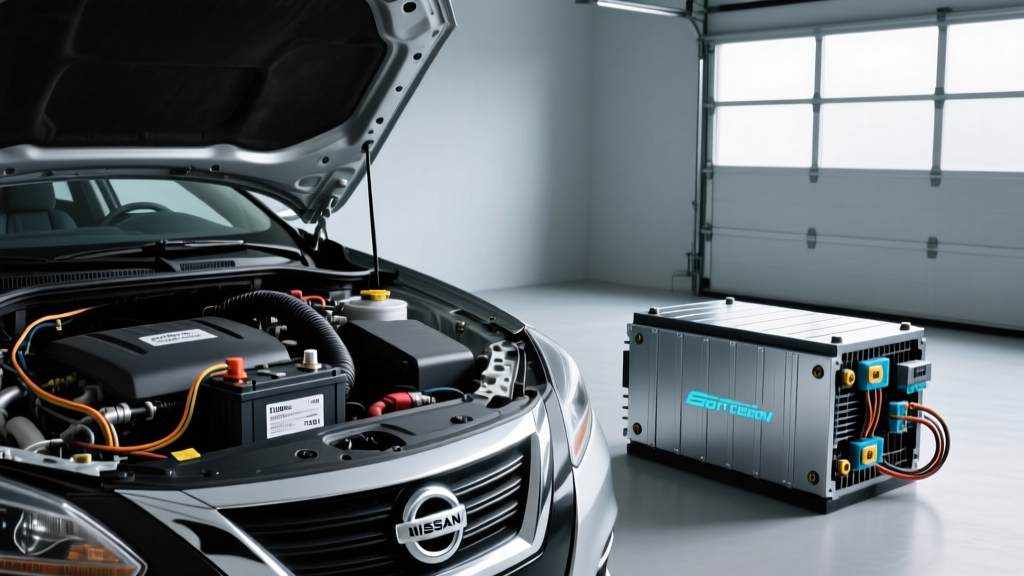
If you've landed here searching for a battery for a 2012 Nissan Maxima, you likely have a dead or dying 12-volt starting battery in a VQ35DE-powered V6 sedan. That Maxima rolls off the line as a conventional gasoline vehicle — no high-voltage traction pack, no kilowatt-hour capacity sticker, and no DC fast-charging port. But your search also opens the door to one of the most misunderstood topics in automotive ownership: the difference between a conventional 12V auxiliary battery and the high-voltage lithium-ion traction batteries that power modern electric vehicles.
This guide covers both. First, we'll sort out exactly what battery your 2012 Maxima needs. Then we'll walk through the full landscape of EV battery technology — chemistry, degradation data, warranty terms, replacement costs, and care strategies — so you're equipped whether you're keeping your Maxima running or evaluating your next electrified purchase.
What Battery Does a 2012 Nissan Maxima Actually Need?
The 2012 Nissan Maxima uses a conventional Group 35 (also labeled 24F in some references) 12-volt lead-acid starting battery. This battery's sole job is cranking the 3.5L V6 engine and powering accessories when the alternator isn't generating current. It has nothing to do with propulsion.
- Group Size: 35 / 24F (verify fitment with your retailer)
- Cold Cranking Amps (CCA): 550–650 CCA recommended
- Reserve Capacity: ~100 minutes
- Chemistry: Flooded lead-acid (standard) or AGM (upgrade option)
- Typical replacement cost: $140–$260 at retail (Interstate, Optima, DieHard)
- Expected lifespan: 3–5 years depending on climate and use
If your Maxima won't crank, this is the battery you need to replace — not a high-voltage pack. A qualified parts counter or mobile mechanic can swap it in minutes. Now let's shift to the battery technology that powers the electric vehicles you may be cross-shopping.
EV Battery Chemistry: LFP vs NMC/NCA Explained
Modern EV traction batteries use lithium-ion cells, but not all lithium-ion is the same. The cathode chemistry determines energy density, longevity, cold-weather behavior, and cost. Two families dominate the 2026 market:
| Attribute | LFP (Lithium Iron Phosphate) | NMC / NCA (Nickel Manganese Cobalt / Nickel Cobalt Aluminum) |
|---|---|---|
| Energy Density | Lower (~160–180 Wh/kg cell-level) | Higher (~220–260 Wh/kg cell-level) |
| Cycle Life | 3,000–5,000+ cycles to 80% SoH | 1,000–2,000 cycles to 80% SoH |
| Cold Performance | Weaker below 32°F; slower charge acceptance | Better low-temp conductivity |
| Thermal Stability | Superior; less prone to thermal runaway | Requires more active thermal management |
| Cost | Lower — no cobalt or nickel | Higher — commodity-priced metals |
| Typical Use | Standard-range models (Tesla Model 3 RWD, Ford Mustang Mach-E Select LFP, BYD) | Long-range and performance models (Hyundai Ioniq 5, Tesla Model Y LR, Rivian) |
| Charging to 100% | Recommended periodically for BMS calibration | Generally 80% daily; 100% for trips only |
Which is better? Neither is universally superior. LFP wins on longevity and cost — ideal for daily commuters who can charge at home and don't need maximum range. NMC/NCA wins on energy density and cold-weather usability — the right call for road-trippers, cold-climate drivers, and anyone who needs 300+ miles of EPA range from a manageable pack size.
How Long Do EV Batteries Actually Last?
The fear that EV batteries need replacing every few years is not supported by fleet data. Most modern liquid-cooled packs are engineered to outlast the vehicle's economic life.
- Tesla Model 3/Y fleet data (2025 Impact Report): Average ~12% capacity loss at 150,000 miles, with NMC packs retaining ~88% State of Health (SoH).
- Nissan Leaf (early air-cooled, 24/30 kWh): Higher degradation — some 2013–2017 Leafs lost 20–30% capacity by 80,000–100,000 miles, particularly in hot climates. This is the historical source of most battery-fear narratives.
- Hyundai/Kia E-GMP platform (Ioniq 5, EV6): Limited long-term data, but 40,000-mile owner reports show 3–5% loss — consistent with modern liquid-cooled NMC behavior.
- Chevrolet Bolt EV/EUV (NMC, liquid-cooled): Fleet averages show ~8–10% loss at 100,000 miles.
A reasonable expectation for a 2024–2026 EV with liquid-cooled thermal management: 85–90% capacity retention at 100,000 miles; 75–85% at 200,000 miles. That translates to an EPA-range loss of 30–50 miles on a 300-mile vehicle over 200k — still very drivable.
EV Battery Warranty Terms: What's Actually Covered
Federal law (EPA emissions warranty provisions) effectively mandates that manufacturers warrant EV batteries for at least 8 years / 100,000 miles. In practice, most automakers match or exceed this. Here's how the major warranties stack up as of the 2026 model year:
| Manufacturer | Warranty Term | Capacity Retention Threshold |
|---|---|---|
| Tesla (Model 3/Y RWD — LFP) | 8 yr / 100,000 mi | 70% minimum |
| Tesla (Model 3/Y LR/Perf — NMC) | 8 yr / 120,000 mi | 70% minimum |
| Hyundai / Kia (E-GMP) | 10 yr / 100,000 mi | 70% minimum |
| Ford (Mach-E, F-150 Lightning) | 8 yr / 100,000 mi | 70% minimum |
| GM (Ultium — Blazer EV, Silverado EV) | 8 yr / 100,000 mi | 70% minimum |
| Rivian (R1T / R1S) | 8 yr / 175,000 mi | 70% minimum |
| BMW (iX, i4) | 8 yr / 100,000 mi | 70% minimum |
What triggers a warranty claim? If your battery's State of Health drops below the stated threshold (typically 70% of original capacity) within the term, the manufacturer must repair or replace it — usually by swapping defective modules rather than the full pack. Normal gradual degradation above the threshold is not covered.
Source: Verify current warranty terms on each manufacturer's official site and the EPA Fuel Economy portal, which lists battery warranty data per model.
How Much Does an EV Battery Cost to Replace?
Out-of-warranty replacement is the nightmare scenario — but it's rare. Most packs outlive their vehicles' economic value. When replacement is needed (catastrophic failure, physical damage, or extreme degradation on an older model), costs vary dramatically by pack size and chemistry:
| Vehicle / Pack Size | Approximate Pack Cost | Labor & Total Installed |
|---|---|---|
| Nissan Leaf 40 kWh (NMC) | $6,500–$9,000 | $8,000–$12,000 |
| Tesla Model 3 Standard Range (~60 kWh LFP) | $8,000–$12,000 | $10,000–$15,000 |
| Hyundai Ioniq 5 (~77 kWh NMC) | $12,000–$16,000 | $14,000–$20,000 |
| Ford F-150 Lightning Extended (~131 kWh) | $18,000–$25,000 | $22,000–$30,000 |
| Rivian R1T Max Pack (~149 kWh) | $20,000–$28,000 | $24,000–$34,000 |
| Chevrolet Bolt EV (~65 kWh NMC) | $9,000–$14,000 | $11,000–$17,000 |
When is replacement typically needed? Catastrophic failure (manufacturing defect, usually caught under warranty), collision damage, or extreme degradation on early-generation vehicles like the 2011–2017 Nissan Leaf. For a 2024–2026 liquid-cooled EV, the battery will very likely outlast your ownership period.
Compare this to your 2012 Maxima, where a $200 battery swap keeps you on the road. The scale difference is massive — but so is the functional difference between cranking a V6 and propoting a 4,500-lb vehicle 300 miles.
Factors That Affect EV Battery Lifespan
Not all miles age a battery equally. Here are the variables that accelerate or decelerate degradation, backed by electrochemistry:
- Limit DC fast charging to road trips. Frequent 150+ kW charging raises cell temperature and stresses the cathode. Weekly Level 2 home charging is gentler. Tesla's own fleet data shows vehicles that primarily use Supercharging degrade slightly faster — though the difference is modest (~2–3% over 100k miles).
- Avoid storing at 100% or 0% SoC. For NMC batteries, the sweet spot is 20–80% for daily use. LFP batteries tolerate 100% better and actually benefit from periodic full charges for cell balancing.
- Precondition before fast charging. Most modern EVs do this automatically when you navigate to a charger. A warm battery (ideally 60–80°F) accepts charge faster and with less internal resistance damage.
- Extreme heat is worse than extreme cold. Sustained ambient temperatures above 95°F accelerate electrolyte decomposition. If you live in Phoenix or Houston, garage parking and preconditioning matter more. Cold weather reduces range temporarily but doesn't permanently damage the pack.
- Don't obsess over it. Modern battery management systems (BMS) actively protect the pack with thermal conditioning, charge-rate limiting, and top/bottom buffers (typically 5–10% of gross kWh is unusable by design). Drive normally.
How to Check Your EV Battery's State of Health
State of Health (SoH) measures your battery's current maximum capacity as a percentage of its original capacity. Here's how to monitor it:
- In-vehicle displays: Tesla shows battery health estimates in the service menu. Hyundai/Kia displays SoH percentage in the EV settings screen on newer models. Nissan Leaf shows capacity bars (12 bars = 100%, with each lost bar representing ~6–8% degradation).
- OBD-II diagnostic tools: Devices like the OBDLink CX paired with apps such as LeafSpy (for Nissan) or EV Health apps can pull detailed SoH, cell voltage variance, and cycle count data directly from the BMS.
- Dealer diagnostics: Any authorized service center can run a full battery health report. Request this during routine service or before purchasing a used EV.
- Charging data analysis: Track how many kWh it takes to charge from a known SoC to full. If your 75 kWh pack consistently accepts only 62 kWh from 10% to 95%, your SoH is roughly 85%. Tools like Tessie (Tesla) or third-party EV loggers automate this.
For used-EV buyers, SoH is the single most important data point — more than odometer miles. A 60,000-mile EV with 94% SoH is a better bet than a 30,000-mile example at 82% SoH (which likely sat at 100% in a hot climate).
Emerging Battery Technology: What's Coming
The next generation of battery technology promises step-change improvements, but timelines matter. Here's what's realistic from a 2026 vantage point:
Solid-state batteries: These replace the liquid electrolyte with a solid conductor, potentially offering 40–50% more energy density, faster charging, and improved safety. Toyota has announced limited solid-state production for 2027–2028, initially in small batches for premium models. Samsung SDI targets 2027 mass production. These are not yet available in any consumer vehicle as of 2026. Expect initial deployment in $70,000+ vehicles before trickling down.
Silicon-dominant anodes: Companies like Sila Nanotechnologies and Group14 are replacing graphite anodes with silicon composites, boosting energy density by 20–40%. Mercedes-Benz's G-Class 580 EQ (announced) uses silicon anode cells from Factorial Energy. This technology is entering production now but remains limited to high-end applications.
Sodium-ion batteries: CATL and BYD are producing sodium-ion cells for low-cost, short-range EVs — primarily in the Chinese market. Lower energy density than LFP but cheaper and free of lithium. Not expected in US-market vehicles before 2028 at the earliest.
The practical takeaway: today's LFP and NMC batteries are mature, well-understood technology with proven longevity. Waiting for solid-state means waiting years and paying a premium when it arrives.
Frequently Asked Questions
How long do EV batteries last in years and miles?
Modern liquid-cooled EV batteries (2020 and newer) typically retain 85–90% capacity at 100,000 miles and 75–85% at 200,000 miles. In calendar years, most outlast 15+ years of typical driving before falling below the 70% warranty threshold. Early air-cooled packs (2011–2017 Nissan Leaf) degraded faster, which is why the reputation persists.
How much does an EV battery cost to replace out of warranty?
Between $8,000 and $30,000+ installed depending on pack size and vehicle. A Bolt EV or Model 3 pack runs $10,000–$17,000; a large pack like the F-150 Lightning Extended Range can exceed $25,000. However, most packs never need full replacement — module-level repairs are more common and significantly cheaper.
What does the EV battery warranty actually cover?
Federally mandated minimum coverage is 8 years / 100,000 miles (10 years in CARB states). The warranty guarantees the battery will retain at least 70% of original capacity. If SoH drops below that threshold within the term, the manufacturer repairs or replaces the pack at no cost. Gradual degradation above 70% is normal and not covered.
How do I check and maximize my EV battery health?
Monitor SoH through your vehicle's settings menu, OBD-II diagnostic apps, or dealer service reports. To maximize lifespan: charge primarily on Level 2 at home, keep NMC batteries between 20–80% daily (LFP can go to 100%), limit DC fast charging to road trips, precondition before fast charging, and avoid prolonged storage at extreme SoC levels in hot climates.
LFP vs NMC — which battery chemistry should I choose?
Choose LFP if you want maximum cycle life, lower cost, and primarily drive in moderate climates with home charging access. Choose NMC/NCA if you need maximum range per charge, live in a cold climate, or take frequent road trips requiring fast DC charging. Both chemistries are proven and warrantied — the right choice depends on your driving pattern, not which is "better" in the abstract.
Does my 2012 Nissan Maxima have a high-voltage EV battery?
No. The 2012 Maxima is a conventional gasoline vehicle with a 3.5L V6 and a standard 12V lead-acid starting battery (Group 35/24F). If your Maxima won't start, you need a $140–$260 12V replacement — not a high-voltage traction battery. The EV battery technology described in this guide applies to battery-electric and plug-in hybrid vehicles, not to your Maxima.
Sources: EPA Fuel Economy (fueleconomy.gov) for battery warranty and range data; IRS §30D Clean Vehicle Credits for current incentive rules; manufacturer specification pages for chemistry and warranty terms. Always verify current specs with the manufacturer, as battery suppliers and warranty terms can change mid-model-year.