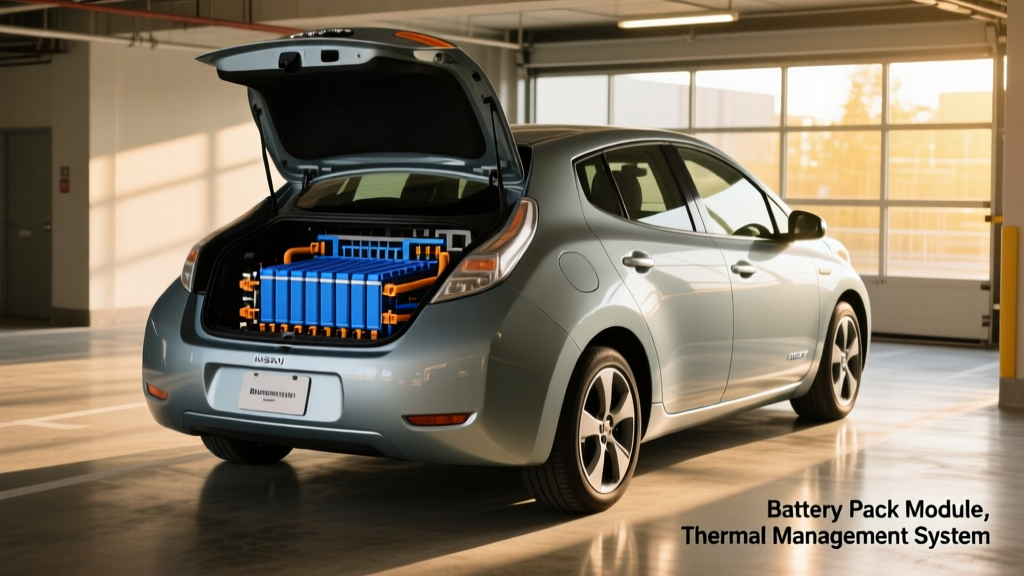
If you own or are considering purchasing a first-generation Nissan Leaf, battery replacement is likely your top concern. The 2012 Leaf was one of the first mass-market EVs, and many original batteries have now degraded significantly after 12+ years of service. This guide covers everything you need to know about 2012 Nissan Leaf battery replacement costs, degradation patterns, warranty coverage, and how modern battery chemistry compares.
2012 Nissan Leaf Battery Specifications and Current Status
The 2012 Nissan Leaf came equipped with a 24 kWh lithium-ion battery pack using manganese oxide chemistry (a variant of NMC). When new, it delivered an EPA-estimated 73 miles of range. In real-world conditions, owners typically saw 60-70 miles in moderate temperatures, dropping to 45-55 miles in cold weather or at sustained highway speeds.
| Specification | 2012 Nissan Leaf |
|---|---|
| Battery Capacity (Original) | 24 kWh usable |
| Chemistry | Lithium Manganese Oxide (NMC variant) |
| EPA Range (New) | 73 miles |
| Real-World Range (New) | 60-70 miles |
| DC Fast Charge Rate | 50 kW peak (CHAdeMO) |
| Level 2 Charge Rate | 6.6 kW |
| Battery Warranty | 8 years/100,000 miles (capacity loss below 70%) |
By 2026, most original 2012 Leaf batteries have degraded to 60-75% of their original capacity, meaning 45-55 miles of real-world range. This level of degradation is typical for early-generation EV batteries that lacked active thermal management systems.
Battery Degradation: What the Data Shows
EV battery degradation follows a predictable pattern: rapid initial loss in the first 1-2 years, then a slower, linear decline. According to EPA data and owner reports, here's what typical degradation looks like across different EV generations:
| Vehicle/Generation | Year 1 | Year 3 | Year 5 | Year 8 | Year 10+ |
|---|---|---|---|---|---|
| 2012-2015 Nissan Leaf (24 kWh, passive cooling) | 5-8% | 15-20% | 20-28% | 25-35% | 30-40% |
| 2016-2017 Leaf (30 kWh, passive cooling) | 4-7% | 12-18% | 18-25% | 22-30% | N/A |
| Modern EVs with active thermal management (Tesla, Hyundai, Ford) | 2-4% | 6-10% | 8-12% | 10-15% | 12-18% |
| LFP chemistry vehicles (Tesla Model 3 RWD, some BYD) | 2-3% | 5-8% | 7-10% | 9-12% | 11-15% |
The 2012 Leaf's passive air-cooling system is the primary culprit behind its accelerated degradation. Without active liquid cooling, the battery experiences thermal stress during fast charging and hot-weather operation, accelerating chemical breakdown. Modern EVs with liquid-cooled battery packs show dramatically better longevity.
Factors That Accelerate Degradation
Several usage patterns accelerate battery wear in the 2012 Leaf and similar early EVs:
- Frequent DC fast charging: Daily use of 50 kW CHAdeMO chargers generates significant heat. Owners who fast-charged daily saw 5-10% more degradation than those using Level 2 primarily.
- High state of charge storage: Regularly parking at 100% SoC, especially in hot climates, stresses the battery chemistry.
- Extreme temperatures: Phoenix and Las Vegas Leaf owners report 5-8% more degradation than Pacific Northwest owners due to sustained heat exposure.
- Deep discharge cycles: Regularly driving to near 0% SoC accelerates wear compared to keeping the battery in the 20-80% range.
Battery Warranty Coverage: What Nissan Covers
The 2012 Nissan Leaf's battery warranty has likely expired for most original owners, but understanding the terms helps contextualize replacement decisions:
| Warranty Aspect | 2012 Nissan Leaf Coverage |
|---|---|
| Duration | 8 years or 100,000 miles (whichever comes first) |
| Capacity Retention Threshold | Battery must retain at least 70% of original capacity (shown as 9/12 bars on dashboard) |
| What's Covered | Battery replacement or repair if capacity falls below threshold during warranty period |
| What Voids Warranty | Unauthorized modifications, accident damage, improper charging equipment |
| Transferability | Warranty transfers to subsequent owners |
By 2026, all 2012 Leafs are outside the 8-year warranty window. However, Nissan did extend warranties on some 2011-2013 models in certain states due to class-action settlements. Check with a Nissan dealer using your VIN to confirm your specific coverage status.
2012 Nissan Leaf Battery Replacement Costs
Battery replacement costs vary significantly based on battery size, source (new vs refurbished), and labor rates. Here's the current cost landscape for 2012 Leaf owners:
| Replacement Option | Battery Size | Cost Range (Parts + Labor) | Resulting Range |
|---|---|---|---|
| Refurbished 24 kWh pack | 24 kWh | $3,500 - $5,500 | 60-70 miles |
| New OEM 24 kWh pack | 24 kWh | $6,500 - $8,500 | 70-80 miles |
| Upgraded 40 kWh pack (2018+ Leaf battery) | 40 kWh | $7,500 - $9,500 | 120-140 miles |
| Upgraded 62 kWh pack (Leaf Plus battery) | 62 kWh | $9,000 - $12,000 | 170-200 miles |
The 40 kWh and 62 kWh upgrades require additional labor for software compatibility and may need updated battery management system (BMS) components. Independent EV shops specializing in Leaf upgrades often offer better pricing than Nissan dealerships for these conversions.
When replacement is typically needed: Most 2012 Leaf owners consider replacement when real-world range drops below 40-50 miles, making the vehicle impractical for daily commuting. This typically occurs at 25-35% degradation, around 150,000-200,000 miles for heavily-used vehicles or 10-14 years for average-use cases.
Battery Chemistry Explained: LFP vs NMC Trade-offs
Understanding battery chemistry helps explain why the 2012 Leaf degraded faster than modern EVs, and informs your replacement decision:
| Factor | NMC/NCA (Nickel Manganese Cobalt / Nickel Cobalt Aluminum) | LFP (Lithium Iron Phosphate) |
|---|---|---|
| Energy Density | Higher (200-260 Wh/kg) — more range in same space | Lower (140-180 Wh/kg) — heavier for same capacity |
| Cycle Life | 1,000-2,000 cycles to 80% capacity | 2,500-4,000+ cycles to 80% capacity |
| Cold Weather Performance | Better at -20°C and below | Reduced performance below -10°C |
| Thermal Stability | Good, requires active cooling | Excellent, more resistant to thermal runaway |
| Cost | Higher (cobalt/nickel pricing) | Lower (abundant iron/phosphate) |
| State of Charge Flexibility | Best kept 20-80% for longevity | Can charge to 100% regularly without significant wear |
| Examples | Tesla Model S/X, Ford Mustang Mach-E, most long-range EVs | Tesla Model 3 RWD, BYD vehicles, some Ford F-150 Lightning trims |
The 2012 Leaf used an early NMC variant without the advanced thermal management that modern NMC batteries employ. Today's LFP batteries, while lower in energy density, offer dramatically better cycle life and can be charged to 100% daily without accelerated degradation — a significant advantage for daily commuters.
Which Chemistry Is Better?
For most 2026 EV buyers, the choice depends on use case:
- Choose NMC/NCA if: You need maximum range, live in extreme cold climates, or prioritize performance.
- Choose LFP if: You want maximum battery longevity, primarily drive in moderate climates, and don't mind slightly less range for lower cost and better durability.
How to Check and Maximize Battery Health
Monitoring your Leaf's State of Health (SoH) helps you plan for replacement and optimize daily usage:
Checking SoH on the 2012 Leaf
The 2012 Leaf displays battery health using a 12-bar system visible on the dashboard:
- 12 bars: 85-100% capacity
- 11 bars: 78-85% capacity
- 10 bars: 72-78% capacity
- 9 bars: 65-72% capacity
- 8 bars or below: Under 65% — significant degradation
For more precise readings, third-party apps like LeafSpy Pro connect to the OBD-II port and display exact SoH percentage, individual cell voltages, and battery temperature. This data is invaluable for tracking degradation trends over time.
Battery Care Best Practices
- Limit DC fast charging: Use Level 2 (240V) charging for daily needs; reserve DC fast charging for road trips.
- Avoid extreme SoC: For NMC batteries like the Leaf's, keep daily charging between 20-80%. Only charge to 100% when you need maximum range.
- Minimize heat exposure: Park in shade or garages when possible. Avoid fast charging immediately after highway driving in hot weather.
- Don't store at 100%: If leaving the vehicle unused for weeks, set charge level to 50-60%.
- Precondition while plugged in: Use the Leaf's timer function to heat/cool the cabin while connected to power, reducing battery strain.
- Monitor cell balance: Using LeafSpy, watch for individual cell voltage variance exceeding 0.1V — this may indicate a weak cell requiring service.
Emerging Battery Technologies: What's on the Horizon
While not relevant to your 2012 Leaf replacement decision, understanding future battery tech provides context for your next EV purchase:
Solid-State Batteries
Solid-state batteries replace the liquid electrolyte with a solid material, promising higher energy density (potentially 400+ Wh/kg), faster charging, and improved safety. Toyota, Nissan, and Samsung have announced prototypes, but commercial availability remains limited. Expect solid-state EVs to reach the US market in limited volumes around 2027-2028, with mainstream adoption not until 2030+.
Silicon Anode Technology
Replacing graphite anodes with silicon can increase energy density by 20-40%. Companies like Sila Nanotechnologies and Group14 are working with automakers, and some luxury EVs may feature silicon anode batteries by 2026-2027. This technology improves range without increasing battery size or weight.
Sodium-Ion Batteries
Sodium-ion chemistry uses abundant, low-cost materials and shows promise for budget EVs and stationary storage. CATL and BYD have begun production in China, with US-market vehicles potentially appearing by 2027-2028. Energy density is lower than lithium-ion, making these best suited for shorter-range urban vehicles.
Important context: These technologies are announced or in limited production. They won't affect your 2012 Leaf battery replacement decision, but they will shape the EV market when you're ready for your next vehicle.
Frequently Asked Questions
How long do EV batteries last?
Modern EV batteries with active thermal management typically last 15-20 years or 200,000+ miles before reaching 70-80% capacity. Early EVs like the 2012 Leaf with passive cooling often need replacement at 10-14 years or 150,000 miles. Most EV batteries outlast the vehicle's useful life, making replacement a rare event for modern EVs.
How much does an EV battery cost to replace?
Replacement costs range from $3,500-$12,000 depending on battery size and source. Small packs (24-40 kWh) cost $3,500-$8,500, while large packs (75-100 kWh) in Tesla or luxury vehicles can reach $12,000-$20,000. Refurbished batteries offer 30-50% savings over new OEM packs.
What does the battery warranty cover?
Most EV battery warranties cover 8 years/100,000 miles (10 years/150,000 miles in California and states following CARB standards). Coverage triggers when capacity drops below 70% of original. Warranties cover defects and premature degradation but exclude accident damage, unauthorized modifications, and normal wear beyond the threshold.
How do I check my EV battery health?
Most EVs display battery health through dashboard indicators or infotainment menus. For precise readings, OBD-II apps like LeafSpy (Nissan), TeslaFi (Tesla), or CarScanner (universal) provide exact SoH percentage, cell voltage balance, and degradation trends. Check health every 6-12 months to track changes.
LFP vs NMC — which is better and why?
LFP batteries offer longer cycle life (3,000+ vs 1,500 cycles), lower cost, better thermal safety, and can charge to 100% daily. NMC provides higher energy density (more range per kg) and better cold-weather performance. For daily commuting in moderate climates, LFP is superior. For maximum range or extreme cold, NMC remains the better choice.
Is it worth replacing a 2012 Leaf battery?
It depends on vehicle condition and your needs. If the Leaf is otherwise reliable and you need a low-cost commuter, a $4,000-$6,000 refurbished battery extends its life 5-8 more years. However, if you need more range or modern features, the replacement cost approaches the vehicle's value, making a newer EV a better investment. Consider a used 2018+ Leaf (40 kWh, 150-mile range) for $12,000-$16,000 as an alternative.
For current federal EV tax credit rules that may apply to your next EV purchase, consult the IRS clean vehicle credit guidelines, which include income caps, MSRP limits, and battery sourcing requirements that change annually.