If you own, are buying, or are maintaining a first-generation Nissan Leaf, the single most important question is how the original 24 kWh lithium-ion traction battery is holding up. The 2012 Nissan Leaf was one of the first mass-market battery-electric vehicles sold in the United States, and more than a decade later, its battery remains a real-world case study in long-term EV cell degradation, replacement economics, and ownership strategy.
This guide examines what 2012 Leaf owners are actually seeing in 2026 — from remaining State of Health (SoH) readings to aftermarket replacement costs — while placing the Leaf's battery in the broader context of modern EV battery chemistry, warranty structures, and care practices. Whether you're troubleshooting range loss or evaluating a used Leaf as a budget commuter, the data below will anchor your decision.
What Battery Does the 2012 Nissan Leaf Use?
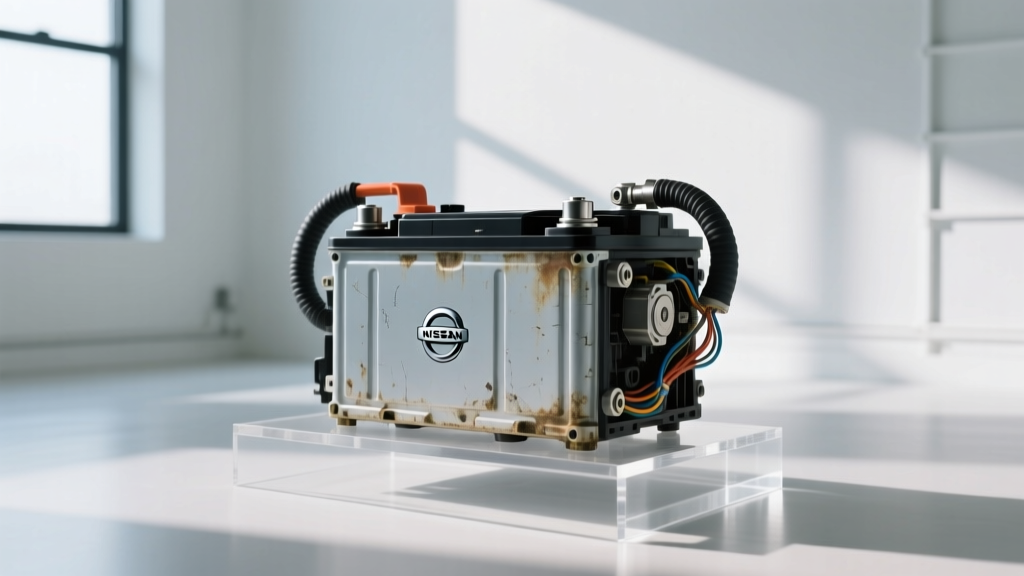
The 2012 Nissan Leaf shipped with a 24 kWh (usable capacity approximately 21.3 kWh) laminated lithium-ion battery pack composed of NMC (nickel-manganese-cobalt) cells manufactured by NEC in a joint venture with Nissan. The pack contains 48 modules, each with four cells, and operates at a nominal voltage of 360V. According to fueleconomy.gov, the 2012 Leaf carried an original EPA range rating of 73 miles and an efficiency of 99 MPGe combined.
That 73-mile figure was modest even at launch. By 2026 standards — where a base Hyundai Ioniq 6 SE delivers 361 miles EPA — the original Leaf pack is a short-range city commuter. But its significance lies in longevity: these packs were among the first to accumulate high-mileage, multi-climate data on passive-air-cooled NMC cells in consumer hands.
- Chemistry: NMC (nickel-manganese-cobalt)
- Gross capacity: 24 kWh | Usable: ~21.3 kWh
- Configuration: 48 modules, 192 cells, laminated pouch
- Thermal management: Passive air cooling (no active liquid system)
- Original EPA range: 73 miles
- DC fast-charge port: CHAdeMO (optional on 2012, ~50 kW peak)
- Level 2 onboard charger: 3.3 kW (6.6 kW optional on later years)
Real-World Degradation: What 2012 Leaf Owners See in 2026
Battery degradation is the gradual loss of usable capacity over time and charge cycles. For the 2012 Nissan Leaf battery, degradation data is now abundant because these vehicles have been on the road for 13-14 years. Multiple owner surveys, fleet studies, and Leaf-specific community data (from forums like MyNissanLeaf and SpeakEV) paint a consistent picture:
- Average capacity loss at 5 years / 60,000 miles: 10-18%, depending on climate and charging habits
- Average capacity loss at 10 years / 100,000 miles: 20-35% for passively cooled packs in hot climates (Arizona, Texas, Southern California)
- Moderate-climate packs at 10 years: 15-25% loss — closer to industry-average NMC degradation curves
- Worst-case observed (high CHAdeMO use + hot climate): 40%+ capacity loss by year 10, leaving effective range under 45 miles
The critical factor unique to the 2012 Leaf is its passive air-cooled thermal management. Unlike modern EVs with active liquid cooling (Tesla, Hyundai E-GMP, GM Ultium), the Leaf's pack cannot actively shed heat during fast charging or sustained high-temperature operation. This makes the 2012 Leaf battery especially vulnerable to:
- Repeated DC fast charging in heat — CHAdeMO sessions above 90°F ambient accelerate cell imbalance and electrolyte breakdown
- Prolonged high SoC in hot garages — sitting at 100% charge in a 100°F+ garage is the highest-stress scenario for NMC pouch cells
- Deep discharge cycles — regularly driving below 10% SoC stresses cell voltage floors
| Year | Miles | SoH (Moderate Climate) | SoH (Hot Climate) | Est. Remaining Range |
|---|---|---|---|---|
| Year 1 | 12,000 | 96-98% | 93-96% | 68-72 mi |
| Year 5 | 60,000 | 85-90% | 80-85% | 58-66 mi |
| Year 8 | 96,000 | 78-84% | 70-78% | 51-61 mi |
| Year 10 | 120,000 | 75-82% | 65-75% | 47-60 mi |
| Year 13 (2026) | 150,000 | 70-78% | 58-68% | 42-57 mi |
Data synthesized from owner-reported Leaf Spy readings, fleet studies, and Nissan technical service bulletins. Individual results vary significantly by charging behavior and ambient temperature exposure.
The takeaway: a 2012 Leaf in a temperate coastal climate (Pacific Northwest, New England) driven mostly on Level 2 with occasional DCFC may still retain 70-78% SoH in 2026 — yielding roughly 50-57 real-world miles. That same car in Phoenix with frequent CHAdeMO use could be below 60% SoH, making it a 40-mile vehicle at best.
Nissan Leaf Battery Warranty: Original Terms and 2026 Status
Understanding the warranty is essential because most 2012 Leaf batteries are now outside original coverage.
| Coverage Type | Duration | Threshold | 2012 Leaf Status in 2026 |
|---|---|---|---|
| Lithium-Ion Battery Capacity Warranty | 8 years / 100,000 miles | SoH drops below 9 of 12 capacity bars (~70-72%) | Expired for virtually all 2012 models |
| EV System Warranty | 5 years / 60,000 miles | Component failure (inverter, charger, motor) | Expired |
| Basic Vehicle Warranty | 3 years / 36,000 miles | Bumper-to-bumper | Expired |
Nissan's capacity warranty used a "bar" system displayed on the dashboard — 12 bars represented full health, and coverage triggered when the pack fell below 9 bars within the 8-year/100,000-mile window. For context, modern EV warranties (and the industry standard) use a percentage threshold: most manufacturers guarantee 70% capacity retention over 8 years / 100,000 miles (Tesla, Hyundai, VW) or 8 years / 100,000 miles at 60-70% retention depending on the brand. Per Nissan's current warranty documentation, newer Leaf models (2018+) with the 40 and 62 kWh packs carry the same 8yr/100k structure but with liquid-cooled thermal management that better preserves SoH.
For 2012 Leaf owners in 2026, all warranty coverage has lapsed. Any battery replacement or module-level repair is an out-of-pocket expense unless covered by an aftermarket extended warranty purchased before expiration.
2012 Nissan Leaf Battery Replacement Cost in 2026
Replacement costs for the original 24 kWh pack have evolved significantly since the Leaf's launch. Here is the current landscape:
| Option | Source | Estimated Cost (Parts + Labor) | Notes |
|---|---|---|---|
| New OEM 24 kWh pack | Nissan dealer | $6,500 - $8,500 | Limited availability; Nissan has deprioritized first-gen pack production |
| Remanufactured 24 kWh pack | Nissan / authorized rebuilder | $4,500 - $6,000 | Cells tested and matched; typically 1-year warranty |
| Used/salvage 24 kWh pack | eBay, EV salvage yards | $2,500 - $4,000 | SoH varies (60-85%); no warranty; buyer assumes risk |
| Aftermarket upgrade (40 kWh) | Specialist shops (e.g., EVolution, Leaf upgrade services) | $8,000 - $12,000 | Requires ECU reprogramming; not universally available; may void registration in some states |
| Module-level repair | Independent EV shop | $1,000 - $3,000 | Replace only failed modules; requires cell-matching expertise |
The most common path in 2026 for a 2012 Leaf with a degraded pack is a remanufactured 24 kWh pack at $4,500-$6,000 installed. This restores the vehicle to approximately 70-75 real-world miles of range and extends usable life by another 5-8 years for city commuting.
Is replacement economically justified? That depends on the vehicle's value. A 2012 Leaf in fair condition trades for roughly $3,500-$6,000 on the used market in 2026, meaning a full pack replacement can exceed the car's value. Owners should weigh whether the Leaf's role as a low-cost commuter (no gas, minimal maintenance) justifies the investment versus trading into a newer used EV like a 2018+ Leaf (40 kWh, liquid-cooled) or a Chevrolet Bolt EV.
Battery Chemistry Explained: NMC vs LFP and Where the Leaf Fits
The 2012 Leaf's NMC pack represents one of two dominant EV battery chemistries in use today. Understanding the trade-offs matters both for Leaf owners evaluating their pack's behavior and for buyers comparing older and newer EVs.
| Attribute | NMC / NCA (2012 Leaf, Tesla, most EVs pre-2023) | LFP (Tesla Model 3 RWD, BYD, Ford base models) |
|---|---|---|
| Energy density | Higher (200-300 Wh/kg cell-level) — more range per pound | Lower (140-180 Wh/kg) — heavier pack for same kWh |
| Cycle life | 1,000-2,000 full cycles to 80% SoH | 3,000-5,000+ full cycles to 80% SoH |
| Cold-weather performance | Better low-temp discharge and charge acceptance | Reduced charge speed and range below 32°F; needs preconditioning |
| Thermal stability | Lower — more prone to thermal runaway if damaged/overheated | Higher — inherently more stable chemistry |
| Cost per kWh | Higher (nickel and cobalt commodity exposure) | Lower (iron and phosphate — no cobalt or nickel) |
| Recommended SoC for daily use | 80% (avoid prolonged 100% storage) | 100% OK — LFP tolerates full charge well; periodic 100% calibrates BMS |
| Used in 2012 Leaf? | Yes — NMC pouch cells | No — LFP was not in consumer EVs at that time |
For the 2012 Leaf specifically, the NMC chemistry's sensitivity to heat and high SoC is the core driver of the degradation patterns described above. Modern LFP packs (found in the Tesla Model 3 RWD, base Ford Mustang Mach-E, and BYD models) sidestep many of these issues through superior cycle life and tolerance for 100% SoC storage — but they were not commercially viable in consumer EVs in 2012.
Factors That Accelerate or Slow Battery Degradation
Battery longevity is not purely a function of age. The following factors determine whether a 2012 Leaf pack reaches 2026 at 78% SoH or 58% SoH:
- 🔴 HIGH IMPACT — Frequent DC fast charging in hot weather: CHAdeMO sessions at 50 kW push cell temperatures past 110°F with no active cooling. Each hot-climate fast charge cycle accelerates electrolyte decomposition. Owners in hot states who relied on CHAdeMO daily show 5-10% more degradation than Level-2-only counterparts.
- 🔴 HIGH IMPACT — Prolonged storage at 100% SoC in heat: Leaving a Leaf at full charge in a 100°F+ garage for days or weeks is the single highest-stress state for NMC cells. Calendar aging at 100% SoC and 95°F can equal hundreds of charge cycles of wear.
- 🟡 MODERATE IMPACT — Deep discharge below 10%: Regularly driving the Leaf to near-zero stresses cell voltage floors and can cause cell imbalance. The Leaf's battery management system (BMS) reserves a buffer (~2.7 kWh) below the "empty" display, but habitual deep cycling still accelerates wear.
- 🟡 MODERATE IMPACT — High ambient temperature exposure: Even without fast charging, parking outdoors in sustained 100°F+ heat causes calendar degradation. Garage parking meaningfully extends pack life in desert climates.
- 🟢 LOW IMPACT — Cold-weather operation: Cold temperatures reduce available range temporarily (expect 20-30% range loss below 20°F due to increased internal resistance and cabin heating), but cold itself does not cause permanent degradation. In fact, cold storage slows calendar aging.
- 🟢 LOW IMPACT — Normal Level 2 charging cycles: Charging at 3.3 kW or 6.6 kW on a home Level 2 station generates minimal heat and is the healthiest charging method for the Leaf's passively cooled pack.
How to Check Battery Health on a 2012 Nissan Leaf
Monitoring State of Health (SoH) is essential for any 2012 Leaf owner or prospective buyer. There are three primary methods:
1. Dashboard Capacity Bars
The Leaf's instrument cluster displays a series of bars (out of 12) to the right of the range estimate. These represent the battery's remaining capacity relative to its original state. A 2012 Leaf showing 12 bars in 2026 is exceptionally rare and likely indicates a recent replacement pack. Most original-pack Leafs now show 8-10 bars (approximately 65-82% SoH). Note: the bar system is coarse — each bar represents roughly 6-8% capacity, so it is not a precision instrument.
2. Leaf Spy Pro (OBD-II App)
This is the gold standard for Leaf battery diagnostics. By plugging an OBD-II Bluetooth dongle (e.g., OBDLink MX or LE) into the Leaf's diagnostic port and running the Leaf Spy Pro app (available for iOS and Android, ~$20), owners can read:
- State of Health (SoH): Precise percentage (e.g., 73.2%) calculated from measured capacity vs. original
- Individual cell voltages: Identifies weak or imbalanced modules — a max cell voltage delta above 200mV signals a failing module
- Hx value: An internal Nissan metric reflecting internal resistance; lower Hx = more degraded
- Odometer, charge cycle count, and QC (quick charge) count: The QC count reveals how many CHAdeMO sessions the pack has endured — a high number in a hot-climate car is a red flag
For anyone buying a used 2012 Leaf, running Leaf Spy before purchase is non-negotiable. A seller who refuses an OBD-II scan is hiding something.
3. Nissan Dealer Diagnostic
Nissan dealerships can run a battery health check using the CONSULT-III diagnostic tool, which provides an SoH percentage and cell-level data. This is typically free or low-cost during a service visit, but the dashboard bar reading and Leaf Spy are more practical for routine monitoring.
Emerging Battery Tech: What's Next Beyond NMC and LFP
While the 2012 Leaf's NMC pack is a legacy design, the broader EV battery industry is advancing rapidly. Here is where next-generation technologies stand as of 2026 — with realistic timelines:
- Solid-state batteries: Toyota, Nissan, and Samsung SDI have announced solid-state prototypes promising 2x energy density and faster charging. Nissan has targeted a solid-state production vehicle by 2028-2029, but these will debut in new premium models — not as retrofit packs for first-gen Leafs. Solid-state remains pre-commercial for consumer vehicles as of early 2026.
- Silicon-anode cells: Companies like Sila Nanotechnologies and Group14 are supplying silicon-dominant anode materials that boost energy density 20-40% over graphite anodes. These are entering production in limited applications (e.g., Mercedes G-Class EV, select Panasonic cells) in 2025-2026 but are years from cost-competitive mass adoption in affordable EVs.
- Sodium-ion batteries: CATL and BYD have begun deploying sodium-ion packs in Chinese-market micro-EVs and energy storage. Sodium-ion offers lower cost and better cold performance than LFP but significantly lower energy density — making it suitable for city cars and stationary storage, not long-range vehicles. US availability is 2027+ at earliest.
- Improved NMC formulations: High-nickel NMC 811 and NMC 9½½ cells with advanced electrolyte additives have improved cycle life and thermal stability over the 2012 Leaf-era NMC chemistry by a wide margin. Modern liquid-cooled NMC packs routinely achieve 1,500-2,500 cycles with minimal degradation.
None of these technologies will retrofit into a 2012 Leaf. Owners seeking a modern pack experience will need to trade into a newer vehicle.
Is Replacing a 2012 Leaf Battery Worth It? A Decision Framework
- The Leaf is your reliable daily city commuter and you have no alternative charging-accessible vehicle
- You can source a remanufactured pack under $5,500 installed and plan to keep the car 4+ more years
- The rest of the vehicle (suspension, brakes, interior) is in good condition
- Your commute is under 40 miles round-trip and you charge at home on Level 2
- The replacement cost exceeds $6,000 and the car's market value is under $4,000
- You need more than 60 miles of range for your daily driving
- You live in a hot climate and lack garage parking (the replacement pack will face the same thermal challenges)
- You can access a used 2018+ Leaf (40 or 62 kWh, liquid-cooled) or a Chevrolet Bolt EV with 259 miles of range for under $15,000
Frequently Asked Questions
How long do EV batteries last in years and miles?
Modern liquid-cooled EV batteries (2018+) are designed to last 15-20 years or 150,000-200,000 miles before reaching 70-80% SoH. The 2012 Nissan Leaf's passively cooled NMC pack has a shorter practical lifespan — typically 10-15 years before degradation makes the vehicle impractical for anything beyond very short trips. Data from fleet studies and owner communities shows most 2012 Leafs in moderate climates retain 70-78% SoH at year 13, while hot-climate examples may fall below 65%.
How much does it cost to replace the battery in a 2012 Nissan Leaf?
In 2026, expect to pay $4,500-$6,000 for a remanufactured 24 kWh pack installed, or $6,500-$8,500 for a new OEM pack (if available). Used salvage packs run $2,500-$4,000 but carry unknown SoH and no warranty. Module-level repairs for isolated cell failures can cost $1,000-$3,000.
What does the Nissan Leaf battery warranty cover?
Nissan's original battery capacity warranty covered the 2012 Leaf for 8 years or 100,000 miles, guaranteeing the pack would not drop below 9 of 12 capacity bars (approximately 70-72% SoH). This warranty has expired for all 2012 models. The separate EV system warranty (5yr/60k mi) covering the inverter, onboard charger, and motor has also expired. Current-year Nissan Leaf models carry the same 8yr/100k battery warranty structure. Per IRS §30D guidelines, battery component sourcing also affects federal tax credit eligibility on new EV purchases — a factor to consider if you're replacing your Leaf with a new EV.
How do I maximize battery health on my 2012 Leaf?
Charge primarily on Level 2 (home 240V). Set the charge timer to stop at 80% for daily use — the Leaf's built-in charge timer in the settings menu allows this. Avoid DC fast charging more than once or twice per week, especially in summer. Never leave the car at 100% SoC in a hot garage for extended periods. Park in shade or a garage when possible. Use Leaf Spy to monitor SoH monthly and watch for cell voltage imbalances (delta above 200mV indicates a module issue).
Can I upgrade my 2012 Leaf to a larger battery?
Aftermarket upgrades to the 40 kWh or 62 kWh pack from later Leaf models are technically possible through specialist shops, costing $8,000-$12,000. However, these require ECU reprogramming, may not be street-legal in all states, and the 2012 Leaf's passive cooling system was not designed for the thermal load of a larger pack. Most owners are better served by trading into a 2018+ Leaf with a factory-engineered 40 or 62 kWh pack and liquid cooling.
Does the 2012 Leaf use the same battery connector as modern EVs?
No. The 2012 Leaf uses CHAdeMO for DC fast charging and a J1772 inlet for Level 1/Level 2 AC charging. CHAdeMO has been largely superseded by CCS1 and NACS (Tesla's North American Charging Standard) in the US market. As of 2026, CHAdeMO infrastructure is declining — Electrify America and most new networks deploy CCS and NACS exclusively. This is a practical ownership concern: finding a working CHAdeMO station is increasingly difficult outside of legacy Nissan-dealer locations and select older installations.