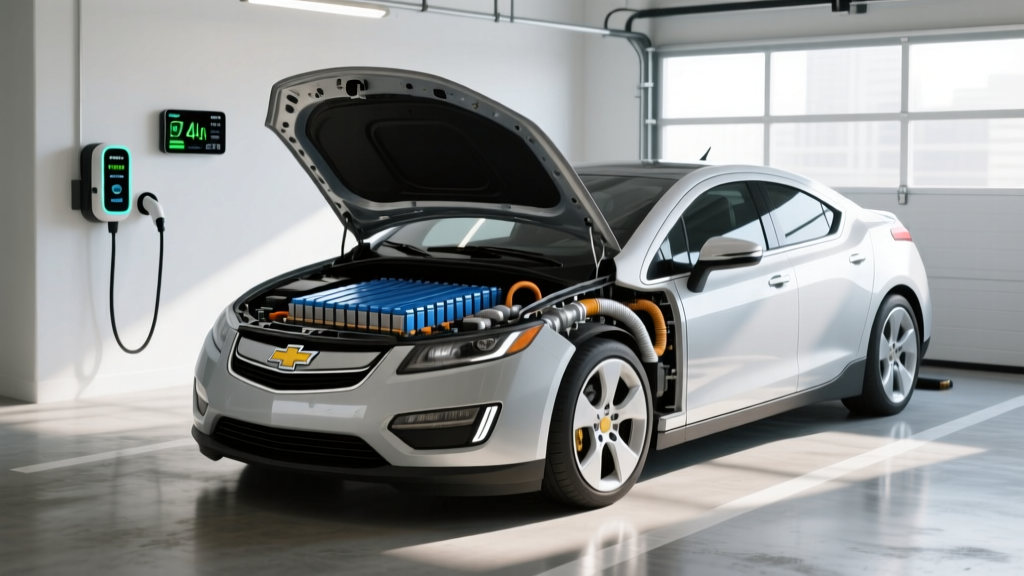
If you own or are shopping for a first-generation Chevrolet Volt, the high-voltage traction battery is the single most important — and most misunderstood — component in the car. The 2012 Chevy Volt battery is a 16 kWh (gross) lithium-ion pack using NMC (nickel-manganese-cobalt) chemistry, of which roughly 10.4 kWh was usable thanks to GM's aggressive top-and-bottom buffer strategy. That buffer is the key reason these packs have aged more gracefully than early critics predicted, but after more than a decade on the road, real questions about degradation, replacement cost, and remaining life are entirely valid.
This guide breaks down exactly what happens to a 2012 Volt battery over time, what replacement actually costs in 2026, how the warranty works, and how modern EV and PHEV battery technology compares — giving you the data to make an informed decision whether you're buying, keeping, or selling.
2012 Chevy Volt Battery Specs at a Glance
Before assessing longevity, it helps to know exactly what's under the floor. The first-generation Volt (2011–2015) used a T-shaped battery pack manufactured primarily by LG Chem (now LG Energy Solution). Here are the core specifications:
| Specification | Value |
|---|---|
| Gross capacity | 16 kWh |
| Usable capacity (new) | ~10.4 kWh |
| Chemistry | NMC (Nickel-Manganese-Cobalt) |
| Cell format | Prismatic pouch |
| Cell supplier | LG Chem |
| Thermal management | Active liquid cooling/heating |
| EPA electric range (new) | 35 miles |
| EPA combined MPGe (new) | 94 MPGe (electric), 37 MPG (gas) |
| Buffer strategy | ~4.5 kWh top buffer, ~1.1 kWh bottom buffer |
The large buffer was a deliberate engineering decision by GM: by never letting the pack charge to true 100% or discharge to true 0%, the cells experience far less stress per cycle. This is the primary reason the 2012 Volt battery has shown comparatively mild degradation relative to early BEVs like the Nissan Leaf, which had no active thermal management and smaller buffers.
How Long Does a 2012 Chevy Volt Battery Actually Last?
The honest answer: most first-generation Volt batteries are still on the road in 2026, and many retain enough capacity for daily commuting on electric power. But "how long" depends on what threshold you consider acceptable.
Observed Degradation Data Points (community-sourced & fleet data):
- Years 1–3 (2012–2015): Minimal measurable loss — typically 2–5% capacity reduction. Most owners reported full 35-mile EPA range or close to it.
- Years 4–7 (2016–2019): Gradual decline to roughly 85–92% State of Health (SoH). Real-world electric range typically 28–33 miles depending on climate and driving habits.
- Years 8–10 (2020–2022): SoH settling between 75–88% for well-maintained packs. Electric range approximately 25–30 miles. Some packs in hot climates (Arizona, Texas) degraded toward the lower end.
- Years 11–14 (2023–2026): Surviving original packs typically show 70–82% SoH. Electric range of 22–28 miles is common. Packs that received regular Level 1/Level 2 charging in moderate climates tend to cluster at the higher end.
Sources: GM-Volt.com owner surveys, fueleconomy.gov user mpg reports, and independent PHEV battery studies.
The critical context here is that the Volt is a plug-in hybrid. Even with significant battery degradation, the 1.4L range-extender engine takes over seamlessly, so the car remains fully drivable. Unlike a pure BEV where a 30% capacity loss means a 30% range loss on every trip, a degraded Volt simply switches to gas mode a few miles earlier. This is a major practical advantage for long-term ownership.
What Does the Volt Battery Warranty Cover?
GM provided an 8-year/100,000-mile warranty on the Volt's high-voltage battery (10 years/150,000 miles in CARB states — California, Connecticut, Maine, Maryland, Massachusetts, New Jersey, New York, Oregon, Pennsylvania, Rhode Island, Vermont, and Washington). For a 2012 model, this federal emissions warranty expired no later than 2020 in non-CARB states and 2022 in CARB states.
| Coverage Element | Standard | CARB States |
|---|---|---|
| Duration | 8 years / 100,000 miles | 10 years / 150,000 miles |
| Capacity threshold | ~60% of original capacity (GM's published trigger) | ~60% of original capacity |
| Covered defects | Cell failure, BMS malfunction, excessive capacity loss | Same |
| Exclusions | Damage from accidents, flooding, unauthorized modifications | Same |
| Status in 2026 | Expired for all 2012 models | Expired for all 2012 models |
The capacity threshold GM used — roughly 60% retention — was notably conservative compared to the industry norm of 70%. This means a Volt battery would need to lose more usable capacity than most BEV batteries before triggering a warranty replacement. In practice, very few Volt packs degraded enough to qualify, which is itself a data point about the pack's durability.
2012 Chevy Volt Battery Replacement Cost in 2026
If your Volt's battery has degraded beyond acceptable levels, has a cell failure, or has been damaged, here's what replacement looks like in today's market:
| Option | Part Cost | Labor | Total Range |
|---|---|---|---|
| OEM new (GM dealer) | $4,000–$6,000 | $800–$1,500 | $4,800–$7,500 |
| Remanufactured pack | $2,500–$3,800 | $800–$1,500 | $3,300–$5,300 |
| Used/salvage pack (low miles) | $1,200–$2,500 | $800–$1,500 | $2,000–$4,000 |
| Individual module replacement (1–2 bad modules) | $150–$400 per module | $600–$1,200 | $750–$1,600 |
Key insight: The Volt's T-shaped pack contains multiple individual modules (typically 4 main modules in the Gen 1 pack). A common failure mode is one module developing weak cells while the others remain healthy. An experienced EV shop can test individual module balance and replace only the degraded module, saving thousands compared to a full pack swap. This is a significant cost advantage over BEVs with single-piece structural battery packs.
Most 2012 Volt owners in 2026 will never need a full battery replacement. The combination of the large buffer, active thermal management, and the range-extender safety net means that even a pack at 70% SoH still delivers 22–25 miles of electric driving — adequate for many commutes — and the gas engine covers everything else.
Battery Chemistry: NMC in the Volt vs. Modern LFP and NMC
The 2012 Volt uses NMC (nickel-manganese-cobalt) lithium-ion cells, which was the dominant chemistry for EVs and PHEVs at the time. Today's market includes LFP (lithium iron phosphate) as a mainstream alternative, particularly in Tesla's Standard Range models, the Ford Mustang Mach-E Select, and several BYD vehicles. Understanding the trade-offs helps contextualize what you have in the Volt versus what modern EVs offer.
| Attribute | NMC (Volt & most 2026 EVs) | LFP (Tesla SR, BYD, Ford) |
|---|---|---|
| Energy density | Higher (~200–260 Wh/kg cell-level) | Lower (~140–180 Wh/kg cell-level) |
| Cycle life | ~1,000–2,000 full cycles to 80% SoH | ~3,000–5,000+ full cycles to 80% SoH |
| Cold-weather performance | Better low-temp discharge capability | More capacity loss below 32°F; needs preconditioning |
| Thermal stability | Good; requires active management | Excellent; inherently more stable |
| Cost (per kWh, 2026) | ~$110–$140 | ~$80–$100 |
| Cobalt content | Yes (ethical sourcing concerns) | None (cobalt-free) |
| Recommended daily SoC | 80% for longevity | 100% OK; LFP tolerates full charge better |
For the 2012 Volt owner, the NMC chemistry paired with GM's large buffer has proven to be a durable combination. You don't need to worry about the chemistry trade-offs that matter for BEV buyers — the Volt's relatively small pack and limited electric-only range mean that even NMC's lower cycle life is more than sufficient for the pack's usable lifespan.
What Affects Volt Battery Health (and What You Can Control)
Battery degradation is driven by a combination of calendar aging (time and temperature) and cycle aging (charge/discharge use). Here are the factors that matter most, ranked by impact:
Battery Care Checklist for Gen 1 Volt Owners:
- Minimize prolonged high SoC in heat: If you live in a hot climate, avoid leaving the Volt plugged in at full charge for days. The liquid cooling helps, but sustained 100% displayed SoC (which is still buffered) at 100°F+ ambient accelerates calendar aging.
- Use Level 2 charging when possible: The Volt's onboard charger is 3.6 kW (Gen 1). Level 2 at 240V is the intended daily charging method and produces less thermal stress than repeated Level 1 (120V) extended sessions.
- Don't avoid using EV mode: Regular cycling between 20–80% displayed SoC is healthy. Letting the pack sit unused for months at low SoC is worse than normal daily use.
- Keep the thermal system maintained: The Volt's battery coolant should be inspected periodically. A failing coolant pump or low coolant level compromises the active thermal management that protects the cells.
- Extreme cold won't destroy the pack: The Volt's liquid heating system warms the battery in cold weather, though this uses some energy. Range drops of 20–30% in sub-freezing temps are normal and temporary — capacity returns as temperatures rise.
- Avoid storing at very low SoC: If the Volt will sit for weeks, leave it plugged in or at roughly 50–60% displayed charge. The car's battery management system draws a small parasitic load even when off; a deeply depleted pack left for months can develop cell imbalance.
How to Check Your Volt's Battery State of Health
Unlike some modern EVs that display battery health in the infotainment system, the 2012 Volt does not have a built-in SoH percentage readout accessible to the driver. Here are the methods available:
Method 1: Real-world range tracking. The simplest approach. Charge the Volt to full and note the displayed estimated electric range. A new 2012 Volt showed approximately 35–40 miles (depending on recent driving history). If your full charge now shows 25–28 miles, you're likely around 75–80% SoH. Track this seasonally, as cold weather temporarily reduces range independent of degradation.
Method 2: OBD-II diagnostic scan. Using an OBD-II reader with GM-specific PIDs (parameter IDs) and software like Torque Pro or ScanGauge, you can read the battery's reported remaining capacity in kWh. Compare the current usable capacity reading to the original ~10.4 kWh to calculate SoH percentage. Several GM-Volt.com community members have documented the specific PIDs for Gen 1 Volt battery monitoring.
Method 3: Dealer or EV shop diagnostic. A Chevrolet dealer or independent EV specialist can run a full battery diagnostic through GM's GDS2 (Global Diagnostic System 2) tool, which provides individual module voltage readings, capacity tests, and a detailed health report. Expect to pay $100–$150 for this service if not covered under a repair visit.
Method 4: Energy usage tracking. If you track your charging energy (kWh added) via your Level 2 charger's meter or app and compare it to the miles driven on electricity, you can estimate remaining capacity. A pack accepting only 8 kWh from empty to full (versus the original ~10.4 kWh) is at approximately 77% SoH.
Looking Ahead: Solid-State and Silicon-Anode Batteries
For Volt owners wondering whether next-generation battery tech will offer a drop-in upgrade: it won't, at least not for the Gen 1 Volt. Here's where emerging technologies stand as of 2026:
Solid-state batteries (from companies like QuantumScape, Toyota, and Samsung SDI) promise higher energy density and faster charging. Toyota has announced limited solid-state production for 2027–2028, but these cells will debut in new BEV platforms, not as retrofit packs for 15-year-old PHEVs. The Volt's pack geometry, voltage architecture, and BMS are incompatible with future solid-state modules.
Silicon-anode cells (used in limited applications by startups like Sila Nanotechnologies and Amprius) increase energy density by replacing graphite anodes with silicon-dominant composites. These are entering production for premium BEVs and consumer electronics in 2025–2027, but again, they won't be backward-compatible with the Volt's LG Chem pouch cells.
Practical takeaway: The best battery upgrade path for a 2012 Volt is a remanufactured pack using tested, balanced NMC modules — not waiting for next-generation chemistry. The economics of retrofitting advanced cells into an aging platform don't work, and the Volt's existing pack design has proven adequate for its intended use case.
Should You Replace, Repair, or Retire a Degraded Volt Battery?
Decision Framework for 2012 Volt Owners:
- Repair (module-level) if: Diagnostics show one or two weak modules while the rest are balanced. Cost: $750–$1,600. This restores most of the pack's original capacity at the lowest expense.
- Replace (used/remanufactured pack) if: Overall SoH is below 65% and you want to keep the Volt for 3+ more years. Cost: $2,000–$5,300. A low-mileage salvage pack from a wrecked 2013–2015 Volt is often the best value.
- Keep driving as-is if: SoH is 70%+ and you're comfortable with 22–28 miles of electric range. The gas engine covers longer trips regardless. Many owners in this range simply accept the reduced EV mode range and continue.
- Retire/replace the vehicle if: Battery replacement cost exceeds the car's value (roughly $4,000–$7,000 for a 2012 Volt in 2026 depending on condition and mileage) AND you want more electric range. Consider a used Gen 2 Volt (2016–2019, 53-mile EPA electric range) or a modern BEV/PHEV with updated battery chemistry and warranty.
Frequently Asked Questions
How long do EV batteries last in years and miles?
Modern EV and PHEV batteries typically last 15–20 years or 150,000–200,000+ miles before reaching 70% capacity retention. The 2012 Chevy Volt's NMC pack, aided by its large buffer and active thermal management, has demonstrated 70–82% SoH after 11–14 years of typical use. Complete battery failure (the car becoming undrivable) is extremely rare; gradual capacity loss is the norm.
How much does an EV battery cost to replace?
Replacement costs vary dramatically by vehicle and pack size. For the 2012 Chevy Volt, expect $2,000–$7,500 depending on whether you choose a used, remanufactured, or new OEM pack. For context, a modern large-pack BEV (like a 100 kWh Tesla Model S) can cost $12,000–$20,000+ for a new OEM replacement. The Volt's relatively small, modular pack makes it one of the more affordable PHEV/EV batteries to service.
What does the battery warranty cover on the Volt?
GM's original warranty covered defects and excessive capacity loss (below ~60% retention) for 8 years/100,000 miles (10 years/150,000 miles in CARB states). For a 2012 Volt, this warranty has expired as of 2020–2022. Any battery repair or replacement is now an out-of-pocket expense unless covered by an extended aftermarket warranty.
How do I check my 2012 Volt's battery health?
The Volt doesn't display a SoH percentage on the dashboard. You can estimate it by tracking your full-charge electric range versus the original 35-mile EPA figure, read specific PIDs via an OBD-II scanner with GM-compatible software, or have a dealer run a GDS2 diagnostic for a detailed module-level report.
LFP vs NMC — which battery chemistry is better?
Neither is universally better; they serve different use cases. NMC offers higher energy density and better cold-weather performance, making it ideal for long-range BEVs and PHEVs where pack size matters. LFP provides longer cycle life, lower cost, and better thermal stability, making it suited for standard-range vehicles and owners who prefer charging to 100% daily. The Volt's NMC pack was the right choice for its era and application.
Is it worth replacing the battery in a 2012 Volt?
It depends on the car's overall condition and your goals. A 2012 Volt in good mechanical shape with 100,000–140,000 miles can be a solid daily driver for several more years with a $2,500–$4,000 remanufactured pack. If the car has other major issues (transmission, engine, suspension) or you want 200+ miles of electric range, the replacement investment may be better applied toward a newer vehicle.
Can I upgrade the 2012 Volt to a larger battery?
No practical upgrade path exists. The Gen 1 Volt's battery compartment, high-voltage wiring, and BMS are designed specifically for the 16 kWh LG Chem T-pack. The Gen 2 Volt (2016–2019) uses a different 18.4 kWh pack with incompatible physical dimensions and electronics. Swapping in a modern BEV pack would require engineering a custom solution that far exceeds the car's value.
For official EPA efficiency data, see fueleconomy.gov — 2012 Chevrolet Volt. For current federal tax credit rules on EV and PHEV purchases, consult the IRS §30D Clean Vehicle Credit page. Safety ratings and recalls can be verified at NHTSA.gov.